

December 28, 2017
Taking time for granted

To be in the presence of a real person who made calendars and almanacs was to Renka a revelation. She could easily imagine such things being printed. But the creation of the calendars was well beyond her grasp. It had never occurred to her that somebody actually made them every year.
Frankly, it's still a mystery where time comes from, though we have learned how to measure it with great accuracy.
The creation of accurate calendars was key to the scientific revolution. Commissioned to create a better calendar, Copernicus ended up rejecting the Ptolemaic model of the solar system in favor of the heliocentric, which Galileo then confirmed with his observations of Jupiter and its moons.
Galileo also created the first pendulum clock. The invention of precision chronometers is documented in Longitude, Dava Sobel's fascinating biography of the 18th century clockmaker John Harrison.
If I want to know the time, I glance at the bottom right of my screen. If I want to know when Daylight Saving Time kicks in, I google it. It's all thanks to the National Institute of Standards and Technology, the keeper of the atomic clock. Yes, somebody is in charge of time. Good thing, too.
Though I wish the people in charge of time would get rid of Daylight Saving Time. Alas, that'd take an act of Congress.
Labels: 12 kingdoms, hisho, science, technology


December 20, 2017
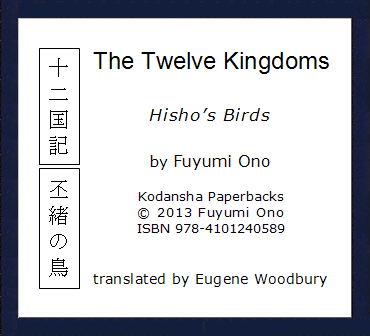
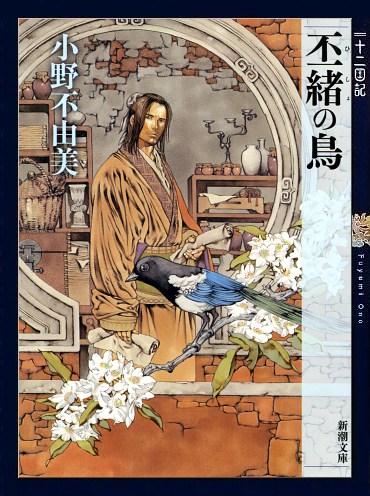
Hisho's Birds
December 19, 2017
Hisho's Birds (notes)
Maps
Notes
Glossary
Downloads
Labels: 12 kingdoms, fantasy, hisho, japanese, translations
December 17, 2017
Weather Vane (6)
Youko allied herself with his men to overthrow the corrupt governor of Wa Province. She later appointed Koukan as Chousai of the Imperial Court.
Labels: 12 kingdoms, hisho
December 10, 2017
Weather Vane (5)

Here is a bumblebee in action.
Labels: 12 kingdoms, hisho, japanese culture
December 03, 2017
Weather Vane (4)
Unlike their cousins the honeybees, the rest of the bumblebee hive does not overwinter with the queen. With no need to stockpile honey, they are not useful as honey producers. However, they are bred for use in agriculture as pollinators.
Although female bumblebees can sting repeatedly, ignore them and they will ignore you.
Of course, bumblebees in our world don't need a yaboku tree to reproduce. As far as that goes, while new plant species come from yaboku trees (as documented in "Blue Orchid"), pollination is a component of sexual reproduction.
This suggests that the flora of the Twelve Kingdoms at least partially follows the biological rules of to our world.
Labels: 12 kingdoms, hisho, science
November 26, 2017
Weather Vane (3)

And yet life went on.
Labels: 12 kingdoms, asadora, hisho, history, ww2
November 19, 2017
Weather Vane (2)
On page 305, Suiga refers to Kakei using the second person pronoun anta, a familiar form of anata. Neither is appropriate when addressing a social superior (even today). I discuss the subject at length here.
An intercalary month is a leap month inserted into a calendar year to make the calendar follow the seasons or moon phases. The Buddhist calendar adds both an intercalary day and month on a regular cycle.
The traditional East Asian lunisolar calendar is divided into 24 "solar terms."
At the end of this chapter, in his example about the rice harvest, Choukou is referring to the 13th solar term (立秋), which begins around August 7 and ends around August 23, and the 14th solar term (処暑), which begins around August 23 and ends around September 7.
Making things more confusing, the eighth month in the Gregorian calendar is the seventh month in the lunisolar calendar. This is why the O-bon festival is held in July or August, depending on whether the region follows the lunisolar or the Gregorian calendar.
Labels: 12 kingdoms, chinese, hisho, science
November 12, 2017
Weather Vane (1)
The political and geographical divisions of the Twelve Kingdoms.
国 Kingdom
州 Province
郡 District (comprised of 50,000 households or 4 prefectures)
郷 Prefecture (comprised of 5 counties)
県 County
党 Township
族 Town
里 Hamlet (comprised of 25 households)
Labels: 12 kingdoms, hisho, japan
November 05, 2017
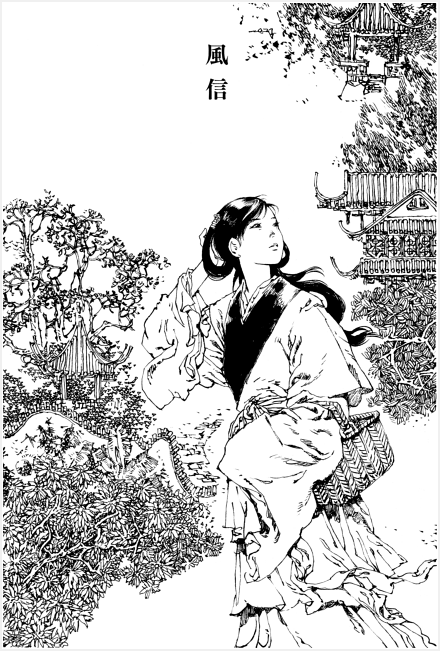
Fuushin ("Weather Vane")
The word fuushin (風信) can refer to 1) information about the wind, such as that obtained from a weather vane (風信器). As in English, it can also figuratively mean to 2) "catch wind of something," gossip and rumors (風のたより). I'll use the first to refer symbolically to the second.
Labels: 12 kingdoms, hisho
October 29, 2017
Blue Orchid (afterword)
Labels: 12 kingdoms, hisho
October 22, 2017
Blue Orchid (8)
More about the names of the Yellow Sea guilds here.
Labels: 12 kingdoms, hisho
October 15, 2017
Blue Orchid (7)
The emperor's loyal soldiers and sailors seemed to have metamorphosed overnight into symbols of the worst sort of egoism and atomization. Officers as well as enlisted men engaged in looting, sometimes on a grand scale, and police reports expressed fear that public disgust would extend upward to "grave distrust, frustration, and antipathy toward military and civilian leaders," even "hatred of the military" in general.
During the Occupation, all that loot spilled onto the black market, which was made worse by the efforts of the Occupation forces to suppress it (as with Prohibition and organized crime, the yakuza was reborn during this era).
Recall from Poseidon of the East that the emperor indeed has no interest in the bureaucracy. But his willingness to delegate will prove a very successful approach to governance.
Labels: 12 kingdoms, hisho, history, ww2, yakuza
October 08, 2017
Blue Orchid (6)
In this case, nashi (梨) is an ateji (当て字), a written kanji assigned to a word based on how it is read aloud (the phoneme), not the meaning.
Perhaps the most common ateji known around the world is sushi (寿司). Its kanji, meaning "longevity" and "political administration," have nothing to do with fish or even food.
A little online research reveals that nashi should logically be written 「無し」 or "none, without any." Thus the expression literally means "no small stones." Throw small stones at a big problem and you'll get no response.
As the result of a semantic substitution or a malapropism that caught on, the adverb nashi was replaced by a noun ("pear") that is its homonymic equivalent but whose literal meaning is nonsensical.
To be sure, all languages, no less English, are plagued by such idioms and colloquial expressions. Off the top of my head (not the bottom or the side):
"head over heels" (not "heels over head"?)
"pull one's leg"
"drunk as a skunk"
"as all get out"
And when you're done, be sure to put the cat back in the bag.
Labels: 12 kingdoms, hisho, japanese, language
October 01, 2017
Blue Orchid (5)
Labels: 12 kingdoms, hisho
September 24, 2017
Blue Orchid (4)
Labels: 12 kingdoms, hisho, translations
September 17, 2017
Blue Orchid (3)

The water-channeling properties of the beech tree is called "stemflow."
Stemflow is the flow of intercepted water down the trunk or stem of a plant. Stemflow, along with throughfall, is responsible for the transferal of precipitation and nutrients from the canopy to the soil. In tropical rain forests, where this kind of flow can be substantial, erosion gullies can form at the base of the trunk. However, in more temperate climates stemflow levels are low and have little erosional power.
The Japanese chinquapin is Castanopsis cuspidata. The camphor tree is Cinnamomum camphora, "a large evergreen tree that grows 60 to 100 feet tall. The leaves have a glossy, waxy appearance and smell of camphor when crushed." The Chinese hackberry is Celtis sinensis.
The ranka is a made-up word, created from the kanji for egg/ovum (卵) and fruit (果).
Labels: 12 kingdoms, hisho, language, science, translations
September 10, 2017
Blue Orchid (2)
Like me, you're probably going to learn more about the beech tree from this story than you ever expected. My own research aligns well with the author's descriptions. For example:
When milled into larger boards, beech tends to have more knots and defects than birch. Beech is more likely to suffer from decay than birch; it also may show mineral discoloration or "spalding," which is a type of decay or fungus.
Labels: 12 kingdoms, hisho, science, translations
September 03, 2017
Blue Orchid (1)
In northern India, a particular species of bamboo flowers all at once every 48 years. The sudden abundance of bamboo seeds causes the rat population to explode. Once the rats have eaten their way through the bamboo, they turn on the granaries and paddy fields.
In the past, this phenomenon triggered famines. Now the cycles can be calculated and anticipated, but it's still a big problem every half-century.
Under the feudal system, a fief was "granted by an overlord to a vassal who held it in return for a form of feudal allegiance and service." In the Twelve Kingdoms, income from the fief pays a civil servant's salary. Apparently, he is also responsible for the wages of his subordinates.
A yaboku tree (野木) is the wild version of a riboku tree (里木). There are two types of yaboku: yaboku from which plants and trees are born, and yaboku from which animals are born. See chapter 53 of Shadow of the Moon.
Labels: 12 kingdoms, hisho, science, translations
August 27, 2017
Blue Orchid (preface)
Labels: 12 kingdoms, hisho, translations