

March 01, 2018
The life of a salesman

The business of business-to-business—a popular subject of Japanese television melodramas—combines persistence and supplication in the face of rejection. The objective, it seems, is to be inoffensively irritating to the point that the other side caves to get rid of you.
Sort of like stalking. In a good way! Ganbaru—to patiently persist, endure, never give up—is intrinsic to the character of the ideal Japanese striver. A good salesman is NOT Alec Baldwin in Glengarry Glen Ross. That's how yakuza behave. That's why yakuza terrify the average Japanese.

In Japan, one such feared "hard sell" technique is known as "catch sales." It uses an aggressive approach (invading a person's space and getting in his face) to physically move the conversation to a "home ground" where the salesman controls every aspect of the interaction.
You know, like a church.
As I recount in Tokyo South, back during the late 1970s and early 1980s, Mormon missionaries deployed catch sales techniques with enormous success. In the short term. In the long term—well, by design, Mormon missionaries aren't around for the long term.
So the whole thing fell apart in a few short years. The catch sales approach treats people as disposable. The bird in the hand is never worth as much as two in the bush, and for good reason. It's a lot easier to sell the idea of joining a community than to create one.
Or as Groucho Marx famously said, "I don't care to belong to any club that will have me as a member." If it's that easy to join, why join? Besides, all Japanese already belong to a club. It's the Japanese club, and being a member is a full time job.
If you can sell that, then you are sure to "always be closing."
Labels: introversion, japanese culture, japanese tv, movies about japan, social studies, tokyo south, yakuza


October 15, 2017
Blue Orchid (7)
The emperor's loyal soldiers and sailors seemed to have metamorphosed overnight into symbols of the worst sort of egoism and atomization. Officers as well as enlisted men engaged in looting, sometimes on a grand scale, and police reports expressed fear that public disgust would extend upward to "grave distrust, frustration, and antipathy toward military and civilian leaders," even "hatred of the military" in general.
During the Occupation, all that loot spilled onto the black market, which was made worse by the efforts of the Occupation forces to suppress it (as with Prohibition and organized crime, the yakuza was reborn during this era).
Recall from Poseidon of the East that the emperor indeed has no interest in the bureaucracy. But his willingness to delegate will prove a very successful approach to governance.
Labels: 12 kingdoms, hisho, history, ww2, yakuza
July 27, 2017
The bosozoku squat
Courtesy of Dan Szpara, here's a veteran bosozoku (暴走族) biker dude showing how it's done.

As Szpara points out, the bosozoku have become a cliché, so in many cases the "acting out" just turns into "acting." Still, a few have kept the faith. Kyra Sacdalan describes the true believers as
a gang, now a lifestyle, still notorious amongst police enforcement. So much so that certain colors and stylings of their flamboyant West Side Story meets Lost Boys uniform are illegal in Japan.
As with the yakuza, the police in Japan have carte blanche to crack down as hard as necessary to maintain (the appearance of) public order. So these "wild ones" have to be careful about where and how they rebel.
But Harley-Davidson riders? "They appear to have an attitude which is carefree, cordial, and genuinely passionate."
Labels: books, ebooks, fox and wolf, japanese culture, peaks island press, yakuza
June 08, 2017
Bleep the bleeping bleep
Especially when it comes to language, it's hard to get offended by something when you don't know it is supposed to be offensive. (Is "bloody" a bad word?) It's all the more difficult when you don't know what the word means. And even when if you do, why is "shit" worse than "crap"?
In Japanese, the offensiveness of crude references to certain body parts shares close analogues in English. Otherwise, most "swear words" are only as severe as the context dictates. Whether a kid's manga or a hardcore yakuza flick, the translation of the above is the same: kuso.
I was reminded of this watching (well, mostly listening while working on my computer) the movie review segment on the Friday "Premium" edition of Asa-Ichi, NHK's morning news/chat show (it means "Morning Market," the shopping sense not the Wall Street sense).
Most foreign movies are subtitled when they debut in Japan (a few blockbusters and Disney animations hit the theaters in both subtitled and dubbed versions). So I'm typing away and all of a sudden, Huh? What?
I turn to the TV and on Asa-Ichi they're showing clips from a film written by a David Mamet wannabee (or maybe even by David Mamet). And nothing gets bleeped. I don't mind well-written cussing. It's just a shock to hear it smack in the middle of the morning.
If Good Morning America played unedited clips like this, the FCC would come down on them like a ton of bricks. And NHK is a pretty conservative outfit. You don't see nudity. Then again, nudity doesn't need to be translated.
Cussing, on the other hand, isn't cussing if it's in a foreign language! If anything, Japanese subtitles can be more coy than their literal Anglo-Saxon equivalents, hitting a zone of vague linguistic neutrality. It makes marketing sense to avoid needlessly offending the audience.
When it comes to manga and anime, sensationalist reports in the western press suggest an "anything goes" attitude, when the opposite is just as true. Relying on a 1907 law still in force, Japanese censors can be stricter and more arbitrary than the FCC, the MPAA, and the U.S. courts.
Ironically, Japanese-English translators often wander off into the weeds by striving for too much "authenticity," producing scripts for manga and anime (especially dubs) that toss in vulgarities not necessarily in the original.
Labels: japanese culture, japanese tv, language, nhk, social studies, yakuza
May 04, 2017
Kicking down the door
Such as The Seven Samurai and The Magnificent Seven. Or literally crossing time and space, The Hidden Fortress and Star Wars.
As in Great Britain, the murder rate in Japan is minuscule. But you'd never know it from the whodunits and police procedurals in books and on TV. Even though, on a per-capita basis, Japan has one-tenth as many lawyers as the U.S., lawyer shows abound on Japanese television too.
Galileo and Numbers, Mr. Brain and Bones, Columbo and Partners, Hero and Blue Bloods (the Erin Reagan arcs) compare pretty well.
 |
| Why dress up? Our heroic ADA makes one court appearance in this series. |
What doesn't match up is revealing in interesting ways. To start with, far fewer lawyer shows in Japan are courtroom dramas. They are more likely to depict lawyers doing lawyerly things like interviewing suspects and negotiating for their clients (with greatly elevated stakes, of course).
Cops in Japan don't usually carry guns unless they have reason to believe that the bad guys are armed too. Which is rare. The bad guys most likely to be packing heat are the yakuza, and the yakuza are usually smart enough to get rid of the guns before the cops show up.
The yakuza are also smart enough to mostly shoot each other. A show with a heavily-armed cast like The Bow-wow Detective is telling the audience not to take it very seriously (if the the title doesn't do that already).
But here's a more subtle one: kicking down doors. Cops in Japan don't kick down doors. Or kick them open either.
The typical front door in Japan opens out. When entering a house or apartment, you step into the genkan and then step up to access the rest of the house. Space being at a premium, there'd be no place for everybody to stand while removing their shoes if the door swung in.
 Kicking the door would simply force it tighter against the jam. And you see that door closer? Residential doors need them. They're that heavy.
Even if doors opened in, most wouldn't be kickable. The door to my pretty typical middle-class apartment in Port Town had a thick steel frame and was mounted in reinforced concrete. In other words, if the door doesn't have breakable glass panels (apartment doors don't), bring along a battering ram.
Or better yet, a gas-powered diamond-tipped circular saw--standard equipment in fire trucks.
So what do cops do? Have the superintendent unlock the door. And unless they're in hot pursuit, they'll leave their shoes in the genkan too.
Related posts
Unregistered
No objection
Labels: japanese culture, japanese tv, law, social studies, yakuza
February 25, 2016
Lawyering up
are lighter in every category of crime, except for homicide. Suspended sentences are meted out extensively, as are small fines. Less than two percent of all those convicted of a crime ever serve a jail sentence as compared with more than 45 percent in the U.S.
The crime rate in Japan is a fraction of what it is in the U.S. But the police have more latitude when it comes to due process. Too much latitude. His .44 Magnum aside, Dirty Harry would be right at home. Detaining a suspect for weeks without access to a lawyer makes extracting a confession the easy way to "solve" a case.
Japan also has a fraction of the number of lawyers as the U.S. Observe that in Hero, criminal defendants almost never have a lawyer present during interrogations, despite ostensibly having the right. On the rare occasions that a defense lawyer does show up, it's cause for great consternation.
 |
| Lots of order, not much law, and hardly ever an actual trial. |
Few complain because the Japanese are generally loath to involve the courts even for civil matters. So on the one hand, doctors pay almost nothing in malpractice premiums. On the other, an incompetent quack is less likely to get sued, and if money changes hands, rarely the sums common in U.S. malpractice suits.
This creates enough uncertainty in the system that patients in dire circumstances will bribe doctors to guarantee getting the proper care by the proper people (a scene not uncommon in Japanese medical melodramas). Oh, excuse me, that's not a bribe; it's a "gift" (orei).
Though to be fair, a decade ago, the UCLA Medical School received a generous "gift" after performing a liver transplant for a yakuza boss. The exception rather than the rule. Dick Cheney really did wait his turn. (So few transplants are performed in Japan that a bribe would have done the yakuza boss no good at home.)
A decade ago efforts were made to increase the number of practicing lawyers in Japan, in part to counter the powerful National Police Agency, after several prominent cases were overturned because of coerced confessions. Those efforts succeeded about as well as government schemes to increase the birth rate.
Most Japanese simply don't want to become lawyers.
But the Justice Ministry was able to enact a jury system in which "one's peers" essentially act as lay judges, in addition to the traditional panel of judges (usually three). An obvious intent was the threat of jury nullification.
Lay judges comprise the majority of the judicial panel. They do not form a jury separate from the judges, like in a common law system, but participate in the trial as inquisitorial judges in accordance with the civil law legal tradition, who actively analyze and investigate evidences presented from the defense and prosecution.
This strikes me as the more logical approach. The U.S. jury trial system makes for great melodrama, but it's hard to imagine a more inefficient and less effective system for dispensing justice. Not to mention being subject to all sorts of manipulation, hence the whole dubious industry of jury selection.

Related posts
Hero
Justice for all (Japanese)
Less Crime and Less Punishment
Labels: japanese culture, japanese tv, law, politics, social studies, yakuza
May 12, 2014
Wagging the long tail
 The Japan box office is, in fact, not that different from the U.S. box office--only delayed a few weeks--plus a bunch of home-grown films you will never hear about unless the list includes a feature-length anime or the odd Takashi Miike production.
Think Disney and Quentin Tarantino. That's the kind of artistic range we're talking about. In other words, the same as in the U.S., where you'll find Frozen and Captain America on the same list with RoboCop.
Then there's the old complaint that while PG and PG-13 movies make all the money, far more R movies are made. I suspect, though, that in bottom-line terms, R-rated movies are a safer bet. A studio can buy in with less risk and be sure to at least break even.
And those R-rated movies are easier to export. Takashi Miike cranks out a couple of low-budget films a year, producing a bona fide hit now and then. With low sunk costs, licensing is less of a concern. The licensees, in turn, can fill an established "same only different" niche.
By contrast, Japan's biggest big-budget film this year is Eien no Zero ("Eternal Zero"), a Gallipoli-style companion piece to another war movie you'll never see, Otoko-tachi no Yamato ("Our Yamato"), about the doomed crew of the fabled battleship.
 After a film festival or two (though even that's doubtful), it will go straight to DVD when it arrives in the U.S. (and who knows when).
The better box office of big PG movies notwithstanding, U.S. audiences are less forgiving. Despite the marketing muscle of Disney behind it (its distributor in Japan too), Ghibli's most successful U.S. release, Arrietty (based on The Borrowers), grossed only $20 million.
Spirited Away, the top-earning film in the history of Japanese cinema, took in barely half that, despite an Academy Award.
An "agnostic" Hollywood hit in the U.S. will probably be a hit in Japan. (Frozen is huge.) But not the other way around, and that isn't going to change anytime soon. This is where the long tail could come to the rescue. As with ebooks, streaming media need never go out of print.
To be sure, to really work, streaming will turn every ISP into a CDN, but that was going to happen anyway. The only question is who will pay what to whom to make it so.
Infrastructure problems aside, there's a lot in the streaming universe to look forward to. Instead of gathering dust in a warehouse, content can be left on a server to find an audience. As Joe Konrath puts it, "Ebooks are forever. Forever is a long time to get noticed."
But the perennial problem is, that long tail will never get noticed if nobody's wagging it. Japanese distributors of live-action television fare are notoriously slow off the mark in this regard, especially compared to their South Korean counterparts.
Speaking of which, Crunchyroll recently gave the long tail a shake. It announced a partnership with Fuji TV to stream 21 live-action television series, including the classic GTO and the great police procedural Galileo (like Bones except the scientist is a physicist).
I can only hope that Japan's other TV networks and studios--especially NHK--will take note and soon follow suit.
Related posts
Netflummoxed
Full stream ahead
Labels: business, crunchyroll, hulu, japan, japanese culture, movies, movies about japan, netflix, nhk, yakuza
October 04, 2012
The Mob Doctor
Unfortunately, what we get instead is an annoying angst-fest.
Our Dr. Grace Devlin (the writers must have exhausted all their creativity coming up with that name) has the emotionally demanding job, the understanding boyfriend, the single mother of a mom, the looser screw-up of a little brother. She's even got student loans!
Give me a break.
At the end of the pilot episode, she's given a clear way out and turns it down for entirely sentimental reasons. She throws her life away because she doesn't want to move. House made his own bed and knew he had to lie in it. Devlin is a victim of circumstance. Poor baby.
Give me another break.
William Forsythe as the local godfather is great just to listen to, but the only interesting storyline I could detect is straight out of the Sopranos. And I thought the Sopranos was never much more than pretentious Emmy bait.
Compare Grace Devlin to Kumiko Yamaguchi in Gokusen, a teacher at an inner-city high school. The catch is that Kumiko is the scion of a yakuza family. She's going to run the "family business" and pound an education into the heads of her juvenile deliquents.
That produces plenty of moral quandaries, but she doesn't spend any time wringing her hands or whining about it. Hollywood can make mobsters and serial killers into male leads, but still can't let a girl be a bad boy without her feeling guilty about it.
Related posts
Gang rule
Girls kick butt
Frozen feminism
Labels: japanese culture, manga, television reviews, yakuza
July 05, 2012
Names and numbers
01 一郎 Ichirô
02 二郎 Jirô
03 三郎 Saburô
04 四郎 Shirô
05 五郎 Gorô
06 六郎 Rokurô
07 七郎 Shichirô
08 八郎 Hachirô
09 九郎 Kurô
Meiji Yasuda Life Insurance Company has a fascinating year-by-year, top-10 breakdown of all the given names registered in their databases since 1912 (Japanese only). It reveals considerable shifts in naming choices over the last century.
Between 1912 and 1923, Ichirô and Saburô consistently show up in the top ten, but not Jirô. Maybe parents got more creative with son number two. After 1923, the "number + rô" combination fell out of the top ten and never made it back in.
Ichirô, though, remains a popular name. The most famous Ichirô is Ichirô Suzuki (鈴木一朗), right fielder for the Mariners. The second character in his given name, however, is written with a slightly difference kanji that means "cheerful," not "son."
Out of the single digits, a literal reading of "number + rô" combination becomes nonsensical. It's unlikely that "Sanjûrô" is supposed to mean "number thirty son."
10 十郎 Jûrô
30 三十郎 Sanjûrô
50 五十郎 Isorô
Names with numbers in them remain common for reasons that have more to do with the way the numbers are pronounced. The Japanese started assigned phonemes to numbers long before the telephone. The Japan Times provides a recent example:
The height of Tokyo Skytree--634 meters--has symbolic meaning for the area known long ago as Musashi, covering Tokyo and parts of Saitama and Kanagawa, because the figure's syllables can stand for 6 ("mu"), 3 ("sa") and 4 ("shi").
Yakuza is the pronunciation of "8-9-3," a losing hand in a Edo period card game resembling blackjack.
The "number + daughter" convention isn't used with girls, but numbers show up in names such as Sen (1000), and the Ma (as in "Mari") prefix (10,000). In the latter case, the character is the same as the first character in Banzai (万才), meaning "long life."
The popular girl's name Nana can also be read "seven," prompting Microsoft to name its Windows 7 mascot "Nanami Madobe" (madobe means "by the window").
One given name on this side of the Pacific derived directly from a number (aside from "Seven of Nine" and "Thirteen") does spring to mind: Trinity.
Labels: japanese culture, language, serpent notes, serpent of time, yakuza
April 30, 2012
Occupation economics
With the economy wrecked and millions of soldiers and civilians being repatriated, MacArthur's first job was to import large amounts of food to keep starvation at bay during the winter of 1945/6, for which he deserves great credit.
But the food was distributed using rationing cards. Futile attempts to squash a parallel system of black markets slowed the creation of above-board distribution networks, and just as did Prohibition, lent great legitimacy to the yakuza.
One thing feudal rulers, utopian socialist and communists have in common is their contempt for merchants and traders, who make and do "nothing" but shuffle goods from one place to another. This contempt often becomes a self-fulfilling prophesy.
Alas, a world without merchants and traders is a poor and inefficient one indeed.
In one episode, Umeko's enterprising uncle flashes a big wad of cash and sums up the law of comparative advantage in a single sentence: "Stuff is worth more in some places than it is in others."
Umeko's father is a doctor (with a low opinion of his mercantilist brother), which would have placed them in the upper middle class. But by the end of the war, they've been reduced to a state of poverty only slightly less grinding than their neighbors.
They had more "stuff," such as kimono, but no way to trade it for stuff they could eat. In one episode, Umeko and her brother travel out to the country to find farmers to barter with. Unfortunately, the farmers have no use for their useless stuff either.
A farmer's wife rolls her eyes and says with jerk of her chin at a shed stuffed with clothing, "I already got more kimono than I'll ever need."
The black markets that blossomed around Tokyo was 1945's version of eBay, putting individual buyers and sellers together. What they really lacked was that other miracle of capitalism, a supply chain (not to mention a sound currency).
MacArthur would have done better to observe the black markets instead of prohibiting them, using that "natural" pricing mechanism to measure "real" supply and demand, and then enhancing distribution with the army's trucks and gasoline.
It's the same concept as waiting a couple of months before installing the sidewalks around a quad and seeing where the grass wears down (or waiting for winter and taking pictures).
May 27, 2010
A seven-three split
Yakuza types traditionally preferred the "panchi paama" (パンチパーマ) or "punch perm." But as their cultural influence has waned, so has the style.
Any television series containing a pop culture reference to Japan's 1950's James Dean craze (which was alive and well when I was in Japan in the late 1970s) is obligated to include a character with a "riizento" (リーゼント) or "regent style." A pompadour, in other words.
The pompadour is still used (though now more tongue-in-cheek) in television dramas to flag "old school" street gang types.
Labels: japanese, language, pop culture, yakuza
November 27, 2009
Tokyo Vice
I'm reminded of the old joke that Japanese law enforcement condones organized crime because it so dislikes disorganized crime. Adelstein says it's no joke. While it's tempting to praise Japan's overt lack of litigiousness, human nature is what it is. And the yakuza, going semi-legit, have stepped in to supply those missing tort services, though with brass knuckles instead of lawsuits.
This may explain why vigilante justice plots remain so popular in Japanese entertainment.
Jake Adelstein broke the story (covered on 60 Minutes) about how yakuza oyabun Tadamasa Goto and three mob flunkies conned the FBI and bribed the UCLA Medical Center to provide them liver transplants.
October 21, 2009
Gang rule
 Japanese television has a whole genre devoted to the revenge drama. It might more accurately be described as the "all your problems can be solved by beating the crap out of somebody" genre. The show must feature a bunch of loser teenage rebels without a cause and/or an ex-yakuza or ex-gang member who's "gone straight" but isn't above using his (or her) fists and past criminal connections to see wrongs righted.
Gokusen is a high school melodrama in the Dragon Zakura vein, casting a woman in the in loco parentis role. Kumiko Yamaguchi, the daughter of a yakuza crime family, becomes a teacher in the roughest, toughest school in town. What make the manga and anime great are her efforts to "go straight" while not abandoning her past, and her ability to outsmart her scheming students as well as outfight them.
The television series, though, quickly falls into a repetitious rut where a bunch of teenagers—as mind-numbingly stupid as they are violent—get themselves into serious trouble every week and their teacher bales them out in an identical—and eye-rollingly implausible—fight sequence every week.
But, hey, what do I know—the third and most painfully tedious season was the year's highest-rated drama series. But the manga and anime versions give Kumiko a far more interesting character arc as she struggles to reconcile her yakuza princess and school teacher roles.
Salaryman Kintaro moves Gokusen into Japan's business world. Anybody who crosses Kintaro or his company gets whupped. And there's somebody crossing them—resorting to extortion, assault, murder, arson, bombing—every darned week. Beyond the absurd plot turns and scenery-chewing acting, Salaryman Kintaro distills down to something between adolescent cliffhanger melodrama and violence porn.
Seriously, I don't get this attitude where showing an attractive naked woman is verboten (Japanese television has actually grown more conservative in this regard over the past quarter century), but beating somebody unconscious is prime time excitement.
The Rookies wants to be the baseball version of Dragon Zakura, except that with all the teenage gangbangers (identified as anybody with spikey dyed hair and tons of angst) on the team constantly going off on each other, the question is how they manage to field a team. The lesson, as Salaryman Kintaro proves, is that with a big enough animal id, you can recover from any life-threatening injury in a week.

Period dramas can't resist the formula. The Killers is about, well, a bunch of "good guy" killers, a star chamber like the gang led by David Soul in Clint Eastwood's Magnum Force. It's got a decent cast (Masahiro Matsuoka gets to ham it up some more, though not as much as in Yasuko and Kenji) and great costumes. But what it boils down to is a bunch of nasty people being better off dead every week.
This is not a recent development. From 1962 to 1989, Shintaro Katsu made twenty-six Zatoichi films (including Zatoichi Meets Yojimbo) and a two-year television series. A well-received 2003 revival cast Takeshi Kitano in the lead. Each Zatoichi installment involves the titular character running into a gang of ne're-do-wells who need themselves some killin' and who get their comeuppance by the time the credits start to roll.
The movies are made watchable by Katsu's acting and the twists and turns in the subplots. The same can't be said for the dozens of B-grade copycats spawned during the same period (some of which were made by Katsu himself), which compensated for a lack of creativity with sex, nudity, and buckets of fake blood.
"Getting even" seems a sure-fire formula in Japan. But watch too many of these shows—practically anything from the insanely prolific career of Takashi Miike (a major inspiration for Quentin Tarantino)—or simply the nightly news, and you can start believing that Japan is a crime-ridden no-man's-land straight out of The Road Warrior.
When it's still one of the calmest countries on the planet.
Labels: criticism, japan, japanese tv, mikako tabe, movies, pop culture, television, yakuza
July 16, 2009
Dying for art
The "dying kid" theme shows up a lot in Japanese melodrama. A large part of it is dramatic convenience, but there's actually a medical reason behind it. Despite having the world's longest lifespans and some of the most modern medical technology in the world, Japan does very few cadaverous organ transplants.
Most transplants are live-donor organs such as kidneys, and weighted for population, Japan does less than a tenth as many as the U.S. Only eleven heart transplants were performed in 2008. This has led to "organ transplant tourism," such as the three yakuza lieutenants and a yakuza oyabun who received liver transplants at UCLA.
EU countries have long complained about this, and only U.S. hospitals still place Japanese nationals on heart transplant lists. Cadaverous organ transplantation was formally legalized in 1997. A bill passed the Lower House in June 2009 intended to bring Japan's medical ethics laws into line with World Health Organization guidelines.
This doesn't really "solve" the problem, as the definitions of "brain death" and the legal concept of "consent" remain far from settled in the public mind. As the Mainichi Shimbun opined about the bill:
It doesn't appear that thorough deliberation of the various proposals has taken place, nor does it seem that Diet members and the public have reached a real understanding of the issues.
What makes this all the more interesting is that abortion is legal in Japan and is little debated. Japan is one of the few developed countries besides the U.S. that has a death penalty and regularly uses it. It is also little debated.
When it comes to surveys showing how "atheistic" Japanese are, it should be remembered that a belief in a Judeo-Christian deity says little about people's beliefs when it comes to life-and-death matters such as transplantation and cancer. Japanese doctors still regularly (as high as 70 percent) hide diagnoses of cancer from patients.
They do so even in the face of studies showing that the decision to conceal the "true diagnosis was not related to the presence of psychiatric disorders in Japanese cancer patients" (informed patients had a lower rate). Doctors are acting upon religious and cultural beliefs, not science.
I believe that at the heart of the matter is the firm hold Buddhism still maintains over all aspects of funerary culture in Japan, including Obon, the second most important holiday after New Year's. (On the other hand, faux Christian marriage ceremonies have become more popular than the traditional Shinto rites.)
In fact, after I wrote the above paragraph, the aforementioned bill passed the Upper House (13 July 2009). This is a "sea change," explains Mari Yamaguchi of the AP, "because of Buddhist beliefs [that] consider the body sacred and reject its desecration."
So the languishing patient remains a very believable possibility in Japanese melodrama. Another good example is My Hime, in which Mai's little brother languishes away for the entire series before going to the U.S. for a heart transplant in the happy ending.
Labels: anime, buddhism, health care, japan, jun maeda, politics, religion, shinto, yakuza
August 27, 2008
Frozen Feminism
 I like to imagine that one day during the filming of Freeze Me, the producers approached writer/director Takashi Ishii, clapped him on the shoulder and said, "We all know the plan was to make a slick, updated "Pinky Violence" sexploitation flick, but, damn, this doesn't look half bad! I know, let's turn it into an art house film!"
So what could have been a kick-ass, soft-core revenge movie instead ends up an unsatisfying pile of faux "independent film" pretentiousness. And still manages to be just as misogynistic.
The story goes as follows: after getting raped by a trio of knuckle-dragging thugs, Chihiro (Harumi Inoue) has moved to Tokyo and made a new life for herself. Then thug number one shows up and, blackmailing her with a video made by his cohorts of their previous "encounter," announces he's ready to pick up where they left off last time.
A bunch of degrading sex later, Chihiro has had it up to here and caves his head in. Well, it was about time. The problem is, she has no convenient way to dispose of the body in downtown Tokyo. So she buys an industrial-sized freezer (delivery included) to store the corpse in while she figures it out.
Then thug number two shows up wondering what happened to thug number one and decides to avail himself of the same opportunities. Chihiro spends less time putting him on ice as well. And then thug number three—well, you get the picture.
But all this freezing is sucking up the power in Chihiro's rabbit hutch of an apartment, and it being the middle of the summer, the only way to keep from throwing a circuit breaker every five minutes is to turn off the air conditioner. Then the only way for her to cool off, natch, is to take lots of long showers.
Now, to be honest, I could have spent the entire 100 minutes just watching Harumi Inoue take showers. In any case, at this point in the film, we have the makings of a clever black comedy, with plenty of eye candy thrown in.
I was even willing to forgive Chihiro her maddening passivity during the first third of the movie. It's the standard Death Wish revenge fantasy formula: pacifist gets shocked into action and delivers violent justice to evil-doers ("a conservative is a liberal who got mugged"). Except that once the revenge is delivered, the plot grinds to a screeching halt.
Here is the rest of the movie (seriously):
Chihiro's loser boyfriend discovers what's in the freezers, and after some "It's not you, it's me" sex, he gets it too. Then she jumps off the balcony. I guess. It's kinda vague. Because it's an "art" film, don't you see. Oh, and it's raining. And it's at night. The end. Wow, moved and impressed, aren't you?
I don't know if the producers truly had the Pinky Violence films in mind as an antecedent, but Freeze Me is certainly less a homage than a betrayal. And sadly indicative of regressive and repressive strains in "modern" attitudes about women and sex. (By the way, the best Pinky Violence parody/homage is the hilarious Kamikaze Girls.)
During the early 1970s in Japan, with television eating away at profit margins, just like a Reese's peanut butter cup commercial, the "pink" (soft-core porn) genre collided with the yakuza action genre and produced a series of low-budget exploitation flicks featuring biker chicks slicing, dicing, and taking their clothes off.
A few of them, such as Delinquent Girl Boss with Reiko Oshida, don't actually suck. With her husky Lauren Bacall voice, Oshida totally sells the role as a bad girl in control of her environment and her own fate, willing to use both her fists and her sexuality to achieve her aims.
I consider Oshida's Rika the archetype for such modern anime heroines as Motoko Kusanagi (Ghost in the Shell) and Kumiko Yamaguchi (Gokusen). But watch Delinquent Girl Boss and then Freeze Me and you can't help but wonder: What happened?
One way I measure the relative quality of a bad movie is how long it takes me to doctor up a better script. It took me about five minutes to think of a better last half to Freeze Me.
Let's say a cop starts poking around—a female cop—wondering why the thugs haven't been reporting to their probation officer. The heat is on, and Chihiro has to figure a way to get rid of the bodies. And no way is she going to cram them down the garbage disposal. She's got to come up with something ingenious, and the cop is beginning to sense what's going on.
Ah, a physical and a moral dilemma. Now we've got pure film noir material. A comparison that springs to mind is Bound by Andy and Larry Wachowski. Freeze Me could have hummed and purred as well. Instead it alternately shivers and sweats and clunks and gives up without a fight.
I blame Thelma & Louise, which should more appropriately be titled: "The Original Dumb & Dumber." This supposed paean to film feminism follows the exploits of two unbelievably stupid grown women who have spent their entire lives as victims of impulse and circumstance and aren't about to let a little (almost justifiable) homicide stop them.
The good-guy cop (Harvey Keitel) finds them such a pathetic pair that he starts emoting like a father in pursuit of his two dimwitted daughters. Their exploits inspire pity at best, contempt at worst. Not once is logic ever allowed to compete with emotion, let alone overcome it. So why not just drive off a cliff?
It's hard not to read a very obvious metaphor into the final scene: the caring man stands by helplessly while the newly "liberated" women cast themselves into oblivion. And a woman actually wrote it.
It doesn't help that so many "artists" are so willing to read "profundity" into self-immolation, if dressed up with enough psychobabble or multiculturalism. It takes years of indoctrination to find something noble in dying for nothing, as Clint Eastwood did in the morally obtuse Letters from Iwo Jima.
Eastwood should have heeded his own advice: "A man's got to know his limits." Then again, Dirty Harry Callahan was much more sensible about things like that. Hells bells, even Rambo has a smarter motto. It's "Live for nothing, die for something!" not the other way around.
To be sure, there are plenty of movies about guys going out in a blaze of pointless glory—Barry Newman in Vanishing Point, James Cagney in White Heat, Michael Douglas in Falling Down, Newman and Redford in Butch Cassidy and the Sundance Kid—but the directors stress that either they really deserved it or there was absolutely no other alternative.
Even then, think about it for five minutes and it's still pretty damn dumb.
And yet for far slighter provocations, women are expected to jump off cliffs, tall buildings (Vertigo) and balconies, and throw themselves under trains. I'm sorry, but I just don't see how depicting women as so unimaginative and psychologically vulnerable is supposed to counter the stereotype of women as the "weaker sex."
I ask along with Erica Friedman, "What the hell is entertaining about reading and watching women being complete idiots and being abused by men?"
Which is why there's something more invidious than the lazy, pretentious plotting going on in Freeze Me. And again, I think this is so deeply ingrained—even in modern, leftist Hollywood—that it goes without comment. That is, it is verboten for women to use sex to level the playing field with physically more powerful men.
Trespassers must be punished! Or as Emily Bazelon puts it, "Whenever a woman sins, or contemplates sin, blam!—she's immediately run over by a truck."
Jean-Claude Brisseau's Secret Things serves as the textbook alternative to Freeze Me. His Machiavellian women are similarly punished, but in proportion to the rules they deliberately—and with self-interest foremost in mind—break. Playing with fire will get you burned, in other words. And it's the man lying in the pool of blood at the end.
Ishii's Chihiro, on the other hand, seems mostly guilty of not playing the proper victim. "Life sucks and then you die" may strike the adolescent mind as profound during the teen goth years, but adults know that having to live with your choices is a heavier burden.
The last scene in Secret Things morally redeems all of its excesses, because it straightforwardly depicts two women who have learned something from their bad decisions, and who know where those scars came from. The last scenes in Freeze Me and Thelma & Louise only confirm that the unexamined life is not worth living.
And so, their lives unexamined, they stop living.
Brisseau's treatment of the subject does get so explicit at times (Ishii is restrained by comparison) that you get bored (bored with sex and nudity—now there's a crime!), or much worse, you start giggling. (The "orgy" scene: just don't do it!) Nothing kills the dramatic mood and the sexual tension faster.
But it is the vulnerability of Ishii's and Brisseau's men in the face of such female wiles that clarifies why some governments and cultures enforce misogynistic laws to prevent stuff like this from happening. The don't-objectify-me left joins hands with the don't-tempt-me right to demonize female sexual desire as the root of all societal evil.
Rika in Delinquent Girl Boss broke free of these constraints way back in 1971. It often seems we haven't moved much beyond that high water mark since. As I observe here, it's as if feminists have been busily manning the Maginot Line while the old school chauvinists have been sneaking through Belgium the whole time.
Related posts
Girls kick butt
Dirty sexy money
Labels: criticism, deep thoughts, ghost in the shell, japanese movie reviews, moral outrage, movie reviews, sex, yakuza
July 17, 2008
Innocence

Ghost in the Shell—to date the best interpretation of William Gibson's cyberpunk classic, Mona Lisa Overdrive—stands alongside Blade Runner, Dark City and The Matrix as one of the handful of films that do the genre any cinematic justice. Consequently, Innocence, as with all such sequels, begins burdened with the expectation that it will somehow out-geek and out-pontificate the original.
To be sure, it doesn't have as many problems as those dreadful Matrix and Star Wars sequels. It avoids resorting to empty philosophical babble (scripted by people not as smart as their characters) in an attempt at faux profundity. There's nothing worse than film makers, who after the fact discover that they produced something profound, and then the next time around try to be profound on purpose. The results are always ugly.
Babble there is, but it's not empty. Director Mamoru Oshii started with good material, and it's been ten years since Ghost in the Shell. But Ghost is the Shell was structured to make a particular existential argument, and with a compelling female protagonist (Motoko). At times, Innocence turns into a My Dinner with Andre (with androids). Hey, I liked My Dinner with Andre, but you want to tell Batou and Togusa to shut up and go shoot some more yakuza.
Innocence is built upon the foundation of a great idea—that the only way to make a robot "real" is to clone a human soul—and is buttressed by the eternal question of what ends justify what ends. The lead, though, is buried by one too many is-this-a-dream-or-reality sequences. Perhaps Oshii thought the idea too obvious and thought it necessary to muddy the waters. Complexity is one thing, but I prefer stories that don't rely on a tangle of tangentialities to keep the audience from figuring out the ending.
The last twenty minutes is worth waiting for, except that it also prompts you to ask why the middle third couldn't have been at least ten minutes tighter or ten minutes more relevant, and why we had to wait this long for Motoko to show up and provide something more than whispered subliminal warnings and cryptic clues you'd only remember if you'd watched Ghost in the Shell about fifty times.
Oshii admits this on the commentary track, which is doubly annoying. Better to embrace clarity in the first place than ask for forgiveness afterwards. But I still recommend the film. There's something to be said for being too talky and too cryptic rather than too dumb. Too much Matrix leaves the eyes glazed over with its self-important navel-gazing. Too much Star Wars actually kills brain cells.
Moreover, I'm not yet ready to give up on hand-drawn animation, especially when it comes to human characters. Even in zillion-dollar productions like Shrek, digitally animated people have that Final Fantasy look that ends up looking less human than traditional pen and ink drawings. Besides, if you can't tell the difference between "real life" and "art," then what's the art for? The Louvre would replace the Mona Lisa with a (digitally scanned) photograph.
One final gripe with the R1 DVD release specifically is that the subtitles combine the closed-captioning track with the subtitle track, which is unbelievably annoying. I spent about five minutes fiddling with the remote and failed to find a "normal" subtitle track. A big boo, hiss to distributor DreamWorks. They can do better than this.
Labels: anime reviews, ghost in the shell, robots, shirow, yakuza
January 07, 2008
Girls kick butt

Essentially, you've got two hours of plot distilled down to fifty minutes, as if they ran out of film stock halfway through the project. The result is a storyline (except for the aforementioned scenes of gratuitous nudity) stripped down to the bare bones: a microscopic setup, a few dabs of character development, and the action sequences. Another hour's worth of compelling questions are left unanswered: what Guizel is actually up to, besides being generally nasty; where all those ships came from in the big showdown; how a pet shop hunter came to be so heavily armored; whether or not Tita is a lesbian . . . .
Such trifling matters notwithstanding, Plastic Little exemplifies anime's unique ability to make the most of its female characters' sexuality, and at the same time present them as compelling and believable protagonists who can hold her own in any rough-and-tumble situation. As Antonia Levi observes, "[Women in anime] may be heroes or villains, saints or sinners, but they rarely blend into the background. And they rarely wear much in the way of clothing . . . . Men will watch because of the sex and women will watch because of the strength, or so the popular wisdom goes."
The popular wisdom is only half-right. Anime bucks the tried and true truism that girls will watch a movie about boys but boys won't watch a movie about girls--but for reasons more substantial than what in otaku-speak is euphemistically known as "fan service." When Captain Tita swings into action, it's no stretch of the imagination that her male crew willingly follows her into battle. And it's no stretch when she dukes it out with the bad guys and prevails. She is completely believable as a literal "leader of men," willing to act before it becomes necessary to react.
(Recall the rooftop standoff between Clint Eastwood and John Malkovich in In the Line of Fire and you can't help but cheer Tita's far more satisfying solution to the same dilemma.)
The paradoxical fact remains that in anime, particularly in action roles, female protagonists, far more so than their comparable Hollywood counterparts, do not rely "on the kindness of strangers" for their well-being. It's remarkably oxymoronic. Women in Japan pursuing a professional careers still have a hard row to hoe. Business is definitely a "man's world," the glass ceiling almost bulletproof. And the majority of married Japanese women with children drop out of the workforce to become housewives.
It sounds like a model neo-Victorian world. Well, not quite. Perhaps because Japan parted with its feudal past only a century and a half ago it has not fallen prey to the sloppy, wishful thinking that confuses equality with sameness, and sameness with the neuter gender, and thus expressions of femininity with powerlessness. To quote Levi:
Traditional Japanese women control the family budget, keep their husbands on strict allowances, determine most major purchases, and have the majority voice in how their children are reared and educated. Under some circumstances they not only keep their own [sur]name, but also bestow it on their husbands and children.
Levi points out that, in the standard Hollywood fantasy setup, the standard device is to get rid of the father. But in Japan, you get rid of the mother. Because the presence of a strong, responsible woman "would kill all the fun." Levi also observes that (to the extent that you lend credence to such things) Japanese girls score much higher on "self-esteem" scales than American girls, and muses that perhaps it is because "Japanese women derive considerable prestige from performing their traditional roles in a satisfactory way."
But what constitutes a "traditional role" points to more important differences between the superficially similar Victorian and Tokugawa-era social structures. A search through the historical antecedents reveals a rich repository of female role models that anime can draw upon. To begin at the beginning, Japan's creation deity, Amaterasu, is female. The miko, Shinto priestesses, are often cast as your all-purpose spiritual guides and ghostbusters (Inuyasha, Shrine of the Morning Mist, Kamichu!).
The historical record also reveals numerous examples of the female warrior, women such as Hangaku, Tomoe Gozen, and Masako Hojo, who were as fierce and competent on the battlefield as any man. Throughout the Tokugawa era, women of samurai lineage were trained in the martial arts, particularly in the use of the naginata, or halberd. Judo, archery, and kendo remain staples of the Japanese high school physical education curriculum for both sexes.
The only comparable European counterpart is Joan of Arc, an exception that proves the rule by its exceptionality. This may explain the trepidation with which Hollywood casts female action leads, in stark contrast to even low-budget Hong Kong action films. The last film actor to fill such a role convincingly was Linda Hamilton in Terminator II. Television has done better with Joss Whedon's Buffy the Vampire Slayer and Angel. "Before Buffy," Hillary Frey argues, "the only women who kicked ass on [American] television did so metaphorically, in the courtrooms or in the ER."
And in an analysis of the two series, Salon writer Stephanie Zacharek, borrowing from Camille Paglia, points to "the identity of sex and power [and] the permeation of eroticism by aggression" in a dramatic arena in which "the masculine hurls itself at the feminine in an eternal circle of pursuit and flight." Zacharek concludes, "In this dynamic there's no such thing as the weaker sex."
Yet the physicality demanded by this "dynamic" continues to prove problematic. I'm a die-hard Buffy fan, but it still takes a lot of clever camera work to make Sarah Michelle Gellar look good when she's whupping the bad guys. It's hard to come up with a single Hollywood actress who could hold a candle to Anita Mui, Michelle Yeoh, or Ziyi Zhang in that department.
Obviously, no anime character is checked by the limitations of an actor's physical training. But this is only half an excuse. Physical strength is a single facet of aggression. Gerard Jones sums up the anime melodrama heroine as follows: "[She] can be flirtatious, cute, embarrassed, silly, self-indulgent, and knowingly sexy. And if [she flies] into a savage rage against a villain [or boyfriend], it [is] likely to be a much more personal and more human reaction." Ryoko in Tenchi Muyo and Akane from Ranma 1/2 come to mind. Even the demure Yukino in His and Her Circumstances—you do not want to get this woman really pissed off.
More recently, Moribito and the Japanese version of Witchblade offer up adult women (rather than overgrown teenagers) as action heroes. In the former case, Balsa's compassion is not presented as a feminine impediment to her ability to fight, the Achilles heel that every villain predictably seizes upon. In the latter, even though Masane is sexualized in often eye-rolling ways, her switching in an eyeblink between "mom" and "superhero" does not strain belief in the slightest.
Denying to women the efficacy of affective as well as physical power are remnants of Victorianism, which, perversely combined with the more self-destructive trends in gender feminism, concluded that for women to achieve "equality" they must shed those feminine attributes that so easily give them power over men. Hollywood up to the early 1950s somehow escaped these influences, promoting actresses such as Lauren Bacall (To Have and Have Not), Rosalind Russell (His Girl Friday), and Grace Kelly (Rear Window) who could be beautiful, sensual and tough as nails. Not to mention that Hollywood's first megastar, Mary Pickford, ran her own production company and was a founding partner of United Artists.
But over half a century on it can be argued that American popular entertainment has only recently again embraced the concept that beauty is not inimical to emotional or physical strength. Of course, a healthy libido has always been considered an asset for any man, real or fictional. The little girls who flocked to Britney Spears concerts and to Charlie's Angels movies, figured this out. And all the better that it shocks! shocks! their parents and moral guardians.
This dichotomy is obvious in the persona of Captain Janeway (Star Trek Voyager), repressed and dispassionate to the point of being sexless, ruling with all the rousing disposition of a 19th century schoolmarm. Her Captain Bligh demeanor should have gotten her shoved out an airlock shortly into the first season. Why, asks Stephanie Zacharek, in a similar vein,
is playing a depressive writer or an anti-death-penalty nun automatically considered superior to (or more difficult than) playing a kook (like Katharine Hepburn in Bringing Up Baby), a prostitute (like Jane Fonda in Klute), or a femme fatale (like Barbara Stanwyck in Double Indemnity)?
Compare Janeway to Major Kusanagi, the purposely dispassionate protagonist of Ghost in the Shell, whose smatterings of feelings you actually do care about. And when she tells her (male) subordinates to jump, you understand why they ask "How high?" on the way up, and don't take their eyes off her on the way down. In the Ghost in the Shell television series (Stand Along Complex), Kusanagi's abilities as a commander are even more pronounced, easily making her the most competent law enforcement officer of either sex on either side of the Pacific.
The wretched original English dub of Ghost in the Shell drives the point home: the only way most American producers know how to depict a "tough woman" is to turn her into a tough (foul-mouthed) guy. With a push-up bra. Minnie Driver's pitch-perfect voice-over of Lady Eboshi in Princess Mononoke is proof that it can be done right. Calm, cool, and scarily in control. U.S. distributors should watch, listen, and learn.
Ironically, Rick Berman went a long way to correcting his own mistake on Star Trek Voyager with Seven of Nine, who all but took over the series from the moment she was introduced. Not surprisingly, Seven and her celluloid sisters-in-spirit—Xena and Buffy—would be quite at home in anime.
Perhaps even more illustrative is Kumiko Yamaguchi in Gokusen (voiced by Risa Hayamizu). Yamaguchi is a freshly-minted and idealistic high school math teacher at an inner-city boy's high school, a stock character in television drama and comedy. The catch is that Yamaguchi is the scion of an established yakuza family. And, no, she's not the good girl running away from her past. She's going to run the "family business" and (often literally) pound an education into the heads of her juvenile deliquents. There's never any doubt, whether in the classroom or holding a tight rein on her own gang members, who's in charge. And her femininity is never in question. She can knock 'em dead in a kimono, not just with her fists.
American television does seem to be growing up faster than film. Chris Carter and Gillian Anderson created a breakthrough character (half of one of the great television duos of all time) in FBI agent Dana Scully. Joss Whedon and Sam Raimi paved the way with Buffy the Vampire Slayer and Xena. Andrea Parker's underappreciated "Miss Parker" in Pretender redefined the bad-guy-worth-rooting-for in ways that have not been matched since. Andromeda delivered a two-for with Rommie (Lexa Doig) and Valentine (Lisa Ryder). Joss Whedon answered the call again with (the shamefully short-lived) Firefly, featuring American television's toughest girl-with-a-gun, Gina Torres as Zoe.
Over and over, action series provide the best role models. Amanda Tapping as Samantha Carter on Stargate. Jill Hennessy as medical examiner Jordan Cavanaugh and Jennifer Garner as superspy Sydney Bristow. Jolene Blalock (Enterprise), who stands out in her supporting role, is Seven redux, down to the body suit and the attitude. I was initially most encouraged by Hennessy, who at least initially was not compelled to apologize for the fact that, yes, she is an excessively gorgeous woman. Garner, in contrast, came across as excessively stoical (she's neither a Vulcan nor an android).
The contrast between Garner and Hennessy is illustrative. The argument can be made that Garner's Sydney Bristow started out working for a bunch of murderous conspirators, so it's no wonder that she should be a tad distant and humorless. But, then, being around someone who hates her job week after week isn't a whole lot of fun for the viewer, either. Here we get back to the either/or problem that so often plagues the female action lead: you can be one or the other, but not both. Yet the whole point of Captain Kirk's life (and Captain Picard's and Captain Archer's) was that he loved being a starship captain. There was never ever any conflict on that point.
Men have long been permitted to wallow in their eccentricities (or sexual peculiarities) without becoming any less acceptable in their roles, as CSI's quirky Gil Grissom (William L. Petersen) demonstrates, or Mel Gibson's borderline psychotic protrayal of Riggs in Lethal Weapon, or Tony Shalhoub playing a neurotic genius in Monk. For several seasons, Joss Whedon populated Buffy with the most interesting female characters ever on television, but the pickings are sparse. The unconventional, competent and relatively angst-free woman Hollywood still has a problem dealing with.
Stephanie Zacharek got it right when she wished Hollywood's veteran actresses "the chance to get ahold of something more valuable than your typical ho-hum actorly prestige: I wish them more opportunities to wear bad-girl lace, without having anyone hold it against them." Or as Rowan Pelling puts it, "Why can't we admire and applaud strong women who are calling the steps of the dance? The qualities of the femme fatale are no longer prized by Hollywood or the wider world."
With the the exception of Buffy and the Scoobies, lead female action roles remain mostly consigned to sidekicks (Emily Deschanel in Bones) or (even rarer) lone wolves. Perhaps leaders of other women (Charmed), but not leaders of men. Leading is a supporting role, as illustrated by Epatha Merkerson's supporting role in Law & Order, Tamara Taylor's supporting role in Bones, Lauren Holly's supporting role in NCIS.
There is no better illustration of this propensity than a 2003 episode of Enterprise ("Twilight"), in which not only does T'Pol give up command of the Enterprise to care for an ailing Captain Archer, but it is also strongly intimated that she was not really cut out to command a starship. Not like those manly Earth men. Talk about a woman's place being literally in the home. Back to the future, indeed.
So there's plenty of room for give and take on both sides. While Hollywood goes about rediscovering what it knew about women sixty years ago and subsequently has fogotten, Japanese society would greatly benefit from applying to daily life what its manga writers and anime directors have long been bringing to its silver screen dreams.
Labels: anime, buffy, deep thoughts, ghost in the shell, manga, sex, shinto, shirow, social studies, superhero, yakuza
June 29, 2006
Silver screen charisma
It's a melodramatically ambitious film, more Greek tragedy than traditional samurai chanbara eiga. In the key scene at the start of the movie, the camera slowly pans across a room. And then, bam! there's Mifune, slouching against a wall with the rest of the rough-looking wannabee rebel rounin. But Mifune's presence lights up the scene, like he's got a spotlight turned on him.
Following Seven Samurai and Yojimbo, Mifune was at the height of his career, so you anticipate his appearance, though you're still blown away. Ditto the first time Grace Kelly walks into frame in Rear Window, and practically walks off the screen into your lap. Holy freaking cow!
But more interesting is spotting that magic before it's acknowledged as a universal fact. For example, Crazed Fruit (1956), a low-budget film in the Rebel Without a Cause genre, featuring a cast of unknowns. But the moment Yuujirou Ishihara runs into the frame, outshining everybody around him, you say to yourself, he's going places, and he did.
It doesn't always turn out that way. In the 1971 exploitation flick (though it's not all that exploitative) Delinquent Girl Boss ("Zubeko Bancho: Zange no Neuchi mo nai") from the Pinky Violence Collection, it's not only Reiko Oshida's natural charisma that leaps off the screen, but her husky Lauren Bacall voice that comes thrumming through the speakers.
In the penultimate scene, the girls dress up in blood-red trenchcoats and Oshida delivers a pitch-perfect oath of retribution before going off to kick yakuza butt--the very antithesis of kawaii, but stop-your-heart seductive. Cut out the several "Austin Powers" moments, ignore the Shinjuku skyline and Oshida's hot pants, and you'd hardly notice the intervening 35 years.
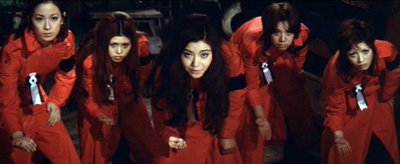
Unfortunately, Oshida must have been in the wrong place at the wrong time, or working for the wrong studio in the wrong film, or simply wasn't considered chirpily kawaii enough, because she never broke out as a major star. What a loss! But what a voice!
And while we're in the preternaturally low voices category, Joji Nakata, who plays the Count of Monte Cristo in Gankutsuou, has one of those delicious, floor-rumbling bass voices, a kind of cross between James Earl Jones and Leonard Cohen.
At the other end of the spectrum is Sakiko Tamagawa, who plays the very lethal but childlike Tachikoma robots on Ghost in the Shell: SAC. Tamagawa's talents turn them into the smartest, cutest, and yet most believable self-aware armored personnel carriers ever devised. R2D2 comes across with the personality of a Campbell's soup can in comparison.
Splitting the difference is Ayumi Ito, who voices Tifa in Final Fantasy VII. Having no interest in video games myself, I hadn't the slightest idea what the movie was about from the first scene until the closing credits started rolling. Unlike the original Final Fantasy movie, Final Fantasy VII was obvious made by game players for game players. Well, all the power to them.
I did manage to sit through the whole thing, though. As it's pretty much a high-def video game, it was like watching the Road Warrior version of Cirque du Soleil. And like I said, there's Ayumi Ito. Honestly, I could listen to her read the phonebook.
Labels: criticism, ghost in the shell, japan, movies, personal favs, robots, yakuza
November 27, 2005
Chapter 16 (A Thousand Leagues of Wind)
During the Tokugawa Era, sumptuary laws were promulgated in the name of moral values, public decorum and respect for the government. But it largely came down to enforcement of the feudal order and was a handy way to check the influence of the growing merchant class. The lowest of the four feudal classes (samurai, farmers, artisans, merchants), the merchants were often the most powerful, due to the profligate borrowing and spending habits of high government officials, who were not above using sumptuary laws as an excuse to default on their debts.
In Japan, an Attempt at Interpretation, written in the late Meiji period, Lafcadio Hearn notes how it is
difficult for the Western mind to understand how human beings could patiently submit to laws that regulated not only the size of one's dwelling and the cost of its furniture, but even the substance and character of clothing[;] not only the expense of a wedding outfit, but the quality of the marriage-feast, and the quality of the vessels in which the food was to be served[;] not only the kind of ornaments to be worn in a woman's hair, but the material of the thongs of her sandals[;] not only the price of presents to be made to friends, but the character and the cost of the cheapest toy to be given to a child.
Sumptuary laws were also an excuse to scrimp on the stipends paid to samurai, who were supposed to lead "austere" lives. As depicted in the movie Twilight Samurai, by the 19th century, the samurai system had become economically unviable. Crippling taxes were required to sustain the samurai class, yet most lower-echelon samurai, forbidden to engage in trade or manual labor, lived in poverty. Along the way, many illegally sold their swords and turned to farming or commerce, or, as in The Seven Samurai, kept their swords and became mercenaries or enforcers for the yakuza.
Ironically, at the same time, merchants often used their wealth to acquire samurai status. Sakamoto Ryouma, one of the founders of modern Japan, came from a family of sake brewers who purchased the rank of "merchant samurai." Not surprisingly, Sakamoto recognized early on the need to end the feudal system of inherited class.
Labels: 12 kingdoms, sakamoto, wind, yakuza
September 11, 2005
Lost on location
Unfortunately, he jumped that shark about a decade after making his one truly decent flick, Under Siege.
Still, you've got to admire an actor who knows his niche, sticks to it, and stays busy doing what people will pay him to do. But there's another reason to admire the movie, artistic considerations aside: it was made in Japan by somebody who knows something about Japan. It's depressing when you realize how rare this is.
I was living in Osaka when Ridley Scott made Black Rain, a ridiculously inaccurate depiction of Japanese law enforcement and a waste of the talents of the great Ken Takakura. (Japanese police enjoy a breadth of latitude in arrest and interrogation that would give an ACLU lawyer a coronary. It's no accident that Japanese prosecutors have a 99.9 percent conviction rate, and mostly from confessions.)
A far better Takakura police drama is Station, in which he plays a Japan Railways transit cop. Add to the list Mr. Baseball, oddly enough, one of the better American films about Japan and Japanese corporate culture. Yes, Mr. Baseball plays to comfortable stereotypes, but far more accurate and instructive stereotypes than the uninformed and self-important nonsense in Black Rain.
Still, when Black Rain came out, I was looking forward to seeing something of my old stomping grounds. I didn't recognize a thing. Why they came to Japan to do the film is beyond me. They could have shot it with a bunch of extras on a set in San Francisco.
Ditto, Tokyo. Lost in Translation isn't the complete waste of time that Black Rain is, but neither can I keep up my interest when show business types start making angsty, self-referential movies about each other (in other words, if you can't top All That Jazz, don't try). As Dana Stevens sums it up in Slate,
Is it simply laziness, the same dearth of ideas that leads movie producers to base movies on 30-year-old sitcoms that no one really liked in the first place? The power of plain old sloth should never be underestimated, but one other explanation may be a variant on the fiction-workshop cliche "Write what you know." Perhaps industry types can only satirize what they know and loathe—themselves.
Like Black Rain, Lost in Translation is another movie made in Japan that has very little Japan in it. Again, it could have been shot on a soundstage and a couple of days at the New Otani Hotel in LA's Little Tokyo. Or just a second unit and a green screen.
Japan is supposed to be "Buddhist monks chanting, ancient temples, flower arrangement," Kiku Day wryly observes. Indeed, the movie comes across as director Sofia Coppola whining for 100 minutes that Japan didn't stay stuck in the 17th century like in the postcards, and pointing her finger like a kindergartener at the naughty Japanese not conforming to stereotype.
Into the Sun, on quite the other hand, takes us into Tokyo, through Tokyo, above Tokyo, and not the tourist trap enclaves that Lost in Translation conveniently sticks to. It's working-class Tokyo, the cramped little shops and narrow back alleyways.
To top it off, Steven Seagal has an excellent grasp of the language. At times the accent disappears completely—at least to my gaijin ears. They leveraged this nicely. A few early exchanges to establish that Seagal can talk the talk, and then (in scenes with native Japanese) Seagal would speak English and whomever he was speaking to would speak Japanese. It sounds goofy, but it worked for me.
It's a lot better than forcing Japanese actors to struggle though English dialogue. This ain't Shakespeare, but better that one's acting skills be spent on acting than trying to badly pronounce a foreign language. (In the interactions between Chinese and Japanese characters, they resort to English, which is indeed painful to listen to.)
Plus, Seagal's martial arts training permits him to move his hulking presence through the frame without looking like a timid bull in a China shop. Though I wish he would give up the guns 'n yakuza material and try something a bit quieter and more cerebral on for size. Say, a Chandler-esque detective solving gaijin crimes in Tokyo. Just rip off Sujata Massey's oeuvre. Seagal could make it work.
Related posts
Dances with Samurai
Japan's Bond legacy
The Pacific War on screen
Labels: japan, movie reviews, movies about japan, yakuza