

September 23, 2013
The danchi revolution
NHK's Bakusho Mondai science series (hosted by the high-brow comedy duo of Yuji Tanaka and Hikari Ota) recently did a pair of shows on danchi. (Scroll down here for stills from the show.)
Danchi were massive urban housing projects initiated in the late 1950s. They were designed to accommodate the burgeoning population and lure people out of their wooden apartments and single-family fire traps.
The great majority of the deaths in the Great Kanto (1923) and even the Great Hanshin (1995) earthquakes were caused by collapsing wooden buildings and the fires that followed.
At the time, danchi were considered very modern and upscale. The Emperor visited what would become the Takashimadaira housing complex--still the largest in Tokyo (10,170 units)--to lend his stamp of approval.
The image below comes from this detailed photo blog: "You can't talk about danchi without mentioning Takashimadaira."
Bakusho Mondai showed a television ad from the era, featuring a "cool" couple entertaining in their cool new digs, with one cool guy mixing a martini. It was like something straight out of Mad Men.
The big architectural and cultural innovation danchi introduced on a widespread basis was room specialization, bedrooms separate from the dining room separate from the living room.
Though a second look reveals just how tiny those living rooms were. The couch and coffee table in the original Dick Van Dyke Show would have completely filled it with no room left for anything else.
These original structures are now seen as cramped and decrepit. In order to attract tenants, older danchi are combining units and liberalizing leasing requirements and zoning, such as converting ground floors to retail.
Later housing projects like Tama New Town (which grew into an entire city) and Port Town (where I lived for a year) accommodated an "urban-suburban" mix from the start, with larger apartments, green space, and shopping malls.
Upscale danchi have been rechristened "mansions" (condos). These days, though, a room of one's own isn't enough. The middle-class dream revolves around "Mai Hoomu" (マイホーム), a house in the suburbs.
Make that new homes and condos in communities close to the cities. The result is a growing surplus of old and abandoned houses in the exurbs (as in The Wolf Children). There's little affection for "this old house" in Japan.
Danchi were massive urban housing projects initiated in the late 1950s. They were designed to accommodate the burgeoning population and lure people out of their wooden apartments and single-family fire traps.
The great majority of the deaths in the Great Kanto (1923) and even the Great Hanshin (1995) earthquakes were caused by collapsing wooden buildings and the fires that followed.
At the time, danchi were considered very modern and upscale. The Emperor visited what would become the Takashimadaira housing complex--still the largest in Tokyo (10,170 units)--to lend his stamp of approval.
The image below comes from this detailed photo blog: "You can't talk about danchi without mentioning Takashimadaira."
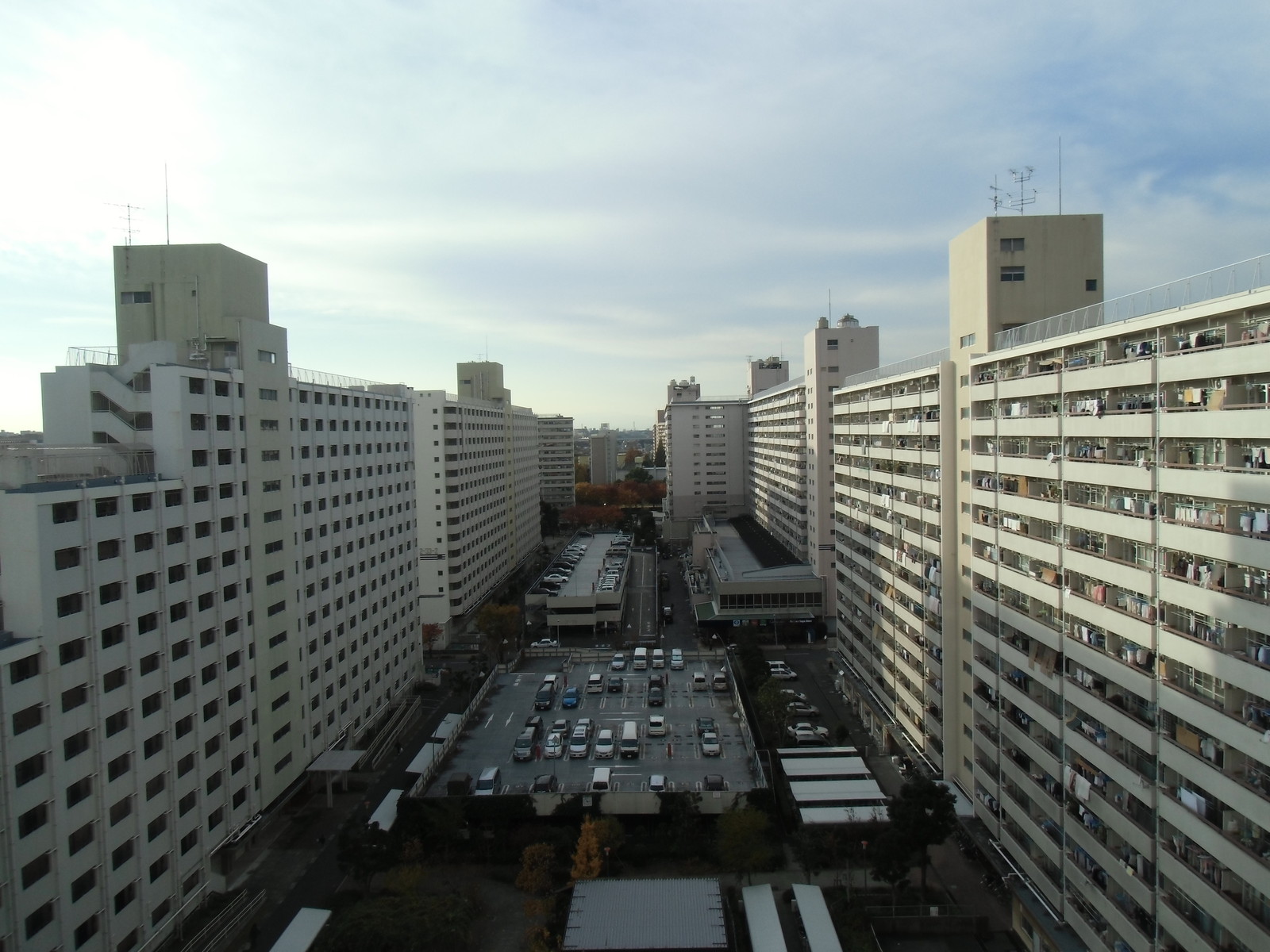 |
| Courtesy Dhanow. |
Bakusho Mondai showed a television ad from the era, featuring a "cool" couple entertaining in their cool new digs, with one cool guy mixing a martini. It was like something straight out of Mad Men.
The big architectural and cultural innovation danchi introduced on a widespread basis was room specialization, bedrooms separate from the dining room separate from the living room.
Though a second look reveals just how tiny those living rooms were. The couch and coffee table in the original Dick Van Dyke Show would have completely filled it with no room left for anything else.
These original structures are now seen as cramped and decrepit. In order to attract tenants, older danchi are combining units and liberalizing leasing requirements and zoning, such as converting ground floors to retail.
Later housing projects like Tama New Town (which grew into an entire city) and Port Town (where I lived for a year) accommodated an "urban-suburban" mix from the start, with larger apartments, green space, and shopping malls.
 |
| Port Town, Osaka. |
Upscale danchi have been rechristened "mansions" (condos). These days, though, a room of one's own isn't enough. The middle-class dream revolves around "Mai Hoomu" (マイホーム), a house in the suburbs.
Make that new homes and condos in communities close to the cities. The result is a growing surplus of old and abandoned houses in the exurbs (as in The Wolf Children). There's little affection for "this old house" in Japan.
Labels: danchi, demographics, japan, nhk, showa period


October 03, 2011
Unfurnished
A recent Heritage Foundation study counters a U.S. Census Bureau claim that "over 30 million Americans are living in poverty," by pointing out that
In The Atlantic, Derek Thompson responds that critics have pointed out that "many families in poverty rent apartments where fridges and air conditioning units come automatically" while conceding that the "ubiquity and affordability of consumer technology is an astounding testimony to productivity in the electronics sector."
What caught my attention in this case are the assumptions about what comes "automatically" with an unfurnished apartment.
Port Town in Osaka is the kind of high rise, middle-class, high-density planned community that urban planners dream about. It really is a great place to live: modern, safe, clean, convenient, with two tram stations and two shopping centers within walking distance, lots of parks, trees, space and a nice view of the harbor.
For a sense of the size, the "green" spaces are the bedrooms. Each rectangle is a tatami mat approximately three by six feet (the number indicates the number of tatami mats, a common way of describing room area). By comparison, this apartment is at least twice the size of Shizuku's danchi apartment in Whisper of the Heart.

My apartment there was the largest I'd ever had in Japan, a 3DK. Here's what a nice unfurnished apartment in Japan doesn't provide: no refrigerator, no stove, no heat, no air conditioning, no phone (back in the day, a dial tone from the NTT monopoly cost you a $500 security deposit). Barely any insulation. And no lights.
No lights!
Well, there was inset lighting in the foyer, over the sinks in the kitchen and vanity, and in the bathroom. But in the dining room and bedrooms, just the ceiling jacks. You had to buy the whole lighting assembly and snap it into the jack. Very clever and very inconvenient. I spent the first night there wandering around in the dark.
The rooms had connections for a heat pump, but it had to be purchased separately.
Probably the worse aspect of renting in Japan is "key money." Key money is the product of a tight housing market and well-meaning legislation that makes it difficult to evict tenants. Landlords calculate how much they stand to lose--half a year's worth of rent--and demand that much up front. It doubles as a legal bribe.
Since the housing bust in the 1990s, more and more landlords are offering to waive key money.
For foreigners, key money is usually a non-issue because few landlords will rent to non-Japanese without a Japanese guarantor. As a result, specialized real estate companies have sprung up in big cities that buy properties and then sublet apartments--high and low end--on the same terms you'd expect to find in the U.S.
most of the persons whom the government defines as "in poverty" are not poor in any ordinary sense of the term. The overwhelming majority of the poor have air conditioning, cable TV, and a host of other modern amenities. They are well housed, have an adequate and reasonably steady supply of food, and have met their other basic needs.
In The Atlantic, Derek Thompson responds that critics have pointed out that "many families in poverty rent apartments where fridges and air conditioning units come automatically" while conceding that the "ubiquity and affordability of consumer technology is an astounding testimony to productivity in the electronics sector."
What caught my attention in this case are the assumptions about what comes "automatically" with an unfurnished apartment.
Port Town in Osaka is the kind of high rise, middle-class, high-density planned community that urban planners dream about. It really is a great place to live: modern, safe, clean, convenient, with two tram stations and two shopping centers within walking distance, lots of parks, trees, space and a nice view of the harbor.
For a sense of the size, the "green" spaces are the bedrooms. Each rectangle is a tatami mat approximately three by six feet (the number indicates the number of tatami mats, a common way of describing room area). By comparison, this apartment is at least twice the size of Shizuku's danchi apartment in Whisper of the Heart.

My apartment there was the largest I'd ever had in Japan, a 3DK. Here's what a nice unfurnished apartment in Japan doesn't provide: no refrigerator, no stove, no heat, no air conditioning, no phone (back in the day, a dial tone from the NTT monopoly cost you a $500 security deposit). Barely any insulation. And no lights.
No lights!
Well, there was inset lighting in the foyer, over the sinks in the kitchen and vanity, and in the bathroom. But in the dining room and bedrooms, just the ceiling jacks. You had to buy the whole lighting assembly and snap it into the jack. Very clever and very inconvenient. I spent the first night there wandering around in the dark.
The rooms had connections for a heat pump, but it had to be purchased separately.
Probably the worse aspect of renting in Japan is "key money." Key money is the product of a tight housing market and well-meaning legislation that makes it difficult to evict tenants. Landlords calculate how much they stand to lose--half a year's worth of rent--and demand that much up front. It doubles as a legal bribe.
Since the housing bust in the 1990s, more and more landlords are offering to waive key money.
For foreigners, key money is usually a non-issue because few landlords will rent to non-Japanese without a Japanese guarantor. As a result, specialized real estate companies have sprung up in big cities that buy properties and then sublet apartments--high and low end--on the same terms you'd expect to find in the U.S.
Related posts
Before and After
Dogs, demons, and construction companies
April 05, 2006
Whisper of the Heart
Of all the Studio Ghibli productions, my sentimental favorite is Yoshifumi Kondo's Mimi o Sumaseba ("If you listen closely"), written and produced by Hayao Miyazaki (note the Kiki doll hanging over Shizuku's desk), based on the delightful manga by Aoi Hiiragi.
Shizuku, the teenager at the center of this coming-of-age story, lives an ordinary life with her danchi-dwelling middle-class family. Miyazaki's adaptation shifts the family down a socioeconomic rung from the manga. But this affectionate and straightforward depiction of lower-middle class Tokyo family life proves one of the pleasant surprises of the film.
You can find communities like this in western Tokyo, where the Kanto plain begins rising into the Japan Alps (the same setting as Initial D). Scenes in the movie bring back memories of the Odawara hills (at the foot of Mt. Fuji), and of bedroom communities on the Nankai line heading southeast out of Osaka toward Mt. Koya.
I lived in a similar danchi (apartment building) in Osaka, though newer and a bit more upscale. But the depiction is spot on, down to the futons airing out on the balcony railing.
Another thing that sets Mimi o Sumaseba apart for me is its depiction of the creative process. It's rare that a movie can talk about any aspect of literature, especially writing, without falling into glib stereotypes about "being an artist."
Miyazaki and Kondo find the right balance by analogizing physical craftsmanship (making musical instruments) with the harnessing of thought through the written word. In either case, artistry is ultimately the product of hard work and sacrifice, and not simply the unconstrained currents of the unfettered imagination.
All of Hiiragi's core themes, characters, and settings--especially the Earth Shop and Sir Cat--are faithfully preserved. In any case, this is not a case of the book being "better" than the movie, or visa-verse, but each standing well on its own and complementing the other.
The dub is well done, with voices by Harold Gould, Courtney Thorne-Smith, Jean Smart, and Cary Elwes putting in a cameo as the Count (the featured role in The Cat Returns, a companion film to Whisper of the Heart). Oh, and John Denver's "Country Roads" (vocal by Olivia Newton John) is in the original, too.
Labels: anime reviews, danchi, miyazaki, personal favs, studio ghibli