

November 17, 2016
"Your Name" (not a review)

Until this year, Makoto Shinkai's oeuvre could be described as the "anime art house masterpiece." In my opinion, his only successful long-form film was Children Who Chase Lost Voices (also titled "Journey to Agartha"), based on the Izanagi and Izanami (Orpheus and Eurydice) myth.
The Place Promised in Our Early Days and 5 Centimeters per Second certainly took us somewhere, but I'm not certain where, and I'm not convinced he knew either (though it was awfully pretty getting there).
His extraordinary skills as a cinematographer have never been in doubt. But Shinkai's talents as an auteur (wearing the producer, writer, and director hats) truly leap off the screen in his short work: She and Her Cat, Voices of a Distant Star, and The Garden of Words.
Rather, I still believe that it is Mamoru Hosoda's talent for accessible storytelling and his firm grasp of the structured cinematic narrative that places him more in the tradition of the legendary Hayao Miyazaki.
Until this year, that is. The caveat is necessary because over the summer (2016), Makoto Shinkai's latest animated film rocketed into the stratosphere, earning over $190 million in its home market (which is about a third the size of the U.S. market).
Your Name is currently the seventh highest-grossing film ever in Japan. The only animated films to earn more are Frozen and Studio Ghibli productions. The box office is strong enough that it is certain to reach second place at the $200 million mark.
(Among all movies ever released in Japan, Spirited Away occupies the top spot with almost $300 million, followed by Titanic, Frozen, and the first Harry Potter film. Then comes Howl's Moving Castle and Princess Mononoke.)
Of course, the big question is why.

Joe Konrath believes that artistic success has a lot to do with creating a deep backlist, working hard, and then counting on plain old luck. Makoto Shinkai put in the hours and built a fan base and an impressive catalog of work.
And then everything clicked: right place, right time, right subject matter.
Certainly the story he tells has a lot to do with it. The BBC does a pretty good job explaining "Why the story of body-swapping teenagers has gripped Japan."
The body-swapping plot device is hardly a unique one. The modern genre goes back to Vice Versa: A Lesson to Fathers, a 1882 comic novel by Thomas Anstey Guthrie, and brought up to date with Freaky Friday in 1972. Disney has made and remade movies based on the book three times.
A better comparison is the anime Kokoro Connect, in which the seemingly random body-swapping (which turns out to be under the control of a "higher" power), also "touches on universal themes such as coming of age, adolescence, and the struggle to assert your identity in a confusing world."
Shinkai himself credits a poem by Ono no Komachi, one of the two Komachi poems that also inspired my novel, The Path of Dreams (the translation here is by Jane Hirshfield from The Ink Dark Moon):
Did he appear
because I fell asleep
thinking of him?
If only I'd known I was dreaming
I never would have wakened
In the Freaky Friday films and its descendants, the body-swapping plot device is played for laughs. There are humorous moment in Kokoro Connect, but as with Your Name, it is not primarily a comedy. For Shinkai, not primarily a comedy means there are still comedic elements.
To be sure, Shinkai doesn't make depressing films. But "upbeat" is not usually the word used to describe them. "Contemplative" and "introspective" might be more accurate adjectives, with an emphasis on interior melodrama.
Mamoru Hosoda has always been able to leaven the pathos with humor, while Shinkai can be fairly criticized for an often unrelentingly earnest approach. His lighter touch in Your Name undoubtedly accounts for its appeal, even while addressing a solemn subject.
The story's real-world antecedent, which he candidly admits to, is the Tohoku tsunami, that in March 2011 killed almost 16,000 people. In Your Name, Shinkai provides the necessary psychological distance by making the disaster a more exotic and less disastrous meteor strike.
But it is still a disaster whose worst aspect could have been avoided with the proper information. Hence the "time slip" denouement (knowing how a story ends ahead of time doesn't bother me).
Which prompts me to hypothesize that the focus of attention on the "body-swapping" business perhaps misses the point. This is far more about transmigration of the soul. In Kokoro Connect, these transmigrations are simply happening in real time without death getting in the way.
That makes it more of a reincarnation story, which brings to mind the quite similar ending in Angel Beats. Theologically, what we find here is a salvific view of reincarnation, that portrays rebirth as integral to the moral evolution of the individual, a second chance to get things right.
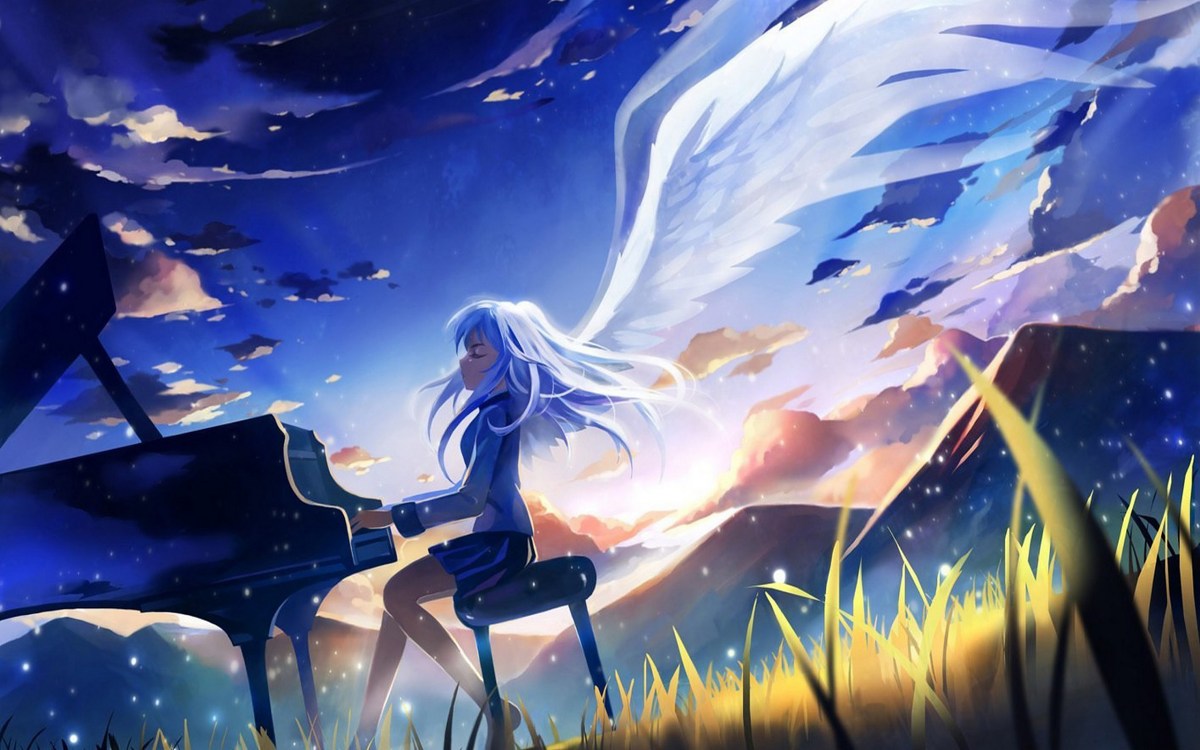
"To die with a peaceful mind will stimulate a virtuous seed and a fortunate rebirth." This is the theme of Angel Beats.
The consciousness in the newly born being is neither identical to nor entirely different from that in the deceased but the two form a causal continuum or stream. Transmigration is influenced by a being's past karma.
By placing this "fortunate rebirth" in the context of the survival of an entire community, as opposed to the tribulations of a bunch of angsty teenagers, Shinkai has greatly expanded the scope and reach of the genre, and formed it into a national touchstone.
Your Name is slated for an Oscar-qualifying run in the U.S. this fall. In any case, it is unlikely to gross even a tenth of its Japanese box office. Spirited Away pulled in $10 million, and, sadly, that's actually a respectable amount for a Japanese film.
Spirited Away presented an otherworldly cosmology to audiences used to fairy tales filtered through the Disney lens. Critical opinion aside, it will be interesting to see how well the transcendental message of Your Name communicates across cultures.
Related links
Makoto Shinkai
Mamoru Hosoda
Voices of a Distant Star
Angel Beats! (Yahoo CR)
Kokoro Connect (CR)
Labels: anime, buddhism, hosoda, japanese culture, personal favs, religion, shinkai, social studies, your name


December 31, 2015
The Boy and the Beast
Mamoru Hosoda was briefly slated to direct Howl's Moving Castle but left after what really were "artistic differences." All for the better, as it turned out. Miyazaki took over and made a great movie. And now Hosoda is well on his way to matching his record.
Hosoda is one of the few directors I consider self-recommending: the name alone in the credits is enough.
If anybody stands to inherit Miyazaki's mantle, it's Hosoda, whose films rival Ghibli productions for their consistent quality, dramatic depth, a sheer entertainment value: The Girl Who Leapt Through Time (2006), Summer Wars (2009), and The Wolf Children (2012).
And this year, The Boy and the Beast. The description sounds like supernatural version of The Karate Kid: the bellicose, bear-like swordsman Kumatetsu takes Kyuta under his wing and trains him to be a fighter.
The setting is Shibuya in Tokyo, except that a connection to an alternate realm has turned this Shibuya into a kind of postmodern Narnia. (Blood Blockade Battlefield sports a similar premise, though in New York, so maybe we've got a sub-genre going here.)
Funimation has licensed the film for North America; it's scheduled to open in theaters in 2016.
Speaking of the Miyazakis, Goro Miyazaki's Ronia the Robber's Daughter, based on the children's fantasy novel by Astrid Lindgren, has been made available to international distributors. The series ran for 26 episodes on NHK between fall 2014 and March 2015.

The series is currently streaming on Amazon.
And speaking of Studio Ghibli, GKids is distributing Only Yesterday, Isao Takahata's 1991 slice-of-life melodrama, with voice-over work by Daisy Ridley, no less. (And GKids now lists Ocean Waves, the last Ghibli film to be released in the U.S., on its website too.)
Related posts
The Girl who Leapt through Time
Summer Wars
The Wolf Children
Labels: anime, funimation, gkids, hosoda, japanese culture, miyazaki, movies about japan, nhk, studio ghibli
June 06, 2015
Makoto Shinkai
Along with Mamoru Hosoda, Makoto Shinkai comes closest to capturing the cinematic "look and feel" of Studio Ghibli (Shinkai cites Castle in the Sky as his favorite anime). However, I think Hosoda hews much closer to Miyazaki's (and John Lasseter's) emphasis on story driven by plot and character.
Shinkai waxes moodier than I usually care for, emphasizing affect over effect. But, boy, can he capture moods! His visual palette is stunning, exquisite, and deeply evocative. Voices of a Distant Star is less a film than a narrative poem. (It's also the best version of Ender's Game that isn't Ender's Game.)
The excruciatingly gorgeous 5 Centimeters per Second vividly captures (especially in the last scene) a very real moment of self-realization. You want honest emotions? Like, man, I'm grokking it totally. But I'm not sure I'd call it "entertaining." Not beyond the dazzling cinematography.
In other words, 5 Centimeters per Second may be the most beautiful work of literary fiction ever created.

One exception in the collection is Children Who Chase Lost Voices. This retelling of Orpheus and Eurydice (Izanagi and Izanami) visually merges the worlds of Totoro and Princess Mononoke in a young adult adventure through the underworld. Death and loss is still the subject, but less meditatively.

Mono no a'wa're is Shinkai's specialty, referring to the classical Japanese aesthetic concept of the beauty that can be found in loss and in the transitory nature of things, "a gentle sadness (or wistfulness) at their passing as well as a longer, deeper gentle sadness about this state being the reality of life."
A'wa're isn't about being nihilistic or deliberately depressing. It's the simple recognition that nothing lasts forever, and if you know where to look there's beauty in that too, so it doesn't have to completely bum you out.
Shinkai's oeuvre truly comes together in Garden of Words, a story told in images that suffuse the senses like a Monet exhibition. No cinematic rain has ever felt wetter. Though here Shinkai does drive toward a specific resolution that pays off in the final frames (stick all the way through the credits).

Senri Oe's 1988 hit single, "Rain," inspired the screenplay. In the movie it's performed by Motohiro Hata.
In Garden of Words, Shinkai has given a well-established romance subgenre (in Japan) a poignant twist. Once you realize that, the film is worth watching again to see how he advances the plot without showing his hand, and how many subtle touches come alive with the additional context.
Netflix still carries The Place Promised in Our Early Days in its dwindling DVD catalog. All of the titles are available at Amazon in one form or another. She and Her Cat is included as an extra on the Voices of a Distant Star DVD.
Shinkai waxes moodier than I usually care for, emphasizing affect over effect. But, boy, can he capture moods! His visual palette is stunning, exquisite, and deeply evocative. Voices of a Distant Star is less a film than a narrative poem. (It's also the best version of Ender's Game that isn't Ender's Game.)
 |
| (Click on images to enlarge.) |
The excruciatingly gorgeous 5 Centimeters per Second vividly captures (especially in the last scene) a very real moment of self-realization. You want honest emotions? Like, man, I'm grokking it totally. But I'm not sure I'd call it "entertaining." Not beyond the dazzling cinematography.
In other words, 5 Centimeters per Second may be the most beautiful work of literary fiction ever created.

One exception in the collection is Children Who Chase Lost Voices. This retelling of Orpheus and Eurydice (Izanagi and Izanami) visually merges the worlds of Totoro and Princess Mononoke in a young adult adventure through the underworld. Death and loss is still the subject, but less meditatively.

Mono no a'wa're is Shinkai's specialty, referring to the classical Japanese aesthetic concept of the beauty that can be found in loss and in the transitory nature of things, "a gentle sadness (or wistfulness) at their passing as well as a longer, deeper gentle sadness about this state being the reality of life."
A'wa're isn't about being nihilistic or deliberately depressing. It's the simple recognition that nothing lasts forever, and if you know where to look there's beauty in that too, so it doesn't have to completely bum you out.
Shinkai's oeuvre truly comes together in Garden of Words, a story told in images that suffuse the senses like a Monet exhibition. No cinematic rain has ever felt wetter. Though here Shinkai does drive toward a specific resolution that pays off in the final frames (stick all the way through the credits).

Senri Oe's 1988 hit single, "Rain," inspired the screenplay. In the movie it's performed by Motohiro Hata.
In Garden of Words, Shinkai has given a well-established romance subgenre (in Japan) a poignant twist. Once you realize that, the film is worth watching again to see how he advances the plot without showing his hand, and how many subtle touches come alive with the additional context.
Netflix still carries The Place Promised in Our Early Days in its dwindling DVD catalog. All of the titles are available at Amazon in one form or another. She and Her Cat is included as an extra on the Voices of a Distant Star DVD.
• She and Her Cat (short; cats)
• Voices of a Distant Star (short; science fiction)
• The Place Promised in Our Early Days (science fiction)
• 5 Centimeters per Second (contemporary)
• Children Who Chase Lost Voices (fantasy)
• The Garden of Words (short; contemporary)
Labels: anime, crunchyroll, hosoda, miyazaki, personal favs, shinkai, studio ghibli
August 12, 2013
The Wolf Children
Mamoru Hosoda started out his career working for franchise productions (Digimon, One Piece). With The Girl who Leapt through Time (2006), Summer Wars (2009), and now The Wolf Children (2012), he's proved himself one of the best and most original anime directors in the business.
The Wolf Children deserves a place alongside Miyazaki's "quiet fantasies" such as My Neighbor Totoro, Kiki's Delivery Service, and Whisper of the Heart. Like Miyazaki, Hosodo embraces the sentimental while avoiding the maudlin, communicating a deep sense of poignancy and loss that Miyazaki rarely achieves.
This is less the loss that comes from melodramatic tragedy (the father dies early on, in what is more of a preface to the rest of the movie) than the inevitable loss that comes from simply living a life to its fullest.
Hosoda has masterfully fused two fundamental concepts of Japanese aesthetics: wabi-sabi, the beauty of the old. Not that of antiques in a museum but objects allowed to age and wear in their natural settings. And awa're, "an awareness of impermanence or transience of things, and a gentle sadness at their passing."
This is a story about family, community, and coming-of-age in rural Japan, a part of Japanese society that is itself inexorably aging and wearing away. As he did in Summer Wars, Hosoda has taken a genre fantasy and moved it to the Japanese countryside (which, to much of his audience, is no less fantastical a setting).
The rural drama in Japan has become a genre of its own (a common variation is the island drama).
The best-known example outside Japan is probably Miyazaki's My Neighbor Totoro. A lesser-known Yoji Yamada classic is Harukanaru Yama no Yobigoe ("The Call of the Distant Mountains"). A wanted man on the run (Ken Takakura) is taken in by a widowed farmer's wife (Chieko Baisho) in Northern Japan.
In Home: Itoshi no Zashiki Warashi, struggling businessman Yutaka Mizutani gets transferred to the sticks. The traditional old house (similar to the one in The Wolf Children) he rents for his family turns out to be haunted by a zashiki warashi, the ghost of a child who brings good fortune to those who treat it well.
Like the zashiki warashi in Home, it's pretty much impossible not to read scads of metaphors into The Wolf Children. There's the obvious (little kids are wild animals), but Hosoda is tackling a much bigger theme: how the maladaptive adapt to societal norms. Or in some cases, how they simply choose not to.
Rarely has the truism that children grow up to pick their own paths in life been stated so unpretentiously and in such a heartfelt manner.
Thankfully, though, Hosoda doesn't let the "message" get in the way of taking the story literally either.
I saw The Wolf Children on TV Japan. It's been licensed by Funimation and is available on DVD and Blu-ray.
Labels: anime reviews, fantasy, fox and wolf, funimation, hosoda, miyazaki, movie reviews, movies about japan, science fiction, tv japan
January 07, 2013
The Wolf Children
I was finishing the final draft of Fox & Wolf when I read this review of Mamoru Hosoda's Okami Kodomo no Ame to Yuki ("The wolf children Ame and Yuki"). The similarities in the genre and even names caught my attention.
Yuki and Ami are fairly common names, though Ame is not. Hosoda's Yuki was born on a snowy day. My Yuki has a snow-white coat. Ami means "beautiful madder" (she's a red fox). Ame means "rain."
My Yuki was raised in the wilds of Hokkaido by her werewolf aunt. I imagine something along the lines of the short-lived 2001 CBS/SyFy fantasy series Wolf Lake, about a mountain town run by its werewolf inhabitants.
Yuki's mother and father also meet at college, though my Yuki's mother is the wolf, and her father is from an aristocratic family.
The plots are worlds apart. However, "as Yuki grows from pint-sized hellion to school-age girl, she decides she wants a more normal life" does describe my Yuki's character arc (though it's hardly a unique one).
In a sense, Okami Kodomo no Ame to Yuki explains what Ami's mom was trying to avoid by denying her daughter's fox nature. As a result, Ami doesn't confront the realities of her were-self until she runs into Yuki in high school.
Okami Kodomo no Ame to Yuki has been licensed by Funimation (no release date yet). Fox & Wolf is available now!
Hosoda previous two films, Summer Wars and The Girl who Leapt through Time, are also highly recommended.
Labels: fantasy, fox and wolf, funimation, hosoda, japan, japanese movie reviews, science fiction
March 07, 2011
Summer Wars
The typical "Oscar bait" flick does its best to reinforce every grim "truth" the critics believe about the world, while patting them on the back for having such refined tastes. After all, no mere dilettante would willingly spend two hours watching such depressing, self-important dreck and then crow about it afterward.
Though if the production studio behind it has any aspirations of breaking even on the project, they'll have read their McKee and smuggled in the necessary quota of crowd-pleasing plot payoffs and made sure the word-of-mouth spreads it around.
With Summer Wars (English language version: WB/Funimation) director Mamoru Hosoda has done the exact opposite. On the surface, he panders shamelessly to the tween video game demographic with a by-the-numbers plot, while sneaking a gem of a human comedy in through the back door.
 Read more »
Though if the production studio behind it has any aspirations of breaking even on the project, they'll have read their McKee and smuggled in the necessary quota of crowd-pleasing plot payoffs and made sure the word-of-mouth spreads it around.
With Summer Wars (English language version: WB/Funimation) director Mamoru Hosoda has done the exact opposite. On the surface, he panders shamelessly to the tween video game demographic with a by-the-numbers plot, while sneaking a gem of a human comedy in through the back door.
Labels: anime reviews, funimation, hosoda, mainframe, robots, technology
January 13, 2009
The Girl who Leapt through Time
 If this were the typical Hollywood product--even getting past the image of Michael J. Fox that certainly springs to mind--you could probably picture the entire movie from the title alone. As a teen science fiction actioner, the plot practically writes itself.
1) A goofy mad scientist with a time machine chased by bumbling bad guys and shadowy government agents (often one and the same), and a geeky kid who unintentionally gets mixed up in everything yet manages to pull it together and save the world and get the cute girl.
2) Or cashing in on the Lord of the Rings and Narnia, a medieval romance with many "clever" anachronisms (A Connecticut Yankee in King Arthur's Court) and a couple of handsome knights and/or cute maidservants with suspiciously contemporary sensibilities.
And you'd be wrong. Director Mamoru Hosoda's adaption of this Japanese Y/A classic is a perfect example of plot as a necessary condition but character as the sufficient one. A legitimate criticism of the film, in fact, might be that the science fiction scaffolding is so sparse.
But that's because the story only takes the bare minimum of what it needs from the time-travel fantasy sub-genre to build a complex narrative that evolves out of the character of its protagonist, Makoto.
Makoto is a bit of a tom girl with a normal family and normal friends. But at the end of a particularly bad day when everything goes wrong, she trips over a gadget at the back of the high school science lab and wakes up to find she can travel backwards through time.
What does she do with this power? After stealing back a stolen dessert from her little sister's clutches, she sets out to make her bad day right. But for everything made "right," something goes "wrong," and she is soon consumed by the quest just to get things back to the way they were.
How she judges the morality of a relative gain for herself against a loss for someone else in each instance is ultimately what matters. We understand why it matters to her because the movie makes us care about what happens to these secondary characters.
A good measure of a good story is how compelling the secondary character are (without upstaging the protagonist). I'd like to see more of Makoto's super-cool "Aunt Witch," and more of the relationship between Kousuke and Kaho that Makoto engineers.
And, of course, find out whatever happens to Chiaki (it's literally all about art appreciation).
All those loose ends don't tie themselves up in nice little bows. To be sure, while it's easy to criticize "bad art" for emphasizing the happy ending and the moral of the story to be imparted, it is the tendency of much worse art to insist that there isn't any point.
There isn't a climactic "Ah ha!" moment or the false promise of a together-forever denouement at the end of The Girl who Leapt through Time. Instead, I came away feeling that I'd watched a trio of fast friends grow and mature in truly meaningful ways.
And that is the most powerful point of all.
Labels: anime reviews, criticism, hosoda, science fiction