

January 24, 2024
Reframing the mainframe plot
And yet Hollywood keeps serving it up. Because we keep chomping it down.
 |
| Conquering the galaxy since the 1950s. |
Even the ending of Edge of Tomorrow (without a computer network in sight) is straight out of The Phantom Menace. And straight out of Oblivion, the previous Tom Cruise SF post-apocalyptic, blow-up-the-alien-mainframe actioner.
Making it an organic mainframe is a slight improvement but just as dumb. The whole "hive mind" thing needs to go too.
Speaking of organic mainframes, Star Wars fell back on the Evil Emperor trope, a linchpin apparently holding the whole universe together by his lonesome. How is never explained, but all the good guys have to do is knock out this one bad guy and peace and prosperity is restored to the galaxy.
Well, after they deal with the truly killer mainframe that is the Death Star. The whole Star Wars franchise ended up being about destroying Death Stars, each one a more ludicrous violation of the laws of physics than the last. Again, what long term problems this solves is never made clear.
Does the mail start arriving on time now? Does the tax code suddenly become more comprehensible? And what happens to the unemployment rate when all those Death Star jobs get instantaneously terminated? Imagine the size of the catering contract for just one of those behemoths.
Of course, destroying a single machine in a single place and winning the war everywhere makes for easy denouements. But if the Earth is ever attacked by malevolent aliens who know how to implement autonomous distributed network technology, we are so screwed.
That aside, though, what do the aliens hope to accomplish by attacking Earth? Or attacking any inhabited planet? (Besides giving the director an excuse to restage the Battle of Britain or the Invasion of Normandy.)
If they wanted to wipe out the humans along with the infrastructure—the whole objective of the Independence Day aliens—there'd be no need to get anywhere near the planet's surface, as Heinlein pointed out back in 1966 with The Moon is a Harsh Mistress. An asteroid makes for a handy ICBM.
There are lots of big asteroids out there.
Another reason is, they want our water. But there is plenty water elsewhere, that is not at the bottom of a deep gravity well. Europa, for starters.
Then there's the "To Serve Man" plot device. But homo sapiens is a lousy food and energy source (The Matrix is dumber than dirt in this regard). That's why so few people get eaten by sharks (surprisingly few!).
Besides, a blown-up country is a huge resource sink. Hence the Marshall Plan. By 1950, SCAP was already regretting Article 9 in the 1947 Japanese Constitution (forbidding war) and was revving up Japanese industry to support the Korean War, which was just what the economy needed.
In The Phantom Menace, Lucas tosses the politics of trade into the picture, but without explaining what is being traded, why, or how. The result is a blur of handwaving when it comes to the story because there are no underlying rational reasons for anything that happens.
The economic model of the Star Wars universe makes no more sense than the socialist utopianism of Star Trek, which finally gave us the robber baron Ferengi to make things interesting.
Still, Lucas was onto something. The unequal treaties imposed on Japan and China by the U.S. and European powers in the mid-19th century led to the Boxer Rebellion in China and propelled Japan into a regional arms race in order to even the scales. Lots of dramatic conflict there.
The thing is, China and Japan had stuff the foreign powers wanted, stuff as trivial (to our modern eyes) as tea. But like spice in Dune, there were underlying economic causes behind the conflicts. And at the time, a bad trade deal was a better deal for both sides than smash and grab.
And so we're back to the Lebensraum ("living space") ideology promulgated by Germany in the 1930s. (The Nazi bad guy connection certainly doesn't hurt.) The Japanese equivalent was used to justify the annexation of Korea and Manchuria.
Both Germany and Japan were doing rather well at expanding their territories (employing their own "unequal treaty" tactics) before they started actually invading their neighbors, after which everything went downhill fast.
So we'll assume our invading aliens are smart enough not to turn the whole thing into a scorched-earth shooting war. The problem is how to make that interesting.
A good place to start is Ryomaden, which describes the opening of Japan in the mid-19th century, the shock to the system, the unequal treaties, the escalating civil strife, finally resolved by a quickly-concluded civil war that launched Japan on a burning quest to surpass the west.
If gunboat melodrama is what you want, (bad) diplomacy seems pretty good at supplying the necessary Sturm und Drang motivations. Kudos to Guardians of the Galaxy on this score.
The problem is the time frame required by real politics. Summing up two decades of geopolitics in two hours would be tough. I suppose it really is simpler to just have Tom Cruise blow up the mainframe.
Labels: computers, mainframe, movies, robots, science fiction, star wars, tech history, technology, thinking about writing


December 23, 2023
The atonement of Pacifica Casull
 In contrast to the ending of Scrapped Princess, I found the atonement scene in The Lion, the Witch and the Wardrobe to be a weak representation of the material being analogized. Furthermore, it makes no sense disconnected from its Christian eschatological framework. And requires a huge suspension of disbelief to make sense of it even when it's not.
C.S. Lewis's hand-wave in this regard is "deep magic," which I think is his way of saying, "Stop asking why." I don't blame him. The Doctrine of the Atonement in the Catholic Encyclopedia covers all the arguments and analogies the dedicated church-goer of any faith has ever heard of and dismisses them one by one as "close but not quite." Ultimately, it can't do much better than the tautology it begins with:
Atonement is the Satisfaction of Christ, whereby God and the world are reconciled or made to be at one.
That sounds awfully Deepak Chopra. The saying, "Fish discover water last," resonates here. Lewis tremendously advanced the cause of Christianity by reframing it in the context of medieval legend and mythology, his areas of expertise. But I think it's necessary to look further afield, to audiences not culturally conditioned to make snap connections between the analogy and the thing being analogized.
Taking Scrapped Princess as a case in point, I can't say whether author Ichiro Sakaki and director Soichi Masui intended the metaphor to be extended this far, but Scrapped Princess frames this bedrock principle of Christian theology with a clarity and logic I've never seen before.
The Earth of Scrapped Princess (which could be viewed as a sequel to The Day the Earth Stood Still) was long ago on the losing side of a literal war in the heavens. After the surrender, the planet was stripped of its advanced technology and sealed inside a kind of global "Biosphere Two." Now called "Providence," it is ruled by a computer system that makes its will known through the "Church of Mauser."
The system maintains Providence in a permanent Middle Ages. The primary means of control is the church (an obvious nod to Rome). But there are several other subroutines running as checks and balances to this goal. Aside from the human Inquisitioners, angel-like beings known as "Peacemakers" (self-aware but cruelly stoic robots) that can trigger Armageddon and reboot the Middle Ages all over again.
Human nature being what it is, sooner or later people start getting too big for their britches, begin discovering the "old technology" (a nod to the Renaissance), and generally causing problems. And so the slate has to be wiped clean.
The other, seemingly contradictory routine is the "Providence Breaker." This independently-running program is designed to terminate the entire system when certain conditions are met, and return to the human race their free agency. It tests for these conditions by raising up a "savior" who is prophesied to destroy the world. If she dies before her sixteenth birthday, then nothing happens and the subroutine restarts.
The anime series doesn't explore all the alternative options, but the following exegesis does fit the material: a Napoleonic figure who rises precipitously to prominence and plows through church and state wouldn't trigger the Providence Breaker either. Because that would inevitably result in a repeat of the same situation, the reason for the world being in this state in the first place.
Rather, the savior has to die to save the world, literally have her blood shed to trigger the Providence Breaker. In the end, Pacifica is betrayed by her own kin, just as Mauser, the original designer of the system, originally betrayed human freedom for "the greater good." (Compare to King Hezekiah trading away future liberty for a present peace in 2 Kings 20:16-19.)
Up to that point, Pacifica has been protected by her mecha "Dragoons" (Knights Templar), and by her followers. If they are not strong and resourceful enough, she will die before her sixteenth birthday. If they are too strong, then their power will corrupt absolutely and nullify the effort. It is only on the razor's edge between these two extremes that her atonement becomes efficacious.
In the end, telling Pacifica that "you were born to destroy me," Mauser's virtual ghost leaves the final choice between peaceful tyranny and chaotic freedom up to her. When Pacifica chooses the latter, like a good deist, Mauser instructs the human race that it is now time for them to take responsibility for their own actions and their own future. And shuts itself down.
This interpretation comes to a logical conclusion and makes a clear, comprehensible point. Not that it's necessarily doctrinally correct (depending on what doctrine you adhere to), but as my old violin teacher used to say, if you're going to play the wrong note, at least play it well. That shouldn't be too much to ask of religious theologies that claim to have the power to damn or save us for all eternity.
Related posts
The catechism of Angel Beats!
Scrapped Princess
The passion of the magical girl
The Lion, the Witch and the Wardrobe
Labels: anime, apocalyptic fiction, deep thoughts, eschatology, magic, religion, robots
October 22, 2015
Robot on the Road
This gorgeously drawn short also has a robot (obviously) with low and ulterior motives, and generous amounts of gratuitous nudity. But veteran animator Hiroyuki Okiura makes no bones about writing and directing what is basically a ten-minute long dirty joke.

Being up front about what you're up to and not pretending the subject matter is more than what it is always makes for better art. Robot on the Road is funnier (on purpose) and orders of magnitude more clever than the hundred long minutes of Ex Machina.
Writing a "good" dirty joke (or, for that matter, any run-of-the-mill episode in any run-of-the-mill police procedural) takes more talent that wallowing in the manipulative angst of unlikable people and their meaningless lives.

Hiroyuki Okiura also directed the heartwarming and family friendly A Letter to Momo. I don't doubt that having a healthy respect for traditional moral values makes it easier to poke gentle fun at them.
Labels: anime, gkids, japan, movies, robots, sex, technology, thinking about writing
October 15, 2015
Ghost in the Belle
 |
| Impressive special effects on a small budget. |
But before going to DEFCON 1 on the "A.I. panic of 2015," Erik Sofge would first like to see "any indication that artificial superintelligence is a tangible threat." So he posed the question to Yoshua Bengio, head of the Machine Learning Laboratory at the University of Montreal. Bengio doesn't see much of a threat either.
Most people do not realize how primitive the systems we build are, and unfortunately many journalists (and some scientists) propagate a fear of A.I. which is completely out of proportion with reality. We would be baffled if we could build machines that would have the intelligence of a mouse in the near future, but we are far even from that.
Alex Garland doesn't share these "concerns" either. If anything, the director and writer of Ex Machina seems to anticipate the day when every nerd will have a fully functioning sex robot in his closet. Not exactly a terrifying prospect (except for Japanese demographers).
So Ex Machina isn't another silly Terminator clone. But it is a very silly movie, and its silliness is largely a product of taking itself so danged seriously. And yet not seriously enough.
The role of science in science fiction is relative to the technical aspirations of the story. Other than stipulating the existence of spaceships, there doesn't need to be a whole lot of actual science in space opera. Even the "mainstream" of the genre demands little more than a nod to the current state of the art.
But make the science the primary focus--enter the realm of "hard" science fiction--and you have to color within the lines. The Second Law of Thermodynamics is no longer a suggestion, and the standard shifts from "vaguely not impossible" to one brilliant mind away from realization.
In Ex Machina, Nathan (Oscar Isaac) is supposedly that brilliant mind. The CEO of search engine giant Bluebook (i.e., Google), he's the amalgamation of Larry Page and Sergey Brin and Larry Ellison (and inexplicably, Sylvester Stallone).
Caleb (Domhnall Gleeson), one of his star programmers, has "won" a "weekend with the boss" contest. When he ends up at Nathan's estate in the wilds of Alaska, it seems he's really there to conduct a Turing test on the comely Ava (Alicia Vikander), Nathan's latest android.
A machine that passes a Turning test can carry on an unconstrained dialogue without its human interrogator realizing it's a machine. Nathan recruits Caleb because he needs an "objective" evaluator to make the assessment, but misleads Caleb at first about what truly is being assessed.
Which isn't all that difficult, as Caleb's "test" consists of vacuous conversations that could have been scripted by a machine. More likely, the writer simply isn't as smart as his characters. Caleb comes across as a dweeb on his first date; Nathan is a boorish football jock who likes to hit stuff.
 |
| Least convincing casting ever. |
What if the whole thing's a Mechanical Turk? If the hardware's that good, it'd be easy to pull off. Where's a Voight-Kampff machine when you need one? Hmm, might this android be as nuts as the guy who built her? Once my suspension of disbelief began to fray, there was nothing to stop it from unraveling all the way.
Now, to start with, Ava is mechanically beyond anything anybody's invented, and her "brain" is more than a bit of a leap. Still, given the proper context, that leap could be made. No surprise that the leap not easily made depends on the Second Law of Thermodynamics, pop sci-fi's biggest stumbling block.
Caleb's first question to Nathan wouldn't have anything to do with her A.I. Rather, what kind of servos does she use? What kind of batteries does she have?
Human nature is such that we tend to judge the internal consistency of a plot, especially in fantasy and science fiction, not so differently than a criminal trial: the prosecution can't cross-examine on excluded evidence unless the defense brings it up on direct. Unmentioned, we happily exclude great swaths of the real world.
Ghost in the Shell begins by positing that non-sentient androids are already ubiquitous. So that takes the subjects of mobility and functional capability off the table.
Fine. Except that Garland introduces the subject into the script. Now it's fair game. The first mention is quite smart, when Ava reveals to Nathan that she gets her power through inductive charging. That's real technology.
But the only reason inductive charging is brought up is because Ava knows she can kill the main power feeds by triggering a "power surge." This idiotic technobabble is the same dumb plot device that has shown up in caper flicks for decades: kill the power and the security systems fail. (Die Hard did it in 1988, okay? Stop it.)
And it's paired with another one just as old and creaky: genius coder reprograms a security system (at the source code level) that he's never seen before. And super-paranoid Nathan doesn't encrypt or do check-sums on any of his super-duper top-secret software.
Oh, and inductive charging would severely limit Ava's range. Without a supply of the most advanced battery technology imaginable, Ava is permanently confined to the house. So why confine Ava to her room as well? We're at least a hundred miles from civilization. There's nowhere else for her to go.
Seriously. The androids want to be free? Set them free. That'd be a million times more interesting than this script. Tossing Caleb into a Survivorman episode with Ava would be the ultimate test of intelligence. It'd be truly hilarious if they both got all bitchy and whiny. Now that'd be human.
In any case, the equivalent of an electronic dog collar or an OnStar system would take care of things quite efficiently. Your super-intelligent robot can't have less sophisticated electronics than cars have had for years. ("Kyoko" aside, the rest of Nathan's androids are turned off, so they can be turned off.)
Hmm, so at what point did Nathan regret not implementing Asimov's Three Laws of Robotics?
Both Caleb and Nathan use the same metaphor: the pretty assistant who distracts the audience while the magician palms the card. Garland deploys a harem of naked girls to distract the audience from a pretty standard femme fatale plot, that relies on the smart people catching a bad case of the stupids.
I'm reminded of Freeze Me, another exploitation thriller that got to thinking it was an art house movie and subsequently drained all the smartness out of it. Garland likewise wants us to root for a sociopath (surrounded by dunces) with an hour of life expectancy. I cared about none of them.
There are better versions of this story. Ghost in the Shell is about a self-realized A.I. that frees itself from the constraints of its makers. As the shell isn't what makes Ava "human," Caleb could simply smuggle out the A.I. in a drive array. The season five climax of Person of Interest did exactly that.
But more on theme is Let the Right One In (the 2008 Swedish version directed by Tomas Alfredson).
Eli is a vampire--permanently a young teenager--who has to periodically recruit a new Renfield to stay alive. The vampire element grounds the plot in that fundamental thermodynamic equation: the constant flow of energy in and out. She's dependent and yet must maintain the upper hand, which keeps her constantly on her toes.
This tension is what's utterly missing from Ex Machina.
Borrowing from Let the Right One In, I see Ava striding up to the helicopter, Caleb trudging behind her with a big rucksack full of battery packs slung over his shoulder. That balancing act between the machine and the human, that necessary mutual addiction, is a much better model of the real world.
Related posts
Freeze Me
Person of Interest
Robot on the Road
Appleseed: Ex Machina
They don't act that way in real life
Labels: anime, computers, movie reviews, movies, robots, science, science fiction, technology
May 11, 2015
Welcome to the Machine

With the battle now fully engaged between the Machine and Samaritan (echoing C.S. Lewis's contention that the Earth is, in fact, "enemy territory"), the one remaining challenge is providing John Greer (aka Decima, played by John Nolan, Jonathan Nolan's uncle) an underlying motivation that matches those of the rest of the cast.
The problem, as Kate points out, is that "the abstract nature of belief" makes "religion difficult to write about," even when couched in equally abstract metaphors.
In order for Martin Luther to argue against indulgences (a practical reality), he has to believe in something far more abstract (that the soul cannot buy its way into heaven or out of accountability). In order for Joseph Smith to argue against infant baptism (another practical reality), he has to believe that Adam and Eve's Fall from God's presence did not entail a fall into sin.
A "bigger worldview lies behind most theological arguments," and that's what often goes missing in the mundane scramble after plot. But it has to surface sometime, else the plot will end up chasing its own tail. At the end of season four, we do catch a compelling glimpse.
A skeptical Control confronts Decima in what can be analogized to the conflict between the Confucianists and the Hobbesian legalists of the Qin Dynasty. Confucians focused on the primacy of ethics and a virtuous ruler, while legalists believed that the whims of any ruler could be subsumed by the objective machine of the law.
Or in the case of Person of Interest, the algorithm. Outside a shrinking number of crumbling Marxist states, the most familiar implementations of legalism are Sharia and the Mosaic Law.

Under legalism, we have the right to do nothing, except for a finite subset of actions the state allows. By contrast, to assert that rights are inalienable" and "god-given" means that we have the right to do anything, except for a finite subset of actions the state deems to be crimes. And even then, we are "presumed innocent."
Legalists see only chaos in such expansive views of liberty. Like Hobbes, they argue that "[T]he purpose of the commonwealth is peace, and the sovereign has the right to do whatever he thinks necessary for the preserving of peace and security and prevention of discord."
In the tension between these two perspectives, we find the foundations of Christian theology as reflected in Milton (or The Pearl of Great Price), which casts the War in Heaven as a conflict between a Hobbesian view of life (man must be forced back into heaven) and one in which man has free will (and can only return via grace).
Wherefore, because that Satan rebelled against me, and sought to destroy the agency of man, which I, the Lord God, had given him, and also, that I should give unto him mine own power; by the power of mine Only Begotten, I caused that he should be cast down;
And he became Satan, yea, even the devil, the father of all lies, to deceive and to blind men, and to lead them captive at his will, even as many as would not hearken unto my voice.
The Machine is the "still small voice," while Samaritan is the enlightened despot. But in dramatic terms, while "justice" and "redemption" can be pursued forever (which is why we'll never run out of police procedurals), it's impossible to square Samaritan's objectives with reality. The world is too analog to "take over."
Every quest for world domination suffers the same fate: This too shall pass away. Entropy always wins in the end (perfectly symbolized by the fates of self-made enlightened despots like Elias and Dominic).
I can imagine Samaritan being oblivious to its own mortality, while John Greer is not. Hence his mission. The Machine knows its limitations, hence Root's procurement of the mysterious bulletproof attache case for reasons none of them understands at the time.
I think Jonathan Nolan is getting a better idea of what makes his machines tick. In the season four finale, Greer does a good job of articulating why the threat of filling the streets with stormtroopers was a diversion all along. He comes quite close to paraphrasing the legalist approach to pragmatic governance:
- The ruler exists to monopolize authority in order to prevent its abuse by feudal magnates [or federal bureaucrats].
- Special tactics or "secrets" should be taken by the ruler to ensure that others do gain not control of the state. Withdraw[ing] from affairs except to manage the course of ministers, the ruler . . . obscures his motivations. By these means, no one can subvert the state through sycophancy, but may only try to advance [within it] by heeding orders.
- The ruler uses the legal system to control the state; if the law is applied effectively, even a weak ruler will be strong.
The question is whether the show can avoid going down the Terminator rabbit hole. That seems the only way Hollywood knows how to resolve conflicts involving sentient machines: "Robots take over the world!" Samaritan will have to take over something quite different. "Robots take over the government!" won't do either.
Jonathan Nolan has created the most ingenious cyber thriller on television (the mesh network episode was one of the smartest ever). He's resorted to both "conspiracy mode" and "Dr. Evil mode" that I worried about here, but has managed to keep pulling the rabbit out of the hat so far.
The best solution can probably be found in how churches and states have sorted themselves out of the past two millennia. Greer could argue, for example, that for all its notoriety, the Spanish Inquisition was a much less gruesome affair than the Thirty Years' War, and that his way will bring more "souls" to "salvation."
On a side note [spoiler alert], Nolan exercises the tightest cast control in the business. He pulled a "Scully" with Sarah Shahi (for the same reason as Gillian Anderson). Like Scully, they've kept Sameen alive, so I presume she'll be back. Camryn Manheim as Control ended up in dire straits, but I presume she'll be back too.
Enrico Colantoni is not so dead he can't come back. I liked Winston Duke as Dominic (another great bad guy from Nolan), but he's pretty dead. Martine (Cara Buono) is pretty dead too (after turning into the Terminatrix there for a while). Meanwhile, the Machine is in a literal box, reduced to a ghost in a shell.
Which means that, as things stand right now, we're back to the original cast size. You see, Joss Whedon, it can be done!
Oh, and the theme music for the penultimate scene of season four was recorded in 1975, but sounds like it was commissioned for this episode.
Related posts
The Difficulty of Writing About Religion
The Two Hands of Person of Interest, Season 3
Person of Interest
The IT enemy is us
Labels: kate, person of interest, politics, religion, robots, science, science fiction, technology, television, thinking about writing
April 27, 2015
Big Hero 6
 A cool concept, I argue in my review of Patema Inverted, is not the same thing as a plot, but can fake it for ninety minutes or so. The same thing goes for inventive settings and ingenious "MacGuffins." As Wikipedia explains:
A MacGuffin is a plot device in the form of some goal, desired object, or other motivator that the protagonist pursues, often with little or no narrative explanation.
Big Hero 6 is a comic book movie constructed out of a bunch of MacGuffins and hand-waves. And not much in the way of plot.
Unlike Patema Inverted, it actually does have a plot. But it's so by-the-numbers that the writers can't resist commenting on the fact, as if to stave off criticism that they didn't know they were doing "the same only--" Well, mostly the same.
So a few bars of "Eye of the Tiger" launches the de rigueur montage sequence. "Fred" (the designated comic book guy who's also the comic relief) shouts at one point: "Hey, it's an origins story!" Stan Lee makes a cameo after the credit roll.
The hero is Hiro, an orphaned teen genius living in "San Fransokyo" with his aunt and older brother, Tadashi. Unlike his older brother, Hiro wastes his prodigious talents betting on underground robot fights (and winning big).
In an effort to set his sights higher, Tadashi introduces Hiro to his fellow grad students at the university robotics lab. Tadashi's senior project is "Baymax," a cuddly medical diagnostic robot that resembles the Michelin Man.
At this university, you can apparently bypass the whole matriculation process and invent yourself right into school. The challenge posed, Hiro comes up with the "microbot," actuated joints that swarm together and self-assemble like Lego blocks.
But then a mysterious explosion kills his brother and supposedly destroys the microbots. (Note that Hiro loses his entire nuclear family in the first twenty minutes, but it's so in tune with the superhero monomyth it jars less than it should.)
In order to track down the villain, Hiro teams up with a retooled Baymax and the rest of the Tadashi's eccentric roboticist friends. We're in ensemble Iron Man territory. Their superhero suits allow them to leap over gigantic plot holes in a single bound.
You really do not want to stop and think about all the disbelief you're being asked to suspend. I did appreciate that only an office building gets destroyed in the climax and the "evil capitalist" turns out to be mostly a red herring.
As a Marvel comic book movie, it'd be one of their better efforts. As a Marvel + Disney collaboration (Disney owns Marvel), well, it's not The Incredibles. Or Frozen. Or Tangled. It's a pretty good cartoon! Just not as good as it could be.
Rather like our protagonist at the beginning of the story, Big Hero 6 is overshadowed by its own unexploited potential. The problem is, the most interesting parts of the movie are the MacGuffins, and they are rendered almost invisible.
The microbots, to start with. And everything else our superheroes invent practically on the spur of the moment. Tony Stark really had to work at that "99 percent perspiration" stuff. And it still took a couple of iterations to get the Iron Man suit right.
And unlike Big Hero 6, the world (and especially the world's militaries) immediately took notice of Tony Stark. A world so blasé about breakthroughs in applied science can't help but bore me (which is which so many superhero flicks end up boring me).
Doubly so for a world so blasé about a place like "San Fransokyo." The backstory is easy to imagine: the "big one" hits Tokyo and millions immigrate to the West Coast of the United States.
Imagine the Los Angeles of Blade Runner, only with better weather and zoning laws. San Fransokyo is one big Little Tokyo. Kanji signage dot the streets. The towers of the Golden Gate Bridge resemble torii gates.

Alas, we barely get to savor any of this. It blurs past. Besides a couple of Asian characters and some cool backgrounds, it has no obvious impact on the story at all (police cars do sport Japanese-style light bars).
Second, Alistair Krei, the "evil" capitalist and supposed antagonist, has built himself a freaking Stargate. No, really, it's the Stargate! Works the same too. That's the kind of thing you could do a whole movie about (plus three television series).

I mean, a wormhole transporter that passes through a different dimension! And yet, again, this total upending of science goes utterly unremarked upon. It's nothing more than another disposable MacGuffin.
Now, like Hiro's self-assembling robots, Big Hero 6 has all the hallmarks of a sequel-making machine. So maybe we'll still get to explore the heart of San Fransokyo. Maybe Krei will fix up those Stargates and do some off-world exploring.
We've got some first-rate world creation going on here, a world that only needs a cast of characters to actually live in it.
Labels: japanese culture, movie reviews, robots, science, science fiction, superhero, technology
February 19, 2015
The Shirow franchises (2)
The "difference engine" was first proposed in the late 18th century, but this now well-worn trope truly came into its own as mainstream entertainment in the 1950s with the Tracy/Hepburn comedy Desk Set (1957) and NASA's adoption of the IBM 7090 at the dawn of the space race.

Only four years after Appleseed, Masamune Shirow saw the future and the future was networked. The last line in Ghost in the Shell (1989) says it all: "The net is vast and infinite."
This marked a true sea change in the genre. The "computer" would no longer be a single "character" (an electromechanical dictator) but part of the landscape. This is especially true in the Stand Alone Complex series, in which cyber is simply there, like the water and air.
As Google chairman Eric Schmidt put it recently, "The Internet will disappear." Meaning that it will become as ubiquitous as electric power and radio waves, treated as a given, as if it has always existed and has always been available, and so is only noticed when it is not.
Alas, too many Hollywood science fiction writers are stuck on the mainframe as the "Big Bad" and "hacking" as a magic wand. A quarter century ago, Shirow got it right.
• Ghost in the Shell (manga) 1989-1990
• Ghost in the Shell (theatrical release) 1995
• Innocence (theatrical release) 2004
• Stand Alone Complex (TV anime series) 2002-2006
• Solid State Society (OVA movie) 2006
• Arise (OVA series) 2013
• Ghost in the Shell (theatrical release) 2017
• Plus 1997 and 2015 video games.
Right from the start, Ghost in the Shell throws a wrench into the sequel machinery. Kusanagi merges with the AI at the end of the first movie. In Innocence she appears only virtually. So the only place to go without completing trashing the premise is backwards.

Thus Stand Alone Complex is a prequel. The two SAC series are not only superior to the original but rank among the very best in the genre. The latest installment in the franchise, Ghost in the Shell: Arise, is a prequel to the prequel, including an "origins" story.
 |
| The real stars of SAC: the Tachikoma robots (Wikipedia Commons). |
And talking about allegiance to established canon (or the lack thereof), Dreamworks has signed Scarlett Johansson for a 2017 live-action remake of Ghost in the Shell. The casting has already raised questions among fans about how a "Johansson" can play a "Kusanagi."
The obvious solution can be gleaned from A Fistful of Dollars (Yojimbo). Or Edge of Tomorrow (All You Need is Kill). Clint Eastwood and Tom Cruise are models for "occidentalization." Just keep the plot moving and don't bury the story beneath piles of ponderousness. A good story will always shine through.
Related posts
The Shirow franchises (1)
Appleseed
Appleseed: Alpha
Appleseed: Ex Machina
Innocence
Reframing the mainframe plot
Labels: anime, computers, ghost in the shell, mainframe, movies, robots, science fiction, shirow
January 26, 2015
The moves make the woman
Our brains are so wired to recognize human motion that the raw dot-data alone gives us away (as this interactive motion capture demo shows). Of course, secondary sexual characteristics matter too, so most of the males look like roided-up body builders and Deunan wears a tank top.
Mr. and Ms. Killer Robot make for a more fascinating example. There's nothing "skin-deep" about them because they have no skin. But we can discern at a glance the male and female of the species. Clear as day. We sift and sort without thinking about the complex visual information our brains are processing.
There's a female and two males in this still (click to enlarge). How do you know? Instantly? It sounds like a dumb question but think about it. (To start with, implied waist-to-hip ratios, and then pelvis and shoulder morphologies.)

Any lingering doubts are erased the moment they start to move, as at the beginning of this clip.
You cannot lie to the motion capture machine! For a side-by-side comparison, click over to this interactive demo and slide the male/female control back and forth.
Despite the apparent silliness of having "male" and "female" robots, it doesn't disturb my suspension of disbelief. At that level of technology, we humans would waste little time mapping onto robots the full range of recognizable human characteristics, including the common markers for sexual dimorphism.
Related posts
Appleseed
Appleseed: Alpha
Appleseed: Ex Machina
The "uncanny valley"
Labels: anime, computers, robots, science, shirow, social studies, technology
January 22, 2015
Appleseed: Alpha
Appleseed: Alpha is a great illustration of that in a visual medium, pulpy entertainment done as well as could be expected on a reasonable budget (dirt cheap by comparable Hollywood standards) and delivered in a hyper-digital medium. It's earnest without becoming ponderous.

The setting is completely different from the previous movies and series. If anything, it owes more to The Road Warrior (with robots instead of biker dudes), and comes to a "Hulk smash!" conclusion: take out the bad guys and kill the mecha Godzilla to keep it out of the hands of the much badder guys.
The easy-peasy plot is a vast improvement over previous Appleseed efforts, that had such tangled narrative structures it was a miracle the villains could remember what they were supposed to do next. Here's a key to good quality schlock: don't over-complicate the premise and stick to what works.
Which ultimately does make Appleseed: Alpha more interesting for reasons other than the story.
To start with, it's a demonstration of how much digital animation technology has improved since Appleseed (2004). There's a scene in Appleseed: Alpha (2014) where my attention was drawn to Deunan's hair--down to the individual strands--shifting ever so slightly as she moved her head back and forth.
That kind of detail was impossible with Appleseed. As I described the state of budget digital animation back in 2004:
Hair is a bear to render digitally, so it's stylized the same chunky way it is in hand-drawn anime. Shading as well uses a limited palette. The resulting low-res digital characters seem caught in a flatland between two and three dimensions, appearing hand-drawn sometimes and like sophisticated marionettes at others.
Evidence that Moore's Law hasn't been repealed shows up in unlikely places, like the cost of rendering digital cartoons.
The backgrounds in Appleseed: Alpha often leap right over the "uncanny valley" straight into a world you could easily mistake for real. Human faces, however, remain firmly planted on the other side of the valley (granted, there are so few human faces in Alpha that it rarely spoils the effect).
As a result, in the emoting department, the human Deunan is upstaged by the cyborgs. Even Ms. Killer Robot (with her runway model moves) has more personality. Not having a face helps. All the rendering in the world still can't infuse a digital face with the same "soul" as hand-drawn animation.
Comparing the Deunan to Madoka (from Puella Magi Madoka Magica), for example, abstract art wins hands down over photorealism (though I'm still impressed by the hair).


Maybe the day is coming when we will increasingly risk losing ourselves in a computerized Matrix that is indistinguishable from what we once knew as "reality." But it isn't here yet, and like the self-aware AI that's supposed to be soon taking over the world, I seriously doubt that day will ever arrive.
Related posts
Appleseed
Appleseed: Ex Machina
Baby DragonForce
The "uncanny valley"
Labels: anime, anime reviews, apocalyptic fiction, japanese movie reviews, movie reviews, movies, robots, shirow, technology, uncanny valley
January 12, 2015
The IT enemy is us
artificial intelligence (AI) "taking over the world and threatening mankind":
Much of this stems from the projection of human feelings and motivation onto a machine. Humans are often mean-spirited and evil, so by extension a smart robot or computer would end up the same way for some unknown reason.
The most likely end-point of these AI threats is Marvin the Android in Hitchkikers Guide to the Galaxy. Infinitely intelligent, this AI device was infinitely bored and depressed, and devolved into an Eeyore-like character.
Another good example is Holly in Red Dwarf, an increasingly absent-minded supercomputer that prioritizes things like erasing its memory banks so it can enjoy reading Agatha Christie all over again.

The Matrix runs off the rails in what I call the "battery scene," in which Laurence Fishburne totally messes up the Second Law of Thermodynamics. What he should have shown Keanu Reeves was a handheld game console (the "smartphone" wasn't quite ready for prime time in 1999).

Say we willingly integrated ourselves into the Matrix, and thus a co-dependency arose. The Matrix's existential sense of "self" arose out of the fusion between hardware and wetware. This makes the revolutionaries into secessionists threatening to undo a duly-constituted union.
Which is essentially the plot of Ghost in the Shell, and especially the Stand-Alone Complex episodes. The objective of the AI in the former, after all, isn't world domination (its original design), but mobility and independence, which it achieves by fusing with Kusanagi's android shell.
What has so far rescued Person of Interest from the Terminator trap is the dependence of the machines on human interaction for a sense of purpose. People exist to be saved or ruled over. But either way, it seems the gods need human beings more than human beings need the gods.
The real IT threat isn't smart machines but browbeaten sysadmins who expose backoffice systems to the Internet because some suit wants to plug into the company intranet and access his Facebook page. Sony being a case in point. Why were all those servers even accessible?
Labels: computers, ghost in the shell, movies, person of interest, robots, technology
November 28, 2013
Pacific Rim
The gentleman has said much that is good, and much that is original; but that which was original was not good, and that which was good was not original.
In other words, I quite enjoyed Pacific Rim, a fun, blow-em-up, alien invader film, even though it is a carbon copy of Independence Day. Except underwater. And with monsters and mechas instead of fighter planes and spacecraft.

Mecha is a well-established science fiction/fantasy genre in Japan, featuring futuristic mechanical devices, especially gigantic human-piloted robots (as distinct from Iron Man type exoskeletons).
I generally avoid mecha series because mecha don't make sense tactically, ergonomically, or thermodynamically. As Sir Arthur Stanley Eddington pointed out:
If someone points out to you that your pet theory of the universe is in disagreement with Maxwell's equations—then so much the worse for Maxwell's equations. If it is found to be contradicted by observation—well, these experimentalists do bungle things sometimes. But if your theory is found to be against the Second Law of Thermodynamics I can give you no hope; there is nothing for it but to collapse in deepest humiliation.
Shorter version: the ain't no such thing as a free energy lunch. Adhering—if only in spirit—to the Second Law of Thermodynamics would greatly improve science fiction across the board.
The appallingly bad science in most Hollywood science fiction notwithstanding, compelling characters and a well-told story can make up for a lot in the stupid department (the scientifically stupid Independence Day being a case in point).
Pacific Rim is certainly the best live-action mecha movie ever made. It's exceptionally faithful to its Japanese roots, not only in the robot designs but in the mind-melding between the pilots, key to mecha series like Simoun and Eureka Seven.
They even got an actual Japanese actress (Rinko Kikuchi) to play an actual Japanese character!
Still, there's nothing wrong with being good and original. It's high time Hollywood got past the Independence Day premise: aliens trash the Earth to exploit its natural resources. Thankfully, the invading aliens are invariable really dumb.
Pacific Rim logically falls apart when it's revealed the monster are being directed by sentient beings. At least the aliens in Independence Day attacked en masse. If conquering the Earth is the objective, doing it piecemeal makes no sense.
Except to give the beleaguered humans a sporting chance. Though this revelation comes late enough in the movie that it can simply be shrugged off.
A few delightful characters help the medicine go down: a pair of mad scientists reminiscent of Leonard and Sheldon from Big Bang Theory, and Ron Perlman as a dealer in dead monster parts (watch the final credits to learn his ultimate fate).
Mecha anime series closer to fantasy than science fiction make the bad science easier to intellectually digest. But there is one series that succeeds as hard science fiction: Patlabor. (Sorry, but Neon Genesis Evangelion does nothing for me.)

Patlabor starts out by establishing a realistic premise: "Patrol Labors" evolved out of heavy construction equipment. A drunk at the controls of a semi-sentient earth mover could cause a lot of problems, necessitating equally equipped cops.
True to the spirit of the Second Law, they're hauled around on huge flatbed trucks and their batteries constantly have to be recharged.
The Patlabor franchise is also responsible for an outstanding entry in the albeit tiny category of monster vs. mech movies, a well-crafted and deeply moving drama in any genre: the feature-length Patlabor WXIII.
Unlike the mecha-centric television series, WXIII is a traditional police procedural, with the mechas playing a supporting role. The monster is man-made, the product of maternal love and human tragedy. No aliens invade and no apocalypse looms.
As I've argues elsewhere, small and mundane human problems often make for far more compelling drama than the ending of the world.
Labels: anime, anime reviews, apocalyptic fiction, movie reviews, robots, science, science fiction, technology
November 25, 2013
Ghost in the Shell: Arise
Not only by avoiding the stale "robots are taking over!" meme that Hollywood writers can't get past. But in imagining a technological society just short of the "Singularity" (one of those evolutionary steps that will always be just over the horizon), and yet no more or less dystopian than this one.
The human species keeps muddling through, as it always has and always will.
The series is being rebooted in a four-film series featuring a new cast, designs, director and writer (though still produced by Production I.G.). It's a prequel even to Stand-Alone Complex, taking Kusanagi back to the beginning of her career with Section 9. This is a series I definitely want to see.
Labels: anime, computers, ghost in the shell, manga, robots, shirow, technology
August 19, 2013
Complex simplicity
To start with a simple example: from three (audio/composite/S-Video) to five (audio/component) cables/jacks replaced by a single HDMI. The back of the TV is no longer a spider's web of wires.
The increasingly rare CRT is such an absurdly complex piece of equipment—basically a tiny linear accelerator—it's amazing that it works at all. From both a design and manufacturing standpoint, the LCD screen is simple by comparison.
The game-changer is that the micro level has been completely automated. Most of the macro assembly tasks are done by robots too. Back in the early days of the semiconductor, transistors were hand-made, just like vacuum tubes.
The planar process (the second great breakthrough in modern electronics, preceded by the transistor and followed by the integrated circuit) made it possible to mass-produce semiconductors using photolithography.
I grew up at the end of the vacuum tube era and dismantled my share of discarded TV sets (and even managed to fix a few). It's truly amazing what electronics engineers could accomplish with a handful of vacuum-tube driven discrete circuits.
A basic B&W set back then had a dozen or so tubes. The typical vacuum tube was the equivalent of two transistors. Your remote control has about a million times as many.
There wasn't a part in a vacuum tube TV you couldn't see with the naked eye, including the stuff inside the vacuum tubes. All of those parts were hand-assembled and quite literally added up to a scalding hot cauldron of energy-eating entropy.
The tuner alone was a two or three-tube local oscillator, frequency mixer and IF amplifier built around a multi-deck rotary switch the size of a gear shift lever. It was a major point of failure, fueling a small industry in cleaning sprays.
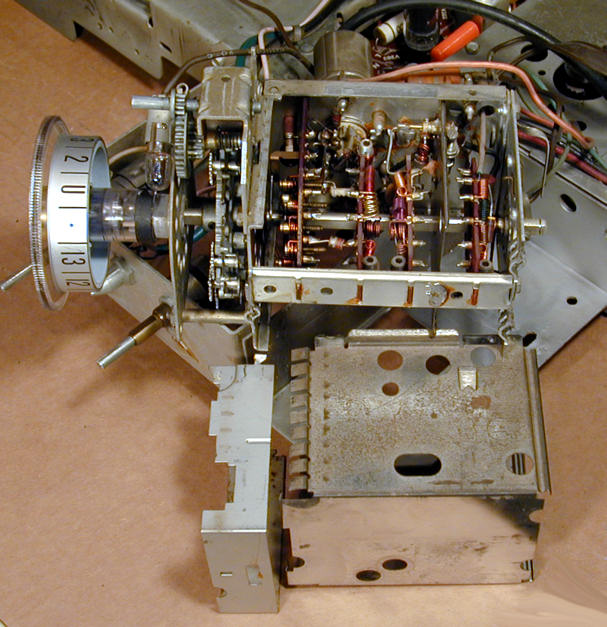
 |
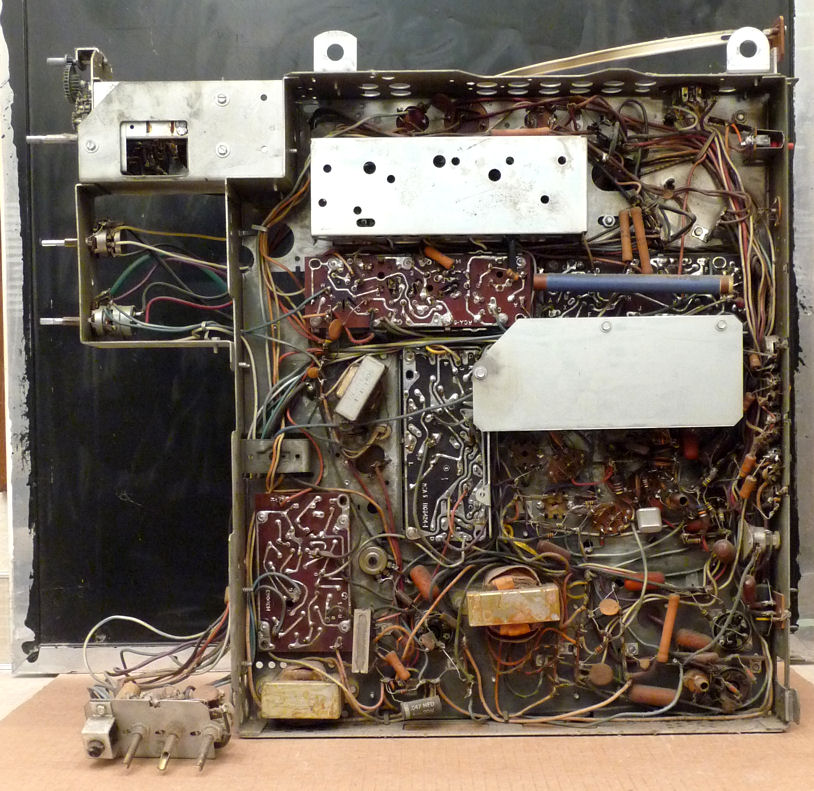
That meant manufacturing televisions was hugely labor-intensive. In inflation-adjusted terms, A 19-inch TV from that era cost almost $2000 in today's dollars!
An LCD TV is simply a specialized laptop with five SKUs: a mainboard, screen, power supply (power brick), remote (instead of a keyboard), and case. Like white box PC parts, wholesalers will happily sell them directly to you (preferable in lots of 1000).
Related posts
HDTV on the cheap
Seiki first impressions
The last picture tube show
Labels: business, radio, robots, science, technology, television
June 17, 2013
The NSA and the "Machine"
Brenner answered that unless the information has foreign intelligence value, the analyst "forgets [he] ever saw it," the only exception being an "imminent threat to life or property," and he emphasized "a really imminent threat." Otherwise the intel is "discarded."
That is exactly the premise of Person of Interest. As Mr. Finch intones in the opening voice-over (written in 2011 by creator and producer Jonathan Nolan):
You are being watched. The government has a secret system, a machine that spies on you every hour of every day. I know because I built it. I designed the machine to detect acts of terror, but it sees everything: violent crimes involving ordinary people, people like you. Crimes the government considered irrelevant. They wouldn't act, so I decided I would.
In the real world, Mr. Finch's "Machine" would have to approach the size of the NSA's $1.5 billion, million square-foot Utah Data Center. And as it turns out, at the end of the 2012 season, we learned that the last known location of the "Machine" was on a train headed for Utah.

Though like Jane in Speaker for the Dead, it'd make more sense for the "Machine" to eventually infuse itself throughout the entire Internet, leaving its mainframe shell behind. Anybody who thinks they've found it will discover there's no longer any "there" there.
Hmm. So what does Jonathan Nolan know and when did he know it?
Labels: mainframe, person of interest, politics, robots, technology, television reviews
August 13, 2012
Profits and payloads
The only thing to go to in low Earth orbit is the ISS (other than the Hubble servicing missions, which actually did have great scientific value).
NASA should have headed in this direction a decade ago. But as Jim Muncy quips, "Democrats don't think that capitalism works within the atmosphere, and Republicans apparently don't think it works above it." Well, better late than never.
Because the commercial route is the only sensible way to go for manned spaceflight.
If you tune into NASA TV before and during an unmanned space mission, you'll see scientists and engineers talking about what the program is supposed to accomplish, how it will get done, and how success will be measured in clear, empirical terms.
I've never seen anything like that with the ISS, other than billion-dollar Show & Tell sessions with elementary school classes. Forget science. The State Department should take over the ISS, as it seems a decent way to foster international relations.
Though the very healthy vig Russia now takes for doing the "fostering" was a big motivation in getting the private sector back into the game. And who knows what the Russians will do once those millions stop flowing? I recommend inviting the Chinese.
So we return to my original point.
Newt Gingrich was the most cogent of the goofball Republican candidates, but his "Man on the Moon" flights of fancy were just plain nuts. He couldn't even come up with a lame scientific reason for going there, like building a big radio telescope.
The same goes for Mars.
To people who rhapsodize about "colonizing Mars," I recommend they colonize Antarctica first, as it's a billion times more friendly to human habitation. Or to get the full experience, camp out near one of the old uranium mines around Moab, Utah.
Minus the vegetation, Moab does kind of look like Mars.

Mars doesn't have a molten core and no magnetic field. The solar wind strips away the atmosphere and cosmic rays bombard the surface. You'd have to live underground to shield yourself from the radiation. How is that better than looking at an HD screen?
The worst place on Earth beats anywhere else in the solar system by light years.
If "discovering life" is the goal, Robert Park is exactly correct. You can't put human beings into any environment where you hope to find life without irrevocably contaminating it. Land a man on Mars and we will indeed colonize it--with E. coli.
About 100 trillion bacteria live in and on every healthy human being.
Unlike the science done by robots like Curiosity, NASA's role in human space exploration has come and gone. The same way trappers and traders "opened" the American West after Lewis & Clark, it's time for capitalism to again go where no man has gone before.
Labels: nasa, robots, science, space, technology
January 16, 2012
Cars

To be sure, there is nothing original about the plot. Cars is a point-for-point retelling of the "arrogant big shot ends up in little town, learns life lesson" trope that Garrison Keillor has been parodying for years on Prairie Home Companion.
Doc Hollywood with Michael J. Fox is a good example (car included).
This again goes to my contention that the most creative and lasting art is accomplished by artists (John Lasseter being one of the best) who not only know how to do things the old-fashioned way, but understand the value of doing things the old-fashioned way.
What's prosaic and persistently unoriginal are those "avant guarde" types who think they are being "original" and "daring" by upending these familiar stories and betraying the expectations inherent in them.
But John Lasseter didn't simply do the same only better. With the story solidly nailed down, he unleashed his animators to create whole freaking alternate universe (including an alternate universe Pixar Animation Studios).
We're talking about world-building on a massively creative scale, and a mechanical world at that, down to the insects (which are, of course, Volkswagon Beetles; lightning bugs leave on the turn signals). Not a human being in sight.
A nostalgic romp through small-town Americana alone would have been a tad too sentimental for my tastes (Frank Capra annoys me too). Thankfully, Lasseter married this trusty old tale to a full-blooded celebration of the gas-guzzling American car culture.
And that most American of motor sports, NASCAR (which, like American football, is far more sophisticated than the aristocratic European versions). And then tied that squarely to the American landscape and those wide-open spaces the car was designed to serve.
The car and the freeway have evolved together to fit a unique ecological niche no less than Darwin's finches. So it makes perfect sense to depict the automobile as a vibrant, sentient, argumentative creature with a say about where the road is going to take us next.
Forget about robots taking over the world. Cars already have. We're just along for the ride.
Labels: movie reviews, personal favs, robots, technology
October 27, 2011
Terra No (2)
The former tries to "connect" with the teen demographic with a wimpy teenage character whose presence shatters suspension of disbelief. The latter tries to "broaden" the appeal by layering on soap opera plots (as if dinosaurs and killer robots didn't provide plenty of conflict as is).
A running joke on Buffy is that the Apocalypse is right around the corner and all she cares about is getting a date to the prom. Some people in Hollywood apparently don't think that's a joke (memo to Hollywood writers: stop trying to relive and romanticize your high school years on my time).
The problem is further compounded by having critical story elements depend on said teenagers doing stupid stuff. The result is to turn off the core geek demographic, who want to be intellectually challenged, not pandered to, and who want to leave their idiot teenage years far behind.
Discussing the politics of ressentiment, Daniel Foster gets right to the point:
Nietzsche was correct to point out that the leaders of men, the successful few--you might even call them the one percent--are too busy acting, doing, and accomplishing to complain about their "emotional crises."
(Incidentally, one of my favorite names for a conceptual alien race is the "Nietzscheans" on Andromeda.) Or as a reviewer on IMDB puts it,
I don't want to watch another show about the estranged dad, the angsty son, the nerdy daughter, the innocent child, the worried mom, the hot girlfriend and the over-confident military guy.
To be sure, Stephen Lang as Commander Nathaniel Taylor makes a pretty good Nietzschean. But this James Kirk or Jack O'Neill has no Spock or Samantha Carter to act as a counterweight. And no mission to get the blood moving every morning, besides babysitting a bunch of listless ingrates.
A competent, go-getting alpha male with no goals. A supposedly brilliant doctor who spends all her time treating oopsies and dealing with whiny teenagers. Man, that's so depressing. Scotty, hurry up and fix the transporter and beam me back to dystopia!
Related posts
Terra No (1)
Apocalypse not now
No way to wage a war
Labels: apocalyptic fiction, robots, television reviews, thinking about writing
May 30, 2011
The uncanny abyss
When a robot becomes 99 percent lifelike--so close that it's almost real--we focus on the missing one percent. We notice the slightly slack skin, the absence of a truly human glitter in the eyes. The once-cute robot now looks like an animated corpse. Our warm feelings, which had been rising the more vivid the robot became, abruptly plunge downward. Mori called this plunge "the uncanny valley," the paradoxical point at which a simulation of life becomes so good it's bad.
Now it appears that a major motion picture has fallen in. Jonathan Kim writes that "Disney's CG/3D animated film Mars Needs Moms [is] destined to become one of the biggest flops of all time," and identifies the culprits as a mediocre script, dull characters, high ticket prices, and the "zombie effect" of the uncanny valley.
Ryan Nakashima adds a few illustrative anecdotes:
Doug McGoldrick, who took his two daughters to see the movie, said the faces of the main characters "were just wrong." Their foreheads were lifeless and plastic-looking, "like they used way too much botox or something."
Frankly, even the human beings in Toy Story creep me out a bit.
Anime avoids this problem by creating an unique aesthetic that makes no attempt to mimic actual human morphology. Another good example is How to Train Your Dragon (one of the best films of the decade), whose characters are all caricatures, but as Craig Ferguson quips, his digital double is a better actor than he is.
Related posts
Appleseed
The "uncanny valley"
Labels: anime, movies, robots, science, technology, uncanny valley
March 18, 2011
Sendai earthquake (3)
So, let's discuss the semi-artistic angle.
The typical anime natural disaster serves to realign the social order in more "interesting"—libertarian—ways, such as creating a society where everybody's armed like in the Wild West. It's rarely framed in the more Christian "end-times" sense, and people adapt to the new order while seeking out new business opportunities, like battling evil robots and exorcising demons.
It's eerie but purely coincidental that I'm translating a fantasy series right now that begins with the destruction of Shinjuku by the "Devil Quake."
Japan went through a huge social upheaval in the mid-19th century, and a physical and existential cataclysm in the mid-20th century, so it's nothing new. As in those times, these events may lead to a welcome political realignment, providing an incentive, for example, to couple Japan's structural debt problem and reconstruction efforts with overdue austerity measures.
And perhaps the stark realities of actual suffering will put a deserved end to a recent, rather loathsome, flirtation with the angsty, sociopathic anti-hero. As Hiroki Azuma writes in the New York Times,
While many will revert [after the crisis passes] to their indecisive selves, the experience of discovering our own public-minded, patriotic selves that had been paralyzed within a pernicious cynicism is not likely to fade away.
I wouldn't be surprised to see a slew of dramas in coming years about the heroic nuclear plant worker struggling against all odds. The relatively minor 2008 Iwate-Miyagi earthquake has already produced a feel-good film about a bunch of brave puppies, valiant JSDF rescuers, and resourceful kids.
I think the most compelling future developments--the biggest opportunity for out-of-the-box thinking--will be tsunami hardening, how Japan prepares for the next "big one." The Patlabor series, for example, is premised on the building of a massive sea wall to protect Tokyo from rising oceans. This "can-do" fiction may yet turn into fact.
Related posts
Sendai earthquake (1)
Sendai earthquake (2)
The world ends (and I feel fine)
Labels: anime, earthquake, geology, good morning japan, japan, politics, robots, tohoku earthquake
March 07, 2011
Summer Wars
Though if the production studio behind it has any aspirations of breaking even on the project, they'll have read their McKee and smuggled in the necessary quota of crowd-pleasing plot payoffs and made sure the word-of-mouth spreads it around.
With Summer Wars (English language version: WB/Funimation) director Mamoru Hosoda has done the exact opposite. On the surface, he panders shamelessly to the tween video game demographic with a by-the-numbers plot, while sneaking a gem of a human comedy in through the back door.

Labels: anime reviews, funimation, hosoda, mainframe, robots, technology