

December 25, 2024
Sony allies with Kadokawa

Kadokawa is one of the top three publishers in Japan, ranked slightly behind Shueisha and Kodansha.
In late 2024, Kadokawa and Sony confirmed reports that Sony was in talks to acquire Kadokawa. A buyout is not off the table, but effective as of January 7, Sony will instead take a 10 percent stake in Kadokawa (in newly issued shares) as part of a "strategic capital and business alliance."
Sony does not have a traditional publishing arm. As Sony Chief Financial Officer Hiroki Totoki explained earlier this year,
Whether it's for games, films or anime, we don't have that much IP that we fostered from the beginning. We're lacking the early phase (of IP) and that's an issue for us.
Sums up the Financial Times,
Sony is betting on a multibillion dollar push into producing more original content, as part of a creation shift the Japanese tech giant hopes will win it a greater share of the three trillion dollar entertainment industry.
The alliance will give Sony first dibs on Kadokawa's enormous catalog of manga and light novels. In exchange, Kadokawa ends up with much deeper pockets that it will use for "creating, developing, and acquiring new IP." Collaborative projects being discussed include initiatives to adapt
Kadokawa's IP into live-action films and TV dramas globally, co-produce anime works, expand global distribution of Kadokawa's anime works through the Sony Group, further expand publishing of Kadokawa's games, and develop human resources to promote and expand virtual production.
Crunchyroll obviously stands to benefit from the deal too. The acquisition of Crunchroll made Sony the dominant anime distributor in North America, though with Hidive, Netflix, Amazon Prime, and Tubi actively acquiring content, it can't be technically said to hold a monopoly position.
In publishing specifically, Kadokawa still has a huge competitor in the Hitotsubashi Group.
The Hitotsubashi conglomerate includes Shogakukan, Shueisha, Hakusensha and related subsidiaries, such as Viz Media in the United States. Given that Shueisha alone is bigger than Kadokawa (and together with Shogakukan is twice its size), the Kadokawa deal likely won't trigger any antitrust issues.
The bigger risk with these sorts of mashups is that the customer, responsible for the success of the enterprise in the first place, gets lost in all the bigness.
Labels: anime, business, crunchyroll, kadokawa, manga, netflix, publishing, sony


December 18, 2024
Manga goes digital
Yeah, I know, hindsight is 20/20, but that bit of prognostication aged rather badly. In less than a decade, Japan's manga market practically turned itself upside down and is currently the most profitable it has been in thirty years.

I once bought Japanese manga from Honto. To take advantage of Honto's more affordable shipping rates (compared to Amazon-Japan), the entire process took about a month. Now Honto no longer stocks and ships paper books and I can get Japanese manga from BookWalker instantly.
Customer convenience is only half of the equation. Industry observer Haruyuki Nakano notes that
For some years now, publishers have been switching emphasis from traditional publishing to the rights and IP business. Shueisha had income of ¥51.1 billion for nondigital publishing in the period from June 2023 to May 2024, compared with ¥72.0 billion for digital publishing and ¥75.3 billion for business including publishing rights and sale of goods.
Hence Sony's interest in acquiring Kadokawa. Having Kadokawa under the same corporate umbrella would let Sony tap into the licensing income streams while eliminating the need to shop for content on behalf of its studios and streaming services. Because Sony would already own the IP.
Successful businesses adapt to new technology and the evolving marketplace. Traditional publishers like Kadokawa and the much bigger Hitotsubashi Group remain powerhouses in the industry. Japan's keiretsu can't turn on a dime. But once they get their bearings, it's full steam ahead.
Publishing is publishing, regardless of how the content gets distributed.
To paraphrase Seth Godin, they figured out they were in the storytelling and information business, not the newsprint business. Compared to magazines, higher quality tankoubon (print digest) sales have remained fairly robust.
Physical media is seeing a decline in video as well. Panasonic and Sony haven't updated their Blu-ray player lines since 2018. Samsung stopped making new players in 2019. LG stopped manufacturing Blu-ray players altogether. When the current inventory runs out, LG will not restock.
But just as vinyl LPs are still being pressed, there will be an ongoing demand for DVDs and Blu-Ray discs. And I am also sure that print books will outlast them all.
Labels: anime, bookwalker, business, crunchyroll, ebooks, japanese tv, kadokawa, manga, publishing, sony, viki
December 04, 2024
Murder, they wrote

Much of the credit goes to Ranpo Edogawa (1894–1965), a tireless promoter of the mystery novel in Japan. His pen name is a pun on the Japanese pronunciation of Edgar Allan Poe. Edogawa is best remembered for the Kogoro Akechi and Boy Detectives Club young adult mystery novels, published between 1936 and 1962.
His efforts are widely acknowledged today. The mystery genre is prominent not only on prime-time television and the best-seller lists, but has long been a staple of young adult manga and anime.
Kindaichi Case Files, based on characters created by mystery writer Seishi Yokomizo, has been published by Kodansha since 1992. The ongoing Case Closed (titled Detective Conan in Japanese) was launched by Shogakukan in 1994, with the accompanying anime totaling more than 1140 episodes.

Speaking of Conan Doyle, Great Britain and Japan share similar cultural elements that make them ideal settings for the cozy mystery. Namely, generally accepted rules of propriety and a veneer of "polite society" easily disrupted (but not deeply damaged) by an otherwise "ordinary" crime. The world need not end in every episode.
Like a returning tide, we expect the greater cultural forces at work to wash away the disruptive elements and reset the stage for next week. So we shrug off the comically high murder rates in Midsomer and Cabot Cove, and the body counts in Kindaichi Case Files and Case Closed that can exceed that of the entire country on a weekly basis.
To be sure, a gun is rarely the murder weapon. But watch out for knives, rope, stairs, and every kind of blunt object! Reality forces Japanese crime writers to get creative, and they embrace all the plausible possibilities. It follows that the geeky appeal of the CSI subgenre has made it a favorite with audiences.


Crunchyroll has a boatload of Case Closed episodes. Sticking strictly to the puzzle-solving cozy mystery formula, five of my anime favorites are Holmes of Kyoto, Hyouka, In/Spectre, Beautiful Bones, and Onihei.
Hyouka and Holmes of Kyoto are classic whodunits that closely follow the classic formula, even though the cases often don't involve any actual crimes.
I love the clever English language title for In/Spectre, a supernatural detective series. It can get overly talky, especially in the first season, but Kotoko takes us through her reasoning process step by step. Though she is an often unreliable narrator, manipulating events to produce the outcome she prefers.

Onihei is an action-heavy Edo period police procedural that doesn't flinch from depicting the complete lack of due process rights for suspects at the time.
And although she only appears in a couple of episodes in a series that can't be classified in the genre, the hard-boiled vampire-hunting private eye in Call of the Night is such a great noir character that I'd like to see her get a show of her own.

Related posts
Scene of the crime writer
Labels: crunchyroll, dlibjapan, edogawa, hidive, japanese culture, japanese tv, mystery, streaming, tubi, viki
November 13, 2024
Crunchyroll 360

Plus an annual subscription saves around sixteen bucks over the monthly rate.
Though then I recalled that my last annual subscription ran out a few days earlier than I expected it to. A little research confirmed that, according to Crunchyroll itself,
Our subscription services are billed on a 30-day cycle (or 90 days, or 360 days), not a fixed rate. Since all months do not have exactly 30 days, the billing date can fluctuate, which can result in these changes.
Ah, now it makes sense. With the more typical month-to-month payment systems, we don't mind getting screwed over in February because the seven 31-day months will make up for it. The whole system is still more irrational than it needs to be.
If I ruled the world, I'd create a calendar of twelve 30-day months with four one-day festival days for the equinoxes and solstices, plus an extra day for the New Year. Then I'd shift the year forward ten days so that the Winter Solstice fell on New Year's Eve.
In ancient times, kings and emperors issued debt relief decrees on special occasions to win the loyalty of the masses. Given the complexities of modern economies, that wouldn't work today without creating all sorts of moral hazards.
I would stipulate that no rents or interest could be charged during those five festival days. This rule would not apply to all the common per diem expenses, only to rolling monthly and yearly accrued charges.
I'm sure it would take no time at all for retailers to come up with all sorts of "Interest free!" sales.
Oh, and I would get rid of Daylight Saving Time too.
Related posts
The relative time of day
Daylight Saving (waste of) Time
Labels: business, crunchyroll, geography, hidive, netflix, politics, science, streaming, technology
October 30, 2024
Mieruko-chan

Donna Howard investigates the provenance of relics and antiques with the help of people from the past who are only visible to her.
For Natsume, his second sight (inherited from his grandmother) often results in the supernatural Shinto world intruding on his otherwise ordinary day-to-day life.
Mieruko can see dead people too. Her name is a pun on the verb meaning "I can see." That makes her privy to an extensive and weirdly thriving ecosystem of the living dead invisible to all but a select few.
Unfortunately for Mieruko, she has a hard time telling the good dead people from the bad dead people.
Even the guardian deities (inari) at the Shinto shrine are fierce and intimidating. Most of the dead people and creepy crawlies look like mutating corpses. Which is bad enough, except when they realize she can see them. Mieruko has gotten good at maintaining a look of deadpan indifference.
The rules governing Mieruko's abilities mirror those in Natsume's Book of Friends (which just debuted a new season). Creatures from the spirit world can only physically interact with you if they catch you looking at them first. Maintaining an attitude of stoic indifference can be the best recourse.
Which brings me to a new word I learned reading the manga: suruu sukiru (スルースキル), a transliteration of "through skill." Weblio defines it as the "ability to ignore bad things happening to you." In other words, the skill to work through a problem by tuning out and not getting upset about it.
But like Natsume, a girl's got her limits. There are times when Mieruko has no choice but to lend the ghouls an ear. Occasionally she discovers their intentions are benign. At other times, not so much. It's easier when the monsters behave like monsters, but even there she can jump to the wrong conclusions.
The occasional Sixth Sense twist will also fool the reader. And there's a touch of Dexter in the cat killer arc as well (which is featured in the anime).
Her best friend Hana is a ghost magnet ("Like moths to a flame," an old soothsayer ally observes), though not having second sight herself, she's clueless about their presence. One of their classmates also has second sight, though not being as powerful as Mieruko, she misjudges their respective abilities.
These moral dilemmas lend Mieruko-chan depth without being depressing or nihilistic. Some of the stories are genuinely heartwarming. If you're a fan of Edward Gorey or Charles Addams, Mieruko-chan is right in your wheelhouse.
Written and illustrated by Tomoki Izumi. Published in Japan by Kodansha and by Yen Press in the United States. The anime is based on the first three volumes of the manga. A live-action film adaptation is scheduled for release in 2025.
Related links
BookWalker (English emanga)
BookWalker (Japanese emanga)
Amazon (Kindle and paperback)
Crunchyroll (anime)
Labels: anime, bookwalker, crunchyroll, ebooks, japanese culture, kindle, manga, manga reviews, movies, religion, shinto
September 25, 2024
Netflix in Japanese (3)

That's how dominate Crunchyroll has become in the anime world.
Some of my all-time favorite titles, such as Insomniacs After School, Made in Abyss, Girls und Panzer, Patlabor, Beyond the Boundary, Beautiful Bones, Tsurune, Clannad, and The Demon Girl Next Door debuted on Hidive. More recently, though, Hidive has been abandoning licenses as fast as it is acquiring new content.
Patlabor, for example. One of the best mecha series of all time. A true Mamoru Oshii classic. Gone without a trace.
As a result, the second seasons of Call of the Night and The Dangers in My Heart are the only recent titles on Hidive that have caught my interest. Separately, Netflix and Hidive don't have big enough anime catalogs to justify staying subscribed for more than a few months at a time.
With Crunchyroll, by contrast, the ongoing challenge is combing through the next season's lineup every quarter and deciding what not to watch (because I simply don't have the time).
Since entering the anime licensing arena, international distributor Remow has embraced a go wide philosophy that includes sharing content on Tubi. Remow partnering with Hidive is the stuff MBA theses are made of, but I'm not sure how plausible it would be from a bottom-line business perspective.
My solution to this problem is for Netflix to buy Hidive and combine their anime catalogs under the Hidive brand (using Netflix's streaming architecture). Netflix would preserve Hidive as a standalone pure play for subscribers like me who aren't that interested in anything else on Netflix besides anime.
Netflix could feature popular Hidive titles on its own service and Hidive would benefit from access to Netflix's licensing and production teams.
Too many players in a niche streaming market works as much to the detriment of the consumer as too few. But I doubt the FTC would condone Sony buying yet another anime distributor on top of what has become the Crunchyroll colossus.
Netflix acquiring Hidive would bring some competition back into the anime market without forcing anime fans to sign up for yet another streaming service. Netflix's platforms are much better and Netflix could inject some fresh blood into Hidive's dwindling catalog with content from its own backlist.
Related posts
Japan's phantom content boom
Netflix in Japanese (1)
Netflix in Japanese (2)
Netflix in Japanese (3)
Samurai vs Ninja
Japanese language links
Labels: anime, business, crunchyroll, hidive, japanese tv, netflix, remow, sony, streaming, tubi
September 11, 2024
Spy x Family

If nothing else, Spy x Family is a great homage to classic spy series from the Cold War era like Get Smart, It Takes a Thief, Mission: Impossible, The Man from U.N.C.L.E., I Spy, and The Saint (in which Roger Moore plays a better James Bond than when he was cast as James Bond).
You know, back in the good old days when we could safely assume that democracies were superior to autocracies and the good guys acted on behalf of the greater good.
In Spy x Family, the European setting is roughly based on East and West Germany during the 1960s, though this East Germany is economically freer and more politically turbulent than that East Germany. A better comparison might be Taiwan and post-1997 Hong Kong.
Operating under the code name Twilight, super spy Lloyd Forger has been tasked with establishing a diplomatic back channel with reclusive party leader Donovan Desmond. Desmond's sons attend Eden Academy, so Forger's handlers conclude that the best cover story is for Forger to enroll his child at the academy.
To do that he will need a child. And a wife. And a dog. A family, in other words.
He rescues Anya from a shady orphanage and arranges a paper marriage with Yor Briar, who has reasons of her own to shed her single status. What Forger doesn't know is that Anya is a telepath and Yor is a professional assassin. And the dog can see the future, except only Anya can communicate with him.
Because of her psychic powers, Anya is privy to the secret lives of her pretend parents, though this knowledge is filtered through the eyes of a precocious six-year-old child (who is probably five but said she was six because she knew that's what Lloyd wanted and was desperate to get out of the orphanage).
As far as Anya is concerned, her top priority is keeping the family together, as fake as it may be, while helping Lloyd complete his mission. And while Lloyd and Yor are always telling themselves they'll go their separate ways, they find themselves growing increasing comfortable with their artificial family life.
There are additional sitcom complications, such as Yor's younger brother being a member of the State Security Service (the equivalent of the Stasi). While Yuri is aware that a foreign agent named Twilight is in the country, he is is too flustered by Lloyd's marriage to his sister to realize that he's right under his nose.
Yuri is equally unaware of his sister's sinister side job. Undoubtedly one of those siloed need-to-know things.
Directors Kazuhiro Furuhashi and Takahiro Harada deftly walk a thin line, keeping the tone of the story simultaneously smart and silly without being stupid. Lloyd's side missions are quite thrilling in their own right too.
If we could go back in time, the perfect cast for a live-action version would be Dick Van Dyke and Mary Tyler Moore as Rob and Laura Petrie from The Dick Van Dyke Show. I'd love to seem them play against type and switch on a dime from normal (if somewhat goofy) middle-class parents to steely-eyed operatives.

The second half of the second season reverses the roles. Yor is sent on a mission that constantly throws her into precarious situations that call on her talents as a cool and competent cutthroat killer. In her absence, Lloyd has to figure out how to be a full-time father figure.
In the universe of secret superheroes, the controlling half of the dual personality—Clark Kent or Superman, Bruce Wayne or Batman—will ultimately determine the direction of the narrative. For Bruce Banner and the Hulk, the conflict arises out of the irradicable nature of the struggle.
This is the question that Lloyd will ultimately have to answer. The decision would end the show in its current form, but given such wonderful characters, I would very much like to see how our family of spies adapts after the Berlin Wall falls.
Spy x Family is a well-crafted series where the long arc of the show can be stretched out without frustrating the audience, allowing the writer and director to get creative with one-and-done episodic plots. Exactly what former network executive Paul Chato identifies as the recipe for a successful television series.
Crunchyroll has both seasons of Spy x Family and Spy x Family: Code White. Tubi has five seasons of The Dick Van Dyke Show and six seasons of The Saint.
Labels: anime, anime reviews, business, crunchyroll, geography, politics, streaming, television reviews
September 04, 2024
Tubi in Japanese (3)

Even there, the Tubi search engine is fuzzy, so the hits will be all over the map and may have nothing to do with Japan. And because Tubi licenses just about anything as long as it's cheap and available, everything from art house to grindhouse to documentaries and travelogues will show up in the results.
I've curated a list of Japanese language titles on Tubi I thought were worth a second glance. I will update this list on a semi-regular basis.
- Kamen Rider: Kuuga (2001) A young Joe Odagiri sets this entry in the long-running franchise apart from the rest. Alas, it suffers from the monster-of-the-week formula and is further hurt by the bad guys having no clear-cut motivation, which turns it into serial-killer-of-the-week. The body count is astronomical. But you can watch it to enjoy Joe Odagiri and a talented supporting cast.
- By contrast, Kamen Rider: Zero-One (2020) follows the George of the Jungle (1997) rule: "Nobody dies in this story. They just get really big boo-boos." Zero-One also illustrates how far budget CGI has evolved in twenty years. Alas, good CGI can't compensate for bad scripts. The series might have worked as a smarter Terminator prequel than the usual but instead gets painfully repetitious.
- Liz and the Blue Bird (2018) is a side story from Kyoto Animation's Sound Euphonium franchise. The movie revisits the first season from the perspective of two members of the high school brass band (supporting characters in the main series) as they rehearse a duet to be featured in the prefectural band competition.
- Onihei (2017) is based on the crime novels by Shotaro Ikenami. Heizo Hasegawa is police superintendent with an intimidating reputation (oni means devil). He and his men specifically investigate crimes of theft, armed robbery, and arson. This action-heavy Edo period police procedural doesn't flinch from depicting the complete lack of due process rights afforded to suspects at the time.
- Priest of Darkness (1975) shares a similar premise with Zankuro (2001). Like Ken Watanabe's Zankuro, Shintaro Katsu (of Zatoichi fame) plays a tea master with a high social rank but a meager stipend. Constantly hustling to pay the rent, he and his little gang settle disputes, investigate crimes, and dispense unofficial justice around the neighborhood.
- Sonny Chiba again plays the historical figure Yagyu Jubei in Shogun's Mission. Jubei's brother is an inspector on the famed Tokai Highway. Yagyu Jubei and his band of ninjas tag along as his bodyguards. This is classic road movie material with at least one big fight scene per episode. The Japanese title translates as "Yagyu's Unruly Journey."
- Thus Spoke Kishibe Rohan (2017) is a live-action spin-off from Hirohiko Araki's JoJo's Bizarre Adventure series. I never got into the latter but quite like the former. Kishibe Rohan is a mangaka who investigates paranormal mysteries for inspiration when he gets writer's block. Basically he and his editor are Mulder and Scully. Issei Takahashi does well in the lead role.
- Speaking of road movies, from 1962 to 1989, Shintaro Katsu made twenty-six Zatoichi films, along with four seasons of the Zatoichi television series. Each episode has the itinerant blind masseur running into a bunch of bad guys who will get sliced and diced in his inimitable style by the time the end credits roll.
Related posts
Tubi in Japanese (1)
Tubi in Japanese (2)
Tubi in Japanese (3)
Samurai vs Ninja
Japanese language links
Labels: anime, anime lists, anime reviews, crunchyroll, kyoani, samurai vs ninja, streaming, television reviews, tubi
August 24, 2024
The Major

Atsuko Tanaka was the voice and soul of Motoko Kusanagi. Alas, the past tense is necessary here, as Atsuko Tanaka died on Tuesday at the age of 61. Her list of credits on ANN includes over four hundred video game and anime roles, including Harumi Kiyama in A Certain Scientific Railgun and Flamme in Frieren: Beyond Journey's End.
But she will be forever remembered as the Major, one of my favorite characters of all time in any medium and the one that truly ignited my interest in anime.
A fascinating cultural conundrum revealed by the advent of manga and anime in America is that traditional Japan is so much better at creating believable female action characters than progressive Hollywood. Motoko Kusanagi is a girl boss you never doubt deserves to be in charge.

Although the movie directed by Mamoru Oshii made Motoko and Ghost in the Shell famous, it was Kenji Kamiyama's Stand Alone Complex series and Solid State Society that defined the canon, into which Kamiyama and Aramaki have done a good job retrofitting their latest installment.
The opening arc of the new series takes place in a post-apocalyptic Los Angeles. Yeah, a bit on the been-there-done-that Mad Max side. But the series returns to form and Kamayama's classic Stand Alone Complex cyberpolice procedural roots once we get the Scooby Gang together again and back in Japan.
I like Purin taking over from Batou as the Tachikoma wrangler. The only real mark against SAC_2045 is that the Post Human storyline falls too far down the AI-as-antagonist rabbit hole. Granted, this AI is more interesting than most and Purin is the driving force during the concluding arc.

At its best, Ghost in the Shell: Stand Alone Complex is a cyberpunk Blue Bloods, and I consider that high praise. I can easily imagine Section Chief Aramaki and Commissioner Reagan trading places or teams and soldiering on with barely a hitch.
The origins story Ghost in the Shell: Arise is on Crunchyroll (with a younger Motoko voiced by Maaya Sakamoto). Netflix has Ghost in the Shell: SAC_2045. Unfortunately, the rest of the installments in the Ghost in the Shell franchise are scattered all over the map.
Tubi has a dubbed version of the original movie. Many of the titles are on YouTube and Amazon Prime, though it might be more affordable to track down the DVD and Blu-ray editions. Anime News Network has an encyclopedic media review for the entire franchise.

Labels: anime, anime lists, anime reviews, crunchyroll, ghost in the shell, japanese culture, streaming, technology, thinking about writing, tubi
June 26, 2024
Samurai vs Ninja

The service launched in 2023 as a joint venture between international distributor Remow and Nihon Eiga Broadcasting, which also runs its own pay TV channel for historical dramas. Samurai vs Ninja is active in forty countries around the world.
The corporate vision statement on the Remow website sums up the underlying problems with Japanese content distribution that have been brought into stark relief by the soaring popularity of Kdrama. Well, somebody finally decided to do something about it.
We hear more and more about Japanese productions being viewed around the world. However, the number of platforms on which Japanese titles can be viewed is limited. The truth is that many users all around the world are viewing pirated copies rather than using legitimate platforms. Japanese entertainment is an expression of our culture and our identity, and we want to deliver this entertainment culture to the people of the world along with the identity of our thoughts and feelings.Remow has identified a chronically underserved market (while NHK Cosmomedia invests in a vanishing niche with Jme TV). Samurai vs Ninja is a work in progress though I have to wonder if its appeal might prove too narrow. Maybe add "Cops vs Yakuza" to the mix next. And lean harder into licensing.
I expect that Sony will end up being taught as a case study in business schools for wisely resisting the siren song to launch its own branded streaming channel. It already owned Aniplex, an anime production and distribution company, and then purchased two established anime streaming services.
Sony subsequently merged Funimation and Crunchyroll into a worldwide operation under the Crunchyroll brand. It didn't have to spend the time and resources building the whole thing from scratch with untested original content.
Owning a bunch of content doesn't matter much if nobody knows about it and can't access it. To its credit, the Samurai vs Ninja YouTube channel is jam-packed with sample episodes and promotional material. Although for now, aside from the website, the only streaming apps are for Android and Apple.
Related links
Samurai vs Ninja (official website)
Samurai vs Ninja (YouTube channel)
Labels: business, crunchyroll, history, japanese culture, japanese tv, jme, nhk cosmomedia, remow, samurai vs ninja, sony, streaming, technology, tubi
May 11, 2024
Japanese language links

My main online dictionary is Weblio. I also reference Eijirou and Word Bank.

NHK World Japan is NHK's English language service. The live feed can be viewed online, along with an extensive VOD library and OTA in some areas (9.4 in Northern Utah). There are apps for most streaming platforms.

The previous 24 hours of NHK Radio newscasts can be streamed online.

For now, my primary sources for anime and Jdrama are Crunchyroll, Netflix, and Tubi. Many of the Japanese historical dramas on Tubi are distributed by Samurai vs Ninja. I purchase emanga at BookWalker.
A Japanese tutoring YouTube channel I watch on a regular basis is Kaname Naito.
Related links
Weblio
Eijirou
Word Bank
Word Hippo
NHK World (Japanese)
NHK World (English)
News from Japan
NHK Radio News
Crunchyroll
Tubi
Netflix
Samurai vs Ninja
BookWalker (Japanese)
BookWalker (English)
Kindle Store
Yes Asia
Labels: anime, bookwalker, crunchyroll, ebooks, hidive, japanese, japanese tv, jdrama, jme, kindle, language, netflix, nhk, nhk world, samurai vs ninja
November 25, 2023
Three to watch on Viki

Even if you're not interested in the rest of the Viki catalog, I recommend subscribing for a month (or two) to watch Isekai Izakaya Nobu, Sleeper Hit, and 99.9 Criminal Lawyer.
The first is a cute live-action drama that is better than the anime (and I usually steer clear of isekai).
What makes the isekai part of Isekai Izakaya Nobu work is that it ultimately doesn't matter that much. The show posits that the back door of the restaurant exits onto an alleyway in Kyoto. The front door opens onto a sort of alternate universe Geneva during the Habsburg Dynasty.
Nobody wastes much effort asking why (or wonders how the electric lights work) and nobody really needs to.
This is ultimately a food-focused show and the setting is an excuse to introduce Japanese cuisine to people who have never heard of it before. There are melodramatic arcs that tie the episodes together but they never overwhelm the rest of the story. The meals are ultimately the main characters.
Viki has two seasons of the live action series. Crunchyroll has one season of the anime.
Sleeper Hit follows the triumphs and travails of the editorial staff at a second tier manga imprint. They are one small division in a big publishing house with healthy enough sales to keep it alive but not in the same stratosphere as Young Jump (and thus have to worry about their best talent getting poached).

The show starts out like a sitcom but soon turns into a serious drama about commerce and creativity. The story arcs make no bones about the punishing deadlines, the inextricable link between business and art, and the primacy of story, with the fickle reader exercising the final vote on success or failure.
We are taken through the life and death of a manga, from acquisition to serialization to cancelation, including a poignant scene in which the company president takes two of the new hires on a pilgrimage to the warehouse where the returns (all of the unsold books and magazines) are getting shredded.
The outstanding cast includes Yutaka Matsushige (Solitary Gourmet) as the managing editor, Joe Odagiri (Midnight Diner) as a senior editor given to bouts of philosophizing, and stars Haru Kuroki as an energetic newbie hired right out of college after the CEO challenges her to a wrestling match.
That last sentence will make more sense once you watch the first episode.
Sleeper Hit should be watched along with Bakuman. The anime covers the manga industry from the perspective of a pair of budding mangaka working hard to create a break-out hit.

Ittoku Kishibe (best known as the Machiavellian government minister on Aibou) plays the managing partner at a big law firm. He recruits the eccentric Hiroto Miyama (Jun Matsumoto of the boy band Arashi) for a newly formed criminal defense division.
Character actor and Kabuki veteran Teruyuki Kagawa is Miyama's ornery boss. The "99.9" refers to the conviction rate in Japan's criminal courts, so his skepticism is understandable. Even in modern Japan, the accused is pretty much presumed guilty until proven innocent.
Related links
Isekai Izakaya Nobu (Viki)
Isekai Izakaya Nobu (Crunchyroll)
99.9 Criminal Lawyer
Sleeper Hit!
Labels: anime, anime reviews, business, crunchyroll, fantasy, japanese, japanese tv, manga, publishing, streaming, tubi, viki
November 18, 2023
Japanese streaming update

I prefer police procedurals, low-stakes slice of life dramas, and documentaries, which Japanese television writers are much better at pulling off.
Viki has a few in that category, just not that many. But speaking of which, I see that Viki has licensed 99.9 Criminal Lawyer. It's a well done execution of the reliable formula that pits an eccentric defense lawyer against his uptight boss (a corporate lawyer because it pays much better).
And while I'm at it, I'll again point out that Viki has Sleeper Hit, a fun, insightful, and even philosophical examination of the manga publishing world and the hard-nosed business of selling art.
In any case, as with pretty much every streaming service that doesn't focus specifically on Japan, Viki's Jdrama offerings take a back seat to its Kdrama series (true of Tubi and Netflix too). But if that is what you're looking for, Viki is one of the better overall sources for Asian content.
Unfortunately, take away dLibrary Japan and Viki and there aren't that many viable Jdrama alternatives left. When TV Japan was alive on traditional cable, it added up to eighty (!) bucks a month for a single channel on Xfinity. Not an option when I cap my monthly streaming budget at twenty dollars.
Tubi has a few Jdrama series and (subbed) Japanese movies worth watching. It sure doesn't make them easy to find. But a little effort will occasionally turn up genuine classics, campy tokusatsu series (featuring primitive CG effects and guys in rubber suits), and recent releases like Blue Thermal.
At least for now, that leaves Netflix as far and away the best of the remaining Hobson's choices.
Anime, by comparison, offers an embarrassment of riches. Thanks to Sony's acquisition of Funimation and Crunchyroll, Crunchyroll rules the anime streaming world. You could watch Crunchyroll all day long and not make a dent in the huge backlist before getting swamped by dozens of new titles.
The annual subscription option makes Crunchyroll an even better deal. On price alone, HIDIVE is the most affordable anime streaming service but is so much smaller that it's hard to justify an annual subscription anymore.
I've been following Princess Principal and Girls und Panzer on HIDIVE. Both franchises have moved to the theatrical model. This wouldn't be a problem if they were releasing standalone movies but they're actually serials. What we end up with are regular series produced at a glacial pace.
I'll wait until a season is over before watching it. I'm very much on board with the old Netflix approach of releasing a whole series at once. Even on Crunchyroll, I watch a season behind the current schedule. The added benefit is that makes it easier to figure out which series are worth the time.
While waiting for titles to accumulate, HIDIVE joins Viki in the watch and drop category. Once I run out of live-action content on Tubi, I'll shift to Viki and then to Netflix. Netflix uniquely provides Japanese subtitles for much of its Japanese content, a very valuable language learning resource.
Related links
NHK World (Japanese)
NHK World (English)
Crunchyroll
HIDIVE
Netflix
Rakuten Viki
Tubi
Labels: anime, business, crunchyroll, dlibjapan, hidive, japanese culture, japanese tv, jdrama, kdrama, manga, netflix, nhk, nhk world, sony, streaming, technology, tubi, tv japan
November 16, 2023
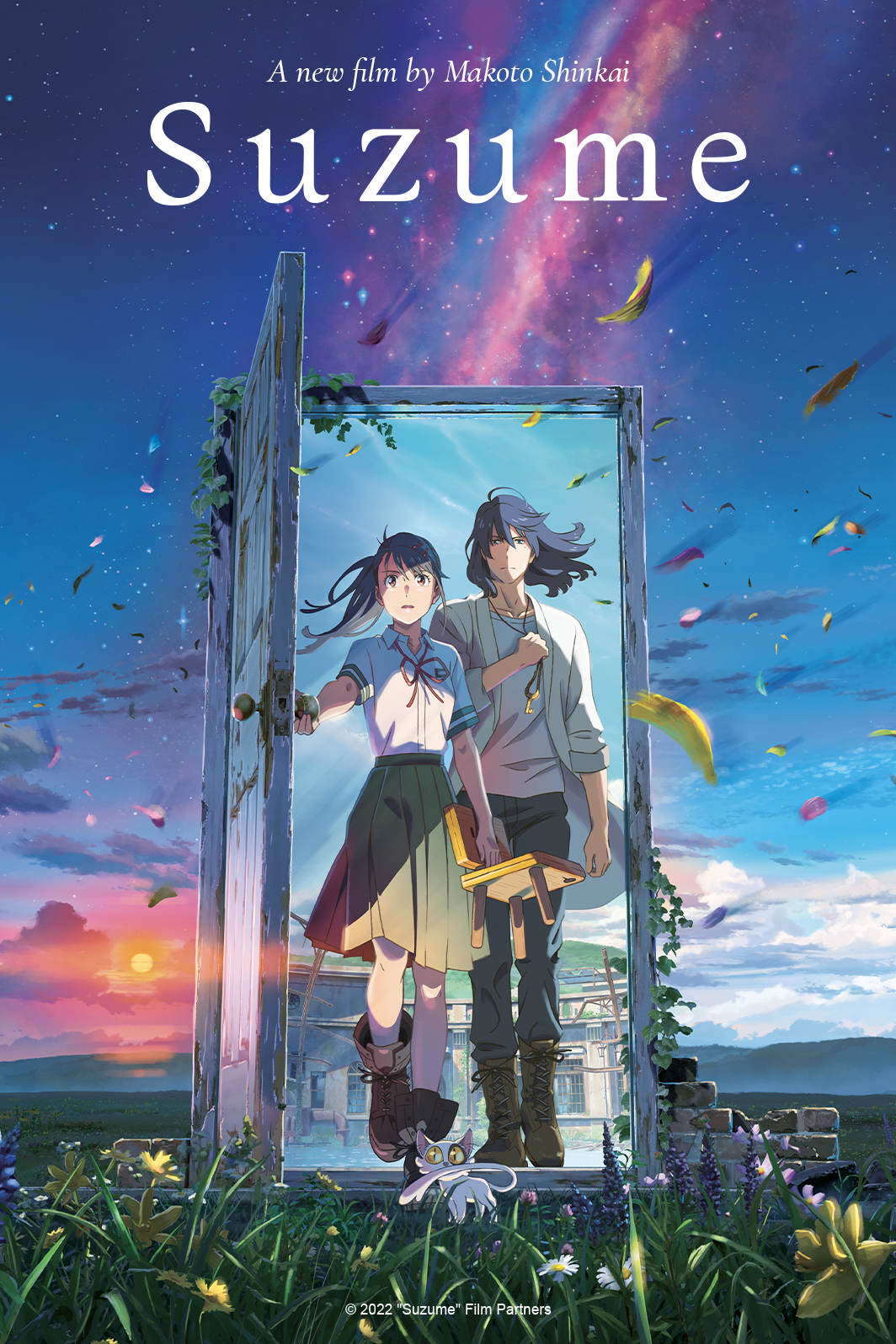
Suzume
Suzume's journey begins in a quiet town in Kyushu (in southwestern Japan) when she encounters a young man who tells her, "I'm looking for a door." What Suzume finds is a single weathered door standing upright in the midst of ruins as though it was shielded from whatever catastrophe struck. Seemingly drawn by its power, Suzume reaches for the knob. Doors begin to open one after another all across Japan, unleashing destruction upon any who are near. Suzume must close these portals to prevent further disaster.
Suzume is Makoto Shinkai's thirteenth directorial work. Here's to hoping Crunchyroll licenses more of his catalog.
Labels: anime, crunchyroll, japan, movies, shinkai
August 05, 2023
Holmes of Kyoto
 In a previous discussion about the Mary Sue trope, I suggested the "cozy romance" as a companion to the "cozy mystery." Well, a series that qualifies as a cozy mystery, a cozy romance, and a Mary Sue that mostly works is Holmes of Kyoto.
Aoi Mashiro is a boy-crazed ditz when we first meet her. But her encounter with Kiyotaka Yagashira at the Yagashira Antique Shop turns her into a cool-headed antiques appraiser.
Eventually. Kiyotaka hires her to dust and sweep and make tea. But she's a fast study. A really fast study. Nevertheless, we see her put in the work. And she's got a great tutor. So she earns it.
Kiyotaka is, of course, young and handsome, the smartest appraiser in Kyoto. He claims that "Holmes" is merely a play on the kanji for "home" in his name, but he and Aoi end up solving a lot of crimes and mysteries.
The series has a Moriarty as well, though he's closer to the "Fiend with Twenty Faces" created by Ranpo Edogawa. Ensho is a defrocked Buddhist priest and frustrated forger who seems mostly obsessed with fooling Kiyotaka.
Along the way, of course, Aoi and Kiyotaka develop feelings for each other. But by externalizing the conflicts and taking the usual "complications" out of the relationship, the "cozy" romance can mature at a slow slow burn.
Aoi is still in high school, to start with. In any case, I'm not interested in a Mary Sue who is forever torn between cowboy Billy and billionaire Bob. Nobody plucks petals off a daisy while intoning, "She loves me, she loves me not."
The art and animation isn't as polished as Snow White with the Red Hair. But if you're looking for cozy mysteries and a very gently simmering romance, this dive into the world of Kyoto antiquing nicely fits the bill.
Holmes of Kyoto is streaming on Crunchyroll.
Labels: anime, anime reviews, crunchyroll, edogawa, mystery, thinking about writing
May 01, 2023
Twelve Kingdoms
The Twelve Kingdoms novels have been licensed by Seven Seas Entertainment. Bookstore links will appear when they are published.
For additional commentary about the Twelve Kingdoms and the translation process, see Kate's Interview with a Translator series.
1. Tsuki no Kage, Kage no Umi. My translation: Shadow of the Moon, a Sea of Shadows.
2. Kaze no Banri, Reimei no Sora. My translation: A Thousand Leagues of Wind, the Sky at Dawn.
Youko, Suzu, and Shoukei join forces to defeat corrupt government leaders in Wa Province.
3. Tasogare no Kishi, Akatsuki no Sora. My translation: The Shore in Twilight, the Sky at Daybreak.
Risai escapes to Kei and asks Youko for help rescuing Taiki. Taiki and Youko are contemporaries.
Fuyumi Ono wrote The Demon Child before she started the Twelve Kingdoms series. See link below. She covers some of this material in The Shore in Twilight, The Sky at Daybreak. In Kaze no Umi, Meikyu no Kishi ("A Sea of Wind, Shores of the Labyrinth"), Taiki choose Gyousou as Emperor of Tai. See links below.
1. Tasogare no Kishi, Akatsuki no Sora. My translation: The Shore in Twilight, the Sky at Daybreak.
Risai escapes to Kei and asks Youko for help rescuing Taiki. Taiki and Youko are contemporaries.
2. Shirogane no Oka, Kuro no Tsuki. My translation: Hills of Silver Ruins, a Pitch Black Moon (book I II III IV).
Risai and Taiki return to Tai. They recruit a small band of allies to search for Gyousou and take back the kingdom.
Higashi no Watatsumi, Nishi no Sokai. My translation: Poseidon of the East, Vast Blue Seas of the West.
Tonan no Tsubasa. My translation: The Wings of Dreams.
Kyouki chooses Shushou as Empress of Kyou. (Shoukei encounters Shushou in A Thousand Leagues of Wind.)
Kasho no Yume. My translation: Dreaming of Paradise.
- (冬栄) "Winter Splendor" (Touei): takes place in Tai and Ren during The Shore in Twilight, the Sky at Daybreak.
- (乗月) "Jougetsu": takes place in Hou after A Thousand Leagues of Wind, the Sky at Dawn.
- (書簡) "Pen-Pals" (Shokan): takes place in Kei and En after Shadow of the Moon, a Sea of Shadows.
- (華胥) "Dreaming of Paradise" (Kasho): takes place in Sai sometime before A Thousand Leagues of Wind, the Sky at Dawn.
- (帰山) "Kizan": takes place in Ryuu and Sou after A Thousand Leagues of Wind, the Sky at Dawn.
Hisho no Tori. My translation: Hisho's Birds.
- (丕緒の鳥) "Hisho's Birds" (Hisho no Tori): takes place before and shortly after the coronation of Youko as Empress of Kei.
- (落照の獄) "Prison of Dusk" Rakushou no Goku: references to Ryuu and Emperor Chuutatsu suggest the beginning of Youko's reign.
- (青条の蘭) "Blue Orchid" (Seijou no Ran): takes place in En before Rokuta chooses Shouryuu as the next Emperor.
- (風信) "Weather Vane" (Fuushin): takes place during the last days of Empress Yo of Kei, and then following her death.
I've created my own abridged glossary. An overview of the Twelve Kingdoms universe can be found at Wikipedia (English Japanese). The Twelve Kingdoms Wiki has scans of the illustrations and additional artwork.
My go-to resource while translating the novels has been Yoshie Omura's Twelve Kingdoms Room (Japanese). Also see the Twelve Kingdoms Database (Japanese).
Fuyumi Ono borrows much of the political terminology from medieval China. Harvard University's "Dictionary of Official Titles in Imperial China" (PDF) provides useful clues about the English equivalents.
However, we are talking about a fantasy series, so historical translations are not always exact. The organizational charts at Twelve Kingdoms Memo (Japanese) have proved quite helpful.
The NHK anime can be streamed at Tubi and Crunchyroll (regional restrictions may apply). The Blu-ray edition is available from Discotek Media.
Labels: 12 kingdoms, books, crunchyroll, fantasy, japanese, kate, publishing, translations, tubi
December 31, 2022
Netflix with ads (content)

In the meantime, Netflix made an important update to its search tools. "Browse by Languages" is now featured in the top menu. Previously, the only way to bring up the language menu was to search for the language content first (you had to search for Japanese content in order to search for Japanese content).
This is one feature that Tubi really needs to implement. Just steal the whole UI from Netflix. Though one oddity is that if you select the A-Z filter, you only get the first half of the alphabet. You have to select Z-A to get the other half. Hey, it's a feature, not a bug! (Don't steal that part.)
Netflix has about as many Japanese live-action series and features as Viki and Tubi, though Netflix covers a wider variety of genres and Tubi features older rerun material. Of course, Crunchyroll and HIDIVE have many more anime titles. Another big difference is that Netflix closely curates its catalog.
That curation does make a difference. Compared to Crunchyroll, HIDIVE, and Tubi, I have seen or am interesting in watching a higher percentage of Netflix anime titles (though there seems to be a polarizing effect too, as the ones I'm not interested in I usually have zero interest in).
At the top of my current list are the latest seasons of Ghost in the Shell, Ultraman, Midnight Diner, and The Way of the Househusband, along with Kotaru Lives Alone, Romantic Killer, I'm Old Enough, and The Makanai, the live-action version of Kiyo in Kyoto.
Though along with its Lupin the Third and Tokusatsu flicks, Tubi's kitchen sink approach occasionally produces some golden oldies.
For example, Tubi has Sonny Chiba's Shadow Warriors ninja series from 1980. Japanese broadcast television was more permissive back then, so along with the slicing and dicing, most episodes feature at least one scene of totally gratuitous nudity. Sonny Chiba's charisma shines through regardless.
As did Hollywood at the time, Japanese television studios back then mastered everything on videotape. It'd be nice if Netflix could grab some old samurai action classics (like the more family friendly Abarenbo Shogun) and run the SD masters through the best upscaling technology available.
On a separate note, I observed last summer that Eleven Arts had pulled its excellent slate of anime movies from Tubi, including Liz and the Blue Bird, Maquia, Penguin Highway, Sound Euphonium, and The Wonderland. They've since all shown up on Crunchyroll.
Related posts
Kiyo in Kyoto
I'm Old Enough
Netflix with ads
Netflix with ads (first impressions)
Labels: anime, business, crunchyroll, hidive, japanese, netflix, samurai vs ninja, streaming, television, tubi
May 18, 2022
Mary Sue to the rescue

the adventures of the youngest and smartest person ever to graduate from Star Fleet Academy and ever get a commission. Usually characterized by unprecedented skill in everything from art to zoology, including karate and arm wrestling, this character can be found burrowing her way into the good graces of Kirk, Spock, or McCoy, if not all three at once. She saves the day by her wit and ability, and, if we are lucky, has the good grace to die at the end, being grieved by the entire ship.
The Mary Sue can be simply summed up as a character who is too good to be true, having acquired more skills and talents and positive personality traits than our most generous expectations suggest is realistically possible.
Put the Mary Sue shortcut down to the rush of wish fulfillment or to impatient writers who want to fast forward to the "interesting" scenes. Or who think they are giving the audience what it wants to see. You know, because practicing to get good at something is for chumps.
Meeting all these criteria, a recent Mary Sue par excellence is Rey in The Force Awakens.
Yoda himself can't keep Luke Skywalker from getting badly beaten by Darth Vader in the second movie. Forget about crossing swords with anybody in the first. But Rey is an expert the first time she touches a lightsaber. She's as good a pilot as Han Solo the first time she sits in the cockpit of the Millenium Falcon.
Now, Luke does have a Mary Sue moment at the end of A New Hope, when he pilots an X-wing starfighter to victory. No, logging a couple hundred hours in a Cessna 172 does not mean you can hop into an F-35 Lightning and out-fly the Top Guns who've been at it for years.
We give Luke a pass here thanks to the narrative trick of making the audience a participant in the trials, travails, and eventual triumphs of the protagonist. As the help wanted ads put it, having proved his mettle, we'll let the good guy skate by on "equivalent experience" in lieu of a resume.
The problem with Rey is that's she's perfect from the moment she appears on the screen. We never see her resume. We never see her burning the midnight oil. Making it all the more annoying, as I outlined in my review, is that it would not have been difficult to give her one.
The big irony of the Mary Sue and its Star Trek origins is that The Next Generation wrote one right into the cast. Pandering to the fan base, I suppose. But perhaps any trope worth being singled out and savagely critiqued is one that connects at a deep level with a significant portion of the audience.
In that light, it deserves a defense. And so now I rise not to bury Mary Sue but to praise her.
To be sure, I cannot bring myself to defend Wesley Crusher. He is exactly the kind of annoying Mary Sue that Paula Smith snarked about back in 1973. Any reasonable appeal to verisimilitude could not tolerate his presence on the bridge of the Enterprise.
But a Mary Sue story can be done right. Komichi Akebi in Akebi's Sailor Uniform is a more recent and perfectly adorable example. But Snow White with the Red Hair really sets the standard.

Based on the manga by Sorata Akizuki, the anime ran two cours (the manga is still being serialized). As befitting the title, the story takes place in a spick and span medieval Disneyland (the setting itself qualifies as a Mary Sue).
When we first meet her, Shirayuki (白雪), whose name translates as "Snow White," is a conscientious herbalist who owns a small pharmacy. That is, until the lecherous Prince Raj, entranced by her brilliant red hair, decides to make Shirayuki his mistress. And won't take no for an answer.
Figuring that caution is the better part of valor, Shirayuki's answer is to pack up and scamper across the border, where she promptly runs into Prince Zen of Clarines and his retainers. It's "like" at first sight.
No mooning around. No one gets serenaded beneath a window. Shirayuki and Zen are preternaturally practical and competent people. Shirayuki has principles and no hesitation in standing up for them. And one of those principles is to own only what she's earned.
Although ostensibly a "European" kingdom, Clarines appears to be run by a ranked bureaucracy of mandarins appointed through an imperial examination system. Determined to stay close to Zen but refusing any handouts, Shirayuki applies for a job as an assistant court herbalist. And passes the tests.
But, again, the backstory has established that she works hard and is good at it, and shows us (doesn't just tell us) that she is deserving of the position. Zen as well works for a living. Being a prince in Clarines comes with a portfolio. Besides going on inspection tours, he has to sit at a desk and push paper around.
These jobs not only make them more interesting but also generate compelling plot material.
(Seriously, what do Disney's Cinderella, Snow White, and Sleeping Beauty actually do? Well, Cinderella is good at housekeeping. What does Elsa do? Anna at least has the important job of keeping Elsa from going nuts and destroying the kingdom.)
There's no need to pretend Shirayuki and Zen aren't Mary Sues. They are too good to be true. Here we have a pair of protagonists who couldn't be any nicer without getting saccharin. Even Prince Raj can't resist becoming a better person when he's around them (a character arc that pays off well in the second cour).
Yet they both possess a depth of character that makes their stories compelling. Yes, nice people can be interesting and do interesting things. I would describe the resulting genre as a "cozy" romance, the equivalent of the "cozy" mystery.
Dispensed with are the angst, the sturm und drang, the love triangles, the miscommunication, all the melodramatic conventions of the genre. Another way of describing this romance sub-genre might be "You and me (and our friends) against the world."
In fact, the only real hint of romantic tension arises among their friends, principally Mitsuhide, Kiki, and Obi, who are Zen's retainers, though Zen assigns Obi to Shirayuki. Later in the series, Mitsuhide seems to have a thing for Kiki, and Obi definitely has unrequited affection for Shirayuki.
But being loyal to Zen and having earned his trust, Obi never does anything stupid or inappropriate. Aside from Mitsuhide getting goofy in one episode in which he goes looking for Shirayuki in the pharmacy and accidentally ingests an elixir, nobody embarrasses, betrays, or compromises anybody.
Even for the day or so that Mitsuhide is under the effect of the elixir, he acts like a stereotypical gallant knight and drives everybody batty. It's a clever way of stating what the show is not about.
In the second cour, more high adventure comes their way, what with pirates and outlaws and damsels in distress and long lost family members showing up in unexpected places. But Shirayuki keeps her head on her shoulders (literally and figuratively) and the relationship never falters. Neither does her career.
In the end, nobody rides off into the sunset. There are no impending nuptials. We don't need to be told that Shirayuki and Zen will live "happily ever after." They only need to live their lives as best they can. From what we have learned about them, that will suffice. Real life is tough enough already.
Labels: anime, anime reviews, crunchyroll, movie reviews, romance, star trek, star wars, streaming, thinking about writing