

January 24, 2024
Reframing the mainframe plot
And yet Hollywood keeps serving it up. Because we keep chomping it down.
 |
| Conquering the galaxy since the 1950s. |
Even the ending of Edge of Tomorrow (without a computer network in sight) is straight out of The Phantom Menace. And straight out of Oblivion, the previous Tom Cruise SF post-apocalyptic, blow-up-the-alien-mainframe actioner.
Making it an organic mainframe is a slight improvement but just as dumb. The whole "hive mind" thing needs to go too.
Speaking of organic mainframes, Star Wars fell back on the Evil Emperor trope, a linchpin apparently holding the whole universe together by his lonesome. How is never explained, but all the good guys have to do is knock out this one bad guy and peace and prosperity is restored to the galaxy.
Well, after they deal with the truly killer mainframe that is the Death Star. The whole Star Wars franchise ended up being about destroying Death Stars, each one a more ludicrous violation of the laws of physics than the last. Again, what long term problems this solves is never made clear.
Does the mail start arriving on time now? Does the tax code suddenly become more comprehensible? And what happens to the unemployment rate when all those Death Star jobs get instantaneously terminated? Imagine the size of the catering contract for just one of those behemoths.
Of course, destroying a single machine in a single place and winning the war everywhere makes for easy denouements. But if the Earth is ever attacked by malevolent aliens who know how to implement autonomous distributed network technology, we are so screwed.
That aside, though, what do the aliens hope to accomplish by attacking Earth? Or attacking any inhabited planet? (Besides giving the director an excuse to restage the Battle of Britain or the Invasion of Normandy.)
If they wanted to wipe out the humans along with the infrastructure—the whole objective of the Independence Day aliens—there'd be no need to get anywhere near the planet's surface, as Heinlein pointed out back in 1966 with The Moon is a Harsh Mistress. An asteroid makes for a handy ICBM.
There are lots of big asteroids out there.
Another reason is, they want our water. But there is plenty water elsewhere, that is not at the bottom of a deep gravity well. Europa, for starters.
Then there's the "To Serve Man" plot device. But homo sapiens is a lousy food and energy source (The Matrix is dumber than dirt in this regard). That's why so few people get eaten by sharks (surprisingly few!).
Besides, a blown-up country is a huge resource sink. Hence the Marshall Plan. By 1950, SCAP was already regretting Article 9 in the 1947 Japanese Constitution (forbidding war) and was revving up Japanese industry to support the Korean War, which was just what the economy needed.
In The Phantom Menace, Lucas tosses the politics of trade into the picture, but without explaining what is being traded, why, or how. The result is a blur of handwaving when it comes to the story because there are no underlying rational reasons for anything that happens.
The economic model of the Star Wars universe makes no more sense than the socialist utopianism of Star Trek, which finally gave us the robber baron Ferengi to make things interesting.
Still, Lucas was onto something. The unequal treaties imposed on Japan and China by the U.S. and European powers in the mid-19th century led to the Boxer Rebellion in China and propelled Japan into a regional arms race in order to even the scales. Lots of dramatic conflict there.
The thing is, China and Japan had stuff the foreign powers wanted, stuff as trivial (to our modern eyes) as tea. But like spice in Dune, there were underlying economic causes behind the conflicts. And at the time, a bad trade deal was a better deal for both sides than smash and grab.
And so we're back to the Lebensraum ("living space") ideology promulgated by Germany in the 1930s. (The Nazi bad guy connection certainly doesn't hurt.) The Japanese equivalent was used to justify the annexation of Korea and Manchuria.
Both Germany and Japan were doing rather well at expanding their territories (employing their own "unequal treaty" tactics) before they started actually invading their neighbors, after which everything went downhill fast.
So we'll assume our invading aliens are smart enough not to turn the whole thing into a scorched-earth shooting war. The problem is how to make that interesting.
A good place to start is Ryomaden, which describes the opening of Japan in the mid-19th century, the shock to the system, the unequal treaties, the escalating civil strife, finally resolved by a quickly-concluded civil war that launched Japan on a burning quest to surpass the west.
If gunboat melodrama is what you want, (bad) diplomacy seems pretty good at supplying the necessary Sturm und Drang motivations. Kudos to Guardians of the Galaxy on this score.
The problem is the time frame required by real politics. Summing up two decades of geopolitics in two hours would be tough. I suppose it really is simpler to just have Tom Cruise blow up the mainframe.
Labels: computers, mainframe, movies, robots, science fiction, star wars, tech history, technology, thinking about writing


February 13, 2020
Godzilla
 The 1954 production of Godzilla, directed by Ishiro Honda, has a good deal in common with Bram Stoker's Dracula, published in 1897. Both are remembered today in terms of the sequels and spin-offs that followed, in the process spawning new genres that have almost nothing to do with the original productions.
In Dracula, the Scooby Gang of vampire hunters led by Van Helsing avail themselves of the latest weaponry and communications technology to defeat Count Dracula. In Godzilla, a team of scientists led by paleontologist Kyohei Yamane and troubled young chemist Daisuke Serizawa must defend Japan against this nuclear natural disaster.
Meanwhile, Emiko Yamane wants to break off her engagement to Serizawa so she can marry her true love, salvage ship operator Hideto Ogata. Given Serizawa's mad scientist personality, this is a understandable decision, and these shifting relationships figure into an important plot point (that has nothing to do with anybody fighting over a girl).
It will be Serizawa who provides the scientific solution that saves the day, not battling monsters or superhero antics.
Dracula and Godzilla are works of contemporary science fiction that would fit well into the oeuvre of Michael Crichton. The two titular antagonists are, in Buffy terms, the Big Bad. As Buffy fans well know, being the Big Bad is a supporting role whose ultimate purpose is to get dusted. That's exactly what happens to Dracula and Godzilla.
So if you want to bring them back for an encore, well, something fundamental will have to change. Making the Big Bad the main attraction completely changes the nature and focus of the fundamental conflict. For starters, a way larger-than-life character stomping all over the scenery in movie after movie is going to upstage the rest of the cast.
As the series progressed and Godzilla grew larger and larger than life, more overpowered Big Bads had to be invented to keep the over-the-top conflicts in proportion. This is unfortunately true of most superhero movies these days. Godzilla set the standard for the Big Bad modus operandi of massive urban vandalism.
The bigger story problem is that, having already reached the pinnacle of badness, the Big Bad has no place to go dramatically, which can't help but reveal the ridiculousness of the whole conceit. A common solution, as in the Dracula genre, is to hang a lampshade on the character and purposely play to the stereotypes with the requisite ironic nods.
Or while playing to the stereotypes, cast the Big Bad as an antihero, the enemy you know being preferable to the worse Big Bads you don't (yet). With a decent screenplay and a compelling character arc, a Big Bad can be transformed into an unreliable ally, as with Spike on Buffy. This is generally the direction Godzilla sequels ended up going.
Less a friend of the human race than an enemy of the all other monsters invading its territory, with not very much in the motivation department aside from sheer destructiveness.
Ishiro Honda's Godzilla soon spawned the tokusatsu (special effects) and kaiju (giant monster) genres. Famously featuring the guy in a rubber suit wrecking scale models of Japanese cities, this deliberately silly and self-referential approach was less concerned with dramatic depth and more about at getting everybody in on the joke.
The first Godzilla, by contrast, is a classic work of film noir, employing black and white cinematography suffused with light and shadow, along with rudimentary but effective mattes and composites, to create a spooky atmosphere of literally looming horror. Godzilla is a keenly-felt menace that most of the time is out of reach or out of sight.
The city-destroying rampage doesn't even commence until an hour in. Leaving a trail of destruction in its wake, Godzilla is more a force of nature, like a typhoon or an earthquake or a tsunami. Or a squadron of B-29s. The focus is less about the Big Bad than on how the affected human beings react to it. And how they conquer it with human ingenuity.
Related posts
Dracula
The big bad
Too super for their own good
Labels: books, history, japanese culture, japanese movie reviews, science fiction
February 14, 2019
Harlock: Space Pirate
Harlock: Space Pirate is a case in point.

To start with, made for an estimated $30 million, here is convincing evidence that the state of the art in motion capture 3DCG animation can be achieved for a fraction of the cost of the typical Hollywood blockbuster. Frozen (released the same year) had a budget of $150 million.
Frankly, it's mind-boggling how far the technology has come since Final Fantasy: The Spirits Within (2001). The first "photorealistic" computer-animated feature film, it cost a staggering $137 million (staggering for a major motion picture based on original Japanese content) and bankrupted Square Pictures.
Director Shinji Aramaki brought in his first Appleseed film for a more reasonable $10 million.
 Aramaki mastered the technical aspects of motion capture 3DCG animation at the helm of the Appleseed films, beginning with Appleseed (2004) and Appleseed: Ex Machina (2007). He followed Harlock: Space Pirate with Appleseed Alpha (2014). In that decade, a technology affordable by a few became truly economical.
But all the computers in the world still can't digitally render a decent script out of raw data. Once again we see on display Aramaki's penchant for overly complex plots that require a flow chart to follow.
Not to mention the overused trope that "profound" means "underlit and moody." Matsumoto's original Captain Harlock is an idealistic Robin Hood in an Art Deco world. But according to the backstory of Harlock: Space Pirate, he inflicted so much damage in pursuit of that idealism that he must now atone for it. Gloomily.
The problem this presents is that watching the protagonist mope around for two hours is no fun. So the until the big climax, our titular character has only a minor supporting role and most of the events take place around him.
Long story short, Captain Harlock must destroy the Earth (again) to save it (or something). Meanwhile, the "Gaia Coalition" is determined to stop him from throwing a big wrench into the gears of their fake Earth-worshipping religion (I liked that part). But I quickly stopped caring about the whys and wherefores.
Because all the movie needs is a MacGuffin to keep the story chugging along while we wallow in Leiji Matsumoto's steam punk space opera universe.
 Leiji Matsumoto is one of the grand old dons of Japanese manga and animation. In 1974, he co-created the Space Battleship Yamato series, in which the WWII battleship is salvaged and launched into space to save the Earth from malevolent aliens.
Reasoning that it doesn't matter what a ship looks like in space, in 1978, he turned a 17th century Spanish galleon into a starship (Captain Harlock) and did the same with a 19th century steam locomotive (Galaxy Express 999). The latter was inspired by Kenji Miyazawa's Night on the Galactic Railroad (1927).
Alas, aside from the ship's wheel on the bridge, the Arcadia in Harlock: Space Pirate retains little of the original's retro features.
Except this Arcadia is powered by "dark matter," and dark matter, don't you know, is all black and sooty. This abject silliness does result in the delightfully iconoclastic image of Captain Harlock's hulking starship belching thick clouds of smoke like one of Commodore Matthew Perry's coal-fired "Black Ships."

"Pirates in Outer Space" has since become a genre of its own. Most notably, Firefly and Cowboy Bebop and all the Han Solo segments in the Star Wars films.
The former two series share a similar premise with Harlock: Space Pirate, positing that Earth has become unlivable and a bureaucratic hegemony rules over the scattered remnants of its inhabitants. They also heavily mine the traditional Hollywood western for iconic inspiration.
For Star Wars, George Lucas looked east. The "knights" in Star Wars are armed with "lightsabers" that are really electrified katana. Darth Vader's outfit (especially the helmet) closely resembles the battle gear of the medieval samurai.
Matsumoto's Captain Harlock, on the other hand, flies the Jolly Roger and wields an épée (that doubles as a rifle). Hey, "exotic" is relative.
Related videos
Captain Harlock (CR) (Tubi)
Space Battleship Yamato (2012 remake)
Galaxy Express 999 (CR) (Tubi)
The Galaxy Railways
Night on the Galactic Railroad
Cowboy Bebop (Fun) (Tubi) (NF)
Labels: anime reviews, matsumoto, science fiction, thinking about writing, tubi
September 06, 2018
New old titles at CR

Sherlock Hound features some of Hayao Miyazaki's earliest work. As you might surmise from the title, in this version, Sherlock Holmes is a dog. And so is everybody else. Lots of fun. I reviewed the series here.
In Magic Users Club (watch the OVA first), we learn that sitting on a broom (sans a pillow) hurts your butt, and the best way to deal with an alien spacecraft is to turn it into a giant cherry tree. (The first scene of the OVA has no sound because there is no sound in space.)
 Patema Inverted and King of Thorn explore the unreliability of human perspective. I reviewed the former here.
Patema Inverted literally asks which way is up. King of Thorn wonders if really you know what time it is. Both require mighty suspensions of disbelief to get past the premises. But there's tons of material for anybody who enjoys musing about philosophical what-ifs.
In terms of narrative structure, King of Thorn reminded me of the "No Reason" episode of House.
Crunchyroll doesn't yet have the 3DCG Appleseed movies but it does have the 3DCG Vexille, a pastiche of every post-apocalyptic, mecha, and military anime series ever made. Watch it as a work of social commentary rather than for its dubious cinematic merits. I reviewed it here.

Welcome to the Space Show takes a gang of kids from rural Japan on an Art Deco roller coaster ride through a fractious galactic empire ruled by a reality TV show host. As the title suggests, it's a dazzling and hilarious trek through the stars.
Night on the Galactic Railroad is based on the fantasy novel by Kenji Miyazawa, an agronomist and social activist who died in 1933 at the age of thirty-seven. Little known for his poetry and fiction in his lifetime, he is now considered one of Japan's great literary figures.
Night on the Galactic Railroad inspired Leiji Matsumoto's anime classic Galaxy Express 999. This morally complex work of science fiction won the Shogakukan Manga Award in 1978 and the Animage Anime Grand Prix prize in 1981.

Video links
5 Centimeters per Second
King of Thorn
Galaxy Express 999 (Tubi)
Magic User's Club
Magic User's Club OVA (YouTube)
Night on the Galactic Railroad
Patema Inverted
Sherlock Hound (YouTube)
Voices of a Distant Star
Vexille
Welcome to the Space Show
Labels: anime, anime lists, anime reviews, crunchyroll, fantasy, matsumoto, miyazaki, movies, science fiction, shinkai, streaming
February 22, 2018
Guardians of the Galaxy II

That's pretty much the end of the science. The laws of thermodynamics? Orbital mechanics? Fuhgeddaboudit. But we are served up some tried and true science fiction memes. And while I'm all for the-same-only-different, the conflict at the core of Guardians of the Galaxy II struck me as entirely recycled, too much the same and not at all different.
The good stuff (and there is some good stuff) gets short shrift, though it is worth sticking around for.
But first, let's venture back in time to 1965 and the second Star Trek pilot, "Where No Man Has Gone Before," a dang good piece of cinematic science fiction for the era (notable for its lack of both monsters and miniskirts).
Gary Mitchell (Gary Lockwood) is the same sort of supercharged human "god" as Kurt Russell's "Ego" (though Gary gets there much quicker). His rule-the-universe end game is the same too. Star Trek returned to this plot device over and again. You'd think that in the process of amassing all the knowledge of creation, these "gods" would learn a thing or two.

Lucifer is about a dysfunctional (very Greco-Roman) family that functions, also true of Guardians of the Galaxy II. Despite being such a weird bunch, the way they connect to each other says a lot about the human condition.
But I don't include Ego in that group, despite the familial connection. He adds nothing to the mix, and finally turns into a by-the-numbers supervillain.
In the end, Captain Kirk buries Gary Mitchell's divine ambitions under a big rock. Ego meets a similar fate. The screwed up sibling rivalry between Gamora (Zoe Saldana) and Nebula (Karen Gillan) pays off better than the screwed up father-son relationship between Ego and Chris Pratt's Peter Quill.
Indeed, Nebula's relentless pursuit of Gamora is a sideshow that could have been the main attraction.
The movie begins with an act of pure MacGuffinry, Rocket stealing some "batteries" from a bunch of hilariously condescending and (literally) gilded aliens (who apparently all descended from Niles Crane) with no concept of the sunk cost fallacy.

It would have been nice to tie these pair of obsessive quests together into a deeper message. Instead, Ayesha is reduced to playing the relentless paperboy from Better Off Dead, hounding John Cusack with cries of "I want my two dollars!"
The even better story lurking in wings of this movie focuses on the father-son relationship between Peter and Yondu (Michael Rooker), the space pirate who "kidnapped" him and then thought better of turning him over to his real father (Ego).
But like every other laudable element of the movie, it is swamped by volume of digitized material hitting the screen in every frame.
In the end, what's good about Guardians of the Galaxy II manages to surmount the overly busy script and the tidal waves of CGI. Please, Hollywood, just because you can fill every square inch of the screen with 3D SFX doesn't mean you should. Give the audience some moments of calm, a respite now and then to let the story to sink in
But now with all the big backstories dealt with, I can only hope that the Guardians of the Galaxy franchise turns into a goofier version of Firefly. Joss Whedon should be available.
Labels: movie reviews, movies, science, science fiction
February 01, 2018
Taking natural gas for granted
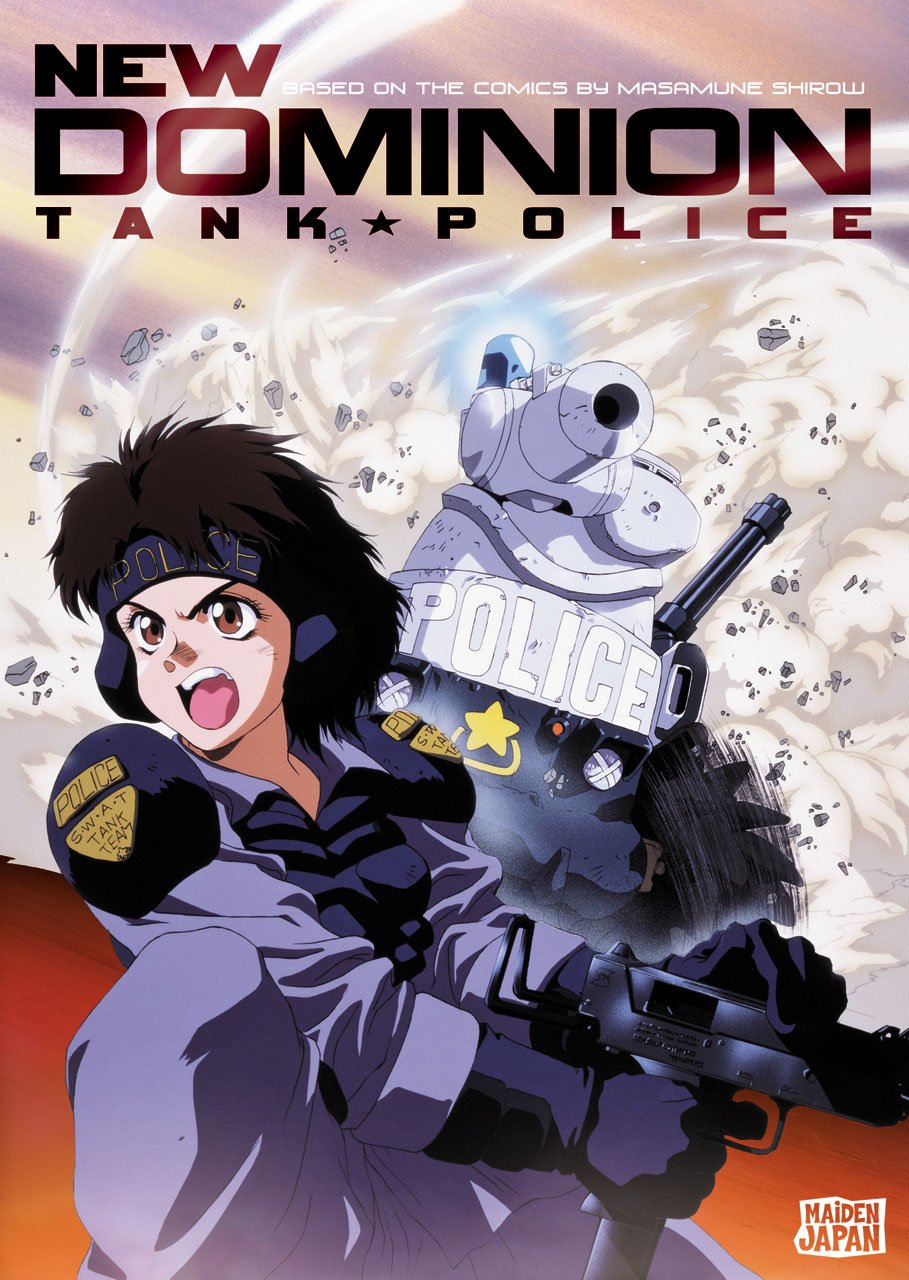
If natural gas were part of my personal energy mix, Dominion Energy would be my provider, having merged with Questar. They subsequently ran public service spots reminding everybody that "Questar Gas is now Dominion Energy!"
I've even see Dominion Energy utility trucks driving around.
The name can't help but make me grin, because what immediately springs to my mind isn't an energy company but Dominion Tank Police. One of Masamune Shirow's lesser known works, it's a mostly silly series that can be quite clever and even poignant at times.
Emphasis on the "silly," as in the "Hey, Boy" strip tease scene from the first series (it looks more NSFW than it actually is).
Imagine Blade Runner as a slapstick comedy. With tanks. It deserves a revival. And might even survive a Hollywood adaptation, what with sci-fi comedies being all the rage these days (Deadpool, Guardians of the Galaxy). Plus a female protagonist!

The second series, New Dominion Tank Police, is available on DVD.
Labels: anime, economics, manga, science fiction, shirow, technology
November 09, 2017
Too super for their own good

At least when Godzilla wrecks Tokyo (which he does as less a "villain" than a force of nature, like a typhoon or earthquake), he has to work at it. And you can't help but appreciate all those scale models being crushed underfoot. Somebody actually made them! With glue and paint and balsa wood! Amazing!
Though Godzilla wears out his welcome pretty fast too.
Otherwise, inflicting billions of dollars of CGI property damage on a major metropolitan area simply isn't entertaining. I mean, it really isn't. It's depressing when it isn't dull. The inputs—the millions of dollars and zillions of credits scrolling by at the end of the film—don't come close to equaling the outputs.
In my bubblegum entertainment classroom, getting a passable grade in science fiction and fantasy means the screenwriter has to at least respect the laws of thermodynamics. Okay, he doesn't have to be totally constrained by them. But putting limits on how big, how fast, and how strong forces writers to get creative.

The latest Wonder Woman gets the balance pretty much right, as focused human effort can force her into a literal crouch. I've gained a new appreciation for the old Bill Bixby Hulk series. Even pumped up and painted green, Lou Ferrigno is a real person constrained on screen by 1970s television technology.

Batman and Ironman (supposedly) only rely on technology, but technologies that too often violate the basic laws of motion too. Same problem with giant robots.
Ironman still contributes to large scale urban renewal projects (though mostly because of the people he hangs out with). And Batman still ends up facing off against vaudevillian bad guys with motivations borrowed from the goofier side of the Bond spectrum, except that Christopher Nolan expects us to take them seriously.
Sorry. Can't. No matter how much he underexposes the film (and Nolan actually shoots on film).
Patlabor gets it right too. I usually avoid the mecha genre because of the basic science issues. Patlabor succeeds because 1) it takes a big team to keep one "labor" operational; 2) the batteries run down pretty quickly; 3) they go to great lengths to limit collateral damage; 4) they don't take themselves too seriously.
In other words, Patlabor demonstrates a healthy respect for the laws of thermodynamics. And common sense.

Hey, we're fighting crime with giant robots! How whacked out is that?
One nice point of the original Star Trek was the constant search for "dilithium." The series since have posited that the magical "antimatter" fuel is "free." Which is boring. A big reason for the opening of Japan in 1854 was the need for refueling stations. Lots of dramatic possibilities in that simple requirement.
 Despite the scientific silliness, at least Tony Stark works hard on the hardware and isn't stone-faced about everything, which makes him enjoyable to hang with for a couple of hours. The same can't be said for whoever's been cast to play Batman since Adam West retired from the role.
The repartee between Chris Pine's Steve Trevor and Gal Gadot's Diana in Wonder Woman is reminiscent of classic 1930's screwball comedies. Setting the story within a known historical context and populating that world with one superhero also contributed to making it the best in the genre.
On that score, Deadpool cranked the sarcasm and fourth-wall-breaking knobs up to eleven. I'm not sure it's sustainable but Deadpool also demonstrates how "small" budgets make for better movies ("small" being bigger than any other movie studio on the planet). A smart script gets way better mileage than more CGI.
One of the running jokes in Deadpool is that they couldn't afford any of the big superheroes, so all they get is a couple of sidekicks. Ryan Reynolds, who stars and produces, reportedly insisted on keeping things (relatively) small. Here's to hoping he can keep the superness of the sequel similarly in check.
Related posts
Lois & Clark
The Big Bad
Reframing the mainframe plot
Labels: fantasy, movies, pop culture, science, science fiction, superhero, thinking about writing
August 17, 2017
Ghost in the Shell

Both 47 Ronin and Ghost in the Shell (2017) were ruined by absurdly generous budgets. Some tightening of the purse strings, some discipline in the art direction, might have reined in the compulsion to plaster every square inch of the screen with CG effects that make no sense in the context provided.
Hollywood needs a new movie-making rule: if you want that Blade Runner "look," pretend you have to do it the old-fashioned way, on a sound stage using in-camera effects. Otherwise, don't do it.
Not only is it wasteful, but the obsession with "big" CG overlooks better "small" CG possibilities. As Aramaki, Beat Takeshi speaks only Japanese. What about other languages? Definitely Mandarin and Cantonese. Simulating simultaneous machine translation capability would open the door to a lot of linguistic fun.
Cinematographic excesses aside, the biggest problem with the latest incarnation of Ghost in the Shell (and with most adaptations of this ilk) is a needlessly muddled and hackneyed script. It didn't stick closely enough to the source material (same problem with 47 Ronin).
Though I'm afraid that still wouldn't have turned it into a blockbuster worth its $110 million budget.

The original film had no problem making back its six (that's six) million dollar budget. But like Blade Runner (1982), which failed to break even during its theatrical run, Ghost in the Shell (1995) has since garnered a reputation that outstripped its initial box office appeal abroad.
Director Mamoru Oshii sifted through Masamune Shirow's manga and extracted the two classic questions at the nexus of philosophy and computer science: 1) At what point does an complex machine gain sentience? 2) How much of a human brain can be replaced with inorganic components before sentience is lost?
Here was cyberpunk done right, that took itself (a bit too) seriously. But it was prescient. The Netscape browser (version 0.9) had only been out a year. The Matrix came along four years later, drastically dumbed down the subject matter, tossed in a big bad mainframe antagonist and tons of gun fu, and made beaucoup bucks.
Hollywood learned exactly the wrong lesson.
Okay, so it was asking too much to expect American audiences to sit through a hundred-minute treatise on cyborg existentialism. But at least director Rupert Sanders could have made a movie that didn't immediately decompose into a mess of cliches, like spending the first five minutes serving up a bucket of unnecessary backstory.
Just start with the classic rooftop opener!
Oh, and about that opener. What Mamoru Oshii gave us in 1995 was not the Major going all cowboy in a shootout at the O.K. Corral (Sanders forgot he wasn't remaking John Wick), but the carefully executed assassination of a foreign diplomat engaged in industrial espionage.

I can well imagine that the Chinese financiers of the 2017 remake weren't too keen on a story that revolved around government-sponsored hacking of foreign entities and internecine battles between competing ministries. Too relevant! Just make the bad guy a Japanese corporation. Yeah, that'll do it.
So what we got instead was Robocop. Seriously. It's Robocop meets a self-
(Also see Kate's comments about the uninspired practice of hiding critical information from the protagonist and the audience in order to maintain suspense.)
Major Kusanagi's past isn't an issue. Her hardware isn't unique. Ghost-less androids are commonplace (Aramaki's assistants, for example). The existential angst doesn't kick in until the cat and mouse game with the "Puppet Master" is well underway, when the possibility arises that sentience can exist in an AI without a ghost.
And that cat and mouse game is smart (though a bit talky at the halfway point). The story hangs together well after twenty years, despite the enormous technological changes. The narrative isn't pushed forward by the characters crashing through doors and shooting everything in sight and taking unnecessary risks.
Major Kusanagi is a tough, competent, by-the-book team leader. She only steps out of line at the very end, when her inner existential crisis threatens her actual existence. And once she steps out of line, all is not forgiven and she's not coming back.
It's no surprise that the best scenes in the remake are exact copies of the original. Ghost in the Shell didn't need to be redone. It's just fine as the penultimate film in the franchise. Major Kusanagi doesn't even make a corporeal appearance in Innocence, the sequel to Ghost in the Shell.
Rather, the prequels provide more suitable material as entry points for American audiences. In particular, I consider the Stand-Alone Complex television series to be better than the manga or the latter two movies (though they are different enough to defy direct comparisons).
Along with the season-long arcs, there's plenty of material in the standalone episodes, plus the feature-length Solid State Society, to fuel a franchise of remakes. Forget about evil mainframes taking over the world. This isn't Deep Blue versus Garry Kasparov, but a bunch of Deep Blues and Garry Kasparovs all playing each other.
Person of Interest was headed in the right direction before it fell into the evil mainframe trap and contended that "there can be only one" (credit for that goes to Highlander). No, in the world of Stand-Alone Complex there can be millions, if not one for every person on the planet.
Sure, a supercomputer can beat a grand master at chess or go. But a pretty good computer teaming up with a pretty good human player is better than both. This is the fundamental concept The Matrix movies failed to grasp. Self-aware machines will need us as much as we need them. (An on-off switch is a powerful thing.)

Plus, the Tachikoma robots—some the most original characters in all of science fiction—would make for a marketing tie-in bonanza.
All the necessary ingredients are there. The next time Hollywood gets a hankering to serve up the latest cool Asian fusion cuisine, well, first hire a chef who bothered to read the cookbook.
Related posts
Innocence
Reframing the mainframe plot
The Medicator (they'll be back!)
What is the narrative need for secrets?
Labels: anime, anime reviews, computers, mainframe, manga, movie reviews, science fiction, shirow, tech history, technology
July 14, 2016
Aogashima Island
But this time high concentrations of gold and silver ore were found in the vicinity of Aogashima Island. Gold in them there underwater hills may provide the kind of motivation to get a gold rush going. Reports the Japan Times:
A team of researchers at the University of Tokyo have discovered high-grade gold ore on a seabed off a remote island south of Tokyo. The ore, collected from a hydrothermal deposit at an underwater volcanic crater off Aogashima, contained as much as 275 grams of gold per ton, a figure that is higher than usual for such deposits on land or sea in Japan.
If you think this sounds like the premise for a James Bond flick, well, check out Aogashima Island. It even looks like the lair of a James Bond villain! (Click to embiggen.)

Those blue spots aren't water. They appear to be roofs, Quonset huts and greenhouses, perhaps. Aogashima Island, 222 miles south of Tokyo, is the the southernmost inhabited island of the Izu archipelago.
Labels: geology, japan, movies, science, science fiction, technology
July 07, 2016
The Force Awakens

Not that there's anything wrong with that. Repurposing old genres makes the topsoil of popular entertainment all the richer. And like McDonald's french fries, when it comes to genre entertainment, the decent low-brow stuff beats the tony high-brow stuff nine times out of ten.
The first Star Wars movie (1977) defined this revised genre. With Irvin Kershner at the helm, The Empire Strikes Back (1980) extended it (it even included a dragon in a cave). Then things went downhill and never recovered. Not even after George Lucas bowed out and laughed all the way to the bank
Granted, at that stage there was no place to go but up. But so determined was Disney to rekindle some of that now "classic" fairy tale goodness (its specialty, after all), that they made the same movie all over again, only with better CGI and a worse script.
It'd be one thing if they'd made exactly the same move. But everybody was so familiar with the archetypes that they forgot to fill in the rest. In between each predictable turn of plot, there's supposed to be, you know, a story. And the accompanying material that fashions ongoing character development.
As a result, The Force Awakens ends up a compilation of deus ex machina moments, the characters and their reasons for being there springing into existence out of empty space like subatomic particles.
The original Star Wars has a few of these problems too, though they're not nearly as glaring. For example, Luke demonstrating the skills of an experienced ball turret gunner straight off the literal farm.
In fact, everybody in the Star Wars universe is surprisingly adept at both operating (and sabotaging) complex military hardware they've never seen before. Galaxies long ago and far away must have had the same high school curriculum as Girls und Panzer (in which armored combat is an extracurricular activity).
And the last act of Star Wars is plain silly, suggesting that a couple hundred hours flying VFR in a Piper Cub qualifies a pilot to jump into an F-22 and fly circles around an MIG-29. (See also: Independent Day, but at least the Randy Quaid and Bill Pullman characters had flown military jets before.)
Otherwise, Luke is realistically shown to be the novice that he is, whose best option in a tight situation (again, until the heroic last act) is to run away or hire some muscle. Even after extensive one-on-one training, he is incapable of besting Darth Vader with a light saber in The Empire Strikes Back.
By contrast, the time to learn any activity, any skill, any knowledge-dependent process in The Force Awakens—from "I've never seen this thing before" to "I can use it as well as a professional"—is about sixty seconds.
All the more exasperating is that most of these glaring plot holes could have been easily fixed.
1. Finn goes AWOL after ten minutes of doing whatever he was programmed/trained to do since forever.
Well, they certainly don't make stormtroopers like they used to. For such a key character, a bit more substance behind the decision would go a long way to informing us about his character and personality.
Easy fix: Make Finn part of Kylo Ren's detail. Finn is sick and tired of babysitting this whiny kid with anger management issues, has been nicked one too many times during his temper tantrums. Then witnessing Ren's depravity in person punches his ticket to get out of there before he ends up as cannon fodder.
This would also explain why a narcissistic sociopath like Ren would notice who Finn was in the first place, let alone bother to call him a "traitor." Because he knew Finn personally.
2. I read the manual and now I can fly a starship better than an experienced pilot.
"Howling Mad" Murdock on the A-Team could fly anything because he learned how to fly everything. But since the original Star Wars, "The Force" somehow became shorthand for "Hard work, study, and practice is for suckers."
Easy fix: Make Ridley a mechanic when we first meet her. She works for the pawnshop proprietor who owns the ticket on the Millennium Falcon. She's trying to fix it because Han disabled it before hawking it and it won't go FTL, making it worthless. In the meantime, Ridley uses it to cart junk around.
One day she spots Finn and BB-8 out in the desert and gives them a ride. When they get back, Han Solo and Chewbacca have shown up to claim their craft. In the middle of arguing about who owns what and who owes whom, the stormtroopers charge in and all hell breaks loose.
3. I didn't even read the manual but just holding a light saber means I can beat a guy with way more experience than me.
It's easy to establish that both Finn and Ridley can handle themselves in a fight. But that's not enough. Not after the first three Star Wars movies established the deadly difficulty of light saber fighting.
Easy fix: This was sorta hinted at, but it should be pointed out (by Finn, say) that, sans the Force, Ren can't fight his way out of a brown paper bag. Lazy jerk that he is, he never had to. But now he has to. The question is whether actually applying himself will make him a better man too. Ah, a character arc!
On the other hand, some things are not fixable.
The Death Star was a cool enough concept that, first time out, I could quell the eye rolling. But this predilection to "Do the exactly same thing only bigger" movie after movie is just inane.
And here I thought that Space 1999 boasted the stupidest SF premise of all time. Supposing that the Queen in Through the Looking-Glass really could believe six impossible things before breakfast, she couldn't believe this:
Moonbase Alpha is a scientific research colony and watchdog over silos of atomic waste from Earth stored on the Moon's far side. On September 13, 1999, magnetic energy builds to cause an explosive chain-reaction of the waste, blasting the Moon out of Earth orbit and off the plane of the ecliptic, out of the Solar System.
The first Death Star (so sad there's more than one) was the spherical version of the Doomsday Machine from Star Trek. And the Doomsday Machine was huge but not-unreasonable sized. But a whole freaking planet on the run? I'd need a space elevator for my suspension of disbelief to go that high.
Also, these super-advanced societies can travel faster than light but can't make a decent circuit breaker. Or make a non-combustible space ship. (Also see Independence Day, but I do give Independence Day credit for setting off a nuke inside the mothership, which would do pretty much as depicted.)
This single-point-of-failure problem extends to the Republic, which hasn't figured out distributed networking either. They need to take lessons from Monty Python on "Not Being Seen."
Speaking of Monty Python, watching Star Wars gets me into a "What have the Romans ever done for us?" frame of mind. The entire argument against the regime du jour is that they're mean. And not very bright, taking a sledgehammer approach (repeatedly) to solving small problems.
These are the kind of people who, lacking a flyswatter, grab a hammer. Now all the windows are broken and the walls are full of holes. With Disney committed to pumping out rebooted Star Wars sequels on a regular basis, turning every conflict into an galactic existential threat will get old fast.
It's already old.
Firefly employed a not-dissimilar premise—big bad bureaucracy against the little guy—with an important difference: our motley crew has a job to do, and overthrowing the Alliance tomorrow isn't anywhere near the top of the list.
Posit instead that the Empire or First Order or whatever rules with a heavy hand but is basically competent. The Republic doesn't want to (and can't) overthrow the whole shebang. It's the Republic of Texas: it'd rather not be part of Mexico anymore (it helped that Santa Anna was not a nice guy or a smart general).
Even if the center could not hold, the result would likely resemble the Warring States period in Japan, which is still producing great story material four centuries later.
The sovereign power wielded by the warlords during the era compares to that of the Italian city-states, with conflicts taking place mostly at the peripheries of their domains, leaving commerce and agriculture largely undisturbed. This, in turn, led to significant economic, cultural and technological growth.
But the lack of central control also produced a veritable queue of claimants to the throne, and great business opportunities for the pirates and mercenaries in (or out of) their employ. The kind of universe in which Han Solo and crew would feel right at home.
Related posts
Attack of the Clones
The Phantom Menace
McKee meets the "Menace"
Labels: history, japan, movie reviews, science, science fiction, star wars, technology
June 16, 2016
The Cast Away Martian

Hollywood's been on a hard science fiction binge of late, to varying degrees of success. The physics in Interstellar is more wishful thinking than science. Gravity turns the laws of orbital mechanics upside down. But The Martian, which maroons Matt Damon on Mars, is basically Apollo 13 and Cast Away (minus most of the angst) set a few years in the future.
In The Martian, man fights nature largely within the limits of current technology and without any bad guys out to purposely harm him. Oh, for a few minutes, they try to make Jeff Daniels into a villain to gin up some conflict. But two scenes later he goes back to playing a perfectly plausible NASA administrator.
The simple yet daunting goal of Damon's Astronaut Mark Watney is to survive until a rescue mission can return to rescue him. The problem is that with current technology, getting from the Earth to Mars takes six months at best. So he's got a lot of problem solving to do. A major motion picture that is about nothing but problem solving is a breath of fresh air.

Like, I'm willing to give the radiation thing a pass, because no manned mission is going to Mars in the first place without solving that vexing problem. They don't solve it in the movie either, they simply ignore it, the same way they mostly ignore the .38 Gs of gravity on Mars.
And unlike Tom Hanks shedding a real fifty pounds for Cast Away, Matt Damon didn't starve himself for the role; a scene toward the end showing us his gaunt frame (face hidden) is almost certainly a body double. He's wearing a space suit most of the time anyway.
Tacking down the Pathfinder lander, plugging it in and powering it on (interplanetary cable standardization at last!) a quarter century after it landed is an eye-roller. Still, I could roll with it just because it's such a cute idea.
And I loved the bit about digging up the RTG (radioisotope thermoelectric generator) and using it as a plutonium-powered handwarmer (accompanied by Damon's wry "Don't try this at home!" narration).
No, what first suspended my suspension of disbelief was the implication (again, in order to create more obstacles to cleverly overcome) that the astronauts had only a single point of direct communication with Earth. In fact, the Mars landers use satellite uplinks to talk to the orbiters, which relay the signals to Earth ground stations.
Likewise, it is beyond belief that an ATV the size of a small truck would be limited to line-of-sight communication. All of the later Apollo missions left working equipment and experiments on the Moon. The vehicle and the habitat would be studded with transponders and satellite dishes humming along long after the humans left.
Equally improbable is that the inner hatch door of a habitat in a near-airless environment wouldn't be sealable and built into the superstructure. To quote NASA, the purpose of such a hatch is to "isolate the airlock from the crew cabin." I bet Astronaut Mark Watney sure wishes he had one of those. They were standard equipment on the Space Shuttle, after all.
The first failure of the NASA resupply rocket was awfully predicable (more conflict creation). While I did appreciate bringing in the Chinese (China should be part of the ISS), the movie ignores that Russia, Japan, and the European Space Agency have comparable launch capabilities, not to mention ULA, Orbital ATK, and SpaceX.
Given the chance to save the day, Elon Musk would be all over this.
And yet I give it a solid A for effort. The Martian isn't one of those movies where the plot holes let all the air out of the suspense. It is a rousing Rubik's Cube of an adventure movie with a bunch of cheating aces tucked up its sleeve. Like the old Star Trek, it's often more interesting for its obvious flaws than for its dramatic successes.
Labels: movie reviews, science, science fiction, space, star wars, technology
October 15, 2015
Ghost in the Belle
 |
| Impressive special effects on a small budget. |
But before going to DEFCON 1 on the "A.I. panic of 2015," Erik Sofge would first like to see "any indication that artificial superintelligence is a tangible threat." So he posed the question to Yoshua Bengio, head of the Machine Learning Laboratory at the University of Montreal. Bengio doesn't see much of a threat either.
Most people do not realize how primitive the systems we build are, and unfortunately many journalists (and some scientists) propagate a fear of A.I. which is completely out of proportion with reality. We would be baffled if we could build machines that would have the intelligence of a mouse in the near future, but we are far even from that.
Alex Garland doesn't share these "concerns" either. If anything, the director and writer of Ex Machina seems to anticipate the day when every nerd will have a fully functioning sex robot in his closet. Not exactly a terrifying prospect (except for Japanese demographers).
So Ex Machina isn't another silly Terminator clone. But it is a very silly movie, and its silliness is largely a product of taking itself so danged seriously. And yet not seriously enough.
The role of science in science fiction is relative to the technical aspirations of the story. Other than stipulating the existence of spaceships, there doesn't need to be a whole lot of actual science in space opera. Even the "mainstream" of the genre demands little more than a nod to the current state of the art.
But make the science the primary focus--enter the realm of "hard" science fiction--and you have to color within the lines. The Second Law of Thermodynamics is no longer a suggestion, and the standard shifts from "vaguely not impossible" to one brilliant mind away from realization.
In Ex Machina, Nathan (Oscar Isaac) is supposedly that brilliant mind. The CEO of search engine giant Bluebook (i.e., Google), he's the amalgamation of Larry Page and Sergey Brin and Larry Ellison (and inexplicably, Sylvester Stallone).
Caleb (Domhnall Gleeson), one of his star programmers, has "won" a "weekend with the boss" contest. When he ends up at Nathan's estate in the wilds of Alaska, it seems he's really there to conduct a Turing test on the comely Ava (Alicia Vikander), Nathan's latest android.
A machine that passes a Turning test can carry on an unconstrained dialogue without its human interrogator realizing it's a machine. Nathan recruits Caleb because he needs an "objective" evaluator to make the assessment, but misleads Caleb at first about what truly is being assessed.
Which isn't all that difficult, as Caleb's "test" consists of vacuous conversations that could have been scripted by a machine. More likely, the writer simply isn't as smart as his characters. Caleb comes across as a dweeb on his first date; Nathan is a boorish football jock who likes to hit stuff.
 |
| Least convincing casting ever. |
What if the whole thing's a Mechanical Turk? If the hardware's that good, it'd be easy to pull off. Where's a Voight-Kampff machine when you need one? Hmm, might this android be as nuts as the guy who built her? Once my suspension of disbelief began to fray, there was nothing to stop it from unraveling all the way.
Now, to start with, Ava is mechanically beyond anything anybody's invented, and her "brain" is more than a bit of a leap. Still, given the proper context, that leap could be made. No surprise that the leap not easily made depends on the Second Law of Thermodynamics, pop sci-fi's biggest stumbling block.
Caleb's first question to Nathan wouldn't have anything to do with her A.I. Rather, what kind of servos does she use? What kind of batteries does she have?
Human nature is such that we tend to judge the internal consistency of a plot, especially in fantasy and science fiction, not so differently than a criminal trial: the prosecution can't cross-examine on excluded evidence unless the defense brings it up on direct. Unmentioned, we happily exclude great swaths of the real world.
Ghost in the Shell begins by positing that non-sentient androids are already ubiquitous. So that takes the subjects of mobility and functional capability off the table.
Fine. Except that Garland introduces the subject into the script. Now it's fair game. The first mention is quite smart, when Ava reveals to Nathan that she gets her power through inductive charging. That's real technology.
But the only reason inductive charging is brought up is because Ava knows she can kill the main power feeds by triggering a "power surge." This idiotic technobabble is the same dumb plot device that has shown up in caper flicks for decades: kill the power and the security systems fail. (Die Hard did it in 1988, okay? Stop it.)
And it's paired with another one just as old and creaky: genius coder reprograms a security system (at the source code level) that he's never seen before. And super-paranoid Nathan doesn't encrypt or do check-sums on any of his super-duper top-secret software.
Oh, and inductive charging would severely limit Ava's range. Without a supply of the most advanced battery technology imaginable, Ava is permanently confined to the house. So why confine Ava to her room as well? We're at least a hundred miles from civilization. There's nowhere else for her to go.
Seriously. The androids want to be free? Set them free. That'd be a million times more interesting than this script. Tossing Caleb into a Survivorman episode with Ava would be the ultimate test of intelligence. It'd be truly hilarious if they both got all bitchy and whiny. Now that'd be human.
In any case, the equivalent of an electronic dog collar or an OnStar system would take care of things quite efficiently. Your super-intelligent robot can't have less sophisticated electronics than cars have had for years. ("Kyoko" aside, the rest of Nathan's androids are turned off, so they can be turned off.)
Hmm, so at what point did Nathan regret not implementing Asimov's Three Laws of Robotics?
Both Caleb and Nathan use the same metaphor: the pretty assistant who distracts the audience while the magician palms the card. Garland deploys a harem of naked girls to distract the audience from a pretty standard femme fatale plot, that relies on the smart people catching a bad case of the stupids.
I'm reminded of Freeze Me, another exploitation thriller that got to thinking it was an art house movie and subsequently drained all the smartness out of it. Garland likewise wants us to root for a sociopath (surrounded by dunces) with an hour of life expectancy. I cared about none of them.
There are better versions of this story. Ghost in the Shell is about a self-realized A.I. that frees itself from the constraints of its makers. As the shell isn't what makes Ava "human," Caleb could simply smuggle out the A.I. in a drive array. The season five climax of Person of Interest did exactly that.
But more on theme is Let the Right One In (the 2008 Swedish version directed by Tomas Alfredson).
Eli is a vampire--permanently a young teenager--who has to periodically recruit a new Renfield to stay alive. The vampire element grounds the plot in that fundamental thermodynamic equation: the constant flow of energy in and out. She's dependent and yet must maintain the upper hand, which keeps her constantly on her toes.
This tension is what's utterly missing from Ex Machina.
Borrowing from Let the Right One In, I see Ava striding up to the helicopter, Caleb trudging behind her with a big rucksack full of battery packs slung over his shoulder. That balancing act between the machine and the human, that necessary mutual addiction, is a much better model of the real world.
Related posts
Freeze Me
Person of Interest
Robot on the Road
Appleseed: Ex Machina
They don't act that way in real life
Labels: anime, computers, movie reviews, movies, robots, science, science fiction, technology
May 11, 2015
Welcome to the Machine

With the battle now fully engaged between the Machine and Samaritan (echoing C.S. Lewis's contention that the Earth is, in fact, "enemy territory"), the one remaining challenge is providing John Greer (aka Decima, played by John Nolan, Jonathan Nolan's uncle) an underlying motivation that matches those of the rest of the cast.
The problem, as Kate points out, is that "the abstract nature of belief" makes "religion difficult to write about," even when couched in equally abstract metaphors.
In order for Martin Luther to argue against indulgences (a practical reality), he has to believe in something far more abstract (that the soul cannot buy its way into heaven or out of accountability). In order for Joseph Smith to argue against infant baptism (another practical reality), he has to believe that Adam and Eve's Fall from God's presence did not entail a fall into sin.
A "bigger worldview lies behind most theological arguments," and that's what often goes missing in the mundane scramble after plot. But it has to surface sometime, else the plot will end up chasing its own tail. At the end of season four, we do catch a compelling glimpse.
A skeptical Control confronts Decima in what can be analogized to the conflict between the Confucianists and the Hobbesian legalists of the Qin Dynasty. Confucians focused on the primacy of ethics and a virtuous ruler, while legalists believed that the whims of any ruler could be subsumed by the objective machine of the law.
Or in the case of Person of Interest, the algorithm. Outside a shrinking number of crumbling Marxist states, the most familiar implementations of legalism are Sharia and the Mosaic Law.

Under legalism, we have the right to do nothing, except for a finite subset of actions the state allows. By contrast, to assert that rights are inalienable" and "god-given" means that we have the right to do anything, except for a finite subset of actions the state deems to be crimes. And even then, we are "presumed innocent."
Legalists see only chaos in such expansive views of liberty. Like Hobbes, they argue that "[T]he purpose of the commonwealth is peace, and the sovereign has the right to do whatever he thinks necessary for the preserving of peace and security and prevention of discord."
In the tension between these two perspectives, we find the foundations of Christian theology as reflected in Milton (or The Pearl of Great Price), which casts the War in Heaven as a conflict between a Hobbesian view of life (man must be forced back into heaven) and one in which man has free will (and can only return via grace).
Wherefore, because that Satan rebelled against me, and sought to destroy the agency of man, which I, the Lord God, had given him, and also, that I should give unto him mine own power; by the power of mine Only Begotten, I caused that he should be cast down;
And he became Satan, yea, even the devil, the father of all lies, to deceive and to blind men, and to lead them captive at his will, even as many as would not hearken unto my voice.
The Machine is the "still small voice," while Samaritan is the enlightened despot. But in dramatic terms, while "justice" and "redemption" can be pursued forever (which is why we'll never run out of police procedurals), it's impossible to square Samaritan's objectives with reality. The world is too analog to "take over."
Every quest for world domination suffers the same fate: This too shall pass away. Entropy always wins in the end (perfectly symbolized by the fates of self-made enlightened despots like Elias and Dominic).
I can imagine Samaritan being oblivious to its own mortality, while John Greer is not. Hence his mission. The Machine knows its limitations, hence Root's procurement of the mysterious bulletproof attache case for reasons none of them understands at the time.
I think Jonathan Nolan is getting a better idea of what makes his machines tick. In the season four finale, Greer does a good job of articulating why the threat of filling the streets with stormtroopers was a diversion all along. He comes quite close to paraphrasing the legalist approach to pragmatic governance:
- The ruler exists to monopolize authority in order to prevent its abuse by feudal magnates [or federal bureaucrats].
- Special tactics or "secrets" should be taken by the ruler to ensure that others do gain not control of the state. Withdraw[ing] from affairs except to manage the course of ministers, the ruler . . . obscures his motivations. By these means, no one can subvert the state through sycophancy, but may only try to advance [within it] by heeding orders.
- The ruler uses the legal system to control the state; if the law is applied effectively, even a weak ruler will be strong.
The question is whether the show can avoid going down the Terminator rabbit hole. That seems the only way Hollywood knows how to resolve conflicts involving sentient machines: "Robots take over the world!" Samaritan will have to take over something quite different. "Robots take over the government!" won't do either.
Jonathan Nolan has created the most ingenious cyber thriller on television (the mesh network episode was one of the smartest ever). He's resorted to both "conspiracy mode" and "Dr. Evil mode" that I worried about here, but has managed to keep pulling the rabbit out of the hat so far.
The best solution can probably be found in how churches and states have sorted themselves out of the past two millennia. Greer could argue, for example, that for all its notoriety, the Spanish Inquisition was a much less gruesome affair than the Thirty Years' War, and that his way will bring more "souls" to "salvation."
On a side note [spoiler alert], Nolan exercises the tightest cast control in the business. He pulled a "Scully" with Sarah Shahi (for the same reason as Gillian Anderson). Like Scully, they've kept Sameen alive, so I presume she'll be back. Camryn Manheim as Control ended up in dire straits, but I presume she'll be back too.
Enrico Colantoni is not so dead he can't come back. I liked Winston Duke as Dominic (another great bad guy from Nolan), but he's pretty dead. Martine (Cara Buono) is pretty dead too (after turning into the Terminatrix there for a while). Meanwhile, the Machine is in a literal box, reduced to a ghost in a shell.
Which means that, as things stand right now, we're back to the original cast size. You see, Joss Whedon, it can be done!
Oh, and the theme music for the penultimate scene of season four was recorded in 1975, but sounds like it was commissioned for this episode.
Related posts
The Difficulty of Writing About Religion
The Two Hands of Person of Interest, Season 3
Person of Interest
The IT enemy is us
Labels: kate, person of interest, politics, religion, robots, science, science fiction, technology, television, thinking about writing
April 27, 2015
Big Hero 6
 A cool concept, I argue in my review of Patema Inverted, is not the same thing as a plot, but can fake it for ninety minutes or so. The same thing goes for inventive settings and ingenious "MacGuffins." As Wikipedia explains:
A MacGuffin is a plot device in the form of some goal, desired object, or other motivator that the protagonist pursues, often with little or no narrative explanation.
Big Hero 6 is a comic book movie constructed out of a bunch of MacGuffins and hand-waves. And not much in the way of plot.
Unlike Patema Inverted, it actually does have a plot. But it's so by-the-numbers that the writers can't resist commenting on the fact, as if to stave off criticism that they didn't know they were doing "the same only--" Well, mostly the same.
So a few bars of "Eye of the Tiger" launches the de rigueur montage sequence. "Fred" (the designated comic book guy who's also the comic relief) shouts at one point: "Hey, it's an origins story!" Stan Lee makes a cameo after the credit roll.
The hero is Hiro, an orphaned teen genius living in "San Fransokyo" with his aunt and older brother, Tadashi. Unlike his older brother, Hiro wastes his prodigious talents betting on underground robot fights (and winning big).
In an effort to set his sights higher, Tadashi introduces Hiro to his fellow grad students at the university robotics lab. Tadashi's senior project is "Baymax," a cuddly medical diagnostic robot that resembles the Michelin Man.
At this university, you can apparently bypass the whole matriculation process and invent yourself right into school. The challenge posed, Hiro comes up with the "microbot," actuated joints that swarm together and self-assemble like Lego blocks.
But then a mysterious explosion kills his brother and supposedly destroys the microbots. (Note that Hiro loses his entire nuclear family in the first twenty minutes, but it's so in tune with the superhero monomyth it jars less than it should.)
In order to track down the villain, Hiro teams up with a retooled Baymax and the rest of the Tadashi's eccentric roboticist friends. We're in ensemble Iron Man territory. Their superhero suits allow them to leap over gigantic plot holes in a single bound.
You really do not want to stop and think about all the disbelief you're being asked to suspend. I did appreciate that only an office building gets destroyed in the climax and the "evil capitalist" turns out to be mostly a red herring.
As a Marvel comic book movie, it'd be one of their better efforts. As a Marvel + Disney collaboration (Disney owns Marvel), well, it's not The Incredibles. Or Frozen. Or Tangled. It's a pretty good cartoon! Just not as good as it could be.
Rather like our protagonist at the beginning of the story, Big Hero 6 is overshadowed by its own unexploited potential. The problem is, the most interesting parts of the movie are the MacGuffins, and they are rendered almost invisible.
The microbots, to start with. And everything else our superheroes invent practically on the spur of the moment. Tony Stark really had to work at that "99 percent perspiration" stuff. And it still took a couple of iterations to get the Iron Man suit right.
And unlike Big Hero 6, the world (and especially the world's militaries) immediately took notice of Tony Stark. A world so blasé about breakthroughs in applied science can't help but bore me (which is which so many superhero flicks end up boring me).
Doubly so for a world so blasé about a place like "San Fransokyo." The backstory is easy to imagine: the "big one" hits Tokyo and millions immigrate to the West Coast of the United States.
Imagine the Los Angeles of Blade Runner, only with better weather and zoning laws. San Fransokyo is one big Little Tokyo. Kanji signage dot the streets. The towers of the Golden Gate Bridge resemble torii gates.

Alas, we barely get to savor any of this. It blurs past. Besides a couple of Asian characters and some cool backgrounds, it has no obvious impact on the story at all (police cars do sport Japanese-style light bars).
Second, Alistair Krei, the "evil" capitalist and supposed antagonist, has built himself a freaking Stargate. No, really, it's the Stargate! Works the same too. That's the kind of thing you could do a whole movie about (plus three television series).

I mean, a wormhole transporter that passes through a different dimension! And yet, again, this total upending of science goes utterly unremarked upon. It's nothing more than another disposable MacGuffin.
Now, like Hiro's self-assembling robots, Big Hero 6 has all the hallmarks of a sequel-making machine. So maybe we'll still get to explore the heart of San Fransokyo. Maybe Krei will fix up those Stargates and do some off-world exploring.
We've got some first-rate world creation going on here, a world that only needs a cast of characters to actually live in it.
Labels: japanese culture, movie reviews, robots, science, science fiction, superhero, technology