

November 06, 2024
Matt Alt on minimalism

To begin with, ascetic practices attributed to Zen Buddhism are not the same as the disciplined use of space due to the fact that there isn't that much of it.
Ongoing population decline notwithstanding, Japan is still home to 126 million people who live in a country the size of California. Only 11 percent of the total land area is arable and less than a third of that is actually usable for housing.
That certainly sounds like a good argument for a less-is-more lifestyle. Except what space is available is nowadays bound to be crammed to the gills with stuff (as George Carlin delightfully put it).
After all, Kondo wrote originally for a Japanese audience, that had apparently forgotten they were supposed to be minimalists living in the land of minimalism.
Though to give Kondo the benefit of the doubt, I believe this is largely a postwar phenomenon brought about by both a booming economy and the additional confidence that all your stuff will still be here tomorrow.
As I discussed in a post about how Edo-period cities handled the constant plague of massive urban fires, perhaps Japanese minimalism simply evolved as a way to cope with that pretty grim reality.
Starting with the Great Fire of Meireki in 1657, fire was such ever-present fact of life that the average Edokko could expect his house to burn down at least once during his lifetime.
This expectation didn't end with the Meiji. As Edward Seidensticker writes in Low City, High City, "From early into middle Meiji, parts of Nihonbashi were three times destroyed by fire. There were Yoshiwara fires in 1871, 1873, 1891, 1911, and of course in 1923."

As late as 1995, the widespread damage from fires throughout Kobe following the Great Hanshin earthquake was a big wakeup call. Fire is no longer the threat it once was in Japan's urban centers, which has allowed clutter to proliferate.
When one of those old Edo period storehouses shows up in a modern mystery series, it will be crammed floor to ceiling with a haberdashery of clutter, that the detectives will have to comb through to find the critical clue.
As Kyoichi Tsuzuki points out, "Simplicity isn’t about poverty at all. It’s about wealth." It's about being able to buy all that stuff and then being able to afford to store it someplace else. Or replace it on a whim.
It's also a good way to have your minimalist cake and eat it too. Before the fussy relatives come over, cart all that materialistic excess to the storehouse and show off your splendidly simple life.
Or I guess you could hire Marie Kondo to eliminate the need in the first place.
Labels: economics, geography, history, japan, japanese culture, religion


March 27, 2020
The rising ebook in Japan

 For a country with such a post-modern reputation, Japan loves paper, especially paper books and paper money. The ¥10,000 note, the equivalent of a $100 bill, is used and accepted everywhere.
Cash in circulation in Japan amounts to over 20 percent of GDP, significantly higher than the United States (8.3 percent), China (9.5 percent), or the Eurozone (10.7 percent).
Recent trends suggest that Japanese may be embracing electronic publishing faster than they are embracing electronic money. The ebook in Japan gained significant momentum in 2019.
According to the All Japan Magazine and Book Publisher's and Editor's Association, while print sales fell for the fifteenth straight year, sales of digital manga shot up 29.5 percent. Digital book publishing rose 8.7 percent. The entire digital market was up 23.9 percent. The overall publishing market even saw a small increase.
Physical video media also took a hit, with the Japan Video Software Association reporting that the market for physical media declined almost 11 percent from 2019 to 2019. Blu-Ray sales fell one percent while DVD sales were down 20 percent.
Like the ebook, Japan is also embracing the convenience and lower costs of streaming. Netflix, Hulu (wholly owned in Japan by Nippon TV), and Amazon Prime are making their presence known in a big way. Even NHK is jumping on the bandwagon, and will launch a domestic live streaming service in April.
Labels: business, ebooks, economics, hulu, japan, japanese culture, netflix, nhk, publishing, streaming, television
October 03, 2019
(Almost) Live Japanese TV

The old-school content delivery model has since gotten turned on its head. Just three years after buying DirecTV, AT&T doesn't want to be in the satellite business anymore. "We've launched our last satellite," John Donovan, CEO of AT&T Communications, stated in November 2018. AT&T chairman Randall Stephenson chimed in that AT&T was essentially "done" with satellites, and was "investing very aggressively" in OTT distribution.
The DirecTV NOW streaming service has already been re-branded as AT&T TV NOW (not to be confused with AT&T TV). Nobody would be surprised at this point if AT&T sold its satellite business to Dish. A lot has change since a proposed acquisition of DirecTV was shot down by the FCC in 2002. Dish would gain a subscriber base competitive with cable. And I would enjoy the irony of TV Japan leaving Dish only to end up back on Dish.
NHK Cosmomedia depends on satellite service to reach a worldwide market outside of North America and to provide programming to its legacy customers and hotels that cater to Japanese businessmen and tourists. To be sure, NHK Cosmomedia has diversified its distribution network, with TV Japan available on Xfinity nationwide. But cable television faces the same competition from streaming (though Internet-only is a profitable business).

Both apps have been poorly received, the biggest complaint being the lack of content. If you're going to charge $10/month, you'd better be at least in the same programming universe as services like Hulu, Netflix, and Crunchyroll that charge less.
NHK Cosmomedia is naturally predisposed to favor its satellite and cable subscribers. And seems to be proceeding as cautiously as possible while waiting for another shoe to drop somewhere. A classic case of what Clayton Christensen calls the "Innovator's Dilemma," according to which companies put too much emphasis on the current business model and fail to anticipate or adopt new technologies to meet future needs.
Though AT&T may be trying too hard to adopt new technologies to meet future needs and has ended up aimlessly flailing around instead.
Though perhaps NHK Cosmomedia saw the writing on the wall and are using the roll-out to collect data about the technology and the user base, in anticipation of adding TV Japan to the platform. TV Japan targets exactly the kind of niche market that streaming was made for. Should the moment arrive that NHK Cosmomedia can't figure out where AT&T is headed next, streaming is one way to take a good deal of uncertainty out of the equation.
 After all, NHK Cosmomedia already has NHK World, a proven live-television streaming platform. At the end of September, dLibrary Japan gave its home page a much needed makeover and announced that "New programs will be available every week from October!" so maybe they are finally getting serious. Though "serious" to me means a Roku app. So not yet serious enough.
For the time being, though, DirecTV provides the most almost-live television options to the Japanese language viewer, with a premium package that includes TV Japan, Nippon TV, and the NECO movie channel. That bundle costs $45/month plus a required "basic" package plus a boatload of taxes and fees. The whole thing would quickly add up to a cool grand a year.
Again, Crunchyroll + Funimation + HIDIVE = $21/month. Total.
Were money no object, the DirecTV package would be a no-brainer. But it is, so now I'm wondering whether AT&T can really back up all the big claims its executives are making about making DirecTV content available through a streaming set-top box. Then again, Nippon TV (the biggest television network in Japan) already owns Hulu/Japan. It may be the best positioned Japanese content provider to break out on the streaming front.
Related posts
dLibrary Japan
Nippon TV and NECO
Japanese media update
The streaming chronicles
Labels: business, crunchyroll, directv, economics, funimation, hidive, japanese tv, nhk, nhk cosmomedia, nhk world, roku, streaming, technology, tv japan
September 26, 2019
Telling the how-to story
 A common criticism of Hollywood is that it cares more about what sells in China than what sells in middle America. That Hollywood can sell its wares in China at all is a testament to the universality of storytelling and the structured approach to the craft that Hollywood has polished to a shine.
At the same time, what makes universality equally interesting are the exceptions that are not so universal. Here I'm thinking about a unique interplay between subject matter and genre, quite apart from cultural specificity, that has no real equivalent in Hollywood when it comes to narrative fiction.
Call this one the "how-to" genre.
In the non-fiction space, there is no lack of DIY and "how-to" programming in the North American market. PBS Create does nothing else 24/7. But while there is often an element of DIY in scripted television shows coming out of Hollywood, it's hard to think of an example where it is the single defining element.
The setting of any series will dictates a certain amount of expository material, as will the occupations of the characters. At the very least, in the name of verisimilitude, a show that, for example, takes place in a radio station (NewsRadio, WKRP in Cincinnati, Frasier) must necessary provide some insights into broadcasting.
 In Home Improvement and Last Man Standing, Tim Allen comes close, epitomizing a "how-to" man working in "how-to" businesses.
On Japanese television, and specifically anime, "how to" is not only a defining element but often the entire point. The hugely popular "gourmet drama" pays the kind of attention to the nuts and bolts of cooking otherwise only found in reality shows and the occasional feature-length Hollywood production.
It is certainly a defining element in the ever-popular sports genre, appealing to its audience with a focus how to play the game better.
Thus the protagonist in a mainstream sports drama commonly starts off with a great deal of promise but an Achilles heel that must be overcome. Tsurune begins with our protagonist suffering from a bad case of the yips in the form of target panic. Big Windup features a pitcher with incredible control but no speed.
Especially in baseball series, multiple episodes can be devoted to a single game, with the granularity of the narrative resolving to a pitch-by-pitch analysis.
Then there is the "oddball sports" category, which features sports or games the audience may be familiar with but probably doesn't know a lot about. Again, an excuse to work a great deal of exposition into the narrative.
Examples include Chihayafuru (karuta), Saki (mahjong ), Hikaru no Go (go), Tsurune (archery), and March Comes in like a Lion (shogi). The latter gained particular resonance when real-life Sota Fujii turned professional at the age of 14 (youngest ever). These sports-related series do also generate a great deal of melodrama.
And finally we come to the "how-to" genre distilled down to its essence.
 The Japanese fascination with "how-to" is fully on display in what I call the "Cute girls doing interesting things in a cute way" genre. The typical approach is to have the protagonist get interested in a somewhat obscure activity, discover that her friends are interested in it too (or recruits them), and plunges in.
The result are slice-of-life stories, often with little actual drama and only the rudimentary scaffolding of a plot, but with great attention given to the specific details of the activity. Recent examples include Encouragement of Climb (hiking), Laid-Back Camp (camping), and Long Riders (bicycle touring).
Even the shamelessly silly and purposely low-brow Bakuon!! explores the world of motorcycling in considerable technical detail.
The result is part how-to guide and part promotional video in a surprisingly entertaining format. And who knows? Maybe viewers here and there will be convinced to put down their phones and venture into the great outdoors. (Along with a great many DIY aficionados, I'll settle for watching the great outdoors on television.)
Related links
Bakuon!! (CR HD)
Big Windup (CR Fun)
Chihayafuru (CR HD)
Encouragement of Climb
Laid-Back Camp
Long Riders (CR HD)
March Comes in like a Lion
Saki
Tsurune (CR HD)
Food fiction
Cute girls doing interesting things
Labels: anime, anime lists, chihayafuru, economics, food, japanese culture, television, thinking about writing
November 15, 2018
A parting of the ways (5/7)

Robert Hummel begged to differ. Only a few pages later in his PC Tutor column, he made one of the most spot-on predictions to grace the magazine.
Years from now, when programmers sit around and wax nostalgic, someone is sure to ask, "Remember OS/2?" Everyone will chuckle. Despite the hype and fanfare, I believe OS/2 is going to be short-lived. Rather than getting an improved DOS, we've gotten a new, completely incompatible operating system.
Or as reader Patrick Anderson stated in the 11 October 1988 Letters section,
All the gushing over OS/2 is amazing. It shows how far out of touch the gurus in Redmond and the magazine editors in New York are with real PC users.
But along with Robert Hummel, Ray Duncan was keeping in touch. He'd previously predicted that it'd take ten years for "OS/2's successors to eclipse MS-DOS." But in two October 1990 issues, and then in the 15 January 1991 issue, he drastically collapsed that time frame. Writing in his 16 October 1990 Power Programming column, Duncan observed that
Somewhere along the tortuous path from the original implementation of OS/2, thing went badly awry. A system designed to provide users and programmers with a painless migration path from DOS was transformed into a system designed to sell hardware and compete with Unix.
Two weeks later, Duncan counted up an installed based of 45 million DOS users, and short of an outright catastrophe, predicted 100 million DOS users by 1995. Microsoft, he advised,
should reconcile itself to the marketplace's resistance to the size and complexity of OS/2, and commit itself wholeheartedly to making DOS everything that it can be—regardless of the impact this might have on Microsoft's Joint Development Agreement with IBM or on OS/2 sales.
In fact, he was handing out advice that had already been taken. Microsoft had indeed fully committed itself to "integrating Windows into DOS," and would soon abandon OS/2 in favor of the massive installed base of DOS and Windows applications.
The momentous event—the dissolution of the Joint Development Agreement between IBM and Microsoft—happened that year. As with the hiring of David Cutler in 1988 to design Windows NT, it took a while for the news to leak out, and then everyone was so committed to the established storyline that it took even more time for the news to sink in.

In the meantime, DOS powerhouses like WordPerfect and Lotus invested heavily in OS/2. They were caught flatfooted when Windows took off like a rocket and never recovered. IBM acquired Lotus and it slowly faded away. In the worst deal of the decade, Novell bought WordPerfect and then sold it a few years later to Corel for pennies on the dollar.
Rumors of the "great divorce" between IBM and Microsoft had circulated the previously year, finally prompting coordinated press releases from the two companies in September 1990. The statements "reaffirmed their relationship" and extended the licensing arrangements for DOS, Windows, and OS/2.
"Semantic content: zero" was how Ray Duncan summed up the substance of these press releases. Authoring two separate articles in the 15 January 1991 issue, he again cut to the heart of the matter:
Although IBM and Microsoft agreed to cross-license everything, they committed themselves to nothing in the way of marketing the cross-licensed products. I suspect that Microsoft took a hard look at the startling success of Windows 3.0, compared it with the dismal penetration of the desktop market by OS/2 after three years (less than 2 percent by the most optimistic estimates), and decided to cut its losses.
Two weeks later, John Dvorak observed that "there has been much chitchat about a falling-out between IBM and Microsoft with denials all around, and more and more evidence indicates that the two are going in opposite directions." But then in the 30 April 1991 issue, Dvorak hedged his bets once again to pooh-pooh a report from January of that year.
The biggest fiasco in the industry was the obituary written in Wall Street Journal recently when OS/2 was pronounced dead. Microsoft was supposedly going to drop the product and concentrate on Windows. After all the facts were straightened out it seemed that nothing changed except there was even more talk of a portable OS/2.
Well, the Wall Street Journal got it exactly right. Microsoft handed OS/2 development back to IBM and concentrated its efforts on Windows and the Win32 API. This guaranteed that compliant programs written for DOS-based Windows would also run on NT, thus staving off the drought of applications that had plagued OS/2 from the start.

With that (mostly) "painless migration path from DOS" now in place, the fate of OS/2 was sealed. Five years later, in the PBS documentary Triumph of the Nerds, Steve Ballmer recalled the moment when everything went sideways.
We were in a major negotiation in early 1990, right before the Windows launch. We wanted to have IBM on stage with us to launch Windows 3.0 but they wouldn't do the kind of deal that would allow us to profit. It would allow them essentially to take over Windows from us, and we walked away from the deal.
After a decade of tumultuous growth, the weirdest marriage in American corporate history was over. And yet the true believers still couldn't believe that digital Mom and Dad were really getting divorced.
Related posts
The future that wasn't (introduction)
The future that wasn't (1/7)
The future that wasn't (2/7)
The future that wasn't (3/7)
The future that wasn't (4/7)
The future that wasn't (6/7)
The future that wasn't (7/7)
The accidental standard
The grandfathers of DOS
Labels: computers, economics, tech history, technology
July 19, 2018
The future that wasn't

And then a big asteroid called the Personal Computer slammed into Silicon Valley.
Unlike at the end of the Jurassic, when the smoke cleared, one very big dinosaur was still left standing. But IBM-Rex soon discovered that the underbrush was crawling with equally persistent critters, competing like crazy and nipping at its heels.
Fueling this frenzy was the knowledge that the meteor showers hadn't ended. Another big one was on the way. There was going to be a Next Big Thing. It was in the cards from the start. The rapid evolution of the CPU had obsoleted the 16-bit Intel 8088 only four years after the debut of the IBM PC.
In its haste to get a product to market, IBM used off-the-shelf parts and an operating system from Microsoft (that Microsoft hurried out and bought from Seattle Computer Products). Within a year, Compaq had reversed-engineered the IBM BIOS to produce a 100-percent IBM PC compatible computer.
With this accidental standard in place, it was off to the races.

Now the billion-dollar behemoths thrashed about trying to figure out what the Next Big Thing would be. They figured it out soon enough. The past was prelude, and a mutated amalgam of IBM and Microsoft were going to produce a 32-bit protected mode multitasking operating system that would soon rule the world.
Except OS/2 didn't. In the words of tech writer William Shakespeare, "It strutted and fretted its hour upon the stage. And then was heard no more."
Microsoft had toyed with Xenix (which it licensed from AT&T and eventually sold to SCO) and delved deeply into OS/2 development with IBM. In the end, Bill Gates chose to stick with Windows and maintained out-of-the-box backwards compatibility with MS-DOS for the next thirty years.

But now, a quarter-century later, we do.
Our time machine, thanks to Google Books, is PC Magazine. Over the next several months, I'll be hopping into that digital Tardis and zooming back to the recent past, following the story as its editors and commentators debated how the future—meaning the present day—was going to unfold.
Related posts
The future that wasn't (1/7)
The future that wasn't (2/7)
The future that wasn't (3/7)
The future that wasn't (4/7)
The future that wasn't (5/7)
The future that wasn't (6/7)
The future that wasn't (7/7)
The accidental standard
The grandfathers of DOS
Labels: economics, history, science, tech history, technology
June 21, 2018
The proof is in the printing

A "light novel" (novella) I purchased back in 1989 for 360 yen ($3.25) has grayed and faded a bit but the paper remains pliable and the spine hasn't lost a bit of flexibility. Manga and paperbacks I ordered from Japan over a decade ago remain in near mint condition.
Despite a consignment system and resale price maintenance laws, paperbacks in Japan often cost much less than mass market paperbacks in the U.S. The Chihayafuru tankoubon I recently purchased are 429 yen each. Less than four dollars at the current exchange rate.
A 350 page short story collection by Fuyumi Ono is priced at 637 yen. That's about $5.75. The paper, full-color dust cover, and binding are comparable to the higher-grade "trade paperback" category. So what accounts for these differences in quality and cost? Shouldn't English-language publishers be able to leverage enormous economies of scale?
To start with, Japanese publishers don't dole out advances. Instead, they pay up-front at the time of the print run. Japanese publishers were essentially printing-on-demand before POD became a thing (though short print runs also mean that books can go out of print pretty fast).
According to Tetsuro Daiki, general manager of legal and licensing at Shogakukan (a major publisher), "The full sum [of royalties] is paid one month after the release of a book." And all those royalties go straight to the writer.
Publishing contracts in Japan are so standard that agents are rarely used (except when licensing foreign translations). This is in large part because the writer retains subsidiary rights by default. In the land of the doujinshi, Japanese publishers know that if you love something, you set it (sort of) free.
To be sure, when negotiating subsidiary rights, the publisher typically steps in as the agent, often with a seat on the "production committee." Again, as Tetsuro Daiki explains, "the authors as well as Shogakukan stand side by side in the contract negotiations." He believes, of course, this is for the best.
If authors try to keep all the [rights] to themselves and regard publishers as enemies, they [have] to confront all the odds single-handedly, leading to negligence of their essential creative activities. It is better if the authors devote themselves to writing, painting and creating new works, leaving business to publishers. This is the choice of the majority of authors in Japan.
The upshot is that publishers like Shogakukan can make available to their authors media formats (including manga, anime, periodicals, video games, television and theatrical adaptations, and even radio dramas on CD) rarely if ever offered to mid-listers in the English-speaking market.
For example, the Bakuman manga series (Shueisha) by Tsugumi Ohba and Takeshi Obata has been adapted to an anime series (NHK Educational television), video game (Bandai), novel (Shueisha), and a live-action film (Toho). The extensive cross-ownership inherent in the production committee system results in extensive cross-promotion and pooled risks.
 Which is all well and good. But as bestselling manga artist Shuho Sato explains in Manga Poverty, his autobiographical exposé of publishing industry finances in Japan, the "average" mangaka can still spend years in the red and never earn enough to cover his out-of-pocket expenses.
The market for print magazines in Japan has contracted sharply over the past decade. Publishers regularly lose money on first serialization rights. Reading the writing on the wall, when Shuho Sato renegotiated with Shogakukan, he transferred the secondary rights to his own company.
Shuho Sato's story ends with him adopting a hybrid approach. Shogakukan prints and sells the paper product while he publishes electronically through his website and shares that platform with other mangaka. After all, he asks,
If you truly believe that [authors] should feel indebted to publishers for making [their books] sell, then doesn't it also make it the publisher's fault if they don't sell?
One of Sato's more interesting revelations is how much it costs to produce a perfect bound book in volume. He secured from an industry source a quote of 150 yen per copy on a print run of 50,000 units that included a 10 percent royalty based on a list price of 500 yen. (Remember that Japanese publishers pay out royalties at the time of the print run.)
Subtract the royalty payment and the unit cost falls under a dollar. This again raises questions about the costs of manufacturing perfect bound books on this side of the Pacific and what exactly all the "overhead" is paying for.
A safe prediction is that hybrid or self-publishing will become the predominant economic model for mid-list writers and artists capable of producing all their own IP by the sweat of their own brows. The future of "traditional" publishing may well be a return to its roots primarily as printers.
Related posts
Manga economics
Manga circulation in Japan
The manga development cycle
The publishing industry in Japan
Labels: business, ebooks, economics, japan, publishing, technology, thinking about writing
April 05, 2018
Winning by losing
Except it was inevitable that Japan would soon rule the world.
These days, Japan is only in the news because of natural or made-made disasters (like North Korea). Or the odd summit meeting. And yet foreign tourism to Japan has reached all time highs and Japanese culture has become ubiquitous outside Japan.
Sony recently purchased Funimation (the biggest anime distributor in North America). Netflix is pouring some of its billions into 30 original anime productions.
The 1964 Olympics focused on the modernization of the Japanese economy. The 2020 Olympics will focus on the internationalization of Japanese culture. Even as Japan gets eclipsed by China economically, it grows more powerful than ever culturally.
Eamonn Fingleton likes to argue that slipping into third place behind China was Japan's "briar patch" strategy to get the rest of the world to stop focusing on trade imbalances. As this Noah Smith Twitter thread shows, it has worked brilliantly.
Noah Smith tends to grossly overgeneralize when it comes to Japan (a bad habit among foreign correspondents in that part of the world). Though that is kind of the whole point. Japan can now count on the overgeneralizers overgeneralizing to its advantage.
Third place is proving not a bad place to be.
February 01, 2018
Taking natural gas for granted
If natural gas were part of my personal energy mix, Dominion Energy would be my provider, having merged with Questar. They subsequently ran public service spots reminding everybody that "Questar Gas is now Dominion Energy!"
I've even see Dominion Energy utility trucks driving around.
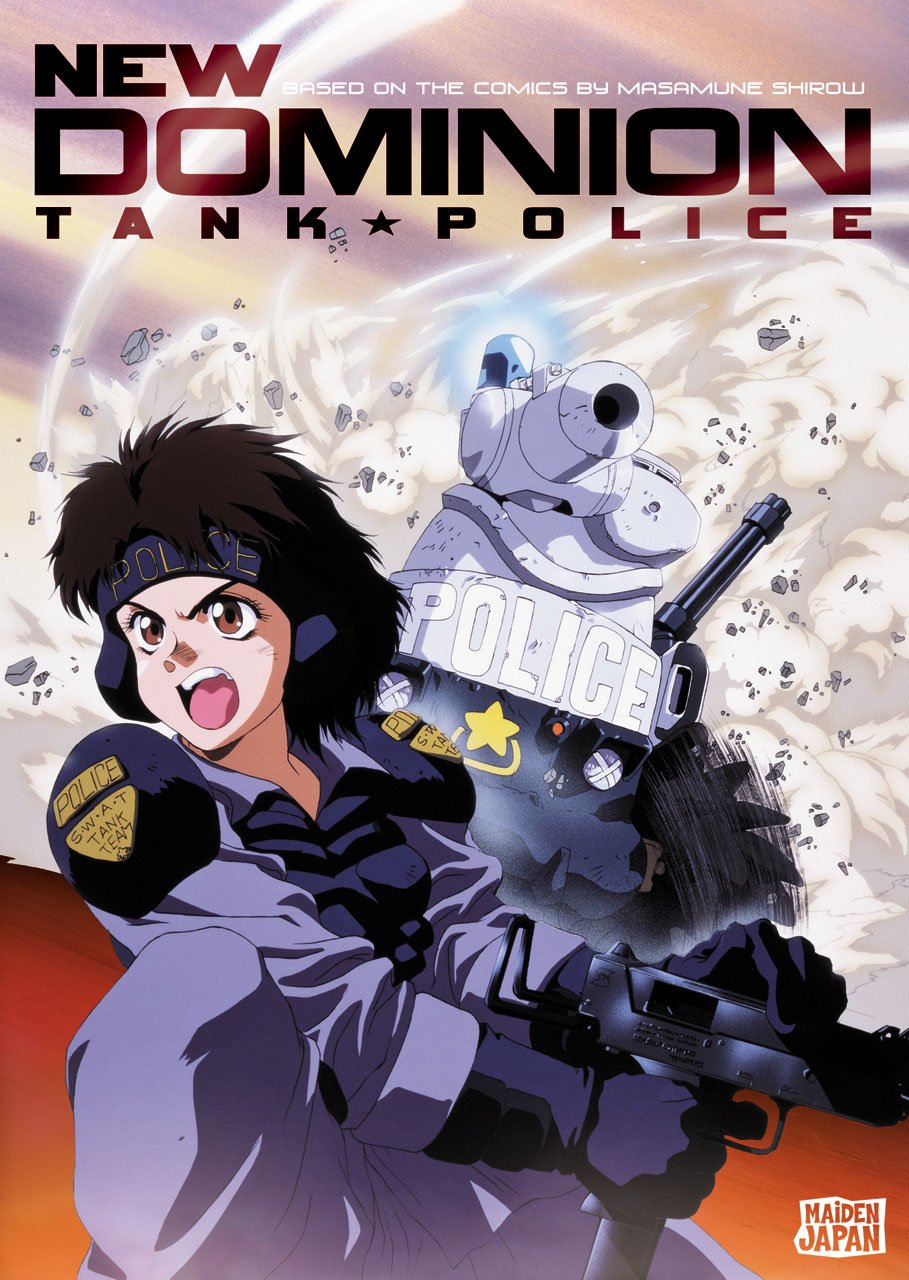
The name can't help but make me grin, because what immediately springs to my mind isn't an energy company but Dominion Tank Police. One of Masamune Shirow's lesser known works, it's a mostly silly series that can be quite clever and even poignant at times.
Emphasis on the "silly," as in the "Hey, Boy" strip tease scene from the first series (it looks more NSFW than it actually is).
Imagine Blade Runner as a slapstick comedy. With tanks. It deserves a revival. And might even survive a Hollywood adaptation, what with sci-fi comedies being all the rage these days (Deadpool, Guardians of the Galaxy). Plus a female protagonist!

The second series, New Dominion Tank Police, is available on DVD.
Labels: anime, economics, manga, science fiction, shirow, technology
September 07, 2017
Trust but financially verify
In 2015, there were 58 total organ transplants in Japan, versus over 30,000 in the U.S. Though Japan is a great place to get an inexpensive MRI or CT scan (technology, natch).
No, I'm talking about mooching off one's friends and relatives. The term du jour is "parasite single." Though it is constrained by certain cultural boundaries. The most common (dramatically speaking) is clearing debts and securing loans. The latter is a recurring dramatic trope: person X cosigns for person Y, who then defaults putting X in a tight spot.

A recent NHK morning melodrama began with the family decamping to the Noto Peninsula (the far side of the Moon) after the father defaults on a loan. It ends with him defaulting again (because his guarantor turned out to be crook), except this time he goes through a formal bankruptcy. This is depicted as the higher road but a tougher choice than in the United States.
In any case, considering the kind of high-tech business he was in, in Silicon Valley, he would have secured venture capital to start with, and at worse would have had to give up a controlling interest in the company. But the whole venture capital concept—giving money to strangers based on the strength of their ideas—hasn't really caught on in Japan.
Only recently has become possible to rent an apartment in Japan without a co-signer and the equivalent of a year's rent in advance. In the current NHK morning melodrama (which takes place during the 1960s), a girl renting a room in a boarding house (not an apartment) has her previous and future employer co-sign the lease.
 The United States, by contrast, because of its heterogeneous nature, evolved a "trust but verify" financial culture that makes it possible to invest in a person's resume rather that in who he's related to, and doesn't stigmatize risk-taking as long as the risk is understood. The venture capitalist accepts from the start that nine out of ten investments will fail.
This gets back to the intricacies of the mooching culture, which leads people to blindly trust "relations" even when the relations may turn out to be strangers. The result is an epidemic of what's called "Ore, ore" ("It's me") fraud. It's gotten so bad at times that police have been stationed at ATMs to ask the elderly why they are withdrawing money.
And yet, the deeply-seated cultural inclination, especially among the older generation, to trust "family" and to avoid public scandal, has made these crimes surprisingly difficult to curtail in a country that can rightfully boast of having one of the lowest crime rates in the world.
Labels: economics, japanese culture, law, nhk, politics, social studies
August 10, 2017
The drama of the PCB
During Japan's boom years in the 1960s, recruiters often turned to these outlying areas to supply factories with assembly line workers. The factories provided room and board (and many still do today).
Mineko's first job is "stuffing" or "populating" printed circuit boards (PCBs) for the brand new transistor radios. Women were deemed better suited for the job because of their slender fingers.

The 1964 Olympics was a big, big deal in Japan (even Hollywood got into the act). So much so that it produced an economic bubble, thanks to the accelerated work on the first showcase Shinkansen line and all the people buying the very latest radios and TVs.
The bubble popped when the Olympics ended, producing a short recession before the economic juggernaut got back up to speed again.
During this economic downturn, the company Mineko is working for goes bankrupt. Unsurprisingly. It was basically an overgrown mom & pop operation with factory floor the size of a basketball court and no room to expand.
Not much in the way of productivity gains could be made by hiring more girls to insert electronic components into circuit boards. This labor-intensive production model gave way to larger economies of scale and automation techniques such as wave soldering (patented in 1956).
In the drama, Mineko ends up working at a restaurant. Alas, the Asadora audience isn't as interested in electronics manufacturing as I am.
Populating PCBs is one of those invisible manufacturing processes our lives have grown dependent upon. Over the past half-century, the technology has become astoundingly efficient, not even counting the productivity gains made by replacing most of the components with integrated circuits.
The old way (what Mineko did on her assembly line) is "PCB Assembly Through Hole." The leads of the electronic components are literally fed through holes in the PCB and soldered.
Since the 1980s, "Surface Mount" PCBs have overtaken "Through Hole." With Surface Mount, there's no "threading the needle." The parts are glued onto the surface of the PCB and and then soldered using, for example, pre-soldered contacts and precision hot air guns.
But "Through Hole" remains alive and kicking wherever ruggedness and power transmission are primary concerns. Yeah, AI and humanoid robots are plenty cool, but the machines that populate PCBs never fail to impress me.
Related posts
Moore's Law illustrated
The accidental standard
The last picture tube show
Labels: asadora, economics, japanese culture, japanese tv, nhk, sports, tech history, technology
June 25, 2017
Prison of Dusk (1)
The Five Punishments (五刑) defined the penalties meted out by the legal system of pre-modern dynastic China. In their earliest forms, they involved (but were not limited to) tattooing, amputation of the nose, amputation of one or both feet, castration, or death.
Japan's Currency Act of 1871 defined 100 sen (銭) as equal to one yen. The ryou (両) was made equal to one yen (円) and taken out of circulation. The yen was defined as 24.26 grams of silver. At the current trading price, around US $10-$15. By the end of the 19th century, the yen was pegged at US $.50, also in the US $10-$15 range when adjusted for inflation.
The yen steeply depreciated during and after WWII. The sen was taken out of circulation in 1953 and replaced by the yen. One yen currently has a value of around one U.S. cent.
The organization of farming hamlets is described in chapter 25 of A Thousand Leagues of Wind. A hamlet typically consists of eight families who farm the eight allotments and one common area. Hamlets are usually only occupied in the summer during the growing season.
Shundatsu's tattoo uses the following characters: Kin (均) Dai (大) Nichi (日) In (尹). Tattooing is one of the penalties spelled out in the Five Punishments.
Labels: 12 kingdoms, economics, hisho, history, law, translations
February 09, 2017
Justice for all (Japanese)
The U.S. remains one of only two countries Japan has a formal extradition treaty with (the other being South Korea). But even that distinction can prove fairly meaningless, especially when it comes to civil matters and white-collar crime in particular.
For example, in divorce cases involving a foreign national, Japanese family courts will almost inevitably favor the Japanese party, regardless of what ruling a foreign court may hand down (which occasions no little bitterness on the part of divorced foreign nationals).
Following WWII, the Occupation forced the dissolution of the family-controlled vertical monopolies called zaibatsu. However, the zaibatsu soon reassembled themselves as the ostensibly more benign keiretsu.
During the economic boom times of the 1950s and 1960s, nobody on either side of the Pacific cared. But then came the rise of the Japanese auto industry and the fall of Detroit. U.S. law, in the form of the Sherman Antitrust Act, frowns on the keiretsu concept, especially in the auto parts industry.
The National Law Review reports that since 2010, "More than 30 companies [auto parts industry] have pleaded guilty to antitrust violations and paid approximately $2.4 billion in criminal fines." And while some guilty executives have "subjected themselves to U.S. jurisdiction,
Others appear to have taken the gamble that the DOJ will not be able to extradite them. In truth, it may not be such a bad gamble in light of the fact that the DOJ has yet to extradite a Japanese national for crimes committed under the Sherman Act [emphasis added].
Extradition treaty or no, Japan just isn't big on the concept for common criminals either. In an in-depth post on the subject, the Turning Japanese website wryly observes that,
An additional "benefit" of becoming legally Japanese [and being a Japanese citizen] is that you're protected (so long as you're on Japanese territory) from facing the justice system of other counties. If you do commit a serious crime overseas, and are arrested in Japan, you will face the courts of Japan and face punishment inside Japan.
What wrongdoers will face in Japan is the equivalent of the "village stocks" from Colonial days.


Public acts of contrition are de rigueur for public officials and titans of industry who get caught doing the wrong thing (or wrong things happening under their watch). Japan doesn't have "show trials" (no cameras in the courtroom during the trial). They do have "show apologies."
It's a very pro forma ritual. The guilty Pooh-Bahs, dressed like they're attending a funeral, stand in front of a swarm of reporters and television cameras and bow deeply. It's the Japanese version of the "perp walk."
 |
| Sony executives apologize for the 2011 PlayStation data breach. |
After which it's common for the guilty parties to disappear from sight until they have "repented." In Japan, prison sentences across the board are spartan and severe (bail and parole are rare) but far shorter than in the U.S. (For truly heinous crimes, the death penalty is still applied.)
Essentially, they are metaphorically banished to Mount Koya.
Mt. Koya is renown as the home of the Buddhist Shingon sect (if you're in Osaka, it's worth a day trip). For a millennium it was also where defeated warlords and disgraced officials could "retire" instead of losing their heads. (And it's the setting for Serpent of Time.)
Related posts
Hero
Lawyering Up
Less Crime and Less Punishment
Labels: economics, japan, japanese culture, law, sony
January 26, 2017
The toast of Japan

The category of "breakfast cereal" never took hold in Japan. A supermarket may stock a few boxes but not an entire aisle. The whole idea of a "sweet" breakfast is recent too. A "traditional" breakfast might include fish and rice and miso soup and natto (the grossest food ever).

On the culinary cultural spectrum, natto is at the opposite end of the scale as toast. A good many Japanese can't stand the stuff either. I would hazard that you see more natto eaten in television dramas than in real life because it just screams "old school" and fairly eccentric to boot.
French toast, on the other hand, is a dessert. As are pancakes. Both are somewhat exotic and yet easy to make. And so can be endlessly modified without much fear of failure. And, yes, there are countless French toast and pancake connoisseurs in Tokyo.
The daily melodrama series Toto Nee-chan devoted a week's worth of episodes on the magazine staff figuring out how to explain pancake-making to their readers in the late 1940s. In the end, a recipe wasn't enough. They had to use photographs, a real innovation at the time.
There is a simple and pragmatic reason for the popularity of French toast and pancakes. Few homes in Japan are equipped with the kind of kitchens that grace even the average apartment in the U.S. A full-sized oven is rare, counter space limited. Refrigerators are still small by comparison.
If they wanted, most Americans could make the dishes shown on America's Test Kitchen. Far fewer Japanese have the room for the basic equipment. A bakery is the only place where an enthusiastic baker can bake. And enthusiastic bakers are enthused over, as in Midnight Bakery.

And Ma're.

The typical cooking shows concentrate on the rice cooker, frying pan, sauce pan, microwave, and toaster oven. Somebody baking at home is probably using a countertop convection oven.
Here we get back to French toast (and pancakes): anybody can make it with the utensils and ingredients on hand.
The same goes for curry over rice (karee raisu), another visitor that's gone native. Curry rice is a 19th century import that seems older. The Japanese navy likely got the idea from the British navy (who got it from India), and universal conscription made it the national dish.

House Foods sold the first curry roux in 1926 and currently has a 60 percent market share. Their big seller going back to 1963 is "Vermont Curry." It is sweetened with apple paste, and apparently apples were associated with Vermont even in 1963.
Again, anybody can make curry anywhere with practically anything, as on all those anime school field trips.
Labels: anime, cooking shows, economics, food, japan, japanese culture
November 03, 2016
The accidental standard (2)

It only took a year for that uncertainty to fall away and things to gel. IBM made the microcomputer respectable and Microsoft made developing applications for other operating systems unnecessary. But they still had to be individually tweaked to account for each manufacturer's BIOS chip and hardware specs.
In November 1982, Compaq debuted a personal computer with a reverse-engineered BIOS, making it truly "IBM-compatible." Eighteen months later, Phoenix Technologies produced its own 100-percent IBM-compatible BIOS chips and sold them to anyone willing to pay the licensing fee (that additionally indemnified its customers from getting sued by IBM for IP infringement).
Microsoft was already selling MS-DOS to all takers and IBM "lookalikes" were flooding the market. But now the era of the 100 percent compatible IBM "clone" had arrived. The market solidified. In the August 1983 issues of PC Magazine, Todd Katz asked, "Is CP/M Dead?"
Naturally, Digital Research product manager Kevin Wandryk didn't think so.
Even if we do lose this marketplace and it goes totally to Microsoft, this is only Round Two. There is the 68000, the Intel 8286 and 8386 [80286 and 80386], the National Semiconductor 16032, and we have a leading edge at the present time in the operating system development in each of those areas. We certainly won't be blindsided again.
They wouldn't be blindsided because the 1970s and its tossed salad of 8-bit CPUs was over. Apple would go with the 68000. Microsoft and IBM and Intel would stick with MS-DOS and the x86 platform. Nobody was pining for alternatives. Katz saw the writing on the wall. His answer: "CP/M-86 is worse than dead, it is irrelevant."
In the October 1983 issue of PC Magazine, Compaq chairman Benjamin Rosen prophetically predicted that three players would remain in the market: "Those adhering to [the IBM PC] standard and those named Apple" and everybody else.
What came to be known as the "Wintel" standard (Windows + Intel) mattered so much that even the "IBM" part faded to insignificance. Compaq upped the game in 1987 with the Deskpro 386, the first PC to run on the 32-bit Intel 80386 chip. An IBM-compatible that was more "compatible" than an IBM PC forced IBM to lead, follow, or get out of the way.

IBM decided to lead, attempting to reassert sovereignty over the PC world with OS/2. OS/2 and the proprietary Micro Channel bus would lock users into the IBM ecosystem. In its struggle for market share, OS/2 was touted as "a better DOS than DOS and a better Windows than Windows," and that was the whole problem. Everybody was happy using DOS and Windows.
The same way nobody had wanted or needed CP/M-86 once MS-DOS had established itself among vendors and users, nobody wanted or needed yet another x86 OS standard. And Microsoft, who had developed OS/2 with IBM, quickly decided that it didn't either.
IBM and Microsoft broke up in 1990. Microsoft said it was sorry with a billion dollar alimony payment. Back in 1988, Microsoft had hired VMS architect Dave Cutler (another connection between DEC and Microsoft) to create NT, its multitasking "protected mode" OS. By the release of Windows XP in 2001, NT had turned into "a better Windows than Windows" that was still Windows.

In 1995, IBM was spending almost a billion dollars a year on OS/2 with "no possible profit or widespread adoption." Warp 4, released in 1996, was the last version of OS/2 distributed by IBM. Now managed by Serenity Systems, it lingers on in embedded environments like automated teller machines. In 2005, IBM sold its entire personal computer division to Lenovo.
Microsoft has never forgotten that lesson, only abandoning native 16-bit MS-DOS (DOS!!!) compatibility with the shift to 64-bit processing. I still use an old WordPerfect DOS dictionary app on my Windows XP machine, and all my 32-bit Windows 95 apps run just fine.
Well, Microsoft did forget it temporarily with Windows 8, when it pretended to be Apple. Apple, remember, had pulled the rug out from under its user and developer base at least three times: switching from MOS Technology 6502 to Motorola 68000 to PowerPC to Intel x86 CPUs.
Microsoft only messed with the interface of Windows and was forced to beat a hasty retreat. Though let's not forget that Windows still owns 90 percent of the (albeit shrinking) desktop/laptop market.
Microsoft getting ahead of itself with Windows 8 was a consequence of
it getting behind the curve with the Windows Phone. And that takes us way back to the beginning and Digital Research's late arrival to the PC party with CP/M-86.
CP/M (like DOS 1.0) wasn't a "standard," but Digital Research was open to customizing the operating system for every 8-bit CPU that came down the pike in the 1970s. The resulting fragmentation and version control problems meant that computers in the same product line often weren't compatible with each other, to say nothing of competing platforms.
Along with Palm and Blackberry, Microsoft was an early player in the mobile OS market, developing Windows CE since 1996. Like Digital Research, it had gotten good at customizing Windows CE for each vendor in a heterogeneous hardware market.
As Digital Research was by IBM and MS-DOS, Microsoft was blindsided by the iPhone, build on a single hardware platform with a new interface. Then Google made Android the DOS of the smartphone, licensing it to all comers. Google could have cribbed from Microsoft's famous mission statement: "A smartphone in every pocket all running Android software."
Back in 1983 and 1984, industry prognosticators were predicting that, any day now, MS-DOS would be superseded by Digital Research's CP/M-86, or Xenix (Microsoft's version of UNIX), or PC/IX (IBM's version of UNIX). A few years later, OS/2 and Micro Channel were going to dominate for sure.
But the IBM PC had set the standard and the PC world didn't need or want another one. Not even IBM could alter the ultimate direction of its own creation. This explains Microsoft's draconian efforts to get old fuddy-duddy hold-outs (like me) onto Windows 10: fragmentation and loss of version control is death.
The evolution of the PC made clear that the consumer market has room for two operating system (Windows and Mac), with the third (Linux) ending up a couple of sigma out on the long tail. The same thing happened with Android and iOS in remarkably similar proportions, this time with Windows Phone ending up with single digits of market share.
Unlike Digital Research, Microsoft has the resources to stay in the race. It plans to focus its Windows Phone efforts on enterprise customers while "betting on a technology leap in a few years with a paradigm shift." Which I take to mean: when Continuum and a Surface phone become practical realities (and Apple loses interest in the desktop OS).
Considering how much the computer industry has changed in the past 40 years, I won't be surprised at all if and when a new "accidental standard" takes over in a flash.
Related posts
The accidental standard (1)
The grandfathers of DOS
The future that wasn't
MS-DOS at 30
The cover
Labels: computers, economics, history, tech history, technology
September 17, 2015
Something Ventured

Here is a system that turns the old feudal order upside down. Marx asserted that the wealthy profited off the labor of the poor. In the world of venture capital, the monied search out unmonied entrepreneurs whose only assets are their bright ideas and willingness to work hard to see them realized.
If the bright idea fails, the monied financiers end up with less money and the unmonied entrepreneurs are back to where they started.
But when they succeed, not only can the investors become fabulously rich but the wealth gets widely spread around. Here is the closest thing to creation ex nihilo since Genesis, turning common bacteria into medicine and beach sand into computer chips.
The dreams of the alchemists—to transform worthless lead into priceless gold—have come true. In 1976, a $250,000 investment created Genentech, which twenty-five years later was sold to Roche for $47 billion. When Apple went public in 1980, it immediately spawned 300 millionaires.
In Triumph of the Nerds, Bob Cringely ruefully recounts how he worked one summer for a fledgling Apple Computer and insisted on being paid in cash, not stock. That's not nearly as bad a miss as Atari president Nolan Bushnell passing on an offer to own one third of Apple Computer for $50,000.
Apple today is worth over $600 billion.
But this story is more about people than calculations of profit and loss.
William Shockley, co-inventor of the transistor, was a highly eccentric man whose dysfunctional management style eventually alienated his entire senior engineering staff. Fed up, they decamped en masse to Fairchild in a deal brokered by future venture capitalists Arthur Rock and Alfred Coyle.
Fairchild Semiconductor pioneered the planar process, shared a patent with Texas Instruments for the integrated circuit, and was the first company to introduce an IC operational amplifier. In the mid-1960s, Fairchild was one of the few profitable semiconductor manufacturers in the U.S.
Unfortunately, Fairchild's East Coast managers ran the West Coast company like a 19th century corporation. The peons were supposed to work to enrich their betters. Except when the value of an enterprise resides in the minds of its employees, those employees can walk that IP right out the front door.
Which they did in droves, founding spin-off companies known as "Fairchildren." Shockley's and Fairchild's disaffected brain trusts created today's Silicon Valley, but only because venture capitalists were willing to risk millions on cash-poor, hard-driving entrepreneurs and their outrageous ideas.
By contrast, this interview about venture capital in Japan details the difficulty the concept has overcoming age-old cultural hurdles. And note how well Steve Jobs matches the Asian ideal of a startup CEO—a charismatic leader in total control of his company—hence his iconic popularity in Japan.
Something Ventured can be viewed on Amazon Prime.
Labels: economics, japan, science, tech history, technology
September 03, 2015
Window fans
Building codes in the U.S. stipulate wall and ceiling insulation ratings but rarely Whole House Mechanical Ventilation. And in an apartment (especially a forty-year-old one)? Fuhgeddaboudit. Unfortunately, because ventilating an apartment would be easy.
(The air conditioner and refrigerator in mine are as old as the apartment; the hermetically sealed compressor pioneered by General Electric is an amazingly rugged piece of machinery. But they are power hogs.)
When I was a kid back in the prehistoric times, my dad installed a WHMV system in our big baby boomer house. That plus tons of insulation in the attic made a huge difference, and was orders of magnitude cheaper than central air conditioning.
My solution has always been to buy a box fan and attach screws to mount it in the window. The first one was the best, with metal blades that were quiet and didn't turn too fast. They've been plastic ever since and noisier. But the last two really disappointed.
My previous Aerospeed fan wasn't unbearably loud but became steadily unbalanced (like a wobbly wheel). I started hearing what I thought was outside helicopter traffic (not that unusual where I live). It was the fan putting on a convincing ventriloquism act.
Its replacement, an inexpensive Lasko B20301, was well-rated on Walmart. That thing is a screamer, a turboprop ready to take off. I'm sure it'd be fine in a barn or a 2000 square foot house. It was too loud even from the bedroom.
So it was time to get a purpose-built window fan. The top-selling twin fan on Amazon is the Holmes HAWF2021. But the bad reviews (always read those) consistently mentioned the noise, and that made me nervous. I didn't feel like rolling the dice again.
In the reviews, somebody recommended the HDX FW23-A1 as the superior choice. HDX is Home Depot's store brand. Having decided I couldn't live with the Lasko, I took a closer look at the Home Depot listing.

Several reviews mentioned how quiet it was. That sold me. I trundled down to the local Home Depot and picked one up. It truly is the quietest fan I've had so far, and just ten bucks more than the Holmes. Plus, the airflow can be reversed with the flick of a switch.
Granted, it won't blow a gale through your living room; more like a gentle breeze. And in reverse, it's better than the air conditioner.
The accordion expander needs work. You have to play tug-of-war to get it out as far as in the picture. I wish they'd enclosed more than one of the Lego-like expansion "feet" instead. But the gap was easily filled by a piece of foam board.
The one disadvantage is that, unlike my old box fan kludges, when the HDX FW23-A1 isn't on it doesn't let much air through, which minimizes passive airflow. But that also means you don't have to hastily remove it with every change of the weather.
Labels: appliances, economics, utah, weather
July 29, 2015
Just don't stand there
Take out a pack, extract a cigarette, give it a couple of taps to pack the tobacco, search the pockets for a book of matches, find it, get one out, strike it, light the cigarette, wave out the match, take a puff, exhale smoke. And on it goes.

(In other words, real political life is not like The West Wing.)
And yet the engine of a story has to idle occasionally. The protagonists can't be in pursuit of the plot 24/7. So what are they doing when they're not?
In real life, people are pretty boring. Middle class, suburban teenagers in particular are really boring. But you can't bore the viewer in the name of "realism." Hence that most reliable of genre fantasy plots: boring kid discovers he's not.
Harry Potter, Peter Parker, Luke Skywalker, to name a few.
The job of the teenage superhero is Saving the World, except Saving the World gets boring week after week too. It really does. Besides, what do they do when the world doesn't need saving? As Kate suggests, it's a problem solved "by simply giving the main characters jobs."
I'd argue that the appeal of action heroes like Tony Stark, Bruce Wayne, Peter Parker, and Clark Kent is due in large part to the fact that they all work for a living. At least when we first meet them. And the less real work they do, the less interesting they are.
I'd prefer to see more of Peter Parker using his superpowers to creatively enhance his job as a photojournalist instead of battling the latest comically absurd supervillain. In other words, less time spent saving humanity (sorry, humanity), more time making a living.
For the Y/A protagonist, being a student can qualify as a job. One of the best examples of this is Buffy the Vampire Slayer. Buffy's two jobs (student/Slayer) means that the mundane is constantly bumping up against the supernatural. This is great for story possibilities.
Manga and anime execute this formula to great effect.
In The Devil is a Part-Timer, our villain with a good heart has gotten stranded on Earth and has to get a job at McDonald's to make ends meet. Even funnier, being the competitive guy that he is, he works hard and cares about being successful at what he does.
So in-between destroying/saving the world, he's got to staff the late shift and keep the customers coming when a Kentucky Fried Chicken opens across the street. It's a much better way to humanize the protagonist than being nice to children and rescuing wayward pets.
(Though just to be sure, he does that too.)
When it comes to non-paranormal melodramas, the budding manga artist is a popular job for a teen protagonist. In Hanasaku Iroha, Ohana works at her grandmother's inn while attending school. In Kodocha, eleven-year-old Sana is a hard-working child actress.

Serious hobbies also qualify. The sports manga/anime is its own huge genre, but there the sole (even relentless) focus of the story is often the sport. There are exceptions: I'm thinking specifically of stories where the story is about something other than the "job."
I think Yawara falls into that category. Yawara Inokuma's grandfather has trained her since infancy to be a judo champion. But now a teenager, she's rebelling. There's plenty of judo, but the story is more about her relationship with her grandfather and classmates.
In K-On, five students at an all-girls high school form a band that turns out to be pretty darn good (almost despite themselves). The running joke is that they're always so busy doing other things that they only get around to practicing the night before a gig.
In Garden of Words, Takao wanting to become a shoemaker works because it keeps him from moping all the time and gives him a goal in life. And it being an odd thing for a teenager to be interested in makes him all the more interesting.
Genre fiction gets boring when it tries too hard not to be. The result is a storm of action and emotions, except that constant action is exhausting and emotions are effervescent. Forcing characters into regular contact with the ordinary world is what brings them to life.
Related links
The Devil is a Part-Timer (H)
Hanasaku Iroha (H CR)
Kodocha (Netflix)
K-On (H)
Yawara (Netflix)
Labels: anime, buffy, economics, superhero, television, thinking about writing