

February 01, 2018
Taking natural gas for granted
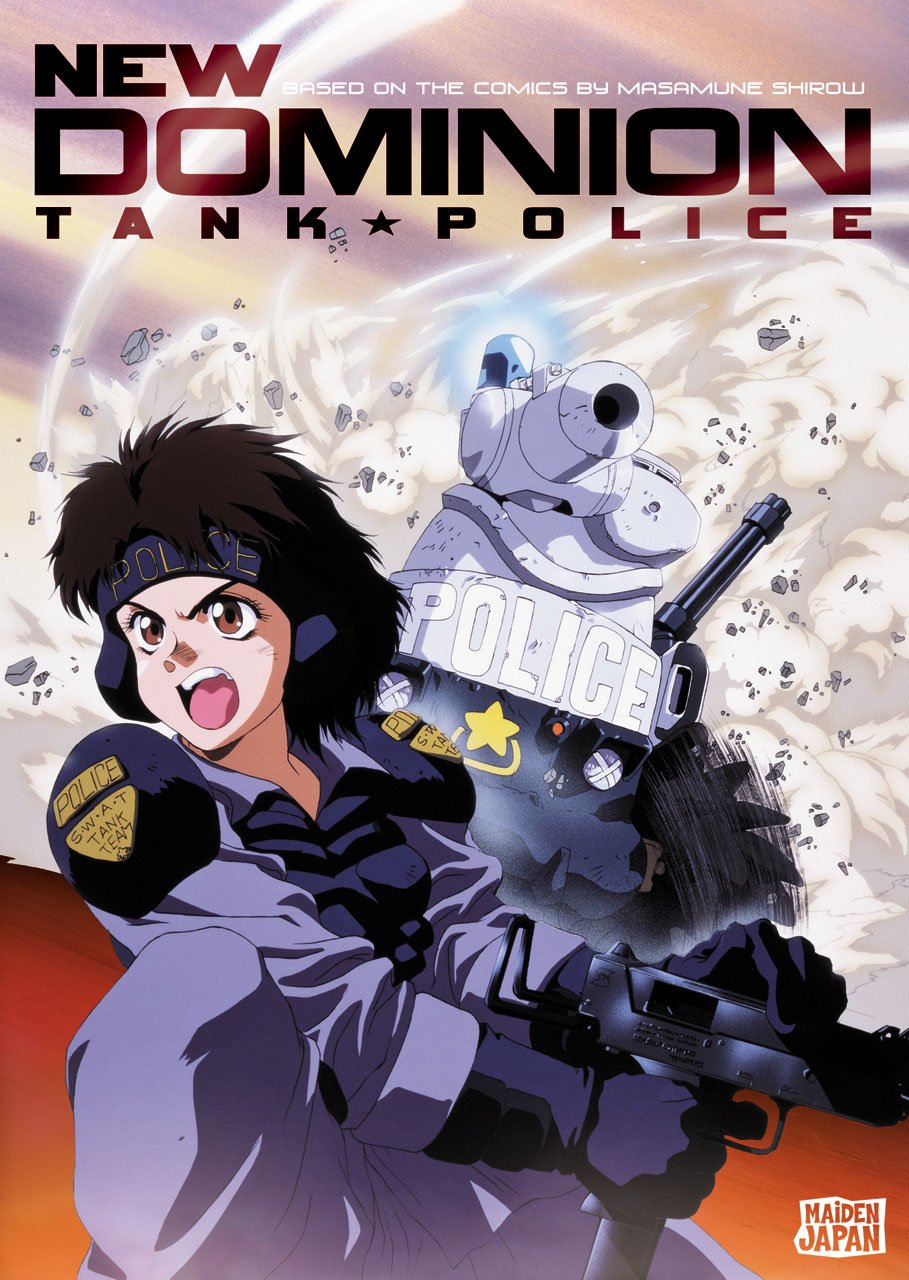
If natural gas were part of my personal energy mix, Dominion Energy would be my provider, having merged with Questar. They subsequently ran public service spots reminding everybody that "Questar Gas is now Dominion Energy!"
I've even see Dominion Energy utility trucks driving around.
The name can't help but make me grin, because what immediately springs to my mind isn't an energy company but Dominion Tank Police. One of Masamune Shirow's lesser known works, it's a mostly silly series that can be quite clever and even poignant at times.
Emphasis on the "silly," as in the "Hey, Boy" strip tease scene from the first series (it looks more NSFW than it actually is).
Imagine Blade Runner as a slapstick comedy. With tanks. It deserves a revival. And might even survive a Hollywood adaptation, what with sci-fi comedies being all the rage these days (Deadpool, Guardians of the Galaxy). Plus a female protagonist!

The second series, New Dominion Tank Police, is available on DVD.
Labels: anime, economics, manga, science fiction, shirow, technology


August 17, 2017
Ghost in the Shell

Both 47 Ronin and Ghost in the Shell (2017) were ruined by absurdly generous budgets. Some tightening of the purse strings, some discipline in the art direction, might have reined in the compulsion to plaster every square inch of the screen with CG effects that make no sense in the context provided.
Hollywood needs a new movie-making rule: if you want that Blade Runner "look," pretend you have to do it the old-fashioned way, on a sound stage using in-camera effects. Otherwise, don't do it.
Not only is it wasteful, but the obsession with "big" CG overlooks better "small" CG possibilities. As Aramaki, Beat Takeshi speaks only Japanese. What about other languages? Definitely Mandarin and Cantonese. Simulating simultaneous machine translation capability would open the door to a lot of linguistic fun.
Cinematographic excesses aside, the biggest problem with the latest incarnation of Ghost in the Shell (and with most adaptations of this ilk) is a needlessly muddled and hackneyed script. It didn't stick closely enough to the source material (same problem with 47 Ronin).
Though I'm afraid that still wouldn't have turned it into a blockbuster worth its $110 million budget.

The original film had no problem making back its six (that's six) million dollar budget. But like Blade Runner (1982), which failed to break even during its theatrical run, Ghost in the Shell (1995) has since garnered a reputation that outstripped its initial box office appeal abroad.
Director Mamoru Oshii sifted through Masamune Shirow's manga and extracted the two classic questions at the nexus of philosophy and computer science: 1) At what point does an complex machine gain sentience? 2) How much of a human brain can be replaced with inorganic components before sentience is lost?
Here was cyberpunk done right, that took itself (a bit too) seriously. But it was prescient. The Netscape browser (version 0.9) had only been out a year. The Matrix came along four years later, drastically dumbed down the subject matter, tossed in a big bad mainframe antagonist and tons of gun fu, and made beaucoup bucks.
Hollywood learned exactly the wrong lesson.
Okay, so it was asking too much to expect American audiences to sit through a hundred-minute treatise on cyborg existentialism. But at least director Rupert Sanders could have made a movie that didn't immediately decompose into a mess of cliches, like spending the first five minutes serving up a bucket of unnecessary backstory.
Just start with the classic rooftop opener!
Oh, and about that opener. What Mamoru Oshii gave us in 1995 was not the Major going all cowboy in a shootout at the O.K. Corral (Sanders forgot he wasn't remaking John Wick), but the carefully executed assassination of a foreign diplomat engaged in industrial espionage.

I can well imagine that the Chinese financiers of the 2017 remake weren't too keen on a story that revolved around government-sponsored hacking of foreign entities and internecine battles between competing ministries. Too relevant! Just make the bad guy a Japanese corporation. Yeah, that'll do it.
So what we got instead was Robocop. Seriously. It's Robocop meets a self-
(Also see Kate's comments about the uninspired practice of hiding critical information from the protagonist and the audience in order to maintain suspense.)
Major Kusanagi's past isn't an issue. Her hardware isn't unique. Ghost-less androids are commonplace (Aramaki's assistants, for example). The existential angst doesn't kick in until the cat and mouse game with the "Puppet Master" is well underway, when the possibility arises that sentience can exist in an AI without a ghost.
And that cat and mouse game is smart (though a bit talky at the halfway point). The story hangs together well after twenty years, despite the enormous technological changes. The narrative isn't pushed forward by the characters crashing through doors and shooting everything in sight and taking unnecessary risks.
Major Kusanagi is a tough, competent, by-the-book team leader. She only steps out of line at the very end, when her inner existential crisis threatens her actual existence. And once she steps out of line, all is not forgiven and she's not coming back.
It's no surprise that the best scenes in the remake are exact copies of the original. Ghost in the Shell didn't need to be redone. It's just fine as the penultimate film in the franchise. Major Kusanagi doesn't even make a corporeal appearance in Innocence, the sequel to Ghost in the Shell.
Rather, the prequels provide more suitable material as entry points for American audiences. In particular, I consider the Stand-Alone Complex television series to be better than the manga or the latter two movies (though they are different enough to defy direct comparisons).
Along with the season-long arcs, there's plenty of material in the standalone episodes, plus the feature-length Solid State Society, to fuel a franchise of remakes. Forget about evil mainframes taking over the world. This isn't Deep Blue versus Garry Kasparov, but a bunch of Deep Blues and Garry Kasparovs all playing each other.
Person of Interest was headed in the right direction before it fell into the evil mainframe trap and contended that "there can be only one" (credit for that goes to Highlander). No, in the world of Stand-Alone Complex there can be millions, if not one for every person on the planet.
Sure, a supercomputer can beat a grand master at chess or go. But a pretty good computer teaming up with a pretty good human player is better than both. This is the fundamental concept The Matrix movies failed to grasp. Self-aware machines will need us as much as we need them. (An on-off switch is a powerful thing.)

Plus, the Tachikoma robots—some the most original characters in all of science fiction—would make for a marketing tie-in bonanza.
All the necessary ingredients are there. The next time Hollywood gets a hankering to serve up the latest cool Asian fusion cuisine, well, first hire a chef who bothered to read the cookbook.
Related posts
Innocence
Reframing the mainframe plot
The Medicator (they'll be back!)
What is the narrative need for secrets?
Labels: anime, anime reviews, computers, mainframe, manga, movie reviews, science fiction, shirow, tech history, technology
February 19, 2015
The Shirow franchises (2)
The "difference engine" was first proposed in the late 18th century, but this now well-worn trope truly came into its own as mainstream entertainment in the 1950s with the Tracy/Hepburn comedy Desk Set (1957) and NASA's adoption of the IBM 7090 at the dawn of the space race.

Only four years after Appleseed, Masamune Shirow saw the future and the future was networked. The last line in Ghost in the Shell (1989) says it all: "The net is vast and infinite."
This marked a true sea change in the genre. The "computer" would no longer be a single "character" (an electromechanical dictator) but part of the landscape. This is especially true in the Stand Alone Complex series, in which cyber is simply there, like the water and air.
As Google chairman Eric Schmidt put it recently, "The Internet will disappear." Meaning that it will become as ubiquitous as electric power and radio waves, treated as a given, as if it has always existed and has always been available, and so is only noticed when it is not.
Alas, too many Hollywood science fiction writers are stuck on the mainframe as the "Big Bad" and "hacking" as a magic wand. A quarter century ago, Shirow got it right.
• Ghost in the Shell (manga) 1989-1990
• Ghost in the Shell (theatrical release) 1995
• Innocence (theatrical release) 2004
• Stand Alone Complex (TV anime series) 2002-2006
• Solid State Society (OVA movie) 2006
• Arise (OVA series) 2013
• Ghost in the Shell (theatrical release) 2017
• Plus 1997 and 2015 video games.
Right from the start, Ghost in the Shell throws a wrench into the sequel machinery. Kusanagi merges with the AI at the end of the first movie. In Innocence she appears only virtually. So the only place to go without completing trashing the premise is backwards.

Thus Stand Alone Complex is a prequel. The two SAC series are not only superior to the original but rank among the very best in the genre. The latest installment in the franchise, Ghost in the Shell: Arise, is a prequel to the prequel, including an "origins" story.
 |
| The real stars of SAC: the Tachikoma robots (Wikipedia Commons). |
And talking about allegiance to established canon (or the lack thereof), Dreamworks has signed Scarlett Johansson for a 2017 live-action remake of Ghost in the Shell. The casting has already raised questions among fans about how a "Johansson" can play a "Kusanagi."
The obvious solution can be gleaned from A Fistful of Dollars (Yojimbo). Or Edge of Tomorrow (All You Need is Kill). Clint Eastwood and Tom Cruise are models for "occidentalization." Just keep the plot moving and don't bury the story beneath piles of ponderousness. A good story will always shine through.
Related posts
The Shirow franchises (1)
Appleseed
Appleseed: Alpha
Appleseed: Ex Machina
Innocence
Reframing the mainframe plot
Labels: anime, computers, ghost in the shell, mainframe, movies, robots, science fiction, shirow
February 12, 2015
The Shirow franchises (1)
 |
| The opening scenes of Ghost in the Shell owe a lot to Ridley Scott. |
Black Magic (1983) got an OVA (meaning: direct-to-video). The goofier Dominion Tank Police (a personal fav) spawned two TV anime series besides the two manga series (1986 and 1995). For most manga artists, that'd be more than enough success for a lifetime.
But it was Appleseed (1985) and Ghost in the Shell (1989) that took on lives of their own. Neither franchise demonstrates much allegiance to an established canon. With new production teams taking up the reins each time around, every iteration gets its own reboot.

Examining his original manga, you will notice that Shirow and Frank Frazetta share a similar visual aesthetic that gets toned down (a lot) for anime (and that includes the Ghost in the Shell movie). Shirow has also published two dozen art books and poster collections.
• Appleseed (manga) 1985–1989
• Appleseed (OVA series) 1988
• Appleseed (theatrical release) 2004
• Appleseed: Ex Machina (theatrical release) 2007
• Appleseed: XIII (TV anime series) 2011
• Appleseed: Alpha (theatrical release) 2014
• Plus a 1988 video game.
Appleseed sprang back to life after a fifteen-year break using motion-capture digital animation for all productions. I guess if you go full digital once, it gets easier to keep on doing it that way, because that's what they've done, including the television series.

The first two films and series stick to the original premise: Deunan Knute and her cyborg partner (and boyfriend), Briareos Hecatonchires, are members of an elite SWAT team/special forces unit in Olympus, the futuristic, post-apocalyptic city at the center of everything.
The one odd discontinuity up to this point is that in XIII, Deunan looks and acts barely out of her teens, and XIII includes origins materials that make it a prequel to Appleseed. (I seem to recall that the origins material in Appleseed is different too.)
The real wildcard is the latest, Appleseed: Alpha, which jumps completely out of the established timeline. Deunan and Briareos haven't even gotten to Olympus (and aren't even sure they ever will), and yet they are clearly older and wearier than in the Olympus arc.
Alpha is, at heart, a classic road movie, and that's a good direction to go in. Olympus pulling the strings from afar rather than up close creates more latitude in the storytelling. Besides, the whole utopian society (but it's rotten underneath) cliche is pretty tired.
On their way to the mythical Olympus, Deunan and Briareos keep getting sidetracked. And at the very, very end (wait for the credit roll), we learn that Olympus plans to keep on sidetracking them. I'm game. I like the direction Appleseed: Alpha is taking things.
I hope they keep heading down that road.
Related posts
The Shirow franchises (2)
Appleseed
Appleseed: Ex Machina
Appleseed: Alpha
Ghost in the Shell: Innocence
Labels: anime, computers, ghost in the shell, manga, personal favs, science fiction, shirow
January 26, 2015
The moves make the woman
Our brains are so wired to recognize human motion that the raw dot-data alone gives us away (as this interactive motion capture demo shows). Of course, secondary sexual characteristics matter too, so most of the males look like roided-up body builders and Deunan wears a tank top.
Mr. and Ms. Killer Robot make for a more fascinating example. There's nothing "skin-deep" about them because they have no skin. But we can discern at a glance the male and female of the species. Clear as day. We sift and sort without thinking about the complex visual information our brains are processing.
There's a female and two males in this still (click to enlarge). How do you know? Instantly? It sounds like a dumb question but think about it. (To start with, implied waist-to-hip ratios, and then pelvis and shoulder morphologies.)

Any lingering doubts are erased the moment they start to move, as at the beginning of this clip.
You cannot lie to the motion capture machine! For a side-by-side comparison, click over to this interactive demo and slide the male/female control back and forth.
Despite the apparent silliness of having "male" and "female" robots, it doesn't disturb my suspension of disbelief. At that level of technology, we humans would waste little time mapping onto robots the full range of recognizable human characteristics, including the common markers for sexual dimorphism.
Related posts
Appleseed
Appleseed: Alpha
Appleseed: Ex Machina
The "uncanny valley"
Labels: anime, computers, robots, science, shirow, social studies, technology
January 22, 2015
Appleseed: Alpha
Appleseed: Alpha is a great illustration of that in a visual medium, pulpy entertainment done as well as could be expected on a reasonable budget (dirt cheap by comparable Hollywood standards) and delivered in a hyper-digital medium. It's earnest without becoming ponderous.

The setting is completely different from the previous movies and series. If anything, it owes more to The Road Warrior (with robots instead of biker dudes), and comes to a "Hulk smash!" conclusion: take out the bad guys and kill the mecha Godzilla to keep it out of the hands of the much badder guys.
The easy-peasy plot is a vast improvement over previous Appleseed efforts, that had such tangled narrative structures it was a miracle the villains could remember what they were supposed to do next. Here's a key to good quality schlock: don't over-complicate the premise and stick to what works.
Which ultimately does make Appleseed: Alpha more interesting for reasons other than the story.
To start with, it's a demonstration of how much digital animation technology has improved since Appleseed (2004). There's a scene in Appleseed: Alpha (2014) where my attention was drawn to Deunan's hair--down to the individual strands--shifting ever so slightly as she moved her head back and forth.
That kind of detail was impossible with Appleseed. As I described the state of budget digital animation back in 2004:
Hair is a bear to render digitally, so it's stylized the same chunky way it is in hand-drawn anime. Shading as well uses a limited palette. The resulting low-res digital characters seem caught in a flatland between two and three dimensions, appearing hand-drawn sometimes and like sophisticated marionettes at others.
Evidence that Moore's Law hasn't been repealed shows up in unlikely places, like the cost of rendering digital cartoons.
The backgrounds in Appleseed: Alpha often leap right over the "uncanny valley" straight into a world you could easily mistake for real. Human faces, however, remain firmly planted on the other side of the valley (granted, there are so few human faces in Alpha that it rarely spoils the effect).
As a result, in the emoting department, the human Deunan is upstaged by the cyborgs. Even Ms. Killer Robot (with her runway model moves) has more personality. Not having a face helps. All the rendering in the world still can't infuse a digital face with the same "soul" as hand-drawn animation.
Comparing the Deunan to Madoka (from Puella Magi Madoka Magica), for example, abstract art wins hands down over photorealism (though I'm still impressed by the hair).


Maybe the day is coming when we will increasingly risk losing ourselves in a computerized Matrix that is indistinguishable from what we once knew as "reality." But it isn't here yet, and like the self-aware AI that's supposed to be soon taking over the world, I seriously doubt that day will ever arrive.
Related posts
Appleseed
Appleseed: Ex Machina
Baby DragonForce
The "uncanny valley"
Labels: anime, anime reviews, apocalyptic fiction, japanese movie reviews, movie reviews, movies, robots, shirow, technology, uncanny valley
December 02, 2013
GITS Surface ad
If you have a pressing need to kill lots of bad guys and steal computer data, the Surface is the tablet for you!
Labels: advertising, anime, ghost in the shell, shirow, technology
November 25, 2013
Ghost in the Shell: Arise
Not only by avoiding the stale "robots are taking over!" meme that Hollywood writers can't get past. But in imagining a technological society just short of the "Singularity" (one of those evolutionary steps that will always be just over the horizon), and yet no more or less dystopian than this one.
The human species keeps muddling through, as it always has and always will.
The series is being rebooted in a four-film series featuring a new cast, designs, director and writer (though still produced by Production I.G.). It's a prequel even to Stand-Alone Complex, taking Kusanagi back to the beginning of her career with Section 9. This is a series I definitely want to see.
Labels: anime, computers, ghost in the shell, manga, robots, shirow, technology
July 17, 2008
Innocence

Ghost in the Shell—to date the best interpretation of William Gibson's cyberpunk classic, Mona Lisa Overdrive—stands alongside Blade Runner, Dark City and The Matrix as one of the handful of films that do the genre any cinematic justice. Consequently, Innocence, as with all such sequels, begins burdened with the expectation that it will somehow out-geek and out-pontificate the original.
To be sure, it doesn't have as many problems as those dreadful Matrix and Star Wars sequels. It avoids resorting to empty philosophical babble (scripted by people not as smart as their characters) in an attempt at faux profundity. There's nothing worse than film makers, who after the fact discover that they produced something profound, and then the next time around try to be profound on purpose. The results are always ugly.
Babble there is, but it's not empty. Director Mamoru Oshii started with good material, and it's been ten years since Ghost in the Shell. But Ghost is the Shell was structured to make a particular existential argument, and with a compelling female protagonist (Motoko). At times, Innocence turns into a My Dinner with Andre (with androids). Hey, I liked My Dinner with Andre, but you want to tell Batou and Togusa to shut up and go shoot some more yakuza.
Innocence is built upon the foundation of a great idea—that the only way to make a robot "real" is to clone a human soul—and is buttressed by the eternal question of what ends justify what ends. The lead, though, is buried by one too many is-this-a-dream-or-reality sequences. Perhaps Oshii thought the idea too obvious and thought it necessary to muddy the waters. Complexity is one thing, but I prefer stories that don't rely on a tangle of tangentialities to keep the audience from figuring out the ending.
The last twenty minutes is worth waiting for, except that it also prompts you to ask why the middle third couldn't have been at least ten minutes tighter or ten minutes more relevant, and why we had to wait this long for Motoko to show up and provide something more than whispered subliminal warnings and cryptic clues you'd only remember if you'd watched Ghost in the Shell about fifty times.
Oshii admits this on the commentary track, which is doubly annoying. Better to embrace clarity in the first place than ask for forgiveness afterwards. But I still recommend the film. There's something to be said for being too talky and too cryptic rather than too dumb. Too much Matrix leaves the eyes glazed over with its self-important navel-gazing. Too much Star Wars actually kills brain cells.
Moreover, I'm not yet ready to give up on hand-drawn animation, especially when it comes to human characters. Even in zillion-dollar productions like Shrek, digitally animated people have that Final Fantasy look that ends up looking less human than traditional pen and ink drawings. Besides, if you can't tell the difference between "real life" and "art," then what's the art for? The Louvre would replace the Mona Lisa with a (digitally scanned) photograph.
One final gripe with the R1 DVD release specifically is that the subtitles combine the closed-captioning track with the subtitle track, which is unbelievably annoying. I spent about five minutes fiddling with the remote and failed to find a "normal" subtitle track. A big boo, hiss to distributor DreamWorks. They can do better than this.
Labels: anime reviews, ghost in the shell, robots, shirow, yakuza
March 19, 2008
Appleseed: Ex Machina

The Matrix proved that carried along by a sufficiently complex and ingenious plot, an idiotic science fiction premise (starting with that business about the batteries) can be stretched out for ninety minutes. Appleseed managed that. Appleseed: Ex Machina doesn't (and neither did the The Matrix sequels).
All the eye candy and video game shoot-em-ups makes the movie an entertaining-enough diversion. But Appleseed did such a good job proving what a really bad idea it is to create an authoritarian society with utopian pretensions run by a bunch of genetically-engineered androids and a ginormous mainframe.
And then Appleseed: Ex Machina proposes that the answer to all those inherent problems are more dispassionate androids and a bigger mainframe, with even more total control of everything. We're even treated to crowds of mainframe-controlled zombies, looking as cornily Roger Corman as it sounds. As economist Donald Boudreaux puts it:
A far greater danger to Americans' prosperity than a President with a poor speaking style and a penchant for standard-fare political shenanigans is the spread of the belief that economic salvation lies in having someone "in control."
But back during the 1960s, the mainframe was the only way to harness enough computing power in one place to do anything useful. By the 1970s, the Cray supercomputer had further cemented the metaphor of the super-smart, centrally-located, all-powerful electronic brain, generously time-sharing out its intelligence to us mere mortals.
If anything, Appleseed is a tribute to a bygone era, when despondent Marxists could dream of benevolent dictatorships putting a chicken in every pot and making the trains run on time. But run by computers, which would make it all totally cool. Yet by the 1990s, Cray Computer Corporation was bankrupt.
The Internet was instead about decentralized, distributed computing using off-the-shelf components.
But the Star Trek universe is still ruled by mainframes. The Matrix universe is run by mainframes. The Star Wars universe is run by mainframes (all conveniently located in one location, without redundancy or backups). Hollywood has mainframes on the brain.
Recall that every other episode of the original Star Trek had one of these Edenic societies blowing a major fuse. At least they got that part right. "One ring to rule them all" became "One mainframe to rule them all." It does give the protagonist and easy objective: toss the ring into the volcano. Or nuke the mainframe.
And then rebuild the blasted thing all over again, exactly the way it was before. A never-ending public works project to beat all public works projects, I guess.
One notable exception is Ghost in the Shell, created by Masamune Shirow after he wrote Appleseed. Second time around, Shirow got it exactly right: a decentralized, distributed, chaotic world where nobody can be in control of everything, and the worst problems are caused by people trying to be in control of everything.
It becomes the contradictory job of the good guys in Section 9 to exert authoritarian force in resisting that authoritarian impulse (ditto: Jack Bauer). But good premises make good stories precisely because the conflict is built in and perfection is elusive. Not surprisingly, every Ghost sequel has equaled or exceeded the original.
Take seriously the notion that a technological, utopian paradise is possible in the here and now, and like all socialist realism art, the essential conflict can only boil down to evil (capitalistic) forces trying to destroy Eden. It sounds high concept at first, but it'll always end up as high camp in the James Bond/Austin Powers/Star Trek vein.
In Buffy the Vampire Slayer, the end of the world (not again!) was turned into a running joke. The underlying plot devices in Ghost in the Shell, by comparison, are surprisingly mundane. Stop aspiring to perfection, and the challenge of wrestling with ordinary desires and frustrations opens the door to transcendence.
Consider the original and its four sequels in terms of the primary plot device:
Ghost in the Shell Industrial espionage Innocence Prostitution Solid State Society Medicare funding SAC: I Medical drug trials SAC: II Terrorism and separatism
To be sure, Solid State Society is a tad deeper than that, but the questions raised by a high-tech society with an aging population and a low birth rate—also explored in Katsuhiro Otomo's comic Roujin Z—are questions about the value of life itself. It makes sense why the various players would be driven to a murderous crime wave.
I thought the free-wheeling world of Star Trek: Enterprise made it the best of the series, though the Orwellian UN-in-outer-space meme still hovered there in the background. In Serenity and Firefly, Joss Whedon created the best space opera series to date by getting back to a messy libertarian world that was recognizably real.
Naive and idealistic politics, however well-intentioned, make for bad movies. Imperfect people battling an imperfect system make for good movies. As novelist Richard Russo puts it, "unrelenting virtue is not just unrealistic but uninteresting." Appleseed: Ex Machina takes on the task of making an uninteresting idea interesting. And mostly fails.
Related posts
Appleseed
The "uncanny valley"
Reframing the mainframe plot
The Medicator (they'll be back!)
Labels: anime reviews, annoying stuff, ghost in the shell, mainframe, politics, science, science fiction, shirow, uncanny valley
January 07, 2008
Girls kick butt

Essentially, you've got two hours of plot distilled down to fifty minutes, as if they ran out of film stock halfway through the project. The result is a storyline (except for the aforementioned scenes of gratuitous nudity) stripped down to the bare bones: a microscopic setup, a few dabs of character development, and the action sequences. Another hour's worth of compelling questions are left unanswered: what Guizel is actually up to, besides being generally nasty; where all those ships came from in the big showdown; how a pet shop hunter came to be so heavily armored; whether or not Tita is a lesbian . . . .
Such trifling matters notwithstanding, Plastic Little exemplifies anime's unique ability to make the most of its female characters' sexuality, and at the same time present them as compelling and believable protagonists who can hold her own in any rough-and-tumble situation. As Antonia Levi observes, "[Women in anime] may be heroes or villains, saints or sinners, but they rarely blend into the background. And they rarely wear much in the way of clothing . . . . Men will watch because of the sex and women will watch because of the strength, or so the popular wisdom goes."
The popular wisdom is only half-right. Anime bucks the tried and true truism that girls will watch a movie about boys but boys won't watch a movie about girls--but for reasons more substantial than what in otaku-speak is euphemistically known as "fan service." When Captain Tita swings into action, it's no stretch of the imagination that her male crew willingly follows her into battle. And it's no stretch when she dukes it out with the bad guys and prevails. She is completely believable as a literal "leader of men," willing to act before it becomes necessary to react.
(Recall the rooftop standoff between Clint Eastwood and John Malkovich in In the Line of Fire and you can't help but cheer Tita's far more satisfying solution to the same dilemma.)
The paradoxical fact remains that in anime, particularly in action roles, female protagonists, far more so than their comparable Hollywood counterparts, do not rely "on the kindness of strangers" for their well-being. It's remarkably oxymoronic. Women in Japan pursuing a professional careers still have a hard row to hoe. Business is definitely a "man's world," the glass ceiling almost bulletproof. And the majority of married Japanese women with children drop out of the workforce to become housewives.
It sounds like a model neo-Victorian world. Well, not quite. Perhaps because Japan parted with its feudal past only a century and a half ago it has not fallen prey to the sloppy, wishful thinking that confuses equality with sameness, and sameness with the neuter gender, and thus expressions of femininity with powerlessness. To quote Levi:
Traditional Japanese women control the family budget, keep their husbands on strict allowances, determine most major purchases, and have the majority voice in how their children are reared and educated. Under some circumstances they not only keep their own [sur]name, but also bestow it on their husbands and children.
Levi points out that, in the standard Hollywood fantasy setup, the standard device is to get rid of the father. But in Japan, you get rid of the mother. Because the presence of a strong, responsible woman "would kill all the fun." Levi also observes that (to the extent that you lend credence to such things) Japanese girls score much higher on "self-esteem" scales than American girls, and muses that perhaps it is because "Japanese women derive considerable prestige from performing their traditional roles in a satisfactory way."
But what constitutes a "traditional role" points to more important differences between the superficially similar Victorian and Tokugawa-era social structures. A search through the historical antecedents reveals a rich repository of female role models that anime can draw upon. To begin at the beginning, Japan's creation deity, Amaterasu, is female. The miko, Shinto priestesses, are often cast as your all-purpose spiritual guides and ghostbusters (Inuyasha, Shrine of the Morning Mist, Kamichu!).
The historical record also reveals numerous examples of the female warrior, women such as Hangaku, Tomoe Gozen, and Masako Hojo, who were as fierce and competent on the battlefield as any man. Throughout the Tokugawa era, women of samurai lineage were trained in the martial arts, particularly in the use of the naginata, or halberd. Judo, archery, and kendo remain staples of the Japanese high school physical education curriculum for both sexes.
The only comparable European counterpart is Joan of Arc, an exception that proves the rule by its exceptionality. This may explain the trepidation with which Hollywood casts female action leads, in stark contrast to even low-budget Hong Kong action films. The last film actor to fill such a role convincingly was Linda Hamilton in Terminator II. Television has done better with Joss Whedon's Buffy the Vampire Slayer and Angel. "Before Buffy," Hillary Frey argues, "the only women who kicked ass on [American] television did so metaphorically, in the courtrooms or in the ER."
And in an analysis of the two series, Salon writer Stephanie Zacharek, borrowing from Camille Paglia, points to "the identity of sex and power [and] the permeation of eroticism by aggression" in a dramatic arena in which "the masculine hurls itself at the feminine in an eternal circle of pursuit and flight." Zacharek concludes, "In this dynamic there's no such thing as the weaker sex."
Yet the physicality demanded by this "dynamic" continues to prove problematic. I'm a die-hard Buffy fan, but it still takes a lot of clever camera work to make Sarah Michelle Gellar look good when she's whupping the bad guys. It's hard to come up with a single Hollywood actress who could hold a candle to Anita Mui, Michelle Yeoh, or Ziyi Zhang in that department.
Obviously, no anime character is checked by the limitations of an actor's physical training. But this is only half an excuse. Physical strength is a single facet of aggression. Gerard Jones sums up the anime melodrama heroine as follows: "[She] can be flirtatious, cute, embarrassed, silly, self-indulgent, and knowingly sexy. And if [she flies] into a savage rage against a villain [or boyfriend], it [is] likely to be a much more personal and more human reaction." Ryoko in Tenchi Muyo and Akane from Ranma 1/2 come to mind. Even the demure Yukino in His and Her Circumstances—you do not want to get this woman really pissed off.
More recently, Moribito and the Japanese version of Witchblade offer up adult women (rather than overgrown teenagers) as action heroes. In the former case, Balsa's compassion is not presented as a feminine impediment to her ability to fight, the Achilles heel that every villain predictably seizes upon. In the latter, even though Masane is sexualized in often eye-rolling ways, her switching in an eyeblink between "mom" and "superhero" does not strain belief in the slightest.
Denying to women the efficacy of affective as well as physical power are remnants of Victorianism, which, perversely combined with the more self-destructive trends in gender feminism, concluded that for women to achieve "equality" they must shed those feminine attributes that so easily give them power over men. Hollywood up to the early 1950s somehow escaped these influences, promoting actresses such as Lauren Bacall (To Have and Have Not), Rosalind Russell (His Girl Friday), and Grace Kelly (Rear Window) who could be beautiful, sensual and tough as nails. Not to mention that Hollywood's first megastar, Mary Pickford, ran her own production company and was a founding partner of United Artists.
But over half a century on it can be argued that American popular entertainment has only recently again embraced the concept that beauty is not inimical to emotional or physical strength. Of course, a healthy libido has always been considered an asset for any man, real or fictional. The little girls who flocked to Britney Spears concerts and to Charlie's Angels movies, figured this out. And all the better that it shocks! shocks! their parents and moral guardians.
This dichotomy is obvious in the persona of Captain Janeway (Star Trek Voyager), repressed and dispassionate to the point of being sexless, ruling with all the rousing disposition of a 19th century schoolmarm. Her Captain Bligh demeanor should have gotten her shoved out an airlock shortly into the first season. Why, asks Stephanie Zacharek, in a similar vein,
is playing a depressive writer or an anti-death-penalty nun automatically considered superior to (or more difficult than) playing a kook (like Katharine Hepburn in Bringing Up Baby), a prostitute (like Jane Fonda in Klute), or a femme fatale (like Barbara Stanwyck in Double Indemnity)?
Compare Janeway to Major Kusanagi, the purposely dispassionate protagonist of Ghost in the Shell, whose smatterings of feelings you actually do care about. And when she tells her (male) subordinates to jump, you understand why they ask "How high?" on the way up, and don't take their eyes off her on the way down. In the Ghost in the Shell television series (Stand Along Complex), Kusanagi's abilities as a commander are even more pronounced, easily making her the most competent law enforcement officer of either sex on either side of the Pacific.
The wretched original English dub of Ghost in the Shell drives the point home: the only way most American producers know how to depict a "tough woman" is to turn her into a tough (foul-mouthed) guy. With a push-up bra. Minnie Driver's pitch-perfect voice-over of Lady Eboshi in Princess Mononoke is proof that it can be done right. Calm, cool, and scarily in control. U.S. distributors should watch, listen, and learn.
Ironically, Rick Berman went a long way to correcting his own mistake on Star Trek Voyager with Seven of Nine, who all but took over the series from the moment she was introduced. Not surprisingly, Seven and her celluloid sisters-in-spirit—Xena and Buffy—would be quite at home in anime.
Perhaps even more illustrative is Kumiko Yamaguchi in Gokusen (voiced by Risa Hayamizu). Yamaguchi is a freshly-minted and idealistic high school math teacher at an inner-city boy's high school, a stock character in television drama and comedy. The catch is that Yamaguchi is the scion of an established yakuza family. And, no, she's not the good girl running away from her past. She's going to run the "family business" and (often literally) pound an education into the heads of her juvenile deliquents. There's never any doubt, whether in the classroom or holding a tight rein on her own gang members, who's in charge. And her femininity is never in question. She can knock 'em dead in a kimono, not just with her fists.
American television does seem to be growing up faster than film. Chris Carter and Gillian Anderson created a breakthrough character (half of one of the great television duos of all time) in FBI agent Dana Scully. Joss Whedon and Sam Raimi paved the way with Buffy the Vampire Slayer and Xena. Andrea Parker's underappreciated "Miss Parker" in Pretender redefined the bad-guy-worth-rooting-for in ways that have not been matched since. Andromeda delivered a two-for with Rommie (Lexa Doig) and Valentine (Lisa Ryder). Joss Whedon answered the call again with (the shamefully short-lived) Firefly, featuring American television's toughest girl-with-a-gun, Gina Torres as Zoe.
Over and over, action series provide the best role models. Amanda Tapping as Samantha Carter on Stargate. Jill Hennessy as medical examiner Jordan Cavanaugh and Jennifer Garner as superspy Sydney Bristow. Jolene Blalock (Enterprise), who stands out in her supporting role, is Seven redux, down to the body suit and the attitude. I was initially most encouraged by Hennessy, who at least initially was not compelled to apologize for the fact that, yes, she is an excessively gorgeous woman. Garner, in contrast, came across as excessively stoical (she's neither a Vulcan nor an android).
The contrast between Garner and Hennessy is illustrative. The argument can be made that Garner's Sydney Bristow started out working for a bunch of murderous conspirators, so it's no wonder that she should be a tad distant and humorless. But, then, being around someone who hates her job week after week isn't a whole lot of fun for the viewer, either. Here we get back to the either/or problem that so often plagues the female action lead: you can be one or the other, but not both. Yet the whole point of Captain Kirk's life (and Captain Picard's and Captain Archer's) was that he loved being a starship captain. There was never ever any conflict on that point.
Men have long been permitted to wallow in their eccentricities (or sexual peculiarities) without becoming any less acceptable in their roles, as CSI's quirky Gil Grissom (William L. Petersen) demonstrates, or Mel Gibson's borderline psychotic protrayal of Riggs in Lethal Weapon, or Tony Shalhoub playing a neurotic genius in Monk. For several seasons, Joss Whedon populated Buffy with the most interesting female characters ever on television, but the pickings are sparse. The unconventional, competent and relatively angst-free woman Hollywood still has a problem dealing with.
Stephanie Zacharek got it right when she wished Hollywood's veteran actresses "the chance to get ahold of something more valuable than your typical ho-hum actorly prestige: I wish them more opportunities to wear bad-girl lace, without having anyone hold it against them." Or as Rowan Pelling puts it, "Why can't we admire and applaud strong women who are calling the steps of the dance? The qualities of the femme fatale are no longer prized by Hollywood or the wider world."
With the the exception of Buffy and the Scoobies, lead female action roles remain mostly consigned to sidekicks (Emily Deschanel in Bones) or (even rarer) lone wolves. Perhaps leaders of other women (Charmed), but not leaders of men. Leading is a supporting role, as illustrated by Epatha Merkerson's supporting role in Law & Order, Tamara Taylor's supporting role in Bones, Lauren Holly's supporting role in NCIS.
There is no better illustration of this propensity than a 2003 episode of Enterprise ("Twilight"), in which not only does T'Pol give up command of the Enterprise to care for an ailing Captain Archer, but it is also strongly intimated that she was not really cut out to command a starship. Not like those manly Earth men. Talk about a woman's place being literally in the home. Back to the future, indeed.
So there's plenty of room for give and take on both sides. While Hollywood goes about rediscovering what it knew about women sixty years ago and subsequently has fogotten, Japanese society would greatly benefit from applying to daily life what its manga writers and anime directors have long been bringing to its silver screen dreams.
Labels: anime, buffy, deep thoughts, ghost in the shell, manga, sex, shinto, shirow, social studies, superhero, yakuza
March 19, 2006
Appleseed

I've noticed that this backstory problem comes in two general varieties. The first is when the screenwriter starts with too much material and can't bear to part with it (as in this case). The second is when there was no backstory to begin with, and so the producers feel it necessary to make something up after the fact, and usually that something (Star Wars, The Matrix) is pretty awful.
There also needs to be moratorium on any more movies about supercomputers running the world. The rule is, if it ever turned up in an original Star Trek episode, then you've got to wait at least another century before using it again.
What Neal Stephenson says about Star Wars applies here as well: "[V]ery little of the new film makes sense, taken as a freestanding narrative. What's interesting about this is how little it matters. Millions of people are happily spending their money to watch a movie they don't understand."
Stephenson explains it as "geeking out," or immersing oneself in the details rather than the plot, story, or characters. The geek-out element in Appleseed that caught my attention is the digital animation. (Of course, the immediate audience for Appleseed would be those geeks who had already been following the Appleseed manga/anime series since its inception.)
It's all digital (as opposed to Innocence, in which the human beings are hand-drawn, a look I quite like). The static and mechanical elements are as good as you'll find elsewhere. It's the human characters that cost you the big bucks. Innocence and Appleseed offer two ways of getting around the huge rendering costs of trying to make digital people look real.
The problem--call it the Final Fantasy problem--is that really good digital animation of human beings still isn't good enough, and ends up making people look kinda creepy. The Pixar approach is to stay away from humans, or to keep them cartoony. Appleseed takes that retrogression a step further. It makes them look like anime characters again.
Hair, for example, is a bear to render digitally, so they don't even try. Hair is stylized the same chunky way it is in hand-drawn anime. Shading as well uses a very limited palette, just like in anime. The result are low-res digital characters that seem caught in a flatland between two and three dimensions, appearing hand-drawn sometimes and like sophisticated marionettes at others.
What's interesting is that the hand-drawn characters in Innocence, surrounded by digital animation, never jar the senses in the same way. I think it's about physical movement. The eye recognizes the human movements from the motion-capture, but then tries to append it to something that doesn't "look human." I found it both very weird and very compelling.
Related posts
Appleseed: Ex Machina
The "uncanny valley"
Labels: anime reviews, shirow, uncanny valley
November 13, 2005
Chapter 12 (A Thousand Leagues of Wind)
It is also a way to introduce foreign words into the narrative. Masamune Shirow does this (perhaps to excess) in Ghost in the Shell, for example, glossing 確認 (confirmation) as "information" (infuomeeshon) and 素子 (device) as "device" (debaisu). He also invents new words like 脳潜入 (lit. brain infiltration), which he glosses as "brain diving" (burein daibingu).
"Setsuko" is a popular girl's name. The kanji Ono uses are 赤虎or "red tiger," which she uses both as a name as a descriptive noun.
甘蕈 [かんきん] kankin, lit. "sweet + mushroom"
海客 [かいきゃく] kaikyaku, lit. "sea visitor" (visitor from across the sea)
Labels: 12 kingdoms, shirow, wind