

October 14, 2023
The Showa drama
The era name of his son Akihito is Heisei, so Showa 64 and Heisei 1 both refer to 1989. Confusing? You bet! Historical references prior to the Meiji period often include the Gregorian year in parentheses because it's confusing to Japanese too.
 |
| In Carnation, Itoko has to work hard to save her precious sewing machine from getting recycled. |
Political events such as the February 26 Incident are noted in passing (if at all) and the war is depicted from the point of view of a middle-class housewife—coping with draconian rationing while watching the young conscripts go off to war and come home in boxes.
And in series like Hanako and Anne and Massan (the former because Hanako was an English translator, the latter because Ellie was a British national), fending off the loathed Kenpeitai, the Gestapo-like police force.
The Great Tokyo Earthquake in 1923, the firebombing of Tokyo in March of 1945 and the broadcast of Hirohito's Surrender Rescript a few months later, the Tokyo Olympics and debut of the Shinkansen in 1964, all frame the Showa drama as metaphorical turning points.
The genre has eclipsed even the popularity of Edo period (1603–1868) samurai dramas. With every milestone (almost eight decades have passed since the war's end), it is increasingly steeped in nostalgia. Of the ten Asadora serials broadcast on NHK between 2010 and 2015, seven were Showa dramas.
 Including Hanako and Anne and Massan. Hayao Miyazaki's The Wind Rises is in many respects a very conventional Showa drama.
The more upbeat Happy Days version of the Showa drama is prefaced by the Occupation and ends in 1964 with the Shinkansen and the Tokyo Olympics. Ume-chan Sensei belong in this latter category, as does Goro Miyazaki's From up on Poppy Hill.
There probably isn't a more sepia-steeped example of the latter than Always: Sunset on Third Street. Literally, in this case, as you can tell from the title.
Always tells the story of a working-class neighborhood in Tokyo, focusing on Ryunosuke Chagawa, a struggling novelist, and Norifumi Suzuki, an auto mechanic who can't resist buying the latest gadget—a refrigerator and B&W television in the first film, a color TV by the third.

Yasujiro Ozu's slice-of-life family dramas from the 1950s and early 1960s make for an interesting comparison. The only nostalgia on display in Ozu's postwar films is for those few remaining remnants of a world destroyed by the war and now fading away.
Ozu spends little time looking backwards and instead focuses his attention on the world around him. Not knowing what was going to happen hence, Japan in the 1950s was a less than reassuring time. For all anybody knew, it was going to be the Taisho period all over again.
In 1953, Donald Keene visited Kyoto as a graduate student, at one point attending an economics conference sponsored by the Institute for Pacific Affairs. He observed that the Japanese attendees were uniformly "convinced that Japan's future was dismal."
The general impressions of the conference, at least to an outsider like myself, were of resignation on the part of the Japanese and friendly but unhelpful attempts by non-Japanese to cheer them. I could not detect anything positive arising from the discussions.
None of them could imagine that the three decades of double-digit economic growth right around the corner would turn Japan into an industrial powerhouse.

His later films are suffused with a bemused wonder at the new world blossoming around him. Ozu delights in framing old, worn, wooden architecture in facades of glistening glass and steel; characters leave one scene in traditional kimono and enter the next in suits and skirts.
People move from old businesses to modern office buildings, from old houses to concrete apartment blocks. The glowing technicolor turns them into photo spreads out of National Geographic, preserving a point in time as it really was rather than how it is now remembered.
Still, Showa nostalgia is more than a trick of memory. Japan went on a thirty year winning streak, temporarily tripped up only by the oil shocks of the early 1970s. It became the second largest economy in the world and not a few "big thinkers" predicted it would soon pass the U.S.
Little wonder that Japan's most popular anime series today remains the long-running Sazae-san, a family-friendly Showa dramedy that take place roughly between the late 1960s and the early 1980s.
Come the 1990s and the bubble burst. For the next two decades, everything that could go wrong did: a stock market crash, two devastating earthquakes, a nuclear meltdown, birth rates below replacement and a declining population that shows no sign of leveling out anytime soon.
Except when that declining workforce is factored into the equation (GDP-per-worker), the Japanese economy is doing rather well. Now it's only the third biggest in the world. Per-capita GDP in 2014 is over three times that in 1964. Japan leads the world in life expectancy.
A few years ago at TEDx Kyoto, Jesper Koll enthusiastically made the forward-looking argument.
Which isn't to say that the good old days weren't, just that they weren't quite as good as we like to remember, and the present day isn't quite as bad as we like to pretend. This too shall pass and Japan will still be here, doing better than most.
Related posts
Massan
Hanako and Anne
The Wind Rises
Ume-chan Sensei
From up on Poppy Hill
Showa nostalgia
Labels: akihito, history, japanese culture, japanese tv, movies, nengou, nhk, showa period, television, ww2


January 01, 2015
The Wind Rises

This criticism is not only absurd, it is mostly tangential to the substance of the film. (Though Miyazaki is guilty of making it all look gorgeous.)
There are people who are simply opposed (selectively, of course) to depicting war in anything but Manichaean terms. To be sure, Clint Eastwood's Letters from Iwo Jima was too morally relativistic for my tastes, but this is not a narrative trap that Miyazaki stumbles into.
To start with, The Wind Rises isn't about the Zero at all, but instead follows the development of the Mitsubishi A5M. First flown in 1935, it shared its unique inverted gull wing design with the Junkers Ju-87 Stuka and later the Vought F4U Corsair.
And it's not really about that either.
The Wind Rises is about war primarily because of the time period. The movie mostly takes place during the 1920s and 1930s and reflects Miyazaki's ambivalence on the subject. The most indelible images are of the destruction visited upon Japan, and he isn't subtle about who is in the wrong.
Vacationing at a resort in Karuizawa, Horikoshi is drawn into a puzzling conversation with a mysterious German visitor by the name of Castorp (a character in The Magic Mountain by Thomas Mann).
| Castorp: | It is a nice night. Here ist der Zauberberg. |
| Horikoshi: | The Magic Mountain, Thomas Mann. [Like many Japanese engineers, he'd spent time in Germany.] |
| Castorp: | Yes. A good place for forgetting. Make a war in China? Forget it. Make a puppet state in Manchuria? Forget it. Quit the League of Nations? Forget it. Make the world your enemy? Forget it. Japan will blow up. Germany will blow up, too. |
| Horikoshi: | Do you think Germany will go to war again? |
| Castorp: | Yes. They must be stopped. |
Miyazaki's Castorp was perhaps inspired by Richard Sorge, a German journalist who worked in Japan as a double agent for the Soviet Union. One of the greatest spies of all time, he was also the greatest Cassandra, seeing his reports on Operation Barbarossa and Pearl Harbor ignored.
Castorp tells Horikoshi that the German aviation pioneer Hugo Junkers has run afoul of the Nazi government: "He bites the hands that feeds him. And he will lose. The Nazis are a gang of hoodlums."
This comparison to Horikoshi's "see no evil" approach to his work is made explicit in the parallel story of Horikoshi's romance with his wife Nahoko. The relationship blossoms as Horikoshi's airplane prototypes break apart and plummet to the ground one after the other.
Then at the moment of his technical triumph, she succumbs to tuberculosis. His success is rewarded with her death—the ultimate price of his obsession—as was Japan's in a few short years.
At its core, The Wind Rises is about moral compromise and the creative process (see, for example, the depiction of Werner Heisenberg in Copenhagen), told as a traditional "Showa drama."
"Showa" (the era name of Emperor Hirohito) here refers to period melodramas that take place during the first half of the 20th century. As in The Wind Rises, Showa dramas are often bracketed by Great Tokyo Earthquake in 1923 and the firebombing of Tokyo in March of 1945.
The former draws the curtain on "Taisho Democracy," the latter symbolizes the folly of WWII, after which life must be wrenched forth from the ashes. (A more optimistic sub-genre begins in 1945 with the Occupation and ends in 1964 with the Shinkansen and the Tokyo Olympics.)
So Miyazaki concludes his swan song following a familiar theatrical formula that brings us back to the beginning of his oeuvre.
The Wind Rises should be viewed in the context of his two great flying films: Nausicaä of the Valley of the Wind, the post-apocalyptic epic that founded Ghibli Studios, and Porco Rosso, his tribute to the "Lost Generation" of post-WWI aviators.

The aircraft that fill Horikoshi's dreams resemble Nausicaä's jet-powered glider, while bombers lumber through the sky (as they do in Nausicaä's world) and crash and burn. To fly is to live, but when flight is brought to the fight, the inevitably result is death and destruction.

Like Nausicaä, the protagonist of Porco Rosso only barely survived the aerial gauntlet and has paid the price. He is a Hemingwayesque fighter ace whose PTSD turned him—literally—into a pig (hence the title).

One day on patrol, he observes a band of silver far above him. Soaring skywards, he discovers an aviation graveyard in the sky, his friends and foes piloting their ghost planes in a great eternal round. They tell him that now is not his time to join them and he must return to the world below.
The Wind Rises concludes with the same visual metaphor, as a squadron of Zero fighters flies up to join that great sepulcher in the sky (and perhaps here, having announced his retirement, Miyazaki bids farewell to his body of work).
But this is not Horikoshi's time either. Accompanied by his spirit guide, the Italian aircraft designer Giovanni Caproni (playing the same role as Piccolo in Porco Rosso), he departs the aeronautical graveyard for a burning Tokyo that will, in time, rise once again.

The title of the movie comes from "The Graveyard By The Sea" by Paul Valéry: "Le vent se lève! . . . Il faut tenter de vivre! "The wind rises! . . . We must live!"
Because in 1945, that was the only thing left for the people of Japan to do.
Related posts
Twilight of the Zero
Miyazaki's European flying arc
Labels: anime reviews, history, japanese culture, japanese movie reviews, miyazaki, showa period, studio ghibli, technology, ww2
December 11, 2014
Massan

Newcomer Charlotte Kate Fox (Northern Illinois University, MFA Acting) plays Scotswoman Ellie Kameyama, wife of Masaharu Kameyama (Tetsuji Tamayama), the scion of a sake-brewing family who brought whiskey to Japan.
Like Hanako and Anne, this is a fictionalized account of real people: Jessie "Rita" Cowan (1896-1961) and Masataka Taketsuru (1894-1979), the "father" of Japan's distilled spirits industry. "Massan" was Cowen's nickname for her husband.
They met in Scotland while Masataka was researching whiskey making. His research paid off well: this year, "Yamazaki Single Malt Sherry Cask 2013" was named the world's finest. Masataka Taketsuru was one of the founders of the Yamazaki distillery.
Yamazaki was subsequently acquired by Suntory. Masataka and Rita moved to Hokkaido to establish Nikka (now owned by brewing giant Asahi).
Fox isn't Scottish and doesn't have to be: 95 percent of her dialogue is in Japanese. Besides her acting skills and onscreen presence, she was probably hired for her ability to speak Japanese. Or recite Japanese, since she hadn't studied Japanese before.
This isn't unheard of for Hollywood actors, though some do better than others. Marlon Brando speaks pretty good Japanese in Teahouse of the August Moon. Richard Chamberlain tries hard in Shogun (but not hard enough). Tom Cruise does surprisingly well in The Last Samurai.

But Fox is tackling a huge amount of material: six 15-minute episodes a week for half a year. When all is said and done, she will have memorized—spoken or reacted to—about 40 solid hours of Japanese dialogue, most of it fairly practical, everyday material.
Boy, is there a dissertation in this. Her pronunciation already qualifies as above average, thanks in large part to her tutor, who preps her scripts using heavily modified romaji. It'd be fascinating to regularly test her language abilities along the way.
She has a fine singing voice and probably a good ear for accents. Though the one thing she readily admits she can't do is speak Japanese with a Scottish accent (her Scottish English accent sounds okay to me).
In any case, considering the challenges of performing in a just-learned language, Fox is doing quite well. She has nice chemistry with Tetsuji Tamayama. Together they reveal Massan to really be a modern family sit-com with a historical setting.
As Peter Payne likes to point out, Japanese women often voice the same complaint as Emma Watson (and idealize American men no less):
The Harry Potter star said that even though men from the UK dress well and have good manners they take two months just to ask her out. Instead an American will come up to her straight away and suggest a date, a boldness she finds attractive.
In that light, by using Fox's Ellie as the extroverted "interloper" in a traditional Japanese family and business, Massan becomes a clever way to talk about marital relationships, and analogize that to Japan's relationships with the outside world.
Labels: asadora, history, japanese tv, japanese tv reviews, nhk, shogun, showa period
September 29, 2014
Hanako and Anne

The series is based on a biographical novel written by her granddaughter, Eri Muraoka. The fictional version streamlines and simplifies her childhood, and goes out of its way to draw parallels between Hanako's life and Anne's story.
Hanako had seven siblings in real life, three in the series. As in Anne of Green Gables, the farming out of "excess" children to relatives was common practice. Hanako's daughter was actually her sister's child. Her own son died at the age of five.
This adoption (once quite common in Japan and still done today) is depicted in the series.
A Christian, Hanako's father had his daughter baptized into the Methodist Church (that part left out). From the age of ten, Hanako boarded at a missionary school for girls in Tokyo. The school, Toyo Eiwa Junior High and High School, still exists.
Like Anne, after graduating (with the equivalent of an associate's degree), she taught school before marrying and becoming a full-time writer. In the 1930s, she hosted a weekly children's program on NHK radio.
Hanako translated just about every popular work of young adult English literature published in the 19th and early 20th centuries, starting with The Prince and the Pauper and including Polyanna, The Secret Garden, and Anne of Green Gables.
Between 1927 and 1968, she translated two books a year on average. Published in 1952, her abridged version of Anne of Green Gables (completed in secret during the war) became a bestseller.
Over a dozen new translations and annotated editions of "Red-Haired Anne" (as it's titled in Japan) have been published since. The book appeared at exactly the right time in 1952 to leave a lasting imprint on the culture.
Hanako's life and career are also a good example of necessary and sufficient conditions coming together. Hanako was born with all the right tweaks in her Broca's area to make the most of a unique opportunity, and coupled that with tons of drive.
The television series depicts her as fanatical about learning English, far more than her classmates, which I think is exactly right. Nobody devotes that fabled "10,000 hours" to mastering a skill if they don't like it and don't consistently improve at it.
The series ends with the publication of Anne of Green Gables. Hanako traveled to North America for the first time in 1967. She died the next year at the age of 75.

Their friendship reveals the sociolinguistic conventions of the time: Hanako always refers to Renko using the honorific "-sama" while Renko addresses Hanako using the diminutive "-chan."
Byakuren married three times. The first two were blatant exchanges of titles for money, her brother having screwed up the family finances. She ended the second marriage (to a coal magnate thirty years her senior) with a scandalous affair and very public divorce.
Along the way she published several collections of tanka poetry and became a vocal advocate for women's rights.
Stripped of her title, she lived a much happier life as a commoner (though was devastated by the war-time death of her son in 1945). She and her third husband were married for 46 years, until her death in 1967.
Labels: anne, asadora, japanese tv, language, nhk, radio, showa period
August 18, 2014
August 15

It was an eerie repeat of the "February 26 [1936] Incident" (and even the Satsuma Rebellion in 1877), when a similar coup d'état was launched with the goal of "purging the government and military leadership of their factional rivals and ideological opponents."
The "August 15 Incident" ran out of steam when die-hard War Minister General Korechika Anami refused to lend his moral or material support (unlike Saigo Takamori back in 1877, whose participation ensured a lot more people dying for no reason).
The best cinematic account of the events of August 15 is Japan's Longest Day.
Kihachi Okamoto's 1967 docudrama (based on the book by Kazutoshi Hando), with Toshiro Mifune as General Anami, is rather too hagiographic about Hirohito's role. But it faithfully portrays the suicidal spasm of fanaticism that ended the war for good.
What makes it all the more fascinating is that, almost immediately following a "war without mercy," the war did indeed end for good, as John Dower lays out in detail in his history of the Occupation, Embracing Defeat.
Popular culture perhaps makes an even stronger argument. A number of surprisingly decent Hollywood movies with marquee stars were set in—and even made in—Japan not long after the end of the war.
- Tokyo Joe (1949, with Humphrey Bogart)
- House of Bamboo (1955, with Robert Ryan and Robert Stack)
- Teahouse of the August Moon (1956, with Marlon Brando, Glenn Ford, Eddie Albert, and Harry Morgan)
- Sayonara (1957, with Marlon Brando, Patricia Owens, James Garner, Miiko Taka, Red Buttons, and Ricardo Montalban!)
- Escapade in Japan (1957, with Jon Provost of Lassie fame)
Go for Broke! (1951, with Van Johnson) is about the 442nd Regimental Combat Team, composed of Japanese-Americans. They fought in Europe. It depicts the Nisei soldiers in a quite positive light. The screenplay was nominated for an Academy Award.
Then into the 1960s, we have:
- Cry for Happy (1961, with Glenn Ford, Donald O'Connor, and Miiko Taka)
- My Geisha (1962, with Shirley MacLaine, Yves Montand, and Edward G. Robinson)
- Walk, Don't Run (1966, with Cary Grant, Samantha Eggar, Jim Hutton, and Miiko Taka)
- You Only Live Twice (1967, with Sean Connery as James Bond)
You Only Live Twice canonized the silliest of modern stereotypes about Japan. Japanese audiences, though, were delighted with the whole thing. The same can be said about The Last Samurai, which is about as historically insightful as an old western B movie.
It seems a little Orientalism can be good for art. I'm sure Hollywood found the "exoticism" of Japan fascinating. But it was exactly this fascination that allowed them to take the non-exotic parts at face value, rather than filter them through their own biases.
Labels: embracing defeat, history, japanese movie reviews, movie reviews, movies about japan, showa period, ww2
October 24, 2013
Ticket to ride

This particular pass was for the month of June. The "1" means Heisei 1, according to the nengou system. The Showa emperor (Emperor Hirohito) died on January 7, making 1989 the last year of Showa and the first year of Heisei (Emperor Akihito).
By comparison, here's a 250 yen paper ticket to Ryokuchi-kouen (緑地公園). I was probably going to the park on my day off. It's a couple of stops north of Umeda.

These passes are made from flexible plastic with a magnetic strip on the back. You stuck the pass (or paper ticket) in a slot while going through the turnstiles, it zipped through the electronic reader, and would be waiting for you when you exited.
Of course, that technology is so last century. Now it's all RFID. (The paper tickets are still the same.)
Labels: akihito, japan, japanese culture, nengou, showa period, transportation
September 30, 2013
Emperor
As it turns out, I had nothing to worry about. In the end, Emperor has MacArthur simply using General Bonner Fellers to rubber-stamp the outcome he'd planned for all along.

In any case, the narrative is so meandering and muddled it'd be hard to read any political or ideological point of view into what takes place on screen.
The problem is a script that tries to do two incongruent things at once: Fellers investigating the emperor's war-time record, on the one hand, and chasing down Aya, his long-lost love, on the other.
Neither ends up going anywhere worth making a movie about. Only at the very end does a compelling story emerge, when Fellers stumbles on an account of an attempted palace coup in the final hours before the surrender.
The best cinematic account of those events is Japan's Longest Day (1967), with Toshiro Mifune as die-hard War Minister General Korechika Anami.
The argument in that film and this one is that since the coup was an attempt to prevent the surrender against the ostensible will of the emperor, he must have been in the right about everything else too.
The moral logic doesn't follow, but it's a more interesting thesis that what actually transpired. In real life, Fellers had already convinced MacArthur to exonerate Hirohito, not that MacArthur needed any convincing.
MacArthur was Hirohito's biggest cheerleader, and would later clearly state that "the preservation of the Emperor system was my fixed purpose. It was inherent and integral to Japanese political and cultural survival."
It was up to Fellers to get everybody else involved in on the fix and then throw Hideki Tojo under the bus during the Tokyo War Crimes Tribunal.
The historical Fellers is far more interesting as an amoral manipulator of events on a par with the Cigarette Smoking Man in The X-Files. But that's not the kind of heroic character you can build this sort of a movie around.
I would have dispensed with the romance from the start, using it instead as an excuse for Fellers to hook up with Aya's uncle, (the fictitious) General Kajima, played by the great character actor Toshiyuki Nishida.
Together they would stitch together an account of the attempted coup. This way, the script could tread firm and fairly objective historical ground while describing in depth a series of truly dramatic events.
Emperor is a good example of a "historical" drama where a little more fiction would have served the available facts much better.
Related posts
Emperor trailer
Hirohito and the Making of Modern Japan
The Pacific War on screen
Labels: history, japan, movies about japan, showa period, ww2
September 23, 2013
The danchi revolution
Danchi were massive urban housing projects initiated in the late 1950s. They were designed to accommodate the burgeoning population and lure people out of their wooden apartments and single-family fire traps.
The great majority of the deaths in the Great Kanto (1923) and even the Great Hanshin (1995) earthquakes were caused by collapsing wooden buildings and the fires that followed.
At the time, danchi were considered very modern and upscale. The Emperor visited what would become the Takashimadaira housing complex--still the largest in Tokyo (10,170 units)--to lend his stamp of approval.
The image below comes from this detailed photo blog: "You can't talk about danchi without mentioning Takashimadaira."
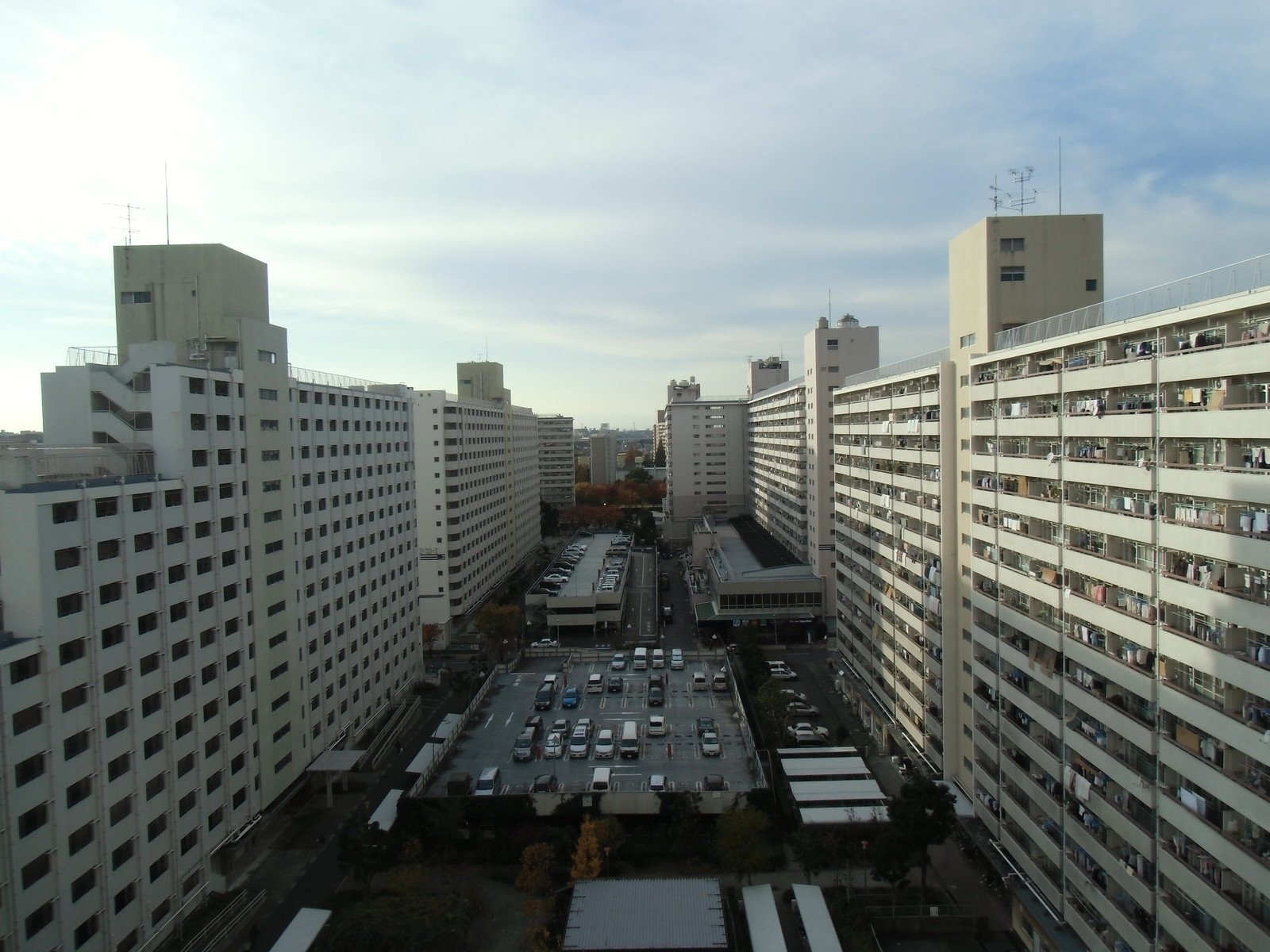 |
| Courtesy Dhanow. |
Bakusho Mondai showed a television ad from the era, featuring a "cool" couple entertaining in their cool new digs, with one cool guy mixing a martini. It was like something straight out of Mad Men.
The big architectural and cultural innovation danchi introduced on a widespread basis was room specialization, bedrooms separate from the dining room separate from the living room.
Though a second look reveals just how tiny those living rooms were. The couch and coffee table in the original Dick Van Dyke Show would have completely filled it with no room left for anything else.
These original structures are now seen as cramped and decrepit. In order to attract tenants, older danchi are combining units and liberalizing leasing requirements and zoning, such as converting ground floors to retail.
Later housing projects like Tama New Town (which grew into an entire city) and Port Town (where I lived for a year) accommodated an "urban-suburban" mix from the start, with larger apartments, green space, and shopping malls.
 |
| Port Town, Osaka. |
Upscale danchi have been rechristened "mansions" (condos). These days, though, a room of one's own isn't enough. The middle-class dream revolves around "Mai Hoomu" (マイホーム), a house in the suburbs.
Make that new homes and condos in communities close to the cities. The result is a growing surplus of old and abandoned houses in the exurbs (as in The Wolf Children). There's little affection for "this old house" in Japan.
Labels: danchi, demographics, japan, nhk, showa period
September 16, 2013
From up on Poppy Hill

Unlike most Ghibli films, From up on Poppy Hill has no surrealistic or fantasy elements. As a girl-meets-boy high school melodrama, it could be favorable compared with Whisper of the Heart, that takes place a generation later.
The story begins with Umi managing her grandmother's boarding house on a hill overlooking the Port of Yokohama. Her mother is doing post-doc work in the U.S. Her father was killed during the Korean War when his ship hit a mine, so she also watches after her brother and sister.
Upon meeting Shun, however, our super-competent protagonist is thrown for a bit of a loop.
Shun literally falls out of the sky while staging a publicity stunt in an effort to save the ramshackle old building that houses the high school's clubs from the wrecking ball. The delightful Ye Olde Curiosity Shop depictions of the clubhouse alone are worth watching the movie for.
Shun publishes the school paper, and had already caught Umi's attention with a haiku not-so subtly directed at her. Recruited to the cause along with her sister, Umi naturally devises a highly practical approach to the problem, which Shun quickly sees the wisdom in.
Halfway through the movie, however, the quiet pace of their high school romance is unsettled by a dramatic plot twist that revolves around Japan's peculiar family register system. (This particular plot twist is a not-uncommon one in Japanese melodramas.)
So now it's a race (some actual racing about does take place in the final act) to save the clubhouse and their relationship. But even then, nobody wigs out. Everybody's got his head screwed on right. Thankfully, even the grown-ups are grown up.
This backwards glance at the Japan of a half-century ago is certainly steeped in nostalgia. Though thinking about the Japan I experienced twenty years later, the cluttered, warmly-lit nooks and crannies of Tokyo and Yokohama at times looked awfully familiar to my eyes too.
 |
| I've bought croquette and tonkatsu at shops just like that. |
From up on Poppy Hill is a gentle melodrama about good, decent, hardworking people. There's no reason for that to ever grow old.
The English script adaptation and dub are excellent, with Sarah Bolger and
Anton Yelchin (Chekov in Star Trek) in the leads, and featuring the voices of Chris Noth, Gillian Anderson, Jamie Lee Curtis, Beau Bridges, Bruce Dern, and a few lines from Ron Howard.
A note about the names: Umi (海) means "sea." Sora (空) means "sky." Riku (陸) means "land." Shun (俊) means "sagacious."
Labels: japanese movie reviews, miyazaki, personal favs, showa period, studio ghibli
August 26, 2013
Miyazaki interview
And speaking of the Miyazakis, From Up on Poppy Hill, a post-war Showa melodrama directed by Miyazaki's son, Goro, is scheduled for a September release on region 1 DVD.
Goro's first effort, Tales from Earthsea, is a good example of a bad adaptation. It is technically proficient, but anybody not familiar with the Earthsea series (like me) would just end up confused.
Even Le Guin had mixed feelings about the film and the editorial choices made about what was kept, cut, and changed.
I saw NHK documentary about Hayao Miyazaki when Earthsea was coming out and it was clear that he thought the "suits" had rushed the "heir apparent" into the director's chair before he or the project was ready.
He was so grumpy at the in-house screening it made me cringe. But Goro must have a thick skin and learned a lot in the meantime as From Up on Poppy Hill has been very well received.
Related links
Twilight of the Zero
Labels: miyazaki, movies about japan, nhk, showa period, studio ghibli
November 26, 2012
Sunset, sunrise
Kenneth Cukier more realistically splits the difference, predicting that a "handful of companies, sectors and locations will be extraordinarily successful globally, in an environment of national deterioration."
A more upbeat assessment comes from Jesper Koll, an economist who calls himself "the last Japan optimist." Along with contrarian Eamonn Fingleton, he argues that Japan isn't quite the economic basketcase it's been made out to be since the real estate bubble burst. A big reason is the national character.
There's a difference between ignoring reality (as the Japanese are doing for now, there being plenty of other apocalyptic fare on their plates) and being delusional about it. The Greeks apparently believe that if they just protest enough (and if those damned Germans weren't so stingy), good times would roll again.
It's not going to happen. And one day it will sink in. But not before Greece (Spain following close behind) circles the drain a few more times.
A not uncommon response to lamentations about Japan's declining population is: "Well, things weren't so bad during the Edo period." The same goes for the post-war Showa period, the setting for many a Happy Days melodrama. And families back then were significantly poorer than the Cunninghams.
For all the blather about "shared sacrifice," the Japanese could actually pull it off. They'll tighten their belts and sing the twin unofficial national anthems: "Shikata ga nai." That's how the cookie crumbles (and the earth shakes). And Gambarou! Roll up the sleeves and put that shoulder to the wheel.
In the land of the rising sun, after all, it's bound to come out tomorrow.
Labels: economics, japan, japanese culture, showa period
April 23, 2012
Ume-chan Sensei
Showa dramas typically depict Japan (symbolized by the spunky female protagonist) struggling through the ashes of WWII to make a place for herself in the world. In this case, scaling the very high hurdle of becoming a medical doctor.
The television season in Japan officially begins in April, and Ume-chan Sensei is now the third Showa drama in a row since the 3/11 earthquake and tsunami, and the fourth of the last five (only two of the nine before that were Showa dramas).

Unlike the previous four, where the end of the war came at the climax of the first or second act, the very first episode of Ume-chan Sensei takes place on August 15, with the Emperor's radio speech announcing the surrender.
One thing this and previous Asadora have pointed out is that the Emperor had never made a radio address before, used stilted and dated language, and nobody under the age of forty could understand a thing he said. No King's Speech here.
The previous Showa dramas I've seen took place far from Tokyo, where the only damage came from an off-course B-29. Ume-chan Sensei begins in Kamata. I've been there. It's right between Tokyo and the industrial port city of Kawasaki.
Pretty much ground zero. The first scene starts with the family eating breakfast. Then Umeko runs outside—into an utterly wrecked and charred landscape. It was hard not to think of post-tsunami scenes from the Northern Japan.

I'm sure the director intended the connection to be drawn, and it makes for a fascinating and detailed look at post-war Japan I haven't seen before. Needless to say, the lead actress, Maki Horikita, makes it very much worth looking at too.

Related posts
Asadora
Ganbarou! Japan
Labels: asadora, history, japan, japanese tv reviews, radio, showa period, television, television reviews, ww2
February 06, 2012
Silver linings
He has a worthy point there, namely that human beings possess a remarkable ability to simply muddle through. (The apocalyptic nuts have all abandoned religion for economics and climatology.) To start with, even including earthquakes and meltdowns, Japan certainly isn't Greece.
Western journalists are just as gullible now as they were back during the rah-rah 1980s when Japan was #1! And Japanese are sanguine about the problem of population growth (despite there being a cabinet minister with the problem of population growth in her portfolio) for good reasons.
The problem is, Fingleton messes up a worthy thesis with nonsensical apples vs. oranges arguments. The grouchy Spike Japan admits that "had Fingleton deigned to mention crime, drugs, or even general orderliness, I would have conceded the advantage to Japan immediately."
But practically everything Fingleton cites in Japan's favor betrays a no less superficial understanding, is unrelated to the actual strength or weakness of Japan's economy, or is a product of Japan being chock full of Japanese. As far as that goes, Japanese live longer and better in the U.S.
Paul Krugman's response, however, in the form of a backhanded compliment, is more revealing.
Krugman quickly points out Fingleton's errors, but then predictably comes to the conclusion that "[the U.S. is] are doing worse than Japan ever did." Except that in arguing that "1990-2000 really was a lost decade," he makes the sort of silly mistake Fingleton likes to crow about.
Krugman bases this on the pre-popped 1990 bubble, the same way cynical economists like to use the inflation-riven 1970s as a benchmark for middle-class malaise. But draw a straight line through Krugman's graph and 2000 performance fall right in line with the previous three decades.
But taking Krugman at face value, the more interesting question is why Japan is supposedly "doing better." For reasons, alas, that would not please any liberal's heart:
1.) Japanese prefer underemployment to unemployment. "Extending unemployment benefits" is not a subject that greatly consumes the attention of Japanese politicians.
2.) Probably because population growth is flat and immigration is almost nonexistent, factors that will produce tight labor markets under practically any conditions.
3.) Japanese still have to put 20 percent down to get a secured loan on anything. Unsecured loans (credit cards) remain difficult to come by (short of payday lenders and loan sharks).
4.) Bonus-based pay at all levels means that a "salaryman" has to live with the expectation of losing a big chunk of his take-home pay if his company hits a rough patch.
5.) Which means that he has no choice but to save heavily (at zero real interest rates) or live significantly within his means (or live with his parents).
As a result, the average middle-class Japanese has a significantly lower standard of living than his American (or even Italian) counterpart, which is readily apparent from the residences they live in.
But it also means that the Japanese have a greater ability to conform and adapt (as Gillian Tett points out in this BBC interview), and so are much better prepared to make the "sacrifices" our political scolds like to go on about.
NHK set three of the last four Asadora dramas in the Showa Era. The inescapable message: you think life is tough now? Let's remind you what it was like then.
Japan's productivity is still ranked dead last in the G7 and lags even the OECD-30 average. Looking for the silver lining, that means bringing up productivity could buffer the effects of an aging and declining population. I'll bet on the country that would rather work than not.
Related posts
Before and After
Showa nostalgia
Apocalypse not now
Labels: asadora, economics, japan, politics, showa period
October 17, 2011
Hirohito and the Making of Modern Japan

In short, Bix argues that the Showa Emperor, rather than being a passive pawn of the Tojo militarists, was deeply involved in every aspect of WWII. He was, to mix modern terms, an "activist" emperor who hung onto power as long as he could and deeply resented giving it up.
Perhaps Bix's most disturbing claim is that Hirohito himself was responsible—contrary to the propaganda fashioned both by MacArthur's GHQ and the Imperial staff and Hirohito himself—for delaying surrender until after Nagasaki, while he attempted to secure (largely through fruitless negotiations with the Soviet Union) the continuation of his reign in a post-war Japan.
Bix is not as compelling a writer as John Dower (Embracing Defeat). For one thing, Dower draws from a wider spectrum of secondary materials, such as mass-media publications, to flesh out his arguments. Bix's primary sources—diaries and interviews by members of the Imperial household, the parliament and the cabinet—bring us eyeball-to-eyeball with the day-to-day machinations that drove both the war and the peace, but it also results in dryer prose. It's all "inside politics."
And unlike with Germany, one finds not so much a banality of evil arising out of deliberate, malicious intent, but rather a banality of evil rising out of ego and incompetence and self-ingested propaganda and raw political power struggles. Japan's war-era cabinets tossed around prime ministers like juggling balls.
One apt criticism of Bix's approach is that his focus is so narrow that he never pulls back far enough to examine in any kind of depth the horrifying consequences of this Machiavellian, play-king gamesmanship.
But as does Dower, Bix concludes that the Tokyo trials ended up a farce to equal any Stalinist show trial. The real quest for the truth was corrupted by MacArthur's desire to use Hirohito for his own purposes, and, as Bix notes, Hirohito was only too happy to be used if it'd get him off the hook (and sell his subordinates down the river in the process).
To make matters worse, a dozen judges from Pacific Rim nations showed up at the trials, all with competing agendas.
The Nationalist Chinese, who had collected mountains of evidence of war crimes, checked their severest indictments in hopes of securing Japan's backing against the Communists. The OSS spirited away all the hard evidence of Japan's battlefield use of biological and chemical weapons. An iconoclastic judge from India was hardly upset that the British had spent four years getting their butts kicked by Asians.
Of course, MacArthur made sure that his battlefield enemies in the South Pacific were summarily tried and executed. Bix does credit MacArthur for being as aggravating to the Japanese as he was to the Joint Chiefs. The Japanese navy had anticipated a winner-take-all contest with Nimitz in the central Pacific, believing that the ultimate objective of naval warfare was "to win by hurling a large, powerful fleet into a single decisive battle."
After Pearl Harbor, every time the Japanese navy maneuvered itself into such an engagement, it lost, and badly. Equally unprepared to support a land war against MacArthur at the same time, it ended up throwing away a third of its resources in the process.
Perhaps Bix's most astute observations comes in the parallels he draws between MacArthur and Hirohito. They were diametrical opposites in terms of physical presence and personality, but both saw themselves at the center of all victory—the sole reason any great effort should and would succeed—while ascribing failure to dark forces and political conspiracies and placing the blame on their subordinates (and expecting them to do impossible things).
In the end, Hirohito's fascination with his own manufactured image as a divine emperor, combined with his incompetence (rarely questioned by his handlers), both led to the war and guaranteed that Japan would never win it. MacArthur's ego and presumptuousness (bolstered by a powerful cohort of ideological sympathizers in the State Department) meant that the emperor, and by extension the nation, would never take responsibility for it.
That is the Showa Emperor's true legacy, and one that unfortunately continues to this day.
Related posts
Kantai Kessen
The last shogun
The known unknowns
Labels: book reviews, embracing defeat, history, japan, showa period, ww2
April 11, 2011
Ganbarou! Japan
Showa dramas typically depict Japan (symbolized by the protagonist) struggling through the ashes of WWII to reclaim her place in the world. They're romanticizations, to be sure--not that exaggerated--of an era when everybody put their shoulders to the wheel.
It's an ethos and state of mind summed up in the verb ganbaru: "to persist, to hang on, to stick it out." You now see the volitional form on banners everywhere: Ganbarou! Japan (がんばろう!日本). Such as at the spring national high school baseball tournament.

Related posts
Asadora
Showa nostalgia
Sendai earthquake
Labels: asadora, baseball, earthquake, japanese, language, showa period, tohoku earthquake
October 28, 2010
Showa nostalgia
Nostalgia is always about forty to fifty years in the past. Forty or fifty years ago, life was perfect! Which is nonsense, of course, but it makes me wonder if, in another twenty years, people will be waxing nostalgic about the 1980s and 1990s.
I think half a century is about how long it takes to take the long view and distill from an era what's worth preserving. Or to put it another way, fifty years is about how long it takes to sort out those cultural artifacts that carbon date the time (like fashion and pop music) from those that transcend it.
Everything else then ends up in a landfill or disappears down the memory hole. As Steve Sailer points out:
The truth is that there is always an absolutely colossal amount of popular culture, the vast majority of which is almost quickly forgotten, except for a tiny fraction that stays in a few influential people's minds and comes to form our heritage of high culture.
So it's not surprising that the things we end up conserving tend to be, well, conservative. Comparing what we've preserved from the past (the less appetizing elements having dimmed with time) with the messy present can't help but foster a sentimentality for the presumably smarter, better, more stable era that produced it.
In Japan, this is epitomized by Edo Period romanticism, conveniently forgetting that the Tokugawa regime ran a heavily-policed feudal state, though one that managed to skirt out-and-out incompetence (until the mid-19th century) and that was quite stable for most of the 17th and 18th centuries.
And more recently, "Showa nostalgia."
The Showa Era (the reign of Emperor Hirohito) lasted from 1926 to 1989. Everybody politely ignores the first two decades. Showa nostalgia instead refers to the twenty years of economic recovery following the war, when everybody pitched in and pulled themselves up by their bootstraps.
This was the time when courageous government officials did courageous government official stuff and weren't all on the take or off starting land wars in Asia. As with the much-heralded era of "lifetime employment," it barely lasted a single generation, and yet continues on and on in the collective memory.
As exemplified in an entertaining example of Showa nostalgia like Always: Sunset on Third Street, the 1950s in Japan was not so different from the 1950s in the United States, except poorer. But starting from such a low point, those years of free, peaceful, year-on-year growth were like a breath of fresh air.
Perhaps even deserving of such rich, sepia-steeped sentimentality.
Labels: deep thoughts, history, japan, kate, movies, showa period, social studies
April 29, 2006
Midori no Hi
 Hirohito, the Showa Emperor, died on 7 January 1989, shortly after I arrived in Osaka.
A morbid media deathwatch had been going on for months. I think most people were relieved when the end finally came. Midori no Hi (April 29) was the Emperor's birthday back then. Now it's called "Green Day," like Earth Day. It's the first day of Golden Week, the Japanese equivalent of Spring Break.
One morning when I was living in Odawara thirty years ago, the train station was swarming with police officers. The Emperor was returning to Tokyo after a stay at Hakone, the Imperial Household's version of Camp David. Odawara is the closest Shinkansen stop to Hakone.
A small, respectful crowd gathered at the station. The motorcade drove up. The Emperor got out. He was a small man wearing a navy-blue suit. He tipped his hat to the crowd, we politely clapped (I took the picture), and he went into the station. Nobody kowtowed or anything.
The Emperor's train arrived. It was two cars long, the Shinkansen version of a corporate jet. The Shinkansen left Odawara and everything went back to normal.
Labels: day in the life, history, japan, shinkansen, showa period