

December 11, 2024
The happens to be rule

In my review of Spy x Family, I argue that in the universe of secret superheroes, the controlling half of the dual personality—Clark Kent or Superman, Bruce Wayne or Batman—ultimately determines the direction of the narrative.
As Kate points out, Lloyd and Yor in Spy x Family are "decent, family people who just happen to be a spy and assassin rather than a spy and assassin pretending to be decent people."
Spy x Family puts Yor in the same moral position as Arnold Schwarzenegger's Harry Tasker in True Lies, "Yeah, but they were all bad." The Yor-centered stories make clear that her targets are, by and large, reprehensible human beings.
Lloyd is more conflicted than Yor, but he is not an enemy of Ostania. He often ends up working tangentially toward the same goals as Yor and her brother, and does his level best to inflict as little collateral damage as possible.
The climactic ending of Code White being a case in point. Lloyd, Yor, and Anya end up saving the day for Ostania.
After all, his overall mission is to establish a diplomatic backchannel with Donovan Desmond. Killing him, he admits, would be easy, but would also not be in any of their interests (and certainly not Desmond's).
If the intelligence services in Westalis suspect that the Berlint Wall is about to collapse, then it would be in the self-interests of both sides for a moderate government to survive and steer the ship of state between the political extremes.
This is a far more politically and intellectually challenging task than saving the world on a weekly basis. Lloyd and Yor spend much of their undercover time picking off extremists on both sides.

When your job is preventing a world apocalypse on a regular basis, those kinds of qualms are bound to fall by the wayside. To start with, you're not going to have the time.
Lloyd's more real-world missions require that he keep his honne and tatemae in close alignment, even though they may seem as far apart as night and day. His ultimate struggle is to accept that he is a family man at heart.
Since the start of the series, his success as a spy and his success as a father have become inextricably intertwined.
The Forgers are a pair of eccentric but otherwise ordinary suburban parents (like Rob and Laura Petrie from The Dick Van Dyke Show or Mike and Vanessa Baxter from Last Man Standing) who happen to be a spy and an assassin.
The order matters. If you get the happens to be rule wrong, you may end up with the wrong audience tuning in. Nothing will doom a series faster than the feeling a bait and switch is going on.
The premise of Moonlight is right up my alley. But halfway through the first season, it turned into a melodrama about a vampire who happened to be a private detective rather than a police procedural about a private detective who happened to be a vampire.

Not that there's anything wrong with that. But in a ratings-based world, the core values of the viewers (as expressed by tuning in to watch) must largely overlap with the values of the characters (as expressed by the writer and director).
The same things goes for message-based entertainment. If a show runner wants to preach a message, it had better be one the audience wants to hear or at least is able to ignore because everything else about the show is so good.
One of the great advantages of anime and especially manga is that quantity has a quality all of its own. You are all the more likely to find titles that match up the honne and tatemae of the characters in an order that matters to you.
Labels: anime, criticism, japanese, language, movies, thinking about writing


October 30, 2024
Mieruko-chan

Donna Howard investigates the provenance of relics and antiques with the help of people from the past who are only visible to her.
For Natsume, his second sight (inherited from his grandmother) often results in the supernatural Shinto world intruding on his otherwise ordinary day-to-day life.
Mieruko can see dead people too. Her name is a pun on the verb meaning "I can see." That makes her privy to an extensive and weirdly thriving ecosystem of the living dead invisible to all but a select few.
Unfortunately for Mieruko, she has a hard time telling the good dead people from the bad dead people.
Even the guardian deities (inari) at the Shinto shrine are fierce and intimidating. Most of the dead people and creepy crawlies look like mutating corpses. Which is bad enough, except when they realize she can see them. Mieruko has gotten good at maintaining a look of deadpan indifference.
The rules governing Mieruko's abilities mirror those in Natsume's Book of Friends (which just debuted a new season). Creatures from the spirit world can only physically interact with you if they catch you looking at them first. Maintaining an attitude of stoic indifference can be the best recourse.
Which brings me to a new word I learned reading the manga: suruu sukiru (スルースキル), a transliteration of "through skill." Weblio defines it as the "ability to ignore bad things happening to you." In other words, the skill to work through a problem by tuning out and not getting upset about it.
But like Natsume, a girl's got her limits. There are times when Mieruko has no choice but to lend the ghouls an ear. Occasionally she discovers their intentions are benign. At other times, not so much. It's easier when the monsters behave like monsters, but even there she can jump to the wrong conclusions.
The occasional Sixth Sense twist will also fool the reader. And there's a touch of Dexter in the cat killer arc as well (which is featured in the anime).
Her best friend Hana is a ghost magnet ("Like moths to a flame," an old soothsayer ally observes), though not having second sight herself, she's clueless about their presence. One of their classmates also has second sight, though not being as powerful as Mieruko, she misjudges their respective abilities.
These moral dilemmas lend Mieruko-chan depth without being depressing or nihilistic. Some of the stories are genuinely heartwarming. If you're a fan of Edward Gorey or Charles Addams, Mieruko-chan is right in your wheelhouse.
Written and illustrated by Tomoki Izumi. Published in Japan by Kodansha and by Yen Press in the United States. The anime is based on the first three volumes of the manga. A live-action film adaptation is scheduled for release in 2025.
Related links
BookWalker (English emanga)
BookWalker (Japanese emanga)
Amazon (Kindle and paperback)
Crunchyroll (anime)
Labels: anime, bookwalker, crunchyroll, ebooks, japanese culture, kindle, manga, manga reviews, movies, religion, shinto
April 10, 2024
Christianity is cool
Catholicism has the deepest roots, having arrived in Japan in the mid-16th century. So the aesthetics associated with Catholic culture and architecture are the first things Japanese think about when Christianity is mentioned. After that comes the ecclesiastical structure, extrapolated from the Roman Curia.
Anime like Witch Hunter Robin and Hellsing (Catholics versus Anglicans) play off the supposed existence of an all-powerful Catholic Church that shows up in movies like Constantine, Stigmata, and The Da Vinci Code. The Catholic Church is just too cool an institution not to imagine it running a global conspiracy.

And as with the spy agencies of any country, in the paranormal action world, the Catholic Church is also a good source of skilled agents, operators, and intelligence networks. Ghost Hunt is an ecumenical paranormal actioner, so it naturally features a Catholic priest as one of the ghost hunters.
At the same time, in terms of theology, the suggestively Catholic Haibane Renmei can stand beside any of C.S. Lewis's work as an accessible Christian parable. The same is true of anime such as Madoka Magica and Scrapped Princess, though you may have to look harder to see the metaphors.

They eagerly pilfer Christian eschatology for interesting characters and conflicts (another good reason to study religion!). Kaori Yuki's Miltonesque Angel Sanctuary turns Paradise Lost into a Gothic romance, with a war in heaven and a descent to the underworld to reclaim a lost love.
At the other extreme, the quite clever The Devil is a Part-Timer (stranded in Japan, the devil gets a job at McDonald's to make ends meet) features both Satan and Lucifer as separate characters.
The only overtly religious aspect of The Devil is a Part-Timer is an institutional church roughly analogous to the medieval Catholic Church (under the Medici popes). The state religion in Scrapped Princess is largely the same.
Then there's the offbeat syncretism of Saint Young Men, about Jesus and Buddha hanging out in modern-day Tokyo. Manga artist Hikaru Nakamura approaches the subject with a goofy but respectful touch. Unless you find the concept itself heretical, there's nothing at all blasphemous about it.
Saint Young Men is hugely popular in Japan (a staggering 10 million copies sold). It won the 2009 Tezuka Osamu Cultural Prize and is still in print. An anime series and movie were released in 2012 and 2013.
There's none of that here. Whether the Shinto gods in Natsume's Book of Friends or the traditional folklore of Northern Europe in The Ancient Magus' Bride, these writers have done their homework. They honestly respect the source material.
What gives manga publishers pause when it comes to the Norther American audience is the fear that somebody will whine and stamp their feet and the bad publicity will kill sales. Nobody's going to get killed. But the suits understandably get skittish about the fringe elements that breath such threats.
During the localization of Saint Tail (which features a Catholic basilica as the "Bat Cave") for the North American market, references to God were
removed from the first two volumes in a possible anticipation of a TV broadcast. Considering that Seira Mimori [the protagonist's sidekick] spends half of the time in a nun's habit, one wonders why they thought they could do Saint Tail without references to God.
Common sense finally prevailed and the censoring stopped with the third volume.
This is rarely a problem in Japan, where the whining and foot stamping mostly comes from the political right. They're strident secularists, except when the emperor enters the picture. Then they turn into strident Shintoists. Until they die, that is, at which point Buddhism kicks in with a vengeance.
"Buddhism for the dead, Shinto for the living," so the saying goes. In everyday life, Japanese move back and forth between Shinto rites and Buddhist beliefs and Christian-style wedding ceremonies. It's not that the adherents are blurring the lines. The lines were never firmly drawn in the first place.
You might expect this sort of fuzzy wuzziness to lead to the kind of apathy and neglect that emptied out the churches in secularized Europe. But in Japan, people not getting worked up about stuff can motivate the curious to mix and match belief systems in ways nobody else would have dreamed of.
And in the process, scrub the dust off of old, worn-out tropes to reveal the shining gems buried beneath.
Related posts
Pop culture Catholicism
Pop culture Buddhism
Pop culture Shinto
The Ancient Magus' Bride
Constantine
Haibane Renmei
Hellsing
Madoka Magica
Scrapped Princess
Labels: anime, eschatology, haibane, hellsing, history, japanese culture, movies, pop culture, religion, social studies
January 24, 2024
Reframing the mainframe plot
And yet Hollywood keeps serving it up. Because we keep chomping it down.
 |
| Conquering the galaxy since the 1950s. |
Even the ending of Edge of Tomorrow (without a computer network in sight) is straight out of The Phantom Menace. And straight out of Oblivion, the previous Tom Cruise SF post-apocalyptic, blow-up-the-alien-mainframe actioner.
Making it an organic mainframe is a slight improvement but just as dumb. The whole "hive mind" thing needs to go too.
Speaking of organic mainframes, Star Wars fell back on the Evil Emperor trope, a linchpin apparently holding the whole universe together by his lonesome. How is never explained, but all the good guys have to do is knock out this one bad guy and peace and prosperity is restored to the galaxy.
Well, after they deal with the truly killer mainframe that is the Death Star. The whole Star Wars franchise ended up being about destroying Death Stars, each one a more ludicrous violation of the laws of physics than the last. Again, what long term problems this solves is never made clear.
Does the mail start arriving on time now? Does the tax code suddenly become more comprehensible? And what happens to the unemployment rate when all those Death Star jobs get instantaneously terminated? Imagine the size of the catering contract for just one of those behemoths.
Of course, destroying a single machine in a single place and winning the war everywhere makes for easy denouements. But if the Earth is ever attacked by malevolent aliens who know how to implement autonomous distributed network technology, we are so screwed.
That aside, though, what do the aliens hope to accomplish by attacking Earth? Or attacking any inhabited planet? (Besides giving the director an excuse to restage the Battle of Britain or the Invasion of Normandy.)
If they wanted to wipe out the humans along with the infrastructure—the whole objective of the Independence Day aliens—there'd be no need to get anywhere near the planet's surface, as Heinlein pointed out back in 1966 with The Moon is a Harsh Mistress. An asteroid makes for a handy ICBM.
There are lots of big asteroids out there.
Another reason is, they want our water. But there is plenty water elsewhere, that is not at the bottom of a deep gravity well. Europa, for starters.
Then there's the "To Serve Man" plot device. But homo sapiens is a lousy food and energy source (The Matrix is dumber than dirt in this regard). That's why so few people get eaten by sharks (surprisingly few!).
Besides, a blown-up country is a huge resource sink. Hence the Marshall Plan. By 1950, SCAP was already regretting Article 9 in the 1947 Japanese Constitution (forbidding war) and was revving up Japanese industry to support the Korean War, which was just what the economy needed.
In The Phantom Menace, Lucas tosses the politics of trade into the picture, but without explaining what is being traded, why, or how. The result is a blur of handwaving when it comes to the story because there are no underlying rational reasons for anything that happens.
The economic model of the Star Wars universe makes no more sense than the socialist utopianism of Star Trek, which finally gave us the robber baron Ferengi to make things interesting.
Still, Lucas was onto something. The unequal treaties imposed on Japan and China by the U.S. and European powers in the mid-19th century led to the Boxer Rebellion in China and propelled Japan into a regional arms race in order to even the scales. Lots of dramatic conflict there.
The thing is, China and Japan had stuff the foreign powers wanted, stuff as trivial (to our modern eyes) as tea. But like spice in Dune, there were underlying economic causes behind the conflicts. And at the time, a bad trade deal was a better deal for both sides than smash and grab.
And so we're back to the Lebensraum ("living space") ideology promulgated by Germany in the 1930s. (The Nazi bad guy connection certainly doesn't hurt.) The Japanese equivalent was used to justify the annexation of Korea and Manchuria.
Both Germany and Japan were doing rather well at expanding their territories (employing their own "unequal treaty" tactics) before they started actually invading their neighbors, after which everything went downhill fast.
So we'll assume our invading aliens are smart enough not to turn the whole thing into a scorched-earth shooting war. The problem is how to make that interesting.
A good place to start is Ryomaden, which describes the opening of Japan in the mid-19th century, the shock to the system, the unequal treaties, the escalating civil strife, finally resolved by a quickly-concluded civil war that launched Japan on a burning quest to surpass the west.
If gunboat melodrama is what you want, (bad) diplomacy seems pretty good at supplying the necessary Sturm und Drang motivations. Kudos to Guardians of the Galaxy on this score.
The problem is the time frame required by real politics. Summing up two decades of geopolitics in two hours would be tough. I suppose it really is simpler to just have Tom Cruise blow up the mainframe.
Labels: computers, mainframe, movies, robots, science fiction, star wars, tech history, technology, thinking about writing
November 16, 2023
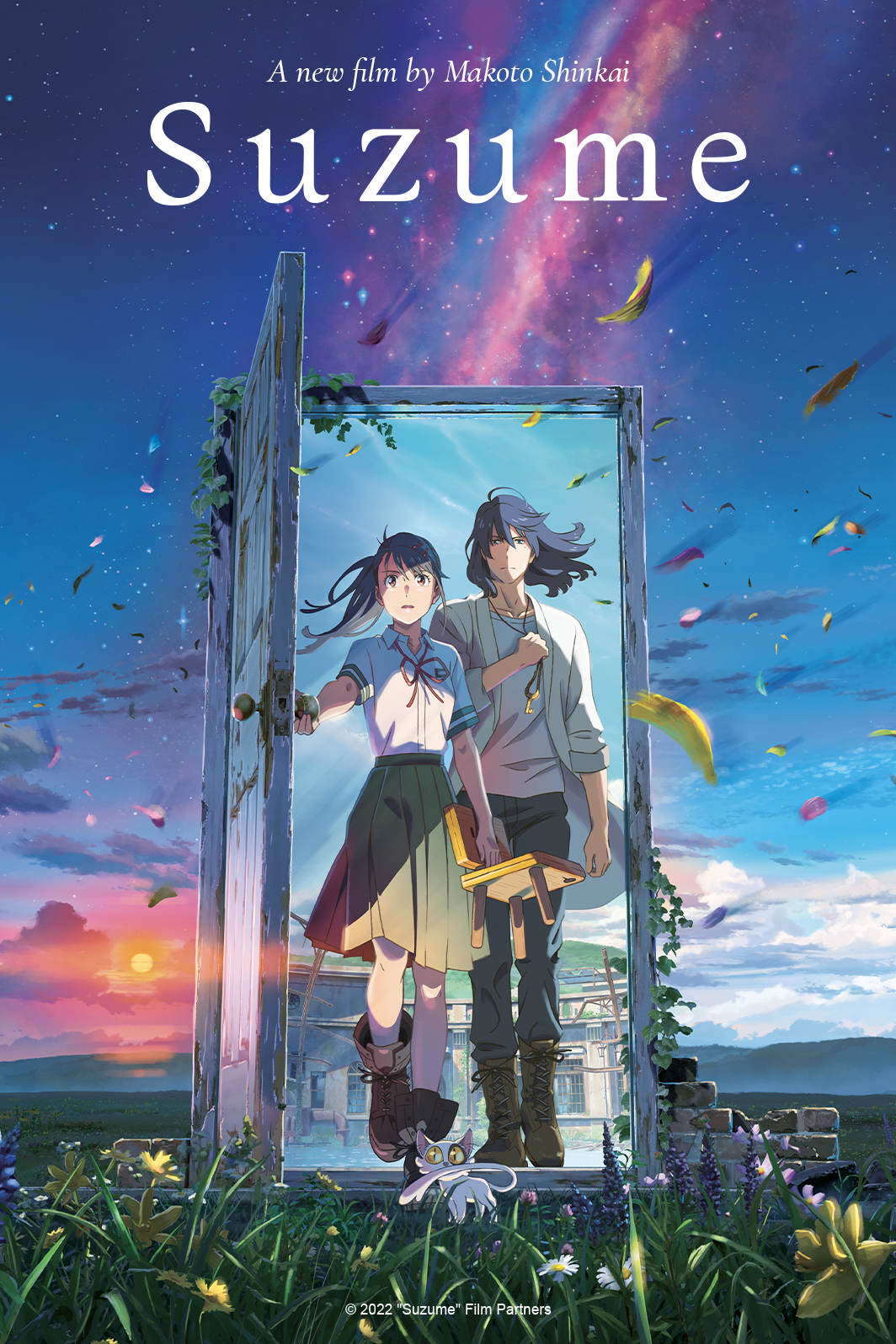
Suzume
Suzume's journey begins in a quiet town in Kyushu (in southwestern Japan) when she encounters a young man who tells her, "I'm looking for a door." What Suzume finds is a single weathered door standing upright in the midst of ruins as though it was shielded from whatever catastrophe struck. Seemingly drawn by its power, Suzume reaches for the knob. Doors begin to open one after another all across Japan, unleashing destruction upon any who are near. Suzume must close these portals to prevent further disaster.
Suzume is Makoto Shinkai's thirteenth directorial work. Here's to hoping Crunchyroll licenses more of his catalog.
Labels: anime, crunchyroll, japan, movies, shinkai
October 14, 2023
The Showa drama
The era name of his son Akihito is Heisei, so Showa 64 and Heisei 1 both refer to 1989. Confusing? You bet! Historical references prior to the Meiji period often include the Gregorian year in parentheses because it's confusing to Japanese too.
 |
| In Carnation, Itoko has to work hard to save her precious sewing machine from getting recycled. |
Political events such as the February 26 Incident are noted in passing (if at all) and the war is depicted from the point of view of a middle-class housewife—coping with draconian rationing while watching the young conscripts go off to war and come home in boxes.
And in series like Hanako and Anne and Massan (the former because Hanako was an English translator, the latter because Ellie was a British national), fending off the loathed Kenpeitai, the Gestapo-like police force.
The Great Tokyo Earthquake in 1923, the firebombing of Tokyo in March of 1945 and the broadcast of Hirohito's Surrender Rescript a few months later, the Tokyo Olympics and debut of the Shinkansen in 1964, all frame the Showa drama as metaphorical turning points.
The genre has eclipsed even the popularity of Edo period (1603–1868) samurai dramas. With every milestone (almost eight decades have passed since the war's end), it is increasingly steeped in nostalgia. Of the ten Asadora serials broadcast on NHK between 2010 and 2015, seven were Showa dramas.
 Including Hanako and Anne and Massan. Hayao Miyazaki's The Wind Rises is in many respects a very conventional Showa drama.
The more upbeat Happy Days version of the Showa drama is prefaced by the Occupation and ends in 1964 with the Shinkansen and the Tokyo Olympics. Ume-chan Sensei belong in this latter category, as does Goro Miyazaki's From up on Poppy Hill.
There probably isn't a more sepia-steeped example of the latter than Always: Sunset on Third Street. Literally, in this case, as you can tell from the title.
Always tells the story of a working-class neighborhood in Tokyo, focusing on Ryunosuke Chagawa, a struggling novelist, and Norifumi Suzuki, an auto mechanic who can't resist buying the latest gadget—a refrigerator and B&W television in the first film, a color TV by the third.

Yasujiro Ozu's slice-of-life family dramas from the 1950s and early 1960s make for an interesting comparison. The only nostalgia on display in Ozu's postwar films is for those few remaining remnants of a world destroyed by the war and now fading away.
Ozu spends little time looking backwards and instead focuses his attention on the world around him. Not knowing what was going to happen hence, Japan in the 1950s was a less than reassuring time. For all anybody knew, it was going to be the Taisho period all over again.
In 1953, Donald Keene visited Kyoto as a graduate student, at one point attending an economics conference sponsored by the Institute for Pacific Affairs. He observed that the Japanese attendees were uniformly "convinced that Japan's future was dismal."
The general impressions of the conference, at least to an outsider like myself, were of resignation on the part of the Japanese and friendly but unhelpful attempts by non-Japanese to cheer them. I could not detect anything positive arising from the discussions.
None of them could imagine that the three decades of double-digit economic growth right around the corner would turn Japan into an industrial powerhouse.

His later films are suffused with a bemused wonder at the new world blossoming around him. Ozu delights in framing old, worn, wooden architecture in facades of glistening glass and steel; characters leave one scene in traditional kimono and enter the next in suits and skirts.
People move from old businesses to modern office buildings, from old houses to concrete apartment blocks. The glowing technicolor turns them into photo spreads out of National Geographic, preserving a point in time as it really was rather than how it is now remembered.
Still, Showa nostalgia is more than a trick of memory. Japan went on a thirty year winning streak, temporarily tripped up only by the oil shocks of the early 1970s. It became the second largest economy in the world and not a few "big thinkers" predicted it would soon pass the U.S.
Little wonder that Japan's most popular anime series today remains the long-running Sazae-san, a family-friendly Showa dramedy that take place roughly between the late 1960s and the early 1980s.
Come the 1990s and the bubble burst. For the next two decades, everything that could go wrong did: a stock market crash, two devastating earthquakes, a nuclear meltdown, birth rates below replacement and a declining population that shows no sign of leveling out anytime soon.
Except when that declining workforce is factored into the equation (GDP-per-worker), the Japanese economy is doing rather well. Now it's only the third biggest in the world. Per-capita GDP in 2014 is over three times that in 1964. Japan leads the world in life expectancy.
A few years ago at TEDx Kyoto, Jesper Koll enthusiastically made the forward-looking argument.
Which isn't to say that the good old days weren't, just that they weren't quite as good as we like to remember, and the present day isn't quite as bad as we like to pretend. This too shall pass and Japan will still be here, doing better than most.
Related posts
Massan
Hanako and Anne
The Wind Rises
Ume-chan Sensei
From up on Poppy Hill
Showa nostalgia
Labels: akihito, history, japanese culture, japanese tv, movies, nengou, nhk, showa period, television, ww2
January 09, 2020
Netflix switch

Netflix has since closed the Salt Lake City center. The single-day turnarounds now take three or four. To give credit where it's due, Netflix uses the "Informed Delivery" service, which (if everything works) notifies Netflix when the envelope is scanned into the USPS system so Netflix can send out the next one.
With my grandfathered one-out, two-a-month plan ($4.99/month or $2.50 a disc), Netflix's DVD service was so cheap the money almost didn't matter. Still, my "Active" queue kept shrinking while my "Saved" queue kept growing (until Netflix zapped most of the "Saved" titles from the catalog).
I'm mostly talking about the more obscure GKids anime releases and old classics. My theory is that Netflix tracks how many times a title appears in the "Saved" queues of its customers and only acquires it when it hits a certain threshold.
Netflix has abandoned the DVD "long tail" for new titles and isn't acquiring anything but bestsellers anymore. Mirai was popular enough but most anime movies obviously aren't. Although Netflix is actively acquiring anime series and feature films on the streaming side, its DVD business doesn't know they exist.
So I looked more closely at Amazon Prime Video and was surprised at how many of the titles in my "Saved" queue were in its catalog. Granted, prices for older titles range from $2.99 to $3.99 but that's a small price to pay for instant gratification and zero commitment.
There are movies on the Criterion Channel I'd like to see too, but not enough of them to justify $10.99/month, even using the subscribe–binge–quit approach. It'd be nice if the Criterion Channel did one-time rentals too. In other words, the original Blockbuster Video model. What's old is new again.
Indeed, I'm a bit puzzled that Netflix, responsible for putting Blockbuster out of business, doesn't offer the option, say, a kind of interlibrary loan arrangement with providers like Criterion and MHz. That's what Amazon is doing with Prime Video (and, no, you don't have to join Amazon Prime to use Prime Video).
Though once rental costs approach the four dollar mark, I'll think seriously about buying the DVD or simply won't bother. Back when Netflix first jumped on the streaming bandwagon, I was a regular Luddite about the whole thing. But Netflix has since acquired enough Japanese content to pique my interest.
So after shipping more than 800 Netflix DVDs back and forth through the good old-fashioned mail, the time has finally come to bid physical media (mostly) goodbye.
Related posts
Hey, watch this!
Netflix in Japanese
Death of the doctrine
The streaming chronicles
Streaming according to Pareto
Labels: business, gkids, movies, netflix, streaming, television
September 06, 2018
New old titles at CR

Sherlock Hound features some of Hayao Miyazaki's earliest work. As you might surmise from the title, in this version, Sherlock Holmes is a dog. And so is everybody else. Lots of fun. I reviewed the series here.
In Magic Users Club (watch the OVA first), we learn that sitting on a broom (sans a pillow) hurts your butt, and the best way to deal with an alien spacecraft is to turn it into a giant cherry tree. (The first scene of the OVA has no sound because there is no sound in space.)
 Patema Inverted and King of Thorn explore the unreliability of human perspective. I reviewed the former here.
Patema Inverted literally asks which way is up. King of Thorn wonders if really you know what time it is. Both require mighty suspensions of disbelief to get past the premises. But there's tons of material for anybody who enjoys musing about philosophical what-ifs.
In terms of narrative structure, King of Thorn reminded me of the "No Reason" episode of House.
Crunchyroll doesn't yet have the 3DCG Appleseed movies but it does have the 3DCG Vexille, a pastiche of every post-apocalyptic, mecha, and military anime series ever made. Watch it as a work of social commentary rather than for its dubious cinematic merits. I reviewed it here.

Welcome to the Space Show takes a gang of kids from rural Japan on an Art Deco roller coaster ride through a fractious galactic empire ruled by a reality TV show host. As the title suggests, it's a dazzling and hilarious trek through the stars.
Night on the Galactic Railroad is based on the fantasy novel by Kenji Miyazawa, an agronomist and social activist who died in 1933 at the age of thirty-seven. Little known for his poetry and fiction in his lifetime, he is now considered one of Japan's great literary figures.
Night on the Galactic Railroad inspired Leiji Matsumoto's anime classic Galaxy Express 999. This morally complex work of science fiction won the Shogakukan Manga Award in 1978 and the Animage Anime Grand Prix prize in 1981.

Video links
5 Centimeters per Second
King of Thorn
Galaxy Express 999 (Tubi)
Magic User's Club
Magic User's Club OVA (YouTube)
Night on the Galactic Railroad
Patema Inverted
Sherlock Hound (YouTube)
Voices of a Distant Star
Vexille
Welcome to the Space Show
Labels: anime, anime lists, anime reviews, crunchyroll, fantasy, matsumoto, miyazaki, movies, science fiction, shinkai, streaming
March 29, 2018
Detective Bureau 2-3

At the time, Hollywood produced some fine films in and about Japan too. Shot on location, a movie like House of Bamboo (with Robert Stack) captures the Tokyo cityscape before modernity swept that sepia-colored world away.
Equally deserving of attention are those entertainment vehicles that won little in the way of high-culture respect (and even less in terms of international attention), and yet created the tropes and types of popular culture that still resonate today.
Unlike the works of Yasujiro Ozu or Akira Kurosawa (such as High and Low, his 1963 police procedural), these movies have little value as artistic or as historical documents that strove for verisimilitude.
But they have great value as records of how the general public perceived the world around them, the ways in which they were willing to suspend their disbelief in order to imagine that social change in entertaining ways (still true of manga and anime today).
A great example of this is the clumsily titled (in English) Detective Bureau 2-3: Go to Hell Bastards! released by Nikkatsu Studios in January 1963.
The bad boy of the post-war Japanese movie business, Nikkatsu Studio avoided historical dramas and concentrated on low-budget comedies, teen melodramas, and actioners. Losing ground to television in the 1970s, Nikkatsu became synonymous with the "pink" genre.
But in 1963, though chock-a-block with armies of gun-wielding yakuza and a sky-high body count, Detective Bureau 2-3 (the "2-3" refers to protagonist's office number) isn't any more violent or explicit than Hollywood westerns of the 1950s.
Director Seijun Suzuki gives the film the look of a classic noir thriller. Joe Shishido (who appeared in six of Suzuki's films) is perfectly cast as a debonair detective who infiltrates the yakuza to expose a gun-running operation.
Featuring a sports car (that looks cool today), beautiful women, and heavies that could pass for Edward G. Robinson's cousins, plus the inventive use of what were then high-tech devices, Detective Bureau 2-3 had Miami Vice and Don Johnson beat by two decades.
Speaking of which, Miami Vice did an episode about the yakuza that wasn't half bad. But Don Johnson never wriggled out of tight situation with a song-and-dance routine that Fred Astaire could have choreographed.
Suzuki later got himself fired from Nikkatsu for making films that were so surreal and absurdist that they alienated Nikkatsu's core audience. When you're in the crowd-pleasing business, you do have to please the crowds.
In Detective Bureau 2-3 Suzuki and Shishido get the mix just right. Sporting a plot worthy of Chandler, it skirts the nihilism that came to typify the yakuza genre and supplies an upbeat ending. More upbeat than how the real world was dealing with the issue.
Robert Whiting recalls of the years leading up to the 1964 Tokyo Olympics in the Japan Times (his fascinating five-part account starts here),
House theft was rampant, narcotics use was endemic, and it was considered too dangerous to walk in public parks at night. Moreover, yakuza were everywhere, their numbers at an all-time high. There were also twice as many places to eat as New York and more bars per square kilometer than anywhere else in the world.
The 1964 Olympics initiated a crackdown that was more of an accommodation. It essentially decriminalized the yakuza. Unlike American gangsters, the big yakuza organizations are legal corporations, and the police prefer to regulate them as such.
Sort of the same argument for decriminalizing drugs: stay away from the hard stuff and don't shoot civilians and we won't look too closely at where the hard cash is really coming from.
Capturing the yakuza sub-culture at its apex, Detective Bureau 2-3 makes hanging with the bad guys look cool. And the bad guys look cruel but cool. As with the glamour of the Miami Vice underworld, this comic book view of the yakuza persists to this day.
Labels: japan, japanese movie reviews, law, movies, politics, social studies, sports, whiting
March 22, 2018
Constancy amidst change
Ghost in the Shell (directed by Mamoru Oshii) epitomizes this basic story structure. Major Kusanagi's character arc parallels the narrative arc, to the extent that by the end of the movie she has literally become a different person. Meanwhile, her partner Batou remains a rock of constancy.

This tension between the constant and the variable focuses our attention on the metamorphosis taking place. Mathematically speaking, however, the distance between the two is the same regardless of the POV. In other words, the person doing the changing need not necessarily occupy the lead role.
In Children Who Chase Lost Voice (directed by Makoto Shinkai), the protagonist, Asuna, goes on a great adventure. But she undergoes no great transformation. She simply grows up. Shinkai includes a scene at the very end emphasizing that Asuna is no less an ordinary girl than she was before.
But Shun and Morisaki, who accompany her on her journey, are completed altered. Not only has Morisaki abandoned all the reasons for the journey he began with, he now bears indelible scars as punishment for his presumptions.

A steadfast protagonist that anchors the narrative holds especially true in television series. By contrast, the soap opera (and many a sit-com) is typified by the constant pursuit of shock and surprise, that inevitably inflicts more change than the suspension of disbelief can bear.
Which is not to suggests that stolid staples of genre storytelling like the detective drama lack character arcs. Quite the contrary. What makes them so enduring and endearing are the circles of fate that turn through each episode.

A role epitomized by that of Watson, far more the observer of the human condition than Sherlock.
Staples of the television crime drama like CSI and Law & Order have less to say about actual crime and punishment than about the wages of sin and the costs of hubris. They are secular homilies for a modern age.
Like the preacher at the pulpit, in an anarchic world, the protagonist of a series must steer an outwardly steady course, evolving in a measured manner while remaining true to the constraints of the genre. By doing so, he casts the moral of the story into even bolder contrast.
Labels: anime, literature, movies, social studies, television, thinking about writing
March 15, 2018
Psy-phi
Fantasy, by contrast, rarely pretends to be anything but imaginary.
Space opera wears the label of "science" the same way the female scientist in the James Bond movie wears a pair of glasses to convince us she's smart. On the other hand, maybe she really is gorgeous, brilliant, and nearsighted. Space opera, too, can be dumb about science and smart about Life, the Universe, and Everything, about how the human mind works.
My name for this particular creature is "psy-phi." The term occurred to me watching Guardians of the Galaxy II, a silly movie in which worthy explorations of psychology and philosophy can be found lurking between the gaudy comic book covers.
Star Wars stumbled into this psychodramatic niche with the first two installments. Alas, the franchise has been drained of all substance since, prompting the need to add another entry to the taxonomy: "space soap opera." Not only scientifically illiterate but equally empty-headed as well. Nothing kills "psy-phi" faster than the pretentiousness of pretend profundity.
Well, except for conflict created solely to generate drama. Any given Wile E. Coyote and the Road Runner cartoon can entertain in the short term. But only the short term. No matter how much tragedy and pathos is slathered on top, it'll never add up to "drama."
The endless cycles of such melodramatic contrivances echo the traditional (gloomy) definition of samsara, a "suffering-laden cycle of life, death, and rebirth, without beginning or end." However "realistic" pessimism may be, without learning, growth, and resolution, there is no point to art.
Han Solo was a better person at the end of the first Star Wars movie than he was at the beginning. Luke Skywalker was certainly a wiser person at the end of the second Star Wars movie. But as far as I could tell, everybody still alive at the end of The Force Awakens is the same as they were going in.
Rey, Finn, and Kyo Ren start off as end products, the meaningful transformations having taken place in unseen prequels. Which may explain how forgettable the whole thing is.
So, sure. Space opera can be dumb as a rock about space. But if I can grab onto a rewarding character arc that goes somewhere with some hope of positive change, I'll keep watching.
Labels: movies, social studies, thinking about writing
February 22, 2018
Guardians of the Galaxy II

That's pretty much the end of the science. The laws of thermodynamics? Orbital mechanics? Fuhgeddaboudit. But we are served up some tried and true science fiction memes. And while I'm all for the-same-only-different, the conflict at the core of Guardians of the Galaxy II struck me as entirely recycled, too much the same and not at all different.
The good stuff (and there is some good stuff) gets short shrift, though it is worth sticking around for.
But first, let's venture back in time to 1965 and the second Star Trek pilot, "Where No Man Has Gone Before," a dang good piece of cinematic science fiction for the era (notable for its lack of both monsters and miniskirts).
Gary Mitchell (Gary Lockwood) is the same sort of supercharged human "god" as Kurt Russell's "Ego" (though Gary gets there much quicker). His rule-the-universe end game is the same too. Star Trek returned to this plot device over and again. You'd think that in the process of amassing all the knowledge of creation, these "gods" would learn a thing or two.

Lucifer is about a dysfunctional (very Greco-Roman) family that functions, also true of Guardians of the Galaxy II. Despite being such a weird bunch, the way they connect to each other says a lot about the human condition.
But I don't include Ego in that group, despite the familial connection. He adds nothing to the mix, and finally turns into a by-the-numbers supervillain.
In the end, Captain Kirk buries Gary Mitchell's divine ambitions under a big rock. Ego meets a similar fate. The screwed up sibling rivalry between Gamora (Zoe Saldana) and Nebula (Karen Gillan) pays off better than the screwed up father-son relationship between Ego and Chris Pratt's Peter Quill.
Indeed, Nebula's relentless pursuit of Gamora is a sideshow that could have been the main attraction.
The movie begins with an act of pure MacGuffinry, Rocket stealing some "batteries" from a bunch of hilariously condescending and (literally) gilded aliens (who apparently all descended from Niles Crane) with no concept of the sunk cost fallacy.

It would have been nice to tie these pair of obsessive quests together into a deeper message. Instead, Ayesha is reduced to playing the relentless paperboy from Better Off Dead, hounding John Cusack with cries of "I want my two dollars!"
The even better story lurking in wings of this movie focuses on the father-son relationship between Peter and Yondu (Michael Rooker), the space pirate who "kidnapped" him and then thought better of turning him over to his real father (Ego).
But like every other laudable element of the movie, it is swamped by volume of digitized material hitting the screen in every frame.
In the end, what's good about Guardians of the Galaxy II manages to surmount the overly busy script and the tidal waves of CGI. Please, Hollywood, just because you can fill every square inch of the screen with 3D SFX doesn't mean you should. Give the audience some moments of calm, a respite now and then to let the story to sink in
But now with all the big backstories dealt with, I can only hope that the Guardians of the Galaxy franchise turns into a goofier version of Firefly. Joss Whedon should be available.
Labels: movie reviews, movies, science, science fiction
February 08, 2018
"Let it Go" (metal version)
"Let it go" sounds like an anthem for the self-esteem movement. Except that, by the end, it's clear that Elsa "being herself" will kill her sister and destroy her kingdom. Elsa doesn't need to "let it go." She badly needs to get over herself.
Actually, it's worse than that. Strip away the family-friendly Disney animation and the lyrics read more like an anarchic scream.
It's time to see what I can do
To test the limits and break through
No right, no wrong, no rules for me,
I'm free!
Hey, there's a nurturing moral code for all you youngsters out there! Nothing against Idina Menzel, but this cover by the goofy and talented Leo Moracchioli better fits the substance of what is actually being said.
What kid doesn't want to believe that the rules apply to everybody but himself? Except these days too many adults are singing that song as well. Yeah, we all do it. But let's not pretend it's a good thing.
November 09, 2017
Too super for their own good

At least when Godzilla wrecks Tokyo (which he does as less a "villain" than a force of nature, like a typhoon or earthquake), he has to work at it. And you can't help but appreciate all those scale models being crushed underfoot. Somebody actually made them! With glue and paint and balsa wood! Amazing!
Though Godzilla wears out his welcome pretty fast too.
Otherwise, inflicting billions of dollars of CGI property damage on a major metropolitan area simply isn't entertaining. I mean, it really isn't. It's depressing when it isn't dull. The inputs—the millions of dollars and zillions of credits scrolling by at the end of the film—don't come close to equaling the outputs.
In my bubblegum entertainment classroom, getting a passable grade in science fiction and fantasy means the screenwriter has to at least respect the laws of thermodynamics. Okay, he doesn't have to be totally constrained by them. But putting limits on how big, how fast, and how strong forces writers to get creative.

The latest Wonder Woman gets the balance pretty much right, as focused human effort can force her into a literal crouch. I've gained a new appreciation for the old Bill Bixby Hulk series. Even pumped up and painted green, Lou Ferrigno is a real person constrained on screen by 1970s television technology.

Batman and Ironman (supposedly) only rely on technology, but technologies that too often violate the basic laws of motion too. Same problem with giant robots.
Ironman still contributes to large scale urban renewal projects (though mostly because of the people he hangs out with). And Batman still ends up facing off against vaudevillian bad guys with motivations borrowed from the goofier side of the Bond spectrum, except that Christopher Nolan expects us to take them seriously.
Sorry. Can't. No matter how much he underexposes the film (and Nolan actually shoots on film).
Patlabor gets it right too. I usually avoid the mecha genre because of the basic science issues. Patlabor succeeds because 1) it takes a big team to keep one "labor" operational; 2) the batteries run down pretty quickly; 3) they go to great lengths to limit collateral damage; 4) they don't take themselves too seriously.
In other words, Patlabor demonstrates a healthy respect for the laws of thermodynamics. And common sense.

Hey, we're fighting crime with giant robots! How whacked out is that?
One nice point of the original Star Trek was the constant search for "dilithium." The series since have posited that the magical "antimatter" fuel is "free." Which is boring. A big reason for the opening of Japan in 1854 was the need for refueling stations. Lots of dramatic possibilities in that simple requirement.
 Despite the scientific silliness, at least Tony Stark works hard on the hardware and isn't stone-faced about everything, which makes him enjoyable to hang with for a couple of hours. The same can't be said for whoever's been cast to play Batman since Adam West retired from the role.
The repartee between Chris Pine's Steve Trevor and Gal Gadot's Diana in Wonder Woman is reminiscent of classic 1930's screwball comedies. Setting the story within a known historical context and populating that world with one superhero also contributed to making it the best in the genre.
On that score, Deadpool cranked the sarcasm and fourth-wall-breaking knobs up to eleven. I'm not sure it's sustainable but Deadpool also demonstrates how "small" budgets make for better movies ("small" being bigger than any other movie studio on the planet). A smart script gets way better mileage than more CGI.
One of the running jokes in Deadpool is that they couldn't afford any of the big superheroes, so all they get is a couple of sidekicks. Ryan Reynolds, who stars and produces, reportedly insisted on keeping things (relatively) small. Here's to hoping he can keep the superness of the sequel similarly in check.
Related posts
Lois & Clark
The Big Bad
Reframing the mainframe plot
Labels: fantasy, movies, pop culture, science, science fiction, superhero, thinking about writing
August 31, 2017
Japan made in Hollywood

More recently, The Last Samurai gave western audiences the same story from Dances with Wolves while Japanese audiences got an fantasy version of the Satsuma Rebellion. As with Rurouni Kenshin, fantasy versions of the Satsuma Rebellion abound in Japanese historical fiction (it's Japan's version of The Wild, Wild West).
The Last Samurai did reasonably well on both sides of the Pacific.
On the other hand, Memoirs of a Geisha didn't do anything that Japanese historical melodramas don't do on a weekly basis, and without any Japanese actresses in the leads. What was exotic to western audiences was ho hum in Japan.
Silence is an art house film that Martin Scorsese got to make because he's Martin Scorsese, so the box office is beside the point. But he filmed it in Taiwan for $46 million ("low budget" in Hollywood), did a good job recreating a recognizable Edo period Japan setting and finding good excuses for his Japanese actors to speak English.
Why 47 Ronin cost $175 million is beyond me. Its budget probably had a lot to do with the relative success of The Last Samurai. But at those nosebleed levels, it was never going to recoup its investment, Keanu Reeves notwithstanding.

The message wasn't going to resonate. It didn't resonate in 1941, when a version of Chushingura commissioned by the Japanese military and directed by Kenji Mizoguchi was also a commercial failure. It's been sourced for Japanese television miniseries over twenty times, except it's Masterpiece Theatre material, not Marvel Comics.
Though 47 Ronin does prove that Ko Shibasaki, who has the lead in NHK's 2017 Taiga historical drama, can hold her own paired with a big Hollywood star. And with the right direction, Japanese actors can speak okay English. Although it (accidentally) also proves that speaking no Japanese doesn't guarantee anything either.
Mismatched cultural assumptions and a needlessly "adapted" adaptation sank 47 Ronin. Same for Ghost in the Shell. Paramount blamed social politics for the failure of the latter to rise to blockbuster status. I think it more accurate to say that these movies weren't nearly good enough to justify the amount of money spent on them.
At the end of the day, critics don't have much of a say in what audiences will like and pay money to see. And neither do the accountants.
The Marvel and DC universes are the current Comstock Lode of the entertainment business. Alas, the richest veins at the Comstock Lode played out in a decade or two. After that, it took more and more work to produce less and less, until the mines eventually closed.
Well, there's a whole lot of gold in them there manga and anime hills. All Hollywood has to do is figure out the mining technology that will refine that precious ore into movies that American audiences actually want to watch.
Related posts
Japan's Bond legacy
Dances with Samurai
Hollywood made in Japan
Labels: business, ghost in the shell, history, japanese culture, movies, movies about japan, nhk, shogun
August 24, 2017
Hollywood made in Japan
Hollywood films once dominated the box office in Japan too. Lately, Japanese filmmakers have started paying less attention to high-brow film critics abroad and learned how to appeal to those common denominators too. In other words, they stopped trying to be the next Kurosawa and started trying to be the next J.J. Abrams.
As a result, the home-grown share of the Japanese movie market has grown from under 30 percent to over 60 percent in under two decades.
Combined with digital technology, cinematographers have proved themselves capable of producing the Hollywood action-flick "look" for a fraction of the cost. Over the span of a single decade, the technological improvements in the Appleseed films (3D animation using motion capture) have been nothing short of staggering.

A Harry Potter or Frozen will still zoom to the top of the charts, but made-in-Japan movies now hold most of the top-twenty spots. Except that, more often than not, they do so by fitting into Japanese culture in ways that Hollywood films can't, by exploiting culture, currents, and trends that are literally foreign outside Japan.
The evolutionary spiral that results has been termed "Galapagos syndrome," referring to products so customized to Japan's "island culture" that they are incompatible with the rest of the world.
In the Japan Times, Stephen Stapczynski and Shoko Oda point out that two of Japan's biggest grossing films of 2016, Your Name and Shin Godzilla, couldn't be less alike, and yet "the two movies share one thing in common—they're relentlessly, unapologetically Japanese."
Your Name is at times a love letter to Tokyo's cityscapes, with key plot points revolving around regional Japanese traditions. Shin Godzilla has more fast-talking scenes riffing on Japan's post-Fukushima politics than it does building-stomping monsters.

Part 1 is worth watching for the dazzling swordplay. Part 3 is worth watching because Masaharu Fukuyama dominates the first third doing a combination of Yoda and Mr. Miyagi from Karate Kid. Plus Yosuke Eguchi shines as Saito Hajime, a cynical ex-Shinsengumi lieutenant who switched sides.
The seeming simplicity of the story aside, the Rurouni Kenshin series assumes a cursory understanding of the Bakumatsu era (during which the various sides negotiated by day and assassinated each other by night), the Boshin War, and the early Meiji period leading up to the Satsuma Rebellion.
Even a Japanese kid who slept through every history class in school will have absorbed the rough details along the way. Western audiences will have a much harder time figuring out what the heck is going on.
This is one of the many reasons made-in-Japan family films and copies of the Hollywood action flick formula can't compete with the Hollywood behemoths outside the Asian market, such that most never even get a DVD release in the U.S. (Getting American audiences to read subtitles is another reason.)
The live-action version of Chihayafuru is a fine adaptation and a great teen movie with a compelling female lead. But I can understand why U.S. distributors would pass on a story that centers around a competition involving medieval Japanese poetry. And only the hint of a romantic sub-plot.

Despite winning a "best picture" award in Japan, the live action film of The Great Passage (about a team of etymologists compiling a Japanese dictionary) also remains unlicensed, while the anime version was picked up by Amazon. The Chihayafuru anime series is available on Crunchyroll
So while the Fast and the Furious franchise has raked in $1.5 billion worldwide by stripping away the cultural baggage and concentrating on a handful of universal story elements, anime and manga have thrived by being not-Disney, by creating a unique media niche not easily duplicated. Which, ironically, makes it all the more niche.
Your Name set records around Asia for a Japanese-produced film. But it's still a niche product that, like all those highly praised Studio Ghibli movies, barely made a dent at the U.S. box office.
Thankfully, audiences are growing large enough to make "borderless" media worth the bother. Increasingly, studios in Japan (same Blu-ray region as the Americas) distribute discs with English subtitles. Maybe someday in the not-too-distant future, any movie made anywhere will be available everywhere at a reasonable price.
Labels: anime, business, chihayafuru, japan, japanese culture, movies, movies about japan, your name
July 13, 2017
Sub vs. dub

Charisma is a real thing. Of course, lots of practice doing lots of interviews helps too.
But it's also a reminder of how rarely American television viewers have to work through the intermediary of a translator. The Il Divo guys default to English on Asa-Ichi. It's easier than arranging for French, Spanish, and German translators everywhere they go.
2017 Indy 500 winner Takuma Sato did his post-race interview in English. Though he's more the exception than the rule. Due to the feudalistic posting system, Japanese baseball players come to the American game midway through their careers, too late in life to bother getting fluent.

Come to think about it, sports is where you're most likely to listen to an interviewee through a translator. English is the world's lingua franca, if not as a first language then as the default second.
Which also means that American rarely have to read subtitles. Unless you are an anime fan, in which case it is a perennially lively topic of discussion. I can't ever remember seeing the subject discussed on a mainstream American chat show the way it is on mainstream Japanese chat shows.
In Silence, Martin Scorsese believably minimizes the use of subtitles. The Shogun miniseries eschews them altogether, depending on in-context translators and the occasional Orson Wells narration. And 47 Ronin has Japanese actors speaking dang good English throughout.
(47 Ronin is a movie with a plethora of problems, beginning with a script that was never going to appeal to American or Japanese audiences. But it does demolish the canard that Japanese actors can't speak English well enough for standard Hollywood productions.)
When subtitles do pop up in lower-brow fare like John Wick II, the director tries awfully hard to pretend the subtitles aren't really subtitles. They're misplaced opening credits! Read them! They might help!
As a general rule, I prefer subs to dubs. For languages other than English and Japanese, my fluency is zero. But when I watch Inspector Montalbano, for example, half the fun is listening to Luca Zingaretti speaking Italian.

I saw an interview with Zingaretti (his English is quite good) in which in said that he plays Montalbano a bit over the top, more "Italian" than the typical Italian. You would miss that in a dub, unless perhaps he dubbed himself. Or recruited Al Pacino or Nick Stellino for the part.
I don't totally discount the possibility of a good dub. Thanks to John Lasseter, Studio Ghibil films can attract top-tier talent. Most U.S. anime releases can't rely on Disney's cache or deep pockets. Though I always hope to be, and sometime am, pleasantly surprised.
Labels: japanese tv, language, movies, nhk, shogun, social studies, television