

May 08, 2021
Hills of Silver Ruins (2/12)
Raising the Yellow Banner (黄旗) over the rishi announces the commencement of the Shouzan (昇山). As depicted in The Wings of Dreams, the Shouzan is an arduous journey to the heart of the Yellow Sea, at the end of which the kirin selects the next emperor from the candidates who survived the gauntlet.
Though as with Youko and Shouryuu, the kirin may dispense with the Shouzan and initiate the search himself.
Though as with Youko and Shouryuu, the kirin may dispense with the Shouzan and initiate the search himself.
Labels: 12 kingdoms, black moon, fantasy, japanese, tonan, translations


September 05, 2013
Tonan no Tsubasa (46)
Saishou (蔡晶) is Shushou's imperial name. The kyouka (供果) is the fruit that bears the kirin of Kyou. The kouki (黄旗) is the flag of the kirin.
Calendar years across much of Asia were traditionally counted according to the years the emperor had reigned. This is still done in Japan, which uses the nengou system side-by-side with the Gregorian calendar (2013 is Heisei 25).
The counter could also be reset based on significant dates in the sexagenary cycle and even according to an emperor's whims, though thankfully that isn't done nowadays. The present system is confusing enough as is.
Labels: 12 kingdoms, nengou, tonan
August 29, 2013
Tonan no Tsubasa (45)
As best I can figure, this is how the whole process works:
These events can be spaced quite far apart. Youko doesn't deliver her inaugural rescript until the end of A Thousand Leagues of Wind.
By comparison, in the U.S., the election and inauguration take place three months apart. The inaugural address is delivered at the same time as the inauguration. In exigent circumstances, as in the case of LBJ, the swearing-in can take place anywhere and by the authority of any federal judge.
Kindle (Mobi) and ePub files should be available on the download page next week after the last chapter is uploaded.
1. If the kirin died with the previous emperor, then the whole process can't start until a new kirin is born on Mt. Hou. This appears to have been the case in Kyou.
2. The kouki (flag of the kirin) is raised over the rishi. This signals the beginning of the Shouzan. In the meantime, some kirin don't wait for potential candidates to come to them but go looking on their own.
3. The kirin chooses the next empress (emperor). The moment she accepts (or at least doesn't say no), she becomes immortal. This is what keeps Youko from dying a dozen times over before the next three steps can take place.
4. Her formal investiture takes place on Mt. Hou (her name is entered upon the Registry of Gods).
5. She is officially enthroned in her kingdom (with much pomp and circumstance).
6. She issues her inaugural rescript.
These events can be spaced quite far apart. Youko doesn't deliver her inaugural rescript until the end of A Thousand Leagues of Wind.
By comparison, in the U.S., the election and inauguration take place three months apart. The inaugural address is delivered at the same time as the inauguration. In exigent circumstances, as in the case of LBJ, the swearing-in can take place anywhere and by the authority of any federal judge.
Kindle (Mobi) and ePub files should be available on the download page next week after the last chapter is uploaded.
Labels: 12 kingdoms, tonan
August 22, 2013
Tonan no Tsubasa (44)
As explained in chapter 25 of A Thousand Leagues of Wind, an allotment is a land grant given to every eligible citizen when they come of age. Technically, it's a lease, as it can't be inherited and the kingdom reclaims the property when the owner dies.
In A Thousand Leagues of Wind, Shushou still treats Kyouki pretty much the same way. But it's not like he can't take it; unlike most kirin, he's described as a big, burly guy.
In A Thousand Leagues of Wind, Shushou still treats Kyouki pretty much the same way. But it's not like he can't take it; unlike most kirin, he's described as a big, burly guy.
Labels: 12 kingdoms, tonan
August 15, 2013
Tonan no Tsubasa (43)
Kouya (更夜) means "late in the evening."
Labels: 12 kingdoms, tonan
August 08, 2013
Tonan no Tsubasa (42)
Hyakka (百稼), a made-up word, means "hundred" + "work." Mt. Tai (泰山) is the foremost of the "Five Great Mountains" of ancient China. It is also the ancient name of Mt. Hou.
Labels: 12 kingdoms, tonan
August 01, 2013
Tonan no Tsubasa (41)
In chapter 3, Shushou observes that if you rise high enough in the government, you will never grow older. That is because high government officials become Chisen, or "wizards of the earth." Hisen ("wizards of the air") do not take part in government. Tensen constitute a third category. In chapter 14 of A Thousand Leagues of Wind, they are referred to as "Hisen who served the gods."
At one point, Shushou comes close to quoting from Hamlet:

At one point, Shushou comes close to quoting from Hamlet:
There are more things in heaven and earth, Horatio,
Than are dreamt of in your philosophy.
Labels: 12 kingdoms, tonan
July 25, 2013
Tonan no Tsubasa (40)
Shushou learns about Kenrou Shinkun in chapters 10 and 12. She applies the lesson about the jewels in chapter 30.
Labels: 12 kingdoms, tonan
July 18, 2013
Tonan no Tsubasa (39)
When Shushou says, "But those aren't real towns. They don't have a riboku," she is commenting on the etymology of riboku (里木), which means "a village with a tree."
The term "koushu no tami" (黄朱の民) is explained at the end of chapter 15.
In chapter 44 of A Thousand Leagues of Wind, Enho tells Youko that emperors can't have children. (He also explains the 100 percent inheritance tax, though people like Shushou's father have figured out a big loophole.) And yet Gankyuu says the Imperial riboku can bear the emperor's child.
Googling around, I found a couple of Japanese message boards where the same question was raised, though nobody could offer a satisfactory explanation other than editorial error. Or Gankyuu is simply misinformed.
Labels: 12 kingdoms, tonan
July 11, 2013
Tonan no Tsubasa (38)
Despite anata being shoehorned into the role, Japanese doesn't really have a neutral, second-person pronoun equivalent to the English "you," relying instead on names (plus the requisite honorifics) and titles.
Wives refer to their husbands as anata (often translated as "dear") while husbands refer to their wives as o-mae. Shushou is pointing out that when Gankyuu refers to the haku as o-mae, it sounds more intimate than a name.
At the end of this chapter, Shushou describes how to get around a 100 percent inheritance tax by setting up a living trust and spending it down to zero.
Labels: 12 kingdoms, tonan
July 04, 2013
Tonan no Tsubasa (37)
A rike (里家) is a foster/retirement home for orphans and the aged.
Labels: 12 kingdoms, tonan
June 27, 2013
Tonan no Tsubasa (36)
I borrowed the line "hardly to be shook off" from Henry V (Henry addressing Katherine in Act 5, Scene 2):
I will tell thee in French, which I am sure will hang upon my tongue like a new-married wife about her husband's neck, hardly to be shook off.
Labels: 12 kingdoms, tonan
June 20, 2013
Tonan no Tsubasa (35)
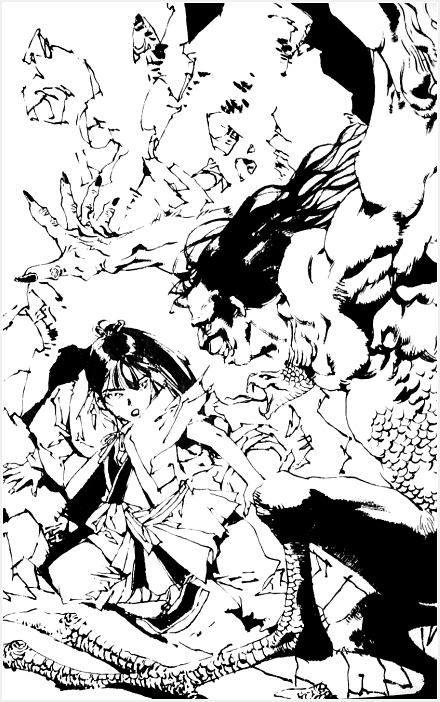
From The Inferno by Dante (though this harpy doesn't appear to have wings):
Here the repellent harpies make their nests,
Who drove the Trojans from the Strophades
With dire announcements of the coming woe.
They have broad wings, a human neck and face,
Clawed feet and swollen, feathered bellies; they caw
Their lamentations in the eerie trees.
Labels: 12 kingdoms, tonan
June 13, 2013
Tonan no Tsubasa (34)
The expression "worthy vessel" goes back to Shushou's first encounter with Gankyuu in the prologue.
Labels: 12 kingdoms, tonan
May 23, 2013
Tonan no Tsubasa (31)
Shuen (朱厭) means "red" + "detestable."
Labels: 12 kingdoms, tonan
May 16, 2013
Tonan no Tsubasa (30)
The siege crossbow (床子弩) illustrated below dates to 12th century China. Based on its design, it's also known as a "three-bow crossbow," essentially an industrial-strength compound bow.

Labels: 12 kingdoms, tonan
May 02, 2013
Tonan no Tsubasa (28)
We find here a good example of ingrained class differences expressed in language. Rikou, Gankyuu, and Kiwa don't use honorifics with Shushou, but Shoutan (a middle-aged man) addresses a twelve-year-old using "sama," a high honorific, because he's reflexively placed her in the same social caste as his employer. Nor does Shushou object to this.
Youko, though, grew up in modern Japan and gets so annoyed at constantly being kowtowed to that she bans the practice. Rikou remarks about this unusual change to the accepted rules of imperial etiquette in "Kizan."
Youko, though, grew up in modern Japan and gets so annoyed at constantly being kowtowed to that she bans the practice. Rikou remarks about this unusual change to the accepted rules of imperial etiquette in "Kizan."
Labels: 12 kingdoms, language, tonan
April 25, 2013
Tonan no Tsubasa (27)
When Shushou says to Kiwa, "If you don't have the courage to go back for your own" (page 263), she uses the pronoun anta, an informal reduction of anata applied only to social inferiors. Everywhere else, she uses "Shitsu-san."
In Japanese, common personal pronouns are never used to address social superiors (unless to insult them), so this starkly reveals Shushou's contempt for the man. A paragraph later, she again refers to him as "Shitsu-san."
Wikipedia has a nice compendium of Japanese personal pronouns.
In Japanese, common personal pronouns are never used to address social superiors (unless to insult them), so this starkly reveals Shushou's contempt for the man. A paragraph later, she again refers to him as "Shitsu-san."
Wikipedia has a nice compendium of Japanese personal pronouns.
Labels: 12 kingdoms, honorifics, japanese, language, pronouns, social studies, tonan
April 18, 2013
Tonan no Tsubasa (26)
I totally identify with this sentiment: "The sheer amount of luggage alone set her nerves on edge." The best way to travel anywhere is with a single duffel bag that can be comfortably slung over the shoulder. Just big enough for your important stuff and nothing more.
And to press home that point, "[U.S.] airlines took in more than $6 billion in baggage and reservation change fees in 2012."
All that stuff is expensive.
And to press home that point, "[U.S.] airlines took in more than $6 billion in baggage and reservation change fees in 2012."
All that stuff is expensive.
Labels: 12 kingdoms, tonan
April 11, 2013
Tonan no Tsubasa (25)
The bread described in this chapter sounds like an unleavened flat bread similar to chapati (or laobing), made from flour, water, salt and a little oil, and pan-fried.
Accoring to Wikipedia, "bisque porcelain is unglazed, white ceramic ware."
Accoring to Wikipedia, "bisque porcelain is unglazed, white ceramic ware."
Labels: 12 kingdoms, tonan