

March 05, 2020
dLibrary Japan (background)
 Long after politicians stopped worrying about Japan as an economic threat (and started worrying about China instead), Japanese popular culture is gaining an increasing mind share around the world, including in China. And yet getting access to Japanese live-action entertainment remains an uphill climb in North America.
Unlike anime, its own genre category on streaming sites such as Hulu, Tubi, and Netflix, Jdrama hasn't found a significant audience outside of Asia. Netflix has ten times as many Korean live-action dramas as Japanese live-actions dramas. DirecTV offers just three Japanese channels and over a dozen Korean channels.
Demographics has a lot to do with this. Korean-Americans (1.8 million) outnumber Japanese-Americans (1.4 million). Korean immigration peaked in the 1980s while Japanese immigration peaked at the end of the 19th century. The large home market for Japanese studios also lessens the need to compete abroad with Hollywood.
Japanese dramas and "unscripted" content (news, talk, and reality shows) are more popular across Asia, where Fuji TV distributes through Alibaba. Hulu/Japan is wholly owned by Nippon TV (the highest-rated network in Japan) and reaches 19 Asian markets.
The Big Three (Crunchyroll, Funimation, HIDIVE) keep their anime offerings up-to-date, and simulcast new series every season. But when it comes to live-action titles, "new" means released in the last decade. Over the past year, Crunchyroll has aggressively pruned its live-action catalog (once the largest) to two dozen titles.
Netflix is the only streaming service actively increasing the number of localized non-anime listings. Alas, little of the content on its Japanese service (like all of the Tora-san movies) is available in North America, where most of the live-action series are "Netflix Originals" rather than content from the domestic networks.
As a result, the only legal way to stay up-to-date with Jdrama has been TV Japan (via Comcast and DirecTV) and Nippon TV (via DirecTV). TV Japan carries a curated selection of shows from NHK and the commercial networks, scheduling episodes soon after being broadcast and some within a few hours. News is carried live.
It can do this because, aside from Cool Japan, sumo, and one nightly news program, TV Japan (and Nippon TV) localize almost none of the content. In language acquisition terms, TV Japan and Nippon TV are "immersive." You experience the content the same way you would in Japan (unfortunately sans most of the domestic commercials).
dLibrary Japan now offers that experience as a streaming option. (And now Rakuten Viki is is competing at the same price point with an emphasis on Jdrama based on manga and anime.)
If you are serious about learning Japanese, a necessary step is immersing yourself in a wide variety of Japanese programming (including Radio Japan). If culture is your primary interest, NHK World is an accessible guide (and includes news and sumo). It's free, mostly in English, and along with streaming, broadcasts OTA in many markets.
NHK World even carries the occasional scripted show, like Home Sweet Tokyo, an amusing educational sitcom about an Englishman who moves to Tokyo with his family to live with his widowed father-in-law.
You can (and should) watch a lot of subtitled anime. But for a true immersion experience and access to a largest catalog of live-action Japanese television available to audiences in North America, the only legal streaming solution is dLibrary Japan from NHK Cosmomedia (which also distributes TV Japan and NHK World).
When it first debuted, dLibrary Japan was full of promise but little substance. Its catalog was threadbare and it had none of the major apps. But at the end of September 2019, dLibrary Japan gave its home page a much needed makeover and announced that "New programs will be available every week from October!"
It has followed through with that promise. Along with the Google Play and Apple TV apps, dLibrary Japan added Roku support at the end of January 2020. Now they're getting serious.
At $9.99/month, dLibrary Japan is a dollar more than Netflix's lowest cost tier and two dollars more than Crunchyroll, both of which have bigger catalogs (by orders of magnitude), so I count it as a "premium" provider.
But let's compare and contrast the streaming services. I paid $42.00 (total) a month for TV Japan from Dish. When TV Japan left Dish for Comcast and DirecTV, the cost for the most basic international package including TV Japan almost doubled. That's when I cut the cord. Here's what I'm paying now.
| Netflix | $6.99/month | $83.88/year |
| Crunchyroll | $7.99/month | $79.99/year |
| HIDIVE | $4.99/month | $47.99/year |
| dLibrary Japan | $9.99/month | $119.88/year |
| NHK World | free | |
The yearly total comes to $34.64/month ($37.95 month-to-month). A ginormous amount of content for six bucks less than what I paid for TV Japan on Dish, and a third the price of the full Japanese package (TV Japan, Nippon TV, NECO movie channel) from DirecTV. That's the big difference that streaming can make.
Related links
dLibrary Japan (user experience)
dLibrary Japan (content)
dLibrary Japan
dLibrary Japan Roku app
NHK World Roku app
Nippon TV and NECO
Labels: crunchyroll, demographics, directv, dlibjapan, funimation, hidive, japanese tv, jdrama, k-drama, netflix, nhk, nhk cosmomedia, nhk world, nippon tv, streaming, tv japan, viki


September 27, 2018
The drama of the single dad
By contrast, regardless of his competence in every other aspect of his life, the single dad is presumed to have a built-in learning curve. Hence the "dumb dad" premise. This plot device has seen an upsurge on Japanese television, in live-action dramas, manga, and anime.

Sweetness & Lightning tackles three genres at once: the single dad, the teacher-student romance, and the cooking show.
Recently widowed high school teacher Kohei Inuzuka never learned to cook, so he and Tsumugi, his spirited five-year-old daughter, eat takeout almost every meal. Until Kotori Iida, one of his students, hands him a flyer for her family's restaurant.
Kotori's (divorced) celebrity chef mom no longer has the time to run it, but Kotori wants a reason to keep the lights on. Realizing that his daughter hasn't eaten a decent home-cooked meal in ages, Kohei takes Kotori up on the offer.
The problem is, Kotori doesn't know how to cook either. But with her mother's recipes, the help of Kotori's classmate (whose family runs the local vegetable stand) and Kohei's college friend (a cook), they tackle a new recipe every week.
The relationship between Kohei and Kotori is handled so subtly that it can be read as romantic or platonic or something in-between. These dinners quickly become the highlight of the week for all three.
The anime is available on Crunchyroll. The English-language manga is published by Kodansha Comics.
 Yotsuba&! [sic] is a manga series by Kiyohiko Azuma, now in its twelfth year. Mr. Koiwai adopted Yotsuba abroad (the details are scant). The stories focus around her daily adventures in Japan. Think of Yotsuba as a kindred spirit of Calvin from Calvin and Hobbes.
An English translation of the manga is available from Yen Press.
Marumo's Rules is a 2011 Fuji TV series. Mamoru Takagi adopts the twin children of his best friend when he suddenly dies of cancer. The plot description in Wikipedia sums up the whole genre:
Together with the help of his landlord and the landlord's daughter, Mamoru [nicknamed "Marumo"] manages to take care of the twins. They face many challenges, with Marumo struggling to balance his time between his work and parental responsibilities.
A cute narrative device is that when Marumo discusses his problems with the family dog, the dog talks back.
(No English versions available.)

Hinamatsuri is based on the manga series by Masao Otake.
One day, Hina drops into the condo of yakuza Yoshifumi Nitta through an interdimensional portal. Some sort of bio-engineered child assassin with telekinetic powers, Hina doesn't know what what she's doing there. She assumes she's on a mission and Nitta is her handler.
This mistaken assumption comes in handy when Nitta has her literally defenestrate an entire rival gang in one fell swoop. But after that, Nitta is stuck with her. So he tells people that Hina is his long-lost daughter, and before long they have assumed their respective roles.
As a brand-new dad, Nitta finds himself with the responsibility of turning this tiny version of Robert Patrick from Terminator 2 into a functioning member of society.
The anime is available on Crunchyroll. The English-language manga is published by One Peace Books.
My Girl is a manga series by Sahara Mizu, made into a TV Asahi series in 2009 starring Masaki Aiba of the mega-boy band Arashi. (As far as I can tell, the members of Arashi are much better actors than they are singers, and they're not terrible singers either.)
Attending the funeral of his ex-girlfriend (who'd been living abroad), Masamune Kazama discovers that not only did she have a child, but she had his child, who now really is his child. What follows is a how-to/day-in-the-life melodrama that defines the next series too.
(No English versions available.)
 Bunny Drop is a manga series by Yumi Unita, an anime series by Production I.G, and a 2011 feature film.
Daikichi's grandfather had a child with his live-in maid. Daikichi only finds this out at his grandfather's funeral. "If the old man was still alive," he grumbles, "I'd give him a high five." He points out to his mother, "That'd make her your sister." She retorts, "And your aunt."
Nobody wants to take responsibility for Rin, the five-year-old girl. Finally (if only out of disgust with the rest of them) Daikichi takes her home. He soon decides to make the arrangement permanent.
Bunny Drop is a sweet, unadorned drama that avoids most of the stereotypical melodramatic devices. Like My Girl, it succeeds by making a virtue of ordinariness and by featuring protagonists who are believably decent human beings striving to do the right thing.
However clueless Daikichi may be at first, he doesn't stay dumb, and grows quite insightful into the strange, topsy-turvy life Rin has led, while cheerfully saying goodbye to his "me-time" and his climb up the corporate ladder.
The anime (based on the first three volumes of the manga; English translation available from Yen Press) is drawn in a pencil-on-watercolor style that gives it a subdued picture book quality. I found it quite pleasant and entirely appropriate to the subject matter.
The anime is available on Crunchyroll and Tubi.
The Japanese government actually has a "Minister of State for Measures for the Declining Birthrate." If government agencies were ever that creative, I could imagine them commissioning television series like these to encourage young men to take up the reins of fatherhood.
Unfortunately, regardless of the good intentions in the regard, it doesn't seem to be working (in Japan and every other country with the same problem).
Labels: anime, anime lists, anime reviews, cooking shows, demographics, food, japanese culture, japanese tv, manga, personal favs, social studies
March 30, 2017
Unregistered
I seriously doubt that proportionally more Japanese go off the grid than Americans. It's just weird when Japanese do it because, well, Japan is weird to start with and the Japanese are so methodical about such things. Even the homeless in Japan are remarkably organized about being homeless.
What makes Japan different is the ease with which one can "evaporate." As Callahan explains,
There is no national database for missing people in Japan. There are no documents or identifiers--such as our Social Security numbers--that can be used to track a person once they begin traveling within the country. It is against the law for police to access ATM transactions or financial records.

As in the United States, identity in Japan is based on the birth record. But in Japan, a "birth record" is derived from the centuries-old (though revised and modernized) koseki system, according to which the life events of every citizen are recorded in a genealogical account attached to the household.
It is a pragmatic system whose sheer pragmatism has made it ruthlessly resistant to social change. The married surname controversy has become emblematic of the whole matter, with Japanese courts ruling that, under current law, a married couple must share the same surname.
While sexual mores have kept apace with the times, "illegitimacy" in Japan is treated very much the way it was back in the 1950s. Again, a large part of this is the koseki, which requires that a child be registered to legally exist. The koseki "made every Japanese family an open book."
So a "cover up" could come back to haunt you. Somebody would find out eventually. And that makes for a great plot device.
In The Art of Memory by Sakumi Yoshino (no English version that I'm aware of), the protagonist discovers she has a long-lost brother when she gets a copy of her koseki in order to apply for a passport.
The mistaken paternity in From Up on Poppy Hill arises from registering the child of a deceased friend in order to erase his "orphan" status. By doing so, Umi's father could legally give his "son" up for adoption. But that made it look like Umi and Shun were half-siblings.
The identity theft loopholes documented by Miyuki Miyabe in her mystery novel All She Was Worth have largely been addressed (only in 2008). And yet the koseki continues to reflect the idealized structure of Japanese society, which defined the individual's identity in relationship to the household.
Break that relationship and you can legally cease to exist. That's why "evaporating" works so well. And why skipping out on your debts continues to be a realistic plot device in Japanese melodramas.
In Ma're, when the dad hauls his family off to the Noto Penisula (literally on the other side of Japan) to escape a looming bankruptcy, there'd be no way a credit bureau could track him down unless he told it. Because until only the last decade, the koseki was the credit bureau.

Regardless of the potential upside, the social risk is too great.
But at least when it comes to personal identity, a sea change is coming, though it is a rising tide, not a tidal wave. The Japanese government has gotten serious about the "My Number" system, the equivalent of a Social Security number.
(It's an official Japanese government website so of course it sports a cute bunny mascot.)
That's right, up to very recently, the notion of a single number that followed you everywhere simply didn't exist in Japan. Once it is fully implemented, it should make identify fraud more difficult. But then it will also make possible Social Security number fraud. Welcome to our world.
Related posts
The Mormon "koseki" problem
The koseki system in The Twelve Kingdoms
Labels: demographics, japan, japanese culture, politics, social studies
November 24, 2016
"Ghost in the Shell" trailer
Okay, I'll get to the trailer. But first this silly whining about Scarlett Johansson not being "Japanese." Silly because she's playing an android whose only "human" component is her brain, and has swapped "shells" more than once. Besides, phenotypic racial characteristics in manga and anime are highly malleable, to say the least.

It's true that casting Japanese as Japanese in Hollywood is a perennial problem. But in Hollywood, everything's ultimately about the box office, which also points to a perennial supply and demand problem.
As an Asian-American ethnic group, Japanese (1.3 million) lag behind Korean (1.7 million), Vietnamese (1.73 million), Indian (3.18 million), Filipino (3.41 million), and Chinese (3.79 million).
Except for the cream of the crop (Ken Watanabe), a Japanese actor with any kind of talent can get more and better work in Japan (and won't have to speak English). The reverse is true too, which is why (with rare exceptions) "Americans" in Japanese productions are so often played by Europeans who "look" the part.
So while Star Trek creates roles for Japanese actors, aside from George Takei, it has a hard time finding Japanese actors to play them. Thus we have Rosalind Chao in Next Generation (who doesn't look Japanese) and Linda Park in Enterprise (who more or less does) and John Cho in Star Trek (close enough).
I always wondered why they just didn't make Linda Park's character Korean. It's not like there was any continuity to preserve.
In any case, the setting of Ghost in the Shell is postmodern and post-mini-apocalyptic, taking place in a Japan that, like Los Angeles in Blade Runner, has become a polyglot tossed-salad of Asian cultures. So it's hard to hung up about the specifics of national identity.
Anyway, who's to say Johansson isn't Japanese? How many people know that Dean Cain (Lois & Clark) is a quarter-Japanese? (I didn't until I looked it up.) Risa Stegmayer (American father, Japanese mother), co-host of NHK's Cool Japan, doesn't look especially Japanese, especially seated next to the very Japanese Shoji Kokami.

Meanwhile, the very Japanese Hiroshi Abe plays a Roman architect in the Thermae Romae movies.
This anecdote by Peter Payne (who lives in Japan, where he runs an online store for otaku) is a good antidote to this plague of third-party offense-taking:
Once I was watching an episode of Alias with my [Japanese] wife, and there was a horrid scene in which some female spy went to "Japan" (which appeared to be shot in a sushi restaurant about ten minutes from West Hollywood), painted her face white like a "geisha" and proceeded to extract information from her target despite not knowing his language. I was livid that in the 21st century TV producers couldn't even come close to getting basic imagery right, but my wife was enthralled with it, laughing at each new hilarious plot twist.
It's always a good idea to make sure that those on whose behalf you are getting offended would actually get offended by what you think would offend them. Because they might not have the slightest idea what you are talking about. (See also here.)
As far as that goes, the great Takeshi Kitano plays Aramaki in the movie, which I do consider inspired casting.

But enough with that, back to the trailer.
Based on this small sample, it looks like the movie is using material from Masamune Shirow's manga (the girl-on-girl stuff), Mamoru Oshii's animated film (the opening sequences are an exact match), and the second season of Stand Alone Complex (directed by Kenji Kamiyama), in which the Major gets some hefty "shell" repair.
The live-action version also draws its existential moodiness from Oshii. Like Blade Runner, Oshii's versions are more psychological thrillers, far "heavier" than the manga. The same shift in tone can be seen comparing the Patlabor anime series to Oshii's Patlabor feature films.
Stand Alone Complex is a straightforward cybernetic police procedural.
Like Sherlock Holmes, Major Kusanagi has adapted to the needs of the director, the story, and the medium. Shirow's Kusanagi is a futuristic take on a Connery-era "Jane Bond." Oshii's is closer to Rutger Hauer's Roy Batty from Blade Runner, while Kamiyama's approximates Mark Harmon's Gibbs in NCIS.
Explaining why he broke with Oshii's interpretation, Stand Alone Complex director Kenji Kamiyama quipped, "The first episode would be the final one!" People would get bored of watching a character search for her identity for half a year."
So far, I rank Stand Alone Complex and Solid State Society as the best of the bunch (the Tachikoma robots being no small reason why). Like The X-Files, the Stand Alone Complex seasons are tied together by season-long arcs, interspersed with science fiction stories that work well on their own.

But we'll have to wait a while to see where Hollywood's live-action version ranks in the franchise.
• Ghost in the Shell (manga) 1989–1990
• Ghost in the Shell (theatrical release) 1995
• Innocence (theatrical release) 2004
• Stand Alone Complex (TV anime series) 2002–2006
• Solid State Society (movie in the SAC arc) 2006
• Arise (OVA series) 2013
• New Movie (movie in the Arise arc) 2013
• Ghost in the Shell (theatrical release) 2017
Related posts
The Shirow franchises (1)
The Shirow franchises (2)
Back to the social welfare future
Haafu and half
Labels: anime, demographics, ghost in the shell, japan, japanese culture, k-drama, manga, movies, nhk, personal favs, pop culture, social studies, technology
December 03, 2015
The Mormon "koseki" problem
As my brother quipped, "And yet the child of two heterosexual Satan-worshipping prostitutes would be?"
The first thing that occurred to me was that the Mormon church had reinvented Original Sin. Hey, kids, welcome to Limbo! "Limbo" isn't official Catholic doctrine. Apparently this is.
But the bigger question is why the church even bothered. Who thought this was a problem that needed solving? What, there were maybe five people in the entire world that such a policy would have otherwise applied to (before turning it into a cause célèbre)?
It struck me as the kind of rule-making engineered by a mid-level bureaucrat who panicked one day when a hypothetical raised by a local bishop clawed its way up the chain of command and he realized that they didn't have a form to handle it.
You see, the church has a koseki problem. Cultural and religious reasons aside, one reason gay marriage has made halting progress in Japan is for the same record-keeping reason.
The koseki tohon (family register) is the official census record in Japan, and the legal equivalent of a person's birth certificate. All major life events--birth, adoption, marriage, death--are recorded in the koseki. If it's not in the koseki, it didn't legally occur.
The Japan Times explains:
People without a family registry are ineligible for passports and driver's licenses, as well as such basic but critical services as public health insurance and national pension benefits. In addition, their lack of a legally valid identity leaves them open to a multitude of other potential problems.
The koseki is a patrilineal document as well as a genealogical record. Before privacy laws were enacted, private investigators, employers, and marriage brokers could peruse any person's koseki for evidence of disreputable fruit hanging in the family tree.
With its roots in medieval Japan and its first major revision back in 1872, with public access to koseki records only being restricted in 2008, the koseki system has adjusted slowly to modern times. Consider, for example, the following:
- When a couple marries, only one family name can appear on the koseki. Except in the case of adult adoption, the woman almost always gives up her maiden name.
- The child of a divorced woman who gave birth before legally remarrying will be listed on her previous husband's koseki.
- To gain custody, the child must be "abandoned" by his "legal" father and adopted by his biological father. This is one reason child adoption is rare in Japan.
Adult adoption, on the other hand, remains surprisingly common.
- Even more bizarrely, there are circumstances where the child doesn't end up on either parent's koseki and so legally ceases to exist.
As many as 10,000 mukoseki ("no koseki") Japanese have fallen through these cracks, children of Japanese citizens but non-persons in the country of their birth.
- And, of course, there's no effective way to deal with gay marriage, especially the child of two women (although for an eldest male, adult adoption becomes an interesting alternative).
A few progressive wards in Tokyo have carved out exceptions, but nothing approaching a national solution is on the horizon. (Keep in mind that Japan is just getting around to creating a social security numbering system and fax machines remain ubiquitous.)
So what does this have to do with the Mormon church? Unlike most faiths, the Mormon church keeps the equivalent of a koseki for every member (which is both weird and kinda scary). Like the koseki, this database is patrilineal in theology and structure.
And like the koseki, simply changing the values in a database field can't help but make a cultural statement, with a boatload of political implications in tow. Perversely, the kind of statements and implications that the Satan-worshipping prostitute avoids.
Here is where that mukoseki status serves to resolve the church's gay marriage dilemma. No koseki? The kid doesn't exist. Neither do the parents. Not our problem.
Frankly, the church should borrow from the Amish and not baptize anybody until they're eighteen. Oh, and I'd tell the Japan census bureau that the clarity of the Jewish matrilineal system has much to recommend for it.
Related posts
Angle Beats!
The hidden reason for the policy change
The koseki system in The Twelve Kingdoms
Labels: anime, demographics, japan, lds, politics, religion, technology
October 21, 2013
Contrary Japan
As I observed earlier this year, "The year 2012 again had Japan boldly going where no man has gone before. Literally, as it turns out. Where it's going, there's nobody there. Because they died."
Greenfield make other contrary points that are pretty spot-on, such as: "Japan isn't really a technocratic wonderland." Well, it is, but in small, highly-concentrated pockets. Compared to the average American, the average Japanese lives a lower-tech life with a lower standard of living.
Except for the toilets. And the trains.
Greenfield observes that "the strain of a feudal society rapidly transitioning to the modern world is still there." I'm not sure about the "strain," though. Those feudal elements are mostly embraced without a second thought, and have only been exacerbated by recent demographic shifts.
A survey conducted on NHK's Cool Japan program, for example, found that the overwhelming majority of teens favored preserving the hierarchical language reflected by senpai-kouhai (senior-junior) relationships, that start in elementary school and continue for the rest of their lives.
That conservatism helped freeze Japan in time, that time being the cusp of the 90s when Japan was at its peak, and crippled its corporations and its culture, but also made the return of the right to power possible. It's far from certain that a conservative revolution can save Japan, but so far it has a better shot at it than we do.
According to Greenfield, one reason Japan survived the consequences of its social implosion was "because of its dislike for immigration." On top of that, "A society of the elderly may be slow to turn around, but it's less likely to drive off a cliff without understanding the consequences."
A country that still waxes nostalgic about the 250-year isolationist reign of the Tokugawa Bakufu is never going to embrace immigration as a solution for anything, nor should it. Or could it. What Michael Blowhard says about the French is equally true of the Japanese:
Hard though it is for an American to believe, the French wake up in the morning and look forward to a full day's-worth of Being French. They go through the day Being French with great relish. They re-charge at night so that they can spend the following day Being French.
The political term for this in Japanese is kokutai, or "national polity." During that Meiji Restoration, kokutai defined "the eternal, and immutable aspects of [the Japanese] polity, derived from history, tradition, and custom, and focused on the Emperor."
In other words, a system, as Colin Jones puts it, "inherently designed to keep order by protecting the old." Even if the old way of doing things isn't any older than 1868.
Labels: deep thoughts, demographics, economics, japan, japanese culture, nhk, politics
October 07, 2013
Haafu and half
Shisaku muses about how the brain trusts in Japan and China might read these particular tea leaves. But I was also struck by how Harris is a kind of mirror image of the Japanese actor Masao Kusakari. I'm not just talking about physiognomy.

Kusakari's father was an American G.I. He was killed in Korea, so Kusakari was raised by his mother in Japan. You can easily imagine one of those "trading places" scenarios.
When a haafu is Japanese/Caucasian, the Japanese genes usually dominate, except for height. Masao Kusakari is six feet tall, way above average for a Japanese born in 1950. Rangers pitcher Yu Darvish (Iranian father) is a towering six feet five.
In reality, the actual genetic mixing and matching is all over the map. Though with enough data it should plot out as a nice Guassian distribution.
Risa Stegmayer, co-host of NHK's Cool Japan (American father, Japanese mother), doesn't look especially Japanese, especially seated next to the very Japanese Shoji Kokami. (She speaks both English and Japanese fluently and without an accent.)
These variations can be found in "Yamato" Japanese too, though long periods of geographical and political isolation trimmed the tails of the distribution curve pretty short.
In the time-travel comedy Thermae Romae, for example, Hiroshi Abe (below) plays a Roman architect and Kazuki Kitamura is cast as Ceionius Commodus. In terms of their physical appearances, I was perfectly able to suspend disbelief.

Just to make sure, however, whenever Abe's character ended up back in Japan, the casting director surrounded him with "Japanese-looking" Japanese so he could observe how different they are (he describes them as having "flat faces").
This is pretty much axiomatic in population studies. Given a large enough cohort, the Guassian distribution of a common trait will reveal bigger differences within the cohort than than the mean differences across similar cohorts.
Labels: cool japan, demographics, japan, japanese tv, nhk, science
September 23, 2013
The danchi revolution
Danchi were massive urban housing projects initiated in the late 1950s. They were designed to accommodate the burgeoning population and lure people out of their wooden apartments and single-family fire traps.
The great majority of the deaths in the Great Kanto (1923) and even the Great Hanshin (1995) earthquakes were caused by collapsing wooden buildings and the fires that followed.
At the time, danchi were considered very modern and upscale. The Emperor visited what would become the Takashimadaira housing complex--still the largest in Tokyo (10,170 units)--to lend his stamp of approval.
The image below comes from this detailed photo blog: "You can't talk about danchi without mentioning Takashimadaira."
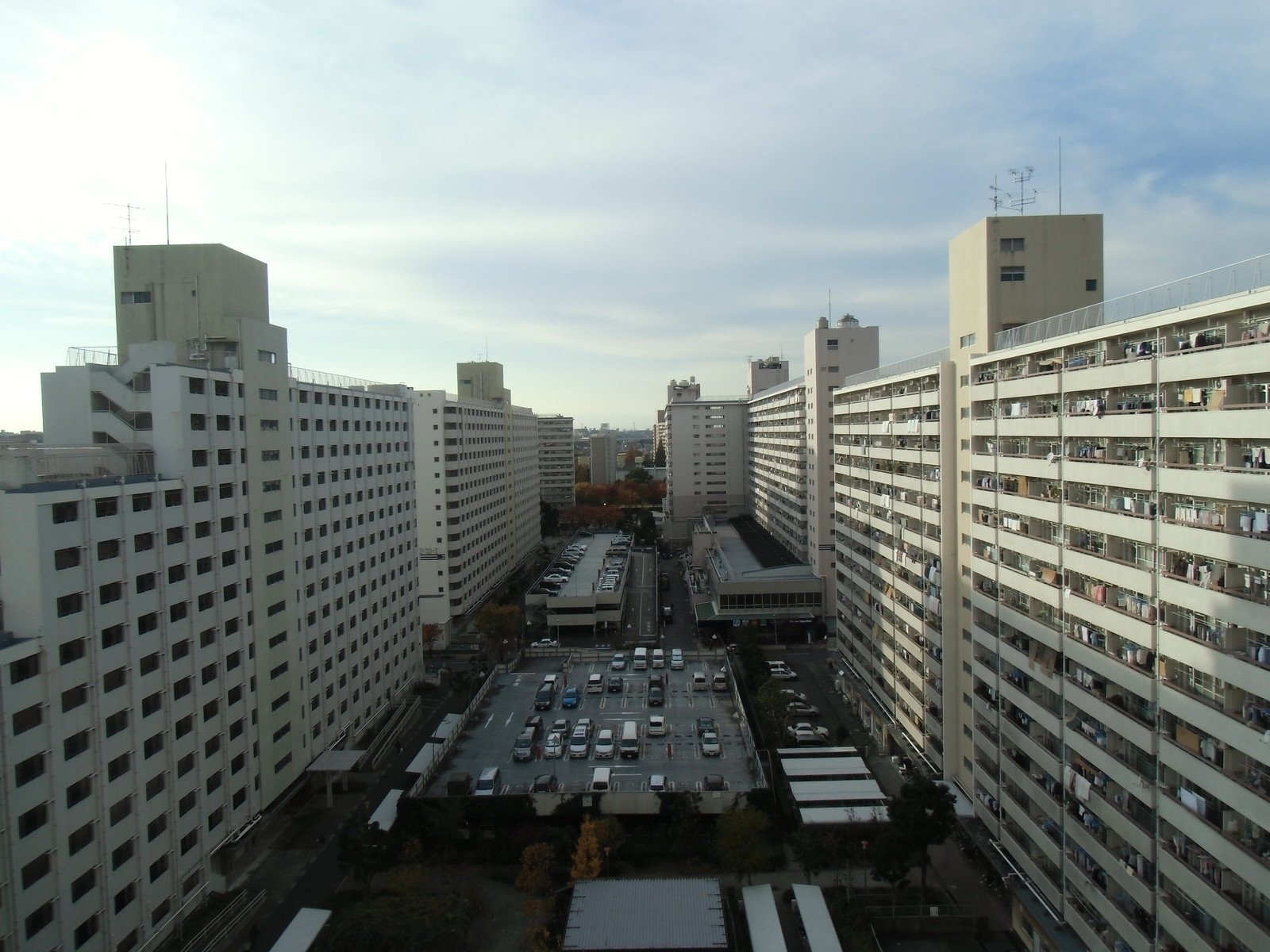 |
| Courtesy Dhanow. |
Bakusho Mondai showed a television ad from the era, featuring a "cool" couple entertaining in their cool new digs, with one cool guy mixing a martini. It was like something straight out of Mad Men.
The big architectural and cultural innovation danchi introduced on a widespread basis was room specialization, bedrooms separate from the dining room separate from the living room.
Though a second look reveals just how tiny those living rooms were. The couch and coffee table in the original Dick Van Dyke Show would have completely filled it with no room left for anything else.
These original structures are now seen as cramped and decrepit. In order to attract tenants, older danchi are combining units and liberalizing leasing requirements and zoning, such as converting ground floors to retail.
Later housing projects like Tama New Town (which grew into an entire city) and Port Town (where I lived for a year) accommodated an "urban-suburban" mix from the start, with larger apartments, green space, and shopping malls.
 |
| Port Town, Osaka. |
Upscale danchi have been rechristened "mansions" (condos). These days, though, a room of one's own isn't enough. The middle-class dream revolves around "Mai Hoomu" (マイホーム), a house in the suburbs.
Make that new homes and condos in communities close to the cities. The result is a growing surplus of old and abandoned houses in the exurbs (as in The Wolf Children). There's little affection for "this old house" in Japan.
Labels: danchi, demographics, japan, nhk, showa period
April 08, 2013
The undiscovered country
Japan's population fell by over 200,000 in absolute terms. Near-term projections have it falling from 127.5 million to 116.6 million in 2030 and 97 million in 2050.
As Spock would put it: "Fascinating." Though hardly catastrophic, not for overpopulated Japan. That doesn't stop the Chicken Littles. Over at The Diplomat, John Traphagan flips a coin between calling it "Japan's Demographic Nightmare" and "Japan's Demographic Disaster."
For some truly disastrous numbers, The Economist gets the heart of the matter with these projections of the net labor force demographics:

But they remain projections. After perusing popular projections about the shrinking length of the Mississippi River, Mark Twain calculated that
Seven hundred and forty-two years from now the Lower Mississippi will be only a mile and three-quarters long, and Cairo and New Orleans will have joined their streets together, and be plodding comfortably along under a single mayor and a mutual board of aldermen.
"There is something fascinating about science," Twain wryly concludes. "One gets such wholesale returns of conjecture out of such a trifling investment of fact."
A century later, apocalyptic group think, once the province of the crackpot right, has come to dominate the intellectual left: "If we don't do X right away we're doomed! Doomed! Take rising sea levels: it's not as if the ocean's going to save it all up and surprise us one morning.
In The Globe and Mail, Doug Saunders coined the appropriate term in this case: "We have entered the age of fertility panic."
Journalism long ago abandoned actual reporting and now functions as the official teller of ghost stories around the campfire. Except we're supposed to believe them. Hence the mindless repetition of the supposed solution to this supposed disaster: immigration!
In the case of Japan, that's a cure worse than the disease, which is why it's never going to happen. Besides, if labor availability is the problem, it's a lot easier to move to where the labor already is. That's why most Toyotas and Hondas come from factories here in the U.S.
Although some Japanese are choosing to retire to Thailand the same way Americans do to Mexico, the elderly can't be exported like cars. Here I think Michael Cucek has ferreted out the real reason for Japan's recent forays into government-sponsored daycare:
How then is the government to allocate resources in carrying out this project, where Japan has no models to follow because it in the vanguard, the leader because it has the most aged society on the planet? It turns out that the Japanese government has been running a pilot project for the coming eldercare explosion--its child daycare program.
People adapt and muddle through. Japan is the third richest country in the world. Sectors of its economy--agriculture, in particular--remain incredibly inefficient. There's a considerable amount of low-hanging economic fruit to be plucked before donning the sackcloth and ashes.
Already curious counter-trends can be observed. Coco Masters reports in Foreign Policy that
A poll conducted by the Japanese government last December shows that 51 percent of respondents think women should be stay-at-home mothers. That figure is up 10 percent since 2009--with the increase most notable among people in their 20s [emphasis added].
And in a New York Magazine article, Lisa Miller documents a similar trend in the U.S.:
The number of stay-at-home mothers rose incrementally between 2010 and 2011, for the first time since the downturn of 2008. While staying home with children remains largely a privilege of the affluent (incomes of $100,000 a year or more), some of the biggest increases have been among younger mothers, ages 25 to 35, and those whose family incomes range from $75,000 to $100,000 a year [emphasis added].
So maybe the problem is getting ready to correct itself, the same way the population was once going to explode us all out of existence--right up until it didn't.
Labels: culture, demographics, economics, japan
May 28, 2012
The Reverse Roe effect
Gradually but relentlessly, Japan is evolving into a type of society whose contours and workings have only been contemplated in science fiction. [Though] it is not clear that Japan's path will be a harbinger of what lies ahead in other aging societies.
Eberstadt is right on that last point. Japan is quite different from other rich countries, in large part because of its very dense infrastructure and the great ability (largely unnoticed by western commentators) of ordinary Japanese to radically adjust their cost of living.
Still, I'm not sure that "Japan's path" will prove much of a harbinger even in Japan.
At the heart of these concerns is a curiously conservative ideology infecting the full spectrum of liberal and academic thought. It is perhaps best summed up in William F. Buckley's famous definition of conservatism: "It stands athwart history, yelling Stop."
First, seeing the world in static terms: whatever is will always be; whatever the current trends, they must be expected to continue forever. Any deviation from what was, or the expectations of what should (and ought to) be, becomes cause for great alarm. Steps must be taken!
Nothing illustrates this better than the recent flurry of "Japan going extinct in 1000 years" stories (coming a quarter century after the "Japan as #1" fad).
Second, an apocalyptic world view, which places every generation at the fulcrum of history, its hands on the levers that will move the world into or away from the precipice. But lurking beneath the sackcloth and ashes are towering egos convinced they can rule the world. And nature.
A fertility rate of 1.4 actually masks a more interesting reality: that a lot of women have no children, and a few have more than none. It's the mirror opposite of what James Taranto calls the "Roe Effect" (there are fewer abortion supporters every generation for the obvious reason).
The Roe Effect kicks in elsewhere. A real problem in Japan (echoing Steven Sailer's theory that family formation inversely tracks cost of living) is that owners of cheap land are loathe to sell and eat the losses, taking the sunk cost fallacy to the point of actual extinction.
It's yet another problem that will eventually fix itself. The people who have land and no children won't be around that much longer to not have either. The cost of family formation will drop as a result, meaning those who want to have more children can afford to have more.
As Troy cynically points out, thanks to Japan's much briefer post-war baby boom, the medium-term demographic problem in Japan "pretty much solves itself" by dying out quite promptly.
Now, if you're Greece, you may plumb run out of people while struggling past this dip. But if the worst case scenarios all come true, a century from now Japan will have the same population as—Great Britain right now. On the same amount of arable land. Hardly the end of the world.
Related posts
Demographics (and manga)
How to live long and prosper
The Medicator (they'll be back!)
The undiscovered country
Labels: demographics, japan, politics
July 04, 2011
Life is a sim
There is no greater joy
than receiving a visitor
But I don't mean you
On this side of the Pacific, it's an extrovert's world, so they get to define the terms of the debate, expressed as anything from rolled eyes to "call the men in the white coats" exasperation to unbridled rage at all those activities introverts enjoy doing that don't involve, you know, them.
In Japan, if you shut yourself in your room and don't come out for a year, okay, you're probably an "introvert." Otherwise, you're "normal," and "normal" activities have been extended and refined to introverted degrees that shock extroverted sensibilities all the more, such as the dating sim.
The dating sim evolved out of the "interactive novel," one of those technologies that has forever remained stubbornly over the horizon--except in Japan, where it has merged with the manga/anime aesthetic and narrative style and succeeded amazingly well.
One of the most popular dating sims is Love Plus (Peter Payne touches upon it here), cited in some translated 2ch responses to this by-the-numbers rant about how Japan's whole problem is the "fantasy world of comics, video games and animated pornography."
• Oh, and its OK to be obsessed with movies and books then?
• Make reality more interesting than games, please.
• Yeah, I can live on games alone.
• If everybody became obsessed with games, then we would live in a peaceful society.
• Reality does not want to deal with me, you idiot.
• The world in the monitor is reality. The world we live in is just imaginary.
• To be honest, I don't want a (real) woman.
• Love Plus IS reality.
• But the 2D world is ideal.
• My [2D] girlfriend is Aika-san. She lets me meet her whenever I want and greets me with a smile if I forget a date, and she does not cost money. Thats all I need.
• I'm 30 and earn 3.5 million yen [$40K USD]--how am I supposed to get married?
• I tried to face reality and it became Love Plus.
• A country of Neets [England] being worried about Japan?
• Girls in games won't cheat on us.
• The solution is simple: make it so that anime and manga characters can get pregnant.
• There are too many Japanese people anyway, so decreasing the population would be just right.
As the first point makes clear, as with slams of romance novels, these kinds of criticisms ultimately boil down to snobbery: my ways of wasting time are more refined than your ways of wasting time. Not to mention that wasting it in a group is always deemed more productive than wasting it alone.
That last one is an important demographic point that the "birth dearth" people utterly fail to comprehend: the Japanese are choosing to not gallop mindlessly into a Malthusian catastrophe. Just to make this point clear:
• Japan has a population of 128 million.
• And is the approximate size of California, with less arable land (and even less than that since the March tsunami and Fukushima meltdown).
• The current population of California (37 million) is about that of Japan two hundred years ago.
Even so, as stubborn contrarian Eamonn Fingleton insists, no ostensibly "dying nation" has ever done so well as Japan.
I'm not a game player, so I can't offer any opinions in that department. But Kanon and Clannad--based on dating sims--are in my top ten list. The KimiKiss manga are pretty good too (very Jack Weyland-ish). Game-play imposes a structure on the narratives that lend to solid plotting.
Here is a Love Plus trailer.
Related posts
Kanon
Clannad
Understanding Japanese women (and introverts)
Fumiko's Confession (how a dating sim is not supposed to turn out)
Labels: anime, computers, demographics, introversion, japan, manga, pop culture, sex
November 01, 2010
Japan takes off (with or without us)
I left a few comments, but here's my long answer.
The isolationism of the Edo Period lasted as long as it did was because the Tokugawa shoguns were so good at doing what they did. The Darwinian contest of the previous Warring States Period, combined with a fairly rational (for its time) feudal order and a high literacy rate pretty much left the best and the brightest in charge.
And later on, a blind eye was turned toward supposedly prohibited movement (up and down) between the classes.
Successful merchants bought themselves samurai credentials and samurai married into merchant families to bail out their flagging fortunes (the muko-iri marriage allowed a lower-class groom to marry a upper-class bride and take her surname). This replenished the gene pool and dampened frustrations over social mobility and primogeniture.
In Japan, Mr. Bennet would have found for his eldest daughter a man of means but with a slightly lower social status and adopted him into the family.
Japan staved off Malthusian pressures with infanticide and the occasional famine, which reduced the number of restless, unlanded sons running around starting revolutions.(1) As a result, the Edo Period is now regarded with great nostalgia. The Edo Period melodrama occupies the same cultural space as the American western and is a staple of Japanese television.
One reason Japanese don't worry that much about the "birth dearth" is that, hey, the Edo Period wasn't half bad! So maybe a Japan with half as many people would be an improvement! But this kind of contentment is inimical to "progress."
Satisfied citizens and competent bureaucracies do not prompt paradigms to shift, just as unstressed ecosystems tend not to promote evolution. However, by the early 19th century, the Tokugawa's hold on power was growing frayed. Inbreeding took its toll. Powerful domains like Satsuma chafed under the draconian trading restrictions, or simply ignored them.
The governor of Satsuma married his adopted daughter into the Tokugawa line. When that failed to change the political tides, Satsuma joined forces with the even more fractious Choshu, and the emperor (still a puppet in Kyoto) was convinced to do the unheard-of equivalent of dissolving parliament, with the promise of holding real power in the new government.
The Tokugawa regime subsequently collapsed in one of the shortest, most decisive civil wars in history.
Perry's arrival was the straw the broke the camel's back. But it'd been creaking for decades. The adventurous curiosity of the Meiji Era reformers--some of the most brilliant minds of the age traveled around the world gathering all the political ideas, science and technology they could lay their hands on--would have perhaps erupted later, but inevitably.
At which point those enormous reservoirs of pragmatism allowed the Japanese to make up a two hundred year industrial and technological deficit in a single generation.
1. The irony here is that Japan kept out of the Malthusian trap during its isolationist phase only to fall into one at the end of the 19th century, when the government started encouraging emigration to South America and the colonization of Manchuria. Japan's Lebensraum problem, more substantive than Germany's and similarly poisoned by a political ideology that was more a state religion, led to WWII.
Having learned its lesson, Japan's post-war baby boom was much shorter in duration than America's, which is why Japan is aging so quickly now. [return]
Labels: demographics, history, japan, social studies
August 16, 2010
How to live long and prosper
I didn't mean you living long and prospering. But your relatives will appreciate the sacrifice on their behalf. This seemed to be what Sogen Kato's family was thinking when he died in 1978. His daughter and son-in-law (now 81 and 83) simply shut the door to his room and never opened it again.
Maybe they were trying to save on funeral expenses (as big a racket in Japan as in the U.S.). And being in a super economizing mode, they continued to live in the same house!
And use his pension as a piggy bank. As they say, if it didn't really happen, people would think you made it up. After repeated attempts to contact him, police were tipped off by a grandchild and found "the mummified corpse of a man, allegedly a shut-in, who would have been 111 years old if still alive."
This set off a nation-wide search, resulting so far in over 100 missing-persons cases for people over 100. Not missing as in they wandered off somewhere, but missing as in there's no evidence they still exist anywhere. In one case, this bizarrely resulted in the opposite situation as the above:
Fusa Furuya is 113 years old and Tokyo's oldest resident. But even though her domicile was transferred to Suginami Ward in 1986, no one clearly recollects when she was last seen, although her daughter has continued paying medical care premiums on her behalf.
A few years ago, the Japanese government lost millions of pension records, again, as in nobody can remember where they put them. The primitive paper reports the U.S. Social Security Administration sends me every year are probably one of the better wastes of taxpayer money. I should save them.
Though if the government had to guestimate my earnings based on medium incomes for my bracket (what they're resorting to in Japan), I'd probably come out ahead.
Labels: demographics, japan, social studies
August 02, 2010
Demographics (and manga)
Among other things, scrolling along the timeline clearly reveals Japan's short-lived, post-war baby boom and its echo. The U.S. counterpart peaked a decade later and practically spans an entire generation between Japan's boom and echo.

The first boom (among other things) energized the manga industry (and popular culture in Japan) in the 1960s when the boomers hits their teens. The echo a quarter-century later turned anime and manga into a billion dollar industry.
But now with the birth rate falling below replacement, a tertiary echo is not appearing and the audience is aging out of the market. A sign perhaps of things to come. I guess it's time to invest in medical robots.
Labels: demographics, economics, japan, manga, robots
April 22, 2009
Japan's pop-culture economic recovery
That sounds way more fun than stuff like "TARP."
I'm skeptical about "low-carbon" anything ("low-fat" made us all fatter), but Japan already has the longest lifespans and the fastest-aging society in the world. Wherever the post-industrial economies are headed demographically, Japan will get there first.
They may have something to teach us in that respect, though I suspect cultural idiosyncrasies will make importing health care systems problematic. I doubt the average American would be at all happy with Japan-style health care, no matter how well it works for the Japanese.
Gazing fondly at the green grass elsewhere, the results of quasi-socialized medicine we like, the means not so much (the same way that, no matter how "good for us" high gas prices would supposedly be, nobody actually wants to pay them).
Anime, on the other hand, is a 20 billion dollar industry in Japan. It's a tenth of that in the U.S., but two billion bucks is nothing to sneeze at. Manga is worth 4.5 billion dollars in Japan, while licensing brings in only a 20th of that in the U.S. So there's a lot of room to grow.
And speaking of room to grow, the economic impact of Japanese genre fiction translations--my specialty--is currently too small to measure. But that means there's only one direction the market can go: up! (he says, crossing his fingers).
Mr. Prime Minister, I am doing my best to help Japan's economy recover. Perhaps a special favor? When's a new edition of Yokohama Shopping Log coming out? Here I am all ready to spend my hard-earned dollar-converted yen, and it's out of print! Aarrgh!
Labels: anime, business, demographics, japan, manga, politics
September 25, 2008
The youngest cabinet officer
Peter Payne gets right to the point with his blog post on the subject: "Hot Japanese Female Politicians, Lack of Children."

I'm not sure how one goes about "tackling" such a problem. At least she's married and has a kid. Though given current fertility rates in Japan (1.3), she's still .8 children behind. Maybe if McCain loses the election, she could recruit Sarah Palin as a consultant.
Labels: demographics, japan, politics
September 07, 2006
Boys over Flowers
According to Rikikazu Sugiyama, director of Sugiyama Ladies Clinic in Tokyo and an expert in obstetrics and gynecology, sex selection is a serious matter for many couples, not just royalty. The fertility expert noted that, unlike the Imperial family, eight out of 10 patients at his clinic desire a baby girl, believing they are easier to raise.
I am in no position to comment on the accuracy of that last assertion, but I am very happy for Princess Aiko, as the travails of her mother must provide convincing evidence that being Empress of Japan would have to be the worst job in the world. No doubt about it, when it comes to constitutional monarchies, much better to be the "spare" than the heir.
Labels: demographics, japan, social studies
December 07, 2005
All in the anime harem family
 The thought occurred to me while I was watching the fascinating anime series Elfen Lied (from the German elfenlied, "elf's song," the third syllable a long /i/), the opening ten minutes of which may be some of the blood-spatteringest ever. Some two dozen people get decapitated, dismembered and eviscerated in a row, sort of an extended version of the killer rabbit scene in Monty Python and the Holy Grail, except these guys seriously don't know when to "Run away!"
The killer rabbit in this case is Lucy, a mutant superhuman with a murderous chip on her shoulder and a case of amnesia that turned her into schizoid psycho killer. A cute psycho killer, naturally. She is rescued by Kouta and Yuka, completely unaware of the ticking time bomb they've just picked up, and taken to Kouta's family estate, where he had been living alone. They also take in Mayu, another basket case (human). A little while later, Nana, Lucy's sort of kinder, gentler version shows up.
That's when it struck me: this has got to be the weirdest-ever contribution to the harem genre. The harem genre is unique to Japanese Y/A shounen (boy's) fiction. The way it works is, usually through some contrived, sit-com circumstances, one guy ends up living cheek-by-jowl with a half-dozen or more tremendously attractive girls. Sort of like the crazy old lady on the corner with the cats, except that the protagonist collects girls; or rather, they end up collecting him.
We're definitely in Madonna/Whore territory here. The female protagonists are as chaste as nuns, rationing their sexuality with the discipline of an Orwellian regime (though sexually titillating characters or situations will be tossed in as often wildly inappropriate "comic relief"). And the guy is generally stuck at the emotional age of thirteen and is passive as a stump.
Of course, in the hentai (whore) versions, the lion is kept quite busy servicing the pride (and/or visa-versa). But hentai's bark far exceeds its market bite and strikes me as more a fantastical exercise in overcompensation precisely arising out of pervasiveness of its mainstream counterpart. For in the popular mainstream versions (again, published initially for the Y/A shounen market), glaciers outpace character development and no relationship is EVER consummated.
In the corresponding shoujo (girl's) genres, to compare, the relationships do generally go someplace. Slowly, to be sure, but ground is covered. Lessons are learned. Steps are taken. Take sex, for example. In His and Her Circumstances, Yukino and Arima eventually sleep together. As do Karin and Kiriya in the shoujo manga Kare First Love. And in the stupendously popular shoujo manga, Nana, the two primary boyfriend/girlfriend relationships are consummated by the end of volume 1.
It never happens in the harem. In an early episode of Ai Yori Aoshi, Kaoru and Aoi do sleep together, but they only sleep. And that's the last time that happens. The next thing you know, he's living in a girl's dorm (and not getting any there, either). In Tenchi Muyo, Tenchi gets hits on repeatedly by his female alien houseguests but hasn't yet gotten to first base on this or any other planet so far as I can tell. Nor does he seem to be trying very hard.
And who can blame him, when some alien warship is always inconveniently invading Earth and landing in the living room? Vandread, an equally broad comedic space opera series, does make some clever puns whenever the one guy-piloted mecha fighter "joins up" with one of the gal-piloted mecha, but don't count on any of the relationships moving beyond the metaphor. To start with, they're too busy battling the bad guys (and you apparently don't need men to get pregnant, anyway).
Abstinence as a plot ploy achieves a state of farcical excess in Maburaho (and goes over the top in the execrable Mouse), with our hero rejecting the explicit advances of three of his coed classmates. He provides no moral grounds for doing so, except, I suppose, he's offended that they don't want him for his mind. Okay, one of them does want him dead as well as bedded (it's complicated), but the other two are eager and willing, and one of them is all ready to move in.
What makes this even more bothersome is that a good reason other than an endemic case of cooties would make the farce funnier. Just as in Ai Yori Aoshi, Kaoru and Aoi having the kind of relationship you would expect of reticent nineteen-year-olds, not twelve-year-olds, would make for better story lines, even without losing the slapstick material. By the end of the series, Hand Maid May similarly begins to gnaw at you. What in the world doesn't Kazuya see in Kasumi? She's smart, funny, competent, cute. And she's human. Oh, yeah. Human.
And speaking of cooties, Masakuza Katsura, who penned the unexpectedly sweet Video Girl Ai, also concocted the often just annoying DNA2, whose male protagonist is literally (and I am using "literally" literally) allergic to girls. The exact same plot device is again deployed in Mario Kaneda's Girls Bravo (the kid actually breaks out in hives).
But the worst of the lot—because it pretends to some realism while going on and on (and on)—is Love Hina. Keitarou is a ronin (an unmatriculated high school graduate) trying to get into Tokyo University. When his grandmother retires from running a girl's dorm, she ropes him into being the live-in manager. Ostensibly, Keitarou will fall in love with one of the borders whom he (wrongly) believes once promised to attend Tokyo U with him, but frankly, it's guys like him that arranged marriages are for.
Brigham Young University (speaking here from personal experience), rated by the Princeton Review as America's "most stone-cold sober campus," is hotter than the Las Vegas strip compared to this bunch. Keitarou and his sort-of-significant-others are so feckless and emotionally inept and just dumb that I can't watch it without wishing that a psycho killer would move in and do something really decisive with a big knife.
The protagonist in the harem genre is often a student living alone or at a boarding school (Mahoromatic, Maburaho, Please Twins, Happy Lesson), a ronin studying for his college entrance exams (Love Hina) or a college student (Ai Yori Aoshi, Oh My Goddess, Hand Maid May, Elfen Lied). Between the regimented hell of high school finals and the regimented hell of corporate life is the one period of life during which a Japanese man pretty much has permission to do nothing the best he knows how.
As he will rarely consider marriage until he has "settled down" with a degree and a job, introducing sex, commitment and marriage at this point would only spoil the fantasy with too much hard reality. (And that "settling down" can take a while. Median age at first marriage in Japan is 30 for men and 28 for women; in the U.S. it is 27 and 25, respectively.)
Many a male high school student must dream of reaching this safe stage of life and staying there forever, like all those American Graffiti boomers who can't get over high school. The irony is that exactly what these Peter Pans are trying to avoid is precisely the point of the shoujo genre. Kinko Ito, professor of sociology at the University of Arkansas, points out that while shoujo stories primarily revolve around a "small number of characters . . . in intimate relationships," those found in
men's weekly comic magazines entail many characters [hence, the harem] and elaborate story lines. This is very similar to the games that boys and girls play. Boys engage in group games with rules, structures, and hierarchy while girls tend to form a group of a few and share intimacy.
One direction to take here is Rene Girard's theory of mimetic desire as applied to the psychological dynamics of the harem. Illustrating the proposition, Philippe Cottet observes that (paraphrasing his rough English translation),
the infatuated girl praising the qualities of her boyfriend to her girlfriends asserts the superiority of her happiness in order to confirm her own desires. Her friends, envious of this happiness, desire the aforementioned friend in turn. Their desire reinforces in the girl the certainty that he is the "one." The object is not anymore the undoubtedly rather banal boyfriend of Miss X, but an illusion arising from rival desires. Outside of this rivalry, at a place of observation not contaminated by this illusion, all will ask the question: What in the world do they all see in him?
That question is too often the only one remaining on the viewer's mind after the video ends. If the five supposedly grown women in Happy Lesson so badly want a child to fawn over, why not do it the old-fashioned way? Perhaps because every Peter Pan has his Wendy.
Still, from the obvious-on-its-face perspective, Cattet's reading of Girard may be spot on: the harem simply represents the universal male desire to be desired by attractive women, and the female desire to desire something that will reciprocate that desire, however juvenile the form of reciprocation. But I believe there's another fantasy at work here, one more deeply rooted in the psyche, one more substantively responsible for the popularity of this specific genre: the harem as family.
According to this formulation, the male protagonist is less a potential lover than a stand-in father/brother/son. Each of the women in the harem, in turn, represents one facet of the ideal mother/wife/sibling figure, from tomboy to sex kitten to kid sister to parent and traditional homemaker. There's usually a lay Shinto priestess or sword-wielding Zen master in there, too. And if the plot mechanics posit that if a pair within the harem pair off—the principal male and female characters—then they become the de facto parents (though with curfews and separate rooms).
In fact, the shounen/harem genre does much better dramatically when the principals start off somewhat committed to each other, making them proxy parents by design. Oh My Goddess (Belldandy and Keiichi) and Ai Yori Aoshi (Kaoru and Aoi) begin with the girl making the first move and the two of them living together—only living—before the houseguests/siblings move in. In the former case, Keiichi's sister and Bellandy's sisters; in the latter case, Kaoru's female college classmates.
But none of his male college classmates. The male lead fills all of the designated male roles.
 Sometimes, though, there is no metaphor to decode. According to the premise of Happy Lesson, five twenty-somethings decided to adopt an orphaned boy (Chitose). However, Happy Lesson isn't the flipside version of Three Men and a Baby. It's "Five Women and a Teenaged Boy." This immediately suggests an Oedipal subtext, but the explicit image of mother-as-sex object is one projected towards the viewer and blithely ignored by the actors, though it can be raised as an external threat.
One episode of Happy Lesson has a seedy real estate agent trying to blackmail Chitose with photographs that could be easily interpreted by the casual onlooker in very much the wrong light. This is seen as a direct challenge to the family structure (rather than an articulation of the patently obvious), and is fought with typical sit-com strategies and resolved with typical sit-com moralizing, again, emphasizing the primacy of the family unit above all other considerations, despite its artificial origins.
This kind of material plays on real-world taboos while staying on the side of angels. The tabloid press in Japan revels in stories of illicit teacher/students trysts as well as Oedipal (in Japanese, mazakon, or "mother complex") relationships getting decidedly out of hand, all reported with the expected hand-wringing salaciousness. On a base level, Happy Lesson is one long exercise in nudge-nudge, wink-wink.
In Hanaukyo Maid Team, the nudging and winking is done with a two-by-four to the back of the head. After his mother dies, Taro inherits his grandfather's mansion and its all-female staff. So predictable is this setup that all the characters could be cut and pasted from Love Hina or Happy Lesson or Oh My Goddess, with slight adjustments to hair color. There's Mariel, the "maid in chief," who becomes the mazakon figure, a clutch of spunky sister figures, the stern authority figure, and a trio of sexually precocious "personal assistants."
As for those latter three, this time around the whole cooties thing does make sense, as Taro appears to be about the age of eleven. But it also makes the running attempted statutory rape gag less than amusing. There certainly is no accounting for what some people think is funny. Or what constitutes "children's programming" in Japan. Or if it's not for children, what in the world the adults are reading into it.
But as noted above, the odds of sexual desire being acted upon within the harem are exactly zero. The taboo is purified and expunged, the impulse transformed into an expression of amae. Amae is the root of amaekko, or "spoiled child." As a verb, it can be used transitively, meaning "to mother" or "to indulge," and also intransitively, meaning to be put in the position of being pampered or taken care of. It describes a mutually dependent relationship (with the male making the token effort of rejecting it).
The expression of amae within the genre is the tried and true recipe for family formation. In Hanaukyo Maid Team, the family unit is first defined by Mariel, as substitute mother, making the newly-orphaned Taro her amae object. Later, a vulnerable "younger sister" (Cynthia) is introduced, becoming his amae object. Then the stern, father-figure (Konoe) warms to Taro and he comes to her rescue in turn. The family grows as each member demonstrates its willingness to take care of and be taken care of.
The rule-proving exception is Fruits Basket. I call it an exception because it follows the harem formula but comes out of the shoujo (girl's) category. Orphan Touru is taken in by the Souma family, three male cousins who share an ancient Chinese curse—they change into creatures of the Chinese zodiac when hugged by a non-clan member of the opposite sex. So right from the start, the asexual nature of the household is ensured.
Although a tenuous romantic relationship does eventually grow between Touru and Yuuki, her primary role is that of sister and mother figure, who starts out being rescued (the amae object) and ends up rescuing them (the amae giver). Despite its Pollyannaish gloss, Fruits Basket (and this is true of the shoujo genre in general) is far more sophisticated about the intricacies of human relationships than most shounen products. Touru eventually exerts a maternal influence on the entire clan, putting her into conflict with its tyrannical (and emotionally repressed) male head.
As with Fruits Basket, this theme of the "discovered" or "invented" family, often centering around the orphan/missing parent motif, turns up in genres far removed from the shounen "harem."
A case in point is My Dear Marie, in which Frankenstein-wannabee Hiroshi invents an sentient, anatomically-correct android girl to be his . . . sister. At the other end of the age spectrum, junior high student Nana of Nana 7 of 7 isn't an orphan. Her parents are working overseas, another common plot device. She is living with her mad scientist grandfather when she accidently clones seven copies of herself, each with a unique personality. In other words, she's now got seven sisters.
In Figure 17, another pre-teen shoujo title, Tsubasa moves with her father to Hokkaido after her mother dies. There she stumbles onto a secret escaped alien monster recovery operation (again, it's complicated). In the process, she accidentally "actives" Hikaru, a super-duper monster killer whose avatar looks just like her. Advertised as a girl-oriented superhero series (e.g., Sailor Moon), the show spends far more time chronicling the normal sibling relationship between Tsubasa and Hikaru.
Kaoru in the aforementioned Ai Yori Aoshi is an orphan. Suguru in Mahoromatic is an orphan, as are Toru in Hanaukyo Maid Team, Chitose in Happy Lesson and Mike in Please Twins. Just like Chitose, Mike (he's half-Caucasian) has returned to the town of his birth and scraped together enough money to rent the house he grew up in. One day, two girls show up on his doorstep, each claiming to be his long-lost twin sister. Of course, both end up moving in. Mike becomes father, brother and potential lover to the girl who isn't his sister, a possibility perpetually postponed.
In the opening episodes of Tenchi Muyo, Tenchi is living alone with his grandfather when the crew of alien girls move in. His mother died when he was young and his ne're-do-well father absconded. In Read or Die (the television series), Michelle, Maggie and Anita (all orphans) live together as sisters. It's several episodes before we realize they are not even related. When Anita rebels against the pretense, Yomiko tells her, "You have the kind of relationship I would want if I had sisters."
Elfen Lied takes this formula to the extreme. The mutation that gives Lucy and Nana their superhuman powers also programs them to kill their parents. So they're all orphans (except for the horrifically empowered Mariko, whose father is one of the mad scientists).
In particular, Elfen Lied and Mahoromatic share several highly informative similarities (besides the gratuitous nudity). Mahoromatic is the more conventional of the two series (according to manga/anime standards), and more comic than dramatic. Mahoro is a combat android, essentially a killing machine created to fight a secret alien invasion of the Earth. The initial battle won, and with only a year left on her life span clock, she retires and moves in with Suguru, the son of the man who had been her commanding officer, ostensibly as his live-in maid.
 Mahoro and Suguru then proceed to collect a stable of other characters around them, filling out the familial and sibling roles (see accompanying graphic).
Both stories play out against the background of (yet another) fiendishly complicated conspiracy to take over the world. Both Mahoro and Lucy are burdened with guilt arising out of violence they inflicted on the protagonist's family, that left Suguru and Kouta orphans. The important difference in their behavior is that Mahoro's intact conscience now leads her to compensate with an motherliness towards Suguru (when she's not dating him), though the relationship ultimately resolves with Mahoro playing a purely parental role.
Lucy's conscience, in contrast, has become binary. She is either childish and innocent (her mere presence literally disarming of her sister mutants), or knowledgeable and ruthless, a doll-faced, pitiless Shiva. She first discovers her powers when, as a elementary school child, she slaughters a gang of kids teasing her. She then goes on a killing spree, with her reductive reasoning leading her to simply walk randomly into a house, kill its occupants, and live there until she is discovered or runs out of food.
When Kouta takes her in, she has reverted to her childish mode, thus making her the object of amae. Kouta's only romantic attachment is to his cousin, Yuka, and so, as the formula dictates, he takes on a strong, paternalistic role. The next addition to the family is Mayu, fleeing child abuse, so also an amae object. Nana, Yuka's genetic kin, who still possesses a conscience, which makes her vulnerable to Lucy's rages, has been abandoned by her mad scientist guardian who, a la Snow White and the Woodsman, was supposed to kill her.
Writer Lynn Okamoto and director Takawo Yoshioka have taken a well-worn genre and sculpted from it a very Grimm tale (as well as a clever retelling of the Prodigal Son), spinning the wheel of fate between the destruction and creation of the world as symbolized in the annihilation and karmic rebirth of the family. When Mariko, the last and unredeemable mutant, is suicidally destroyed by her real father, the only human she spares after slaughtering all parental pretenders, time again moves forward and the family is reborn.
Indeed, Mayu confirms the thesis when she plainly tells Yuka, "You are the mother and Kouta is the father of this house."
It has become a tale for our time. Dystopians once imagined a Brave New World of globally-rationed reproduction. Remember Paul Ehrlich? Soylent Green? I predict that future historians will note that such schemes were attempted over the course of a quarter-center in China, but that China soon started frantically scrambling in the opposite direction as socio-economic factors made coercion mute and the birth rate plunged below replacement.
Instead, we are facing a future unimaginable only decades ago, one devoid of brothers, sisters, cousins, aunts and uncles. With a fertility rate of only 1.29, out of every five Japanese families with at least one child, only one will have two children. The more rare a thing is, the more prized, and the more impossible it becomes to recover. The harem genre echoes a desire for the large, "traditional," extended family that may soon exist only in fairy tales.
Labels: anime, deep thoughts, demographics, sex, shinto, social studies