

October 05, 2024
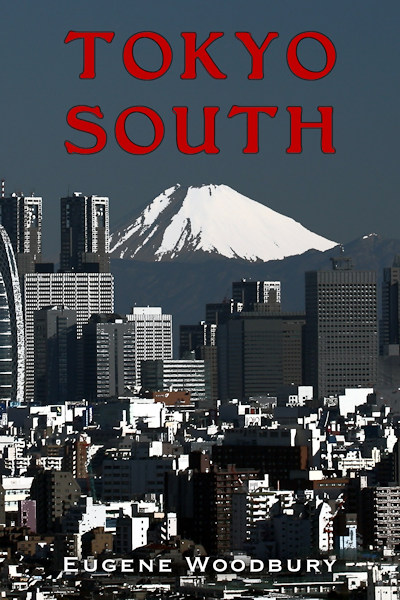
Tokyo South
The first chapter of Tokyo South, "Lost in the Works," was the innagural story of my writing career. I'd signed up for a computer programming class at BYU and discovered that I liked using the Pascal editor as a crude word processor (this was back during the Apple II era) more than programming.
Then "Number Games" won second place in the 1984 Vera Hinckley Mayhew Awards, my first solid bit of external validation. (I doubt the story would be so well received today; I like to call the first half of the 1980s at Brigham Young University under President Jeffrey Holland its glasnost era.)
Over the last two decades, a series of reorganizations and consolidations and force reductions finally resulted in the the Tokyo North and South missions being reunited in 2007. This Ted Lyon interview makes it clear that the shenanigans I describe in Tokyo South were by no means unique to Japan.
If anything, time and nostalgia and the detached sense of sang-froid that comes with age and experience led me to pull my punches a bit.
Tokyo South will be made available at a later date.
Related posts
The evolution
Tokyo South is alive
Tokyo South is dead
The weirdest two years
The problem with projections
Labels: books, BYU, ebooks, japan, japanese culture, kindle, peaks island press, publishing, religion, tokyo south


August 28, 2024
BookWalker
Because the publisher would still be out of pocket for the royalties on those 100,000 books.
As a result, as illustrated in Sleeper Hit, a cautious publisher starts small, tracks the weekly sales numbers, and only prints a second edition when demand significantly outstrips the supply (the Japanese title of the series translates as "Print the Second Edition").
The typical long-tail manga (that didn't generate a ton of online buzz during first-run syndication) starts out with small print run. Unless brought back to life by an anime series or a live-action adaptation (or as in Sleeper Hit, a grass roots marketing push), that'll be it.
As a result, most tankoubon (paperback manga published in book format) do not stay in print for long.

For Japanese emanga, BookWalker has become my online retailer of choice. You can access the English and Japanese sites with a single account and view your digital libraries in a browser or via the Android and iOS apps. (BookWalker no longer supports a desktop app.)
On the Japanese site, you can switch to the English site by clicking Global Store at the top right. On the English site, the button is labeled 日本ストア(Japan Store). One neat feature is that when you search for a manga in a series, it will return a link to the series as well.
Amazon is still worth checking out. Its prices are competitive, the Japanese Kindle store will keep growing, and it has a decent desktop app. Then again, BookWalker is no slacker when it comes to sales and specials too. All the more so given the current exchange rates.
Related links
BookWalker (Japanese)
BookWalker (English)
Kindle Store
Yes Asia
Labels: books, bookwalker, business, ebooks, manga, publishing
August 07, 2024
Tear down this e-wall!

In Japan, copyrighted works like music, movies, and books are exempt from price fixing laws that prohibit the imposition of resale price maintenance rules on resellers. That means a Japanese publisher can enforce the manufacturer's suggested retail price (MSRP) on intellectual property published and sold in Japan.
Even so, the reimportation of Japanese books has never been part of the debate. Piracy has since become a bigger problem. But, if anything, walled gardens exacerbate the piracy problem.
And yet those walled gardens persist.
When you publish a Kindle ebook on Amazon's KDP platform, you can make it available on all Amazon platforms. In a sane world, every digital title in the Amazon catalog would be listed in every Amazon store worldwide. But purchasing Japanese Kindle ebooks on Amazon outside of Japan requires jumping through a bunch of hoops.
Precisely the sort of thing the World Wide Web was supposed to eliminate by being, you know, World Wide. Some progress has finally been made on that front, with legal Japanese IP finding purchase outside the walls.
Amazon US breaks out Japanese as its own category in the Foreign Language section of the Kindle store. Given the great appeal of manga, the e-walls there are crumbling the fastest. The Japanese edition of Ascendance of a Bookworm can be purchased from Amazon US in both the ebook and paperback formats.

Those walled gardens still exist. Companies like Apple and Amazon are basically tossing titles over the walls rather than breaking them down and creating an all-inclusive catalog in the cloud.
This makes sense for paperbacks, as warehousing and shipping traditionally printed books is expensive. It shouldn't be an issue with ebooks.
Except it is. For the customer, even in the digital realm, Amazon Japan is treated as a completely separate entity from Amazon US. For example, Amazon Japan carries the Japanese and English editions of Yokohama Shopping Log. Amazon US only has only the English edition.
By contrast, you can access both the Kadokawa BookWalker English and Japanese catalogs from a single account. And with yen exchange rates hitting lows not seen in forty years, Japanese ebooks are a bargain abroad. You can read BookWalker ebooks in a browser or by using their apps, which work like the Kindle Reader apps.
BookWalker has the English and Japanese ebooks for Yokohama Shopping Log on its respective websites. Granted, BookWalker is the storefront for a single publisher. But the only obstacle here is scale.
Amazon Web Services is the biggest cloud computing platform in the universe. Scale isn't a problem. Amazon could merge their ebook catalogs or take the single-login approach. Either way, "Mr. Bezos, tear down this e-wall!" (Yeah, I know, he's not really in charge anymore, but I couldn't resist the reference.)
Related links
BookWalker (English)
BookWalker (Japanese)
Kindle Store
Yes Asia
Labels: books, bookwalker, business, ebooks, kadokawa, kindle, manga, publishing, streaming, technology
May 01, 2023
Twelve Kingdoms
The Twelve Kingdoms novels have been licensed by Seven Seas Entertainment. Bookstore links will appear when they are published.
For additional commentary about the Twelve Kingdoms and the translation process, see Kate's Interview with a Translator series.
1. Tsuki no Kage, Kage no Umi. My translation: Shadow of the Moon, a Sea of Shadows.
2. Kaze no Banri, Reimei no Sora. My translation: A Thousand Leagues of Wind, the Sky at Dawn.
Youko, Suzu, and Shoukei join forces to defeat corrupt government leaders in Wa Province.
3. Tasogare no Kishi, Akatsuki no Sora. My translation: The Shore in Twilight, the Sky at Daybreak.
Risai escapes to Kei and asks Youko for help rescuing Taiki. Taiki and Youko are contemporaries.
Fuyumi Ono wrote The Demon Child before she started the Twelve Kingdoms series. See link below. She covers some of this material in The Shore in Twilight, The Sky at Daybreak. In Kaze no Umi, Meikyu no Kishi ("A Sea of Wind, Shores of the Labyrinth"), Taiki choose Gyousou as Emperor of Tai. See links below.
1. Tasogare no Kishi, Akatsuki no Sora. My translation: The Shore in Twilight, the Sky at Daybreak.
Risai escapes to Kei and asks Youko for help rescuing Taiki. Taiki and Youko are contemporaries.
2. Shirogane no Oka, Kuro no Tsuki. My translation: Hills of Silver Ruins, a Pitch Black Moon (book I II III IV).
Risai and Taiki return to Tai. They recruit a small band of allies to search for Gyousou and take back the kingdom.
Higashi no Watatsumi, Nishi no Sokai. My translation: Poseidon of the East, Vast Blue Seas of the West.
Tonan no Tsubasa. My translation: The Wings of Dreams.
Kyouki chooses Shushou as Empress of Kyou. (Shoukei encounters Shushou in A Thousand Leagues of Wind.)
Kasho no Yume. My translation: Dreaming of Paradise.
- (冬栄) "Winter Splendor" (Touei): takes place in Tai and Ren during The Shore in Twilight, the Sky at Daybreak.
- (乗月) "Jougetsu": takes place in Hou after A Thousand Leagues of Wind, the Sky at Dawn.
- (書簡) "Pen-Pals" (Shokan): takes place in Kei and En after Shadow of the Moon, a Sea of Shadows.
- (華胥) "Dreaming of Paradise" (Kasho): takes place in Sai sometime before A Thousand Leagues of Wind, the Sky at Dawn.
- (帰山) "Kizan": takes place in Ryuu and Sou after A Thousand Leagues of Wind, the Sky at Dawn.
Hisho no Tori. My translation: Hisho's Birds.
- (丕緒の鳥) "Hisho's Birds" (Hisho no Tori): takes place before and shortly after the coronation of Youko as Empress of Kei.
- (落照の獄) "Prison of Dusk" Rakushou no Goku: references to Ryuu and Emperor Chuutatsu suggest the beginning of Youko's reign.
- (青条の蘭) "Blue Orchid" (Seijou no Ran): takes place in En before Rokuta chooses Shouryuu as the next Emperor.
- (風信) "Weather Vane" (Fuushin): takes place during the last days of Empress Yo of Kei, and then following her death.
I've created my own abridged glossary. An overview of the Twelve Kingdoms universe can be found at Wikipedia (English Japanese). The Twelve Kingdoms Wiki has scans of the illustrations and additional artwork.
My go-to resource while translating the novels has been Yoshie Omura's Twelve Kingdoms Room (Japanese). Also see the Twelve Kingdoms Database (Japanese).
Fuyumi Ono borrows much of the political terminology from medieval China. Harvard University's "Dictionary of Official Titles in Imperial China" (PDF) provides useful clues about the English equivalents.
However, we are talking about a fantasy series, so historical translations are not always exact. The organizational charts at Twelve Kingdoms Memo (Japanese) have proved quite helpful.
The NHK anime can be streamed at Tubi and Crunchyroll (regional restrictions may apply). The Blu-ray edition is available from Discotek Media.
Labels: 12 kingdoms, books, crunchyroll, fantasy, japanese, kate, publishing, translations, tubi
November 24, 2021
Embracing Defeat

The first years of the Occupation saw a spate of surprisingly liberal reforms (that drove conservative anti-war politicians like Shigeru Yoshida up a wall). Leftists, labor organizers, and even communists were released from jail and the press was unleashed.
Dower documents how enthusiastically the Japanese public embraced these freedoms. Analyzing the flood of mass media publications that followed, he portrays how ordinary people were affected by the most dramatic social upheaval in Japanese history.
This bottom-up revolution inevitably ran headlong into the top-down political machinations originating from SCAP (Supreme Commander for the Allied Powers). General Douglas MacArthur was very much Japan's last shogun.
Over the course of seven years, the fusion of these forces shaped the face of modern Japan. A result, Dower argues, that did not arise from "a borrowed ideology or imposed vision, but a lived experience and a seized opportunity."
Related links
August 15
The last shogun
Victory in Defeat
The Showa drama
The rebirth of Japan's mass media
Labels: books, ebooks, embracing defeat, history, japan, japanese culture, ww2
February 13, 2020
Godzilla
 The 1954 production of Godzilla, directed by Ishiro Honda, has a good deal in common with Bram Stoker's Dracula, published in 1897. Both are remembered today in terms of the sequels and spin-offs that followed, in the process spawning new genres that have almost nothing to do with the original productions.
In Dracula, the Scooby Gang of vampire hunters led by Van Helsing avail themselves of the latest weaponry and communications technology to defeat Count Dracula. In Godzilla, a team of scientists led by paleontologist Kyohei Yamane and troubled young chemist Daisuke Serizawa must defend Japan against this nuclear natural disaster.
Meanwhile, Emiko Yamane wants to break off her engagement to Serizawa so she can marry her true love, salvage ship operator Hideto Ogata. Given Serizawa's mad scientist personality, this is a understandable decision, and these shifting relationships figure into an important plot point (that has nothing to do with anybody fighting over a girl).
It will be Serizawa who provides the scientific solution that saves the day, not battling monsters or superhero antics.
Dracula and Godzilla are works of contemporary science fiction that would fit well into the oeuvre of Michael Crichton. The two titular antagonists are, in Buffy terms, the Big Bad. As Buffy fans well know, being the Big Bad is a supporting role whose ultimate purpose is to get dusted. That's exactly what happens to Dracula and Godzilla.
So if you want to bring them back for an encore, well, something fundamental will have to change. Making the Big Bad the main attraction completely changes the nature and focus of the fundamental conflict. For starters, a way larger-than-life character stomping all over the scenery in movie after movie is going to upstage the rest of the cast.
As the series progressed and Godzilla grew larger and larger than life, more overpowered Big Bads had to be invented to keep the over-the-top conflicts in proportion. This is unfortunately true of most superhero movies these days. Godzilla set the standard for the Big Bad modus operandi of massive urban vandalism.
The bigger story problem is that, having already reached the pinnacle of badness, the Big Bad has no place to go dramatically, which can't help but reveal the ridiculousness of the whole conceit. A common solution, as in the Dracula genre, is to hang a lampshade on the character and purposely play to the stereotypes with the requisite ironic nods.
Or while playing to the stereotypes, cast the Big Bad as an antihero, the enemy you know being preferable to the worse Big Bads you don't (yet). With a decent screenplay and a compelling character arc, a Big Bad can be transformed into an unreliable ally, as with Spike on Buffy. This is generally the direction Godzilla sequels ended up going.
Less a friend of the human race than an enemy of the all other monsters invading its territory, with not very much in the motivation department aside from sheer destructiveness.
Ishiro Honda's Godzilla soon spawned the tokusatsu (special effects) and kaiju (giant monster) genres. Famously featuring the guy in a rubber suit wrecking scale models of Japanese cities, this deliberately silly and self-referential approach was less concerned with dramatic depth and more about at getting everybody in on the joke.
The first Godzilla, by contrast, is a classic work of film noir, employing black and white cinematography suffused with light and shadow, along with rudimentary but effective mattes and composites, to create a spooky atmosphere of literally looming horror. Godzilla is a keenly-felt menace that most of the time is out of reach or out of sight.
The city-destroying rampage doesn't even commence until an hour in. Leaving a trail of destruction in its wake, Godzilla is more a force of nature, like a typhoon or an earthquake or a tsunami. Or a squadron of B-29s. The focus is less about the Big Bad than on how the affected human beings react to it. And how they conquer it with human ingenuity.
Related posts
Dracula
The big bad
Too super for their own good
Labels: books, history, japanese culture, japanese movie reviews, science fiction
October 17, 2019
New Twelve Kingdoms novel (more covers)
 |
| 「白銀の墟玄の月」第三巻 ISBN 978-4101240640 |
 |
| 「白銀の墟玄の月」第四巻 ISBN 978-4101240657 |
The books are available online at Amazon/Japan, Honto, and Rakuten.
Related posts
New Twelve Kingdoms novel (title)
New Twelve Kingdoms novel (covers)
New Twelve Kingdoms novel (publication date)
New Twelve Kingdoms novel (Happy New Year!)
New Twelve Kingdoms novel (it's official!)
Squared (lined) paper
Labels: 12 kingdoms, advertising, black moon, books, business, fantasy, japan, japanese, publishing
September 12, 2019
The orphan's saga
 Anne of Green Gables has been a perennial bestseller in Japan ever since the publication of the first translation by Hanako Muraoka in 1952.
The character of the spunky orphan (or a girl who becomes a "social orphan" when she sets off alone for the big city) has long been beloved in Japan. NHK built an entire franchise around the concept, with the Asadora morning melodrama now entering its sixth decade.
When it comes to cheerful and resourceful optimism in the face of punishing circumstances, Tohru from Fruits Basket is every bit Anne's equal. She needs to be when she ends up the only "normal" person in a household whose members are the actual animals of the Chinese zodiac.
The orphaned Takashi in Natsume's Book of Names (a guy for a change) has the ability to see the spiritual beings that haunt the Japanese countryside. Like Anne, he was fortunate enough to finally end up with adoptive parents who truly care for him.
 The far less fortunate Chise in The Ancient Magus Bride has the same abilities as Takashi (a common trope). She was orphaned when her mother committed suicide and blamed her in the process. Little wonder she's a borderline basketcase when we first meet her.
In a twist on Beauty and the Beast, the Beauty (Chise) is saved by the Beast (the monstrous Elias Ainsworth). Although Elias isn't exactly a rock of stability either. He's not even human, to start with.
Speaking of borderline basketcases, Rei in March Comes in Like a Lion is a shogi prodigy orphaned when the rest of his family is killed in an automobile accident. He turns pro in large part to get away from his screwed up adoptive family.
 Rei is saved (psychologically) by an eccentric family of three orphaned sisters (mom died, father ran off) and their grandfather. And by the wealthy Harunobu, another shogi child prodigy who adopts Rei as his best friend. Harunobu is sort of an orphan himself, being raised mostly by his butler.
And then there's Motoko Kusangai from Ghost in the Shell, who can be counted on to be resourceful in the face of punishing circumstances, though not necessarily very cheerful about it. In any case, she can count on her "family" from Section 9 to watch her back.
Related links
Fruits Basket (CR Fun)
Natsume's Book of Friends
The Ancient Magus Bride
March Comes in like a Lion
Ghost in the Shell: Arise
Hanako and Anne
Anne illustrated
The drama of the PCB
Labels: anime, anime lists, anne, asadora, books, japanese tv, social studies
September 05, 2019
"Anne" illustrated
 |
| "Red-Haired Anne" (Anne of Green Gables) |
For her original translation published in 1952, Hanako Muraoka chose the title Akage no Anne (「赤毛のアン」). Due to the book's immense popularity, translations since have stuck with it.
 |
| "Anne's Adolescence" (Anne of Avonlea) |
The kanji for "adolescence" is seishun (青春), literally "green spring." In this context, the word takes on an aura of classical romanticism tinged with sentimentality, the "blossom of youth."
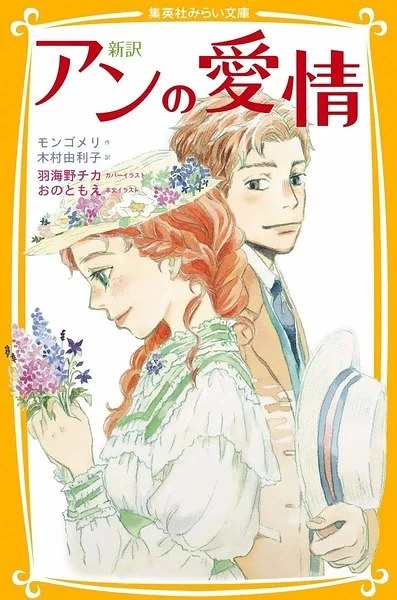 |
| "Anne in Love" (Anne of the Island) |
Though now a century old, Anne of the Island reads very much like a contemporary shojo manga, right down to the emphasis on competitive academic performance.
Related links
Honey and Clover
March Comes in Like a Lion
The orphan's saga
Hanako and Anne
Labels: anime, anime lists, anne, art, books, manga, publishing
September 02, 2019
New Twelve Kingdoms novel (covers)
The Twelve Kingdoms Twitter account is @12koku_shincho (in Japanese).
 |
| 「白銀の墟玄の月」第一巻 ISBN 978-4101240626 |
 |
| 「白銀の墟玄の月」第二巻 ISBN 978-4101240633 |
The books are available online at Amazon/Japan, Honto, and Rakuten.
Related posts
New Twelve Kingdoms novel (title)
New Twelve Kingdoms novel (more covers)
New Twelve Kingdoms novel (publication date)
New Twelve Kingdoms novel (Happy New Year!)
New Twelve Kingdoms novel (it's official!)
Squared (lined) paper
Labels: 12 kingdoms, advertising, black moon, books, business, fantasy, japanese, publishing
August 08, 2019
New Twelve Kingdoms novel (title)
The furigana oka lends the kanji for "ruins" (墟) the meaning of "hill," which is difficult to incorporate without getting wordy. Based on the hiragana for the title (above), it would read, "[A] Silver Hill[s], [a] Black Moon."

As for the literal meaning, all that remains of most medieval castles in Japan are overgrown hills. Oda Nobunaga's magnificent Azuchi Castle was destroyed by fire after his assassination in 1582, leaving behind only the stone foundation.
Without the actual context, other than the Kingdom of Tai being in the midst of a civil war, these are the images the title brings to mind. Considering the northern climate of Tai, "silver" could also describe ruins covered with snow.

The Traditional Colors of Japan website assigns「玄」a web color of #3E1E00, closer to "maroon." But it also describes「玄」as a synonym for black and suggests that「玄」is less a traditional color than a metaphysical concept associated with the dark arts or the darkness before the dawn.

Metaphorically, "silver" and "black" could refer to the silver-haired Gyousou and Taiki, a rare "black kirin." Using the possessive particle no (の), "silver" and "black" can function as both adjectives and nouns in Japanese.
Attempting the equivalent in English would sound clunky. So at this juncture, the English version will lean more heavily on the dictionary meanings.
At the end of July, Shinchosha released a Twelve Kingdoms promotional video (in Japanese). The narrator is Ken'ichi Suzumura, who played Rakushun in the NHK anime series.
Labels: 12 kingdoms, advertising, black moon, books, business, fantasy, japanese, language, publishing
April 25, 2019
New Twelve Kingdoms novel (publication date)
The latest installment in the Twelve Kingdoms series goes on sale this October!! Thank you all for being so patient! Having finalized the release date for the long awaited new novel, we wished to fill you in on the details.
The author's epic manuscript of over 2500 pages will be published in four volumes. Volumes I and II go on sale Saturday, October 12. Volumes III and IV go on sale Saturday, November 9. (Please note that these dates differ from Shinchosha's usual release schedule.)
We received the first volume from the author at the end of last year and the final volume in March. The publishing schedule has been set and we are getting everything ready to deliver them to you.
The best way to enjoy this great new saga is to start with the books already in print. Special displays are being installed in bookstores around the country leading up to the October release. Golden Week would be a great time to reread A Shadow of the Moon, A Sea of Shadows!
For those new to the Twelve Kingdoms, or read it so long ago they've lost track of the important details, don't worry! We've created a new website—"The Twelve Kingdoms in Five Minutes!"—to get you started.
Let's all look forward to the October 12, 2019 launch date together!

Shinchosha also launched a Twitter campaign (the post is misdated on the home page) asking readers to share what they love about the Twelve Kingdoms series. Twelve (randomly selected) submissions will receive a clear file folder signed by Fuyumi Ono and illustrator Akihiro Yamada.

In Japan, "Golden Week" refers to four national holidays starting on April 29 that take place within seven days. This year, Golden Week will be extended to ten days in order to accommodate the abdication of Emperor Akihito on April 30 and the enthronement of Crown Prince Naruhito on May 1.
Labels: 12 kingdoms, advertising, black moon, books, business, fantasy, japan, publishing
January 03, 2019
New Twelve Kingdoms novel (Happy New Year!)
We are coming to you for the last time in 2018. This year, with an enormous sense of relief, we were able to make the long hoped-for announcement that a new installment in the Twelve Kingdoms series is heading to publication. That announcement was met with a deluge of delighted voices through SNS. We thank you again for your warm messages.
The new novel is a sequel to Tasogare no Kishi, Akatsuki no Sora ("The Shore in Twilight, the Sky at Daybreak") and takes place in the Kingdom of Tai. How about reacquainting yourselves with the series during the upcoming holidays? For those of you new to the series, please take this opportunity to dive into the world of the Twelve Kingdoms and enjoy it to the fullest.
Shincho Paperbacks has now published new editions of all of the Twelve Kingdoms novels, including The Demon Child and Hisho's Birds. Available at a bookseller near you! You can find the eleven volumes on Amazon too.
Whilst coping with her long spell of ill health, Ono Sensei's unfolding Twelve Kingdoms drama turned into a massive epic! More than anything else, as we work towards the day when the book will go on sale, we pray for her continuing convalescence. Fresh information will be posted here in "Kirin News."
This is our last Year-End Greetings of the Heisei era. The New Year will also bring with it the first year of a new era, full of newborn promise. And so with that same sense of hope we shall continue to ask for and thank you for your continuing support.
Please have yourselves a Happy New Year!
I'll explain a bit more about the historic end of the Heisei next week.

Labels: 12 kingdoms, advertising, black moon, books, business, fantasy, history, japanese culture, nengou, publishing
December 13, 2018
New Twelve Kingdoms novel (it's official!)
Here is the press release. (I didn't add any of the exclamation points but agree with them.)
The highly anticipated new work is finally here!!!
Today, on the 12th of December ("Twelve Kingdoms Day"), we have delightful news to share. A brand new manuscript has arrived!
The long-awaited novel has turned into a massive 2500 page epic. The setting for the story is the Kingdom of Tai. We are grateful to Ono Sensei for penning such a masterpiece in this 30th year of her career. We thank all her readers for waiting so patiently.
Now commences the business of making a book, such as copyediting and the illustrations. Though a publication date hasn't yet been determined, it is certain to debut in 2019.
As promised, we are posting important updates on this website. It was still an unexpected surprise that this news arrived on "Twelve Kingdoms Day." Going forward, we will do our best to point you to accurate information in a prompt and orderly manner.
To that end, we humbly ask for your continuing support.

Labels: 12 kingdoms, advertising, black moon, books, business, fantasy, publishing, translations
August 16, 2018
The last shogun

Oh, those powers were, on paper, vested in the emperor. So had they been during the shogunate. It's just that from the 17th century through the early 19th, the Tokugawa shogun unquestionably controlled the emperor. Now nobody controlled the emperor. And the emperor didn't control anything either.
In a deadly game of king of the hill, the years in Japan between the Meiji Restoration and WWII were punctuated by a series of attempted coups. None succeeded, but all had the effect of pushing the government further to the right in hopes of deflecting the next military revolt, until the army was operating without any practical constraints.
Echoes of the first half of the 16th century, when the slow rot of the Ashikaga shogunate ignited battles amongst the military governors that culminated in the Warring States period.
Lacking the checks and balances of civilian oversight, the Japanese army ended up starting a small war in China that grew out of control, basically Vietnam on a continental scale. When the U.S. cut off oil and scrap metal exports to Japan as a response, the military lashed out without considering its capabilities or the military consequences.
Thanks to the military doctrine of Kantai Kessen, meaning a winner-take-all contest between battleships, the Japanese war effort was doomed from the start. Japanese military leaders couldn't stop believing in Kantai Kessen because it had proved so decisive during the Russo-Japanese War.
But by June of 1942 and the Battle of Midway, the battleship was a white elephant. The aircraft carrier ruled the waves. To be sure, the Japanese navy had indeed crushed the Russian fleet at the Battle of Tsushima in 1905, compelling a shaky Russian government to sue for peace.
This "underdog" victory was hailed around the world (even though it began with a "sneak attack"). The Japanese government was quick to believe its own press, forgetting that the land war going on at the same time was about as decisive as the First World War would be, with the Japanese infantry taking as many casualties as the Russians.
Notwithstanding one the greatest diplomatic achievements in history, the victorious Japanese came away from the Treaty of Portsmouth (1905) believing that the western powers had robbed them of their due. This combination of victimhood, aggrievement, and overconfidence set the stage for the next forty years of accumulating disasters.
In Japan, ordinary citizens—already living under draconian rationing and sumptuary laws—took the December 1941 attack on Pearl Harbor to be a second Tsushima, signaling an end to the conflict.
By the Battle of Okinawa, nobody in the Japanese government believed they could prevail by force of arms alone. But they could convince the Americans that invading the main islands carried too high a cost, essentially Robert E. Lee's strategy in 1864, that might have succeeded except for the fall of Atlanta and Sherman's March to the Sea.
The bitter irony is that in this they succeeded. Thus the atomic bomb. But the atomic bomb probably had a greater influence on Stalin, who, thanks to his spies, knew more about it than Truman. Stalin didn't launch his invasion of Manchuria until after Nagasaki. Once the bomb was dropped, Stalin had to act before Japan surrendered.
One of Stalin's goals was payback for the Russo-Japanese War. The Soviet army reclaimed all of its former territories, plus several islands that had always been part of Japan. From 560,000 to 760,000 Japanese were shipped off to the gulags, where from 10 to 50 percent of them died. This treatment by a former "ally" still rankles in Japan.
There is much talk of "formally" ending the Korean War. The one-week war between the Soviet Union and Japan has never been formally resolved either.
All through the Second World War, Japan and the Soviet Union had a non-
But a negotiated surrender would not be acceptable to the Allies and certainly not to their citizens. They had been there and done that and suffered the consequences. In July of 1918, Winston Churchill laid out the terms for a lasting armistice with Germany. In the process, he made clear why the "Great War" would not be "the war to end all wars."
Germany must be beaten; Germany must know that she is beaten; Germany must feel that she is beaten. Her defeat must be expressed in terms and facts which will, for all time, deter others from emulating her crime, and will safeguard us against their repetition.
Despite all the treaties signed and reparations extracted at Versailles, between the two world wars, Germany acceded to none of these conditions. But in August of 1945, as John Dower vividly lays out in Embracing Defeat: Japan in the Wake of World War II, Japan very much did.
The atomic bomb was considerably less destructive than Curtis LeMay's ongoing firebombing campaigns. But it forced Stalin's hand and that forced the Japanese government to finally face reality. And when he finally did face reality, the atomic bomb gave the emperor a transcendent power to whom he could surrender Japan's wartime ideology.
This time, history would not repeat itself.
Though in a very real sense, history was repeating itself for the fourth time. In 1185, Minamoto Yoritomo destroyed the Taira clan—the power behind the throne—and moved the capital of Japan to Kamakura, inaugurating the rule of the shoguns. On and off for the next 700 years, the emperor reigned as little more than a figurehead.
When Tokugawa Ieyasu consolidated power after the Battle of Sekigahara in 1600, the country breathed a sigh of relief and mostly aligned itself with the new regime. Like Ieyasu himself, it was an opportunistic resolution that demanded little in the way of ideological conformity, except to go along to get along, a social compact that worked.
In the mid-1860s, as the Tokugawa regime crumbled around them and the center could no longer hold, this opportunistic ambivalence was expressed in the "Ee ja nai ka" movement, an anarchic yet strangely playful popular uprising that proclaimed, "So what? Why not? Who cares?"

In the late summer of 1945, the population was too exhausted to dance in the streets. But they'd had enough of ideology. Observes John Dower, when General MacArthur arrived in Japan on August 30 of that year,
he easily became a stock figure in the political pageantry of Japan: the new sovereign, the blue-eyed shogun, the paternalistic military dictator, the grandiloquent but excruciatingly sincere Kabuki hero.
Dower wryly concludes, "Indeed, the response of huge numbers of Japanese was that the supreme commander was great, and so was democracy." So it comes as no surprise that they should so readily switch their allegiances to the man who promised them much less torment and a much better future.
Related posts
The grudge and the dream
Kantai Kessen
Hirohito and the Making of Modern Japan
Labels: books, embracing defeat, history, japan, politics, ww2
May 03, 2018
What I'm reading

I'm alternating between the Chihayafuru manga series and Edogawa Ranpo's young adult mystery novels. Inspired by Chihayafuru, I'm also working my way through the Manga Hyakunin Isshu Daijiten. It's an encyclopedic guide to the Ogura Hyakunin Isshu written at a 6th grade level, about my speed in this subject.
Chihayafuru wins that rare trifecta as a great manga series, a great anime series, and a great live action film series. A third season of the anime and a third live-action movie should be coming out this year (though they will take longer to make it eastward across the Pacific).
Norihiro Koizumi wrote and directed the live-action films, and did a fine job condensing two seasons of the anime down to four hours of film without compromising the characters or the plot. He also introduced some incidental changes that work well, such as making Harada a Shinto priest.
Chihayafuru
Amazon (JP)
Honto
YesAsia
Kindle (US)
Crunchyroll
Manga Hyakunin Isshu Daijiten
Amazon-JP
Honto
YesAsia

Ranpo wrote the "Boy Detectives Club" series for a young adult audience. It reminds me of the Hardy Boys and Encyclopedia Brown books I read as a kid. Early versions of the "light novel," the Japanese is fairly simple, with an emphasis on action and short but vivid descriptive passages.
As in old radio dramas, the narrator often breaks the fourth wall to address the reader.
Now out of copyright, HTML files of Ranpo's novels can be downloaded from the Aozora public domain library. The files display as plain Unicode text in most browsers. For a more aesthetically-pleasing reading experience, cut and paste the online link into the Air Zoshi reading app.
From the "Boy Detectives Club" series, here's The Witch Doctor using the Air Zoshi app.
Labels: anime, books, chihayafuru, ebooks, japanese culture, manga
January 04, 2018
New Twelve Kingdoms novel (hope springs eternal)
We are closing out 2017 with these year-end greetings. We had hoped for new information about the long-awaited addition to the Twelve Kingdoms series. Alas, we have nothing concrete to share.
During her recent spell of poor health, Ono Sensei continued to work on her new novel. She has since added considerably to the page count, turning it into a true epic.
A publication date won't be announced until after we have received the manuscript. However, our goal is to complete the project in 2018. For the time being, please bear with us a little while longer.
While praying for Ono Sensei's continuing recovery, the entire staff is making every effort to bring you that good news even one day faster.
We humbly ask for your continuing support and wish you a Happy New Year.
Labels: 12 kingdoms, black moon, books, fantasy, japanese, publishing, translations
July 27, 2017
The bosozoku squat
Courtesy of Dan Szpara, here's a veteran bosozoku (暴走族) biker dude showing how it's done.

As Szpara points out, the bosozoku have become a cliché, so in many cases the "acting out" just turns into "acting." Still, a few have kept the faith. Kyra Sacdalan describes the true believers as
a gang, now a lifestyle, still notorious amongst police enforcement. So much so that certain colors and stylings of their flamboyant West Side Story meets Lost Boys uniform are illegal in Japan.
As with the yakuza, the police in Japan have carte blanche to crack down as hard as necessary to maintain (the appearance of) public order. So these "wild ones" have to be careful about where and how they rebel.
But Harley-Davidson riders? "They appear to have an attitude which is carefree, cordial, and genuinely passionate."
Labels: books, ebooks, fox and wolf, japanese culture, peaks island press, yakuza
May 18, 2017
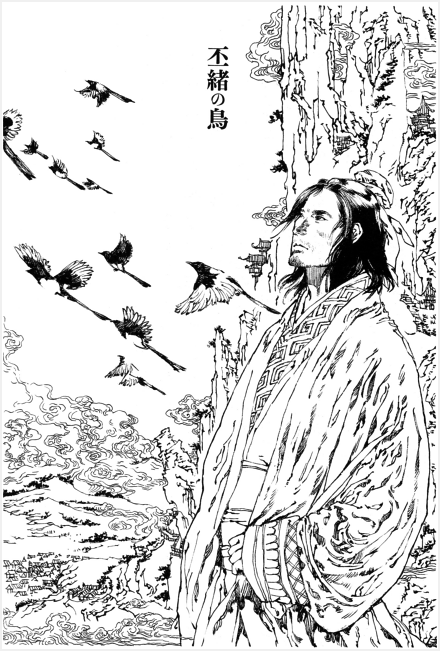
Hisho's Birds
First up is the title story. "Hisho's Birds" is about a creative person working under a looming deadline, so one has to wonder about the extent to which the protagonist's ruminations reflect those of the author.
As the story begins, Hisho has a bad case of artist's block. He produces an important imperial ceremony held on auspicious occasions, like the winter solstice and the ascension of a new empress. He's an innovator with a reputation for outdoing himself but the inspiration just isn't coming.
Which is understandable, considering the state of affairs in the Kingdom of Kei. "Pressure" takes on a whole new meaning when a capricious emperor could have him executed. To make matters worse, a string of short-lived rulers hollowed out his department and left him with a long fallow period.
Hisho has another problem. He wants to deliver a message with his art. But the spectators only see the spectacle (or the lack thereof), not what he's trying to say. On top of everything else, Kei just got a brand new empress. Hisho's been ordered to produce the next ceremony on a tight schedule.
Even if he can settle on the message, he has to figure out how to deliver it with the resources on hand. For Hisho and his loyal assistant, it's a make or break opportunity.
Labels: 12 kingdoms, books, fantasy, hisho, japanese culture, thinking about writing, translations
April 13, 2017
The evolution of the missionary program
Stage I. Mine was one of last cohorts of the legacy system. This was the "Every Young Man Should Serve a Mission" era. (As for the young women, well, if you still hadn't gotten hitched by twenty-one, then sure. But why haven't you gotten hitched?)
In the late 1970s, the church's PR efforts hit Madison Avenue and sociologists started paying serious attention to the church's growth numbers. These studies famously culminated in Rodney Stark's 1984 calculation of a 64 million to 267 million growth in membership over the next century.
Ah, here was "independent" confirmation of the inevitable Mormon hegemony, cementing Mormonism's "fastest growing religion" status (an error that continues to this day). Buoyed by these dubious statistical projections, church leaders convinced themselves they were going to convert the world.
Except the numbers Stark and others were using in their models came from the church itself. The public membership numbers the church publishes each year don't count butts in pews. They're derived from open-ended accounting methods based the accumulation of unexpired membership records.
 |
| The truth is way out there. |
In fact, the church does count how many butts are in the pews every Sunday. Otherwise it'd end up building chapels that sat empty and unused. But like Fox Mulder, they want to believe. And like the Cigarette Smoking Man, they keep the numbers that matter close to the vest.
In any case, wishful thinking eventually ran into the brick wall of reality. To start with, consider the workforce. The more they stressed the hard sell, the more missionaries figured out how to game the system.
Stage II. As these get-big-quick schemes began imploding in missions like Tokyo South, the church decided that not enough young men were serving missions. And it cost too much. The answer was to match mission lengths for men and women at eighteen months.
Mission financing was taken over by the church and quasi-socialized (and then tweaked to preserve the tax incentives) so everybody faced the same up-front costs.
Sounds good in theory. Except a whole lot of twenty-year-olds were more than happy to take a six-month discount on "the two best years." The church was suddenly faced with the challenge of keeping the spiritual sales force intact during its most productive period (the last six months).
That idea was deep-sixed. The cost-sharing measures were preserved.
Stage III. Instead of greasing the skids, maybe it was time to borrow from those Marines Corps ads: "The few, the proud." Raise standards. Toughen the requirements. Emphasize quality over quantity. Missionaries were an elite group, not the hoi polloi.
But once again, too many kids decided that this was good excuse to give the whole ordeal a pass. Especially when dealing with theological cannon fodder, there's strength in numbers. Quantity matters more than quality (because you're never going to have that much quality).
Stage IV. In the meantime, the cruel world was intruding all over the place. Years of cultural diplomacy with China never paid off, delivering a blow to the multi-level marketing strategy I was taught in the MTC. (Seriously, with a few script changes, it could have been turned into any sales pitch.)
The convert-the-world true believers no longer believed quite so much, accepting the stark reality that, in real terms, church membership growth tracks closely to the natural rate. By "natural" I mean the birds and the bees. Mormon boy meets Mormon girl and a bunch of Mormon kids result.
Behind the scenes, the number crunchers at church headquarters were doing (more accurate) butts-in-pews analyses that pointed to a strong correlation between "served a mission" and "shows up to church on Sunday."
That meant maximizing the number of Mormon kids going on missions, which had the best odds of turning them into Mormon adults. It didn't matter if they converted anybody on their mission as long as they converted themselves. Think of it as an institutionalized sunk cost fallacy in action.
It was time to grease the skids again, but with a different set of variables. Knock one year off the start date for men, two years for women. Guys wouldn't have to red-shirt their freshman year and women wouldn't be taking themselves out of the college (BYU) dating market.
Plus, an eighteen-year-old is that much more susceptible to peer group pressure. What are you gonna do straight out of high school? Answer: go on a mission. What joining the military used to be.
This time it looks like they got it right. So far, the new program has been hugely successful. Pay no attention to the slumping conversion rates. Missionaries now spend less time proselytizing and more time trying to be useful. It's turned into the Mormon Peace Corps.
Frankly, that's what the missionary program should have been all along.
Related posts
How it began
The truth is worse
Tokyo South is alive
The weirdest two years
The problem with projections
Labels: books, ebooks, lds, peaks island press, publishing, religion, tokyo south