

September 14, 2024
Spy x Sony CV-2000
Sony introduced the CV-2000 video tape recorder (VTR) in 1965 as part of its home electronics line. At the time, the CV-2000 retailed for $695. Adjusted for inflation, that'd be $7000 today. I'm sure Lloyd put it on his expense account (which his handler complains about).
In Japan, the initialism VTR is still used to refer to prerecorded video content on broadcast television (even though it's all digital by now).

Labels: anime, business, history, japanese culture, japanese tv, sony, tech history, technology, television


August 14, 2024
Netflix in Japanese (2)

Aside from anime, which continues to see dramatic increases in supply and demand, I remain skeptical that we are "on the precipice of a [live-action] content boom" from Japanese production houses. Rakuten Viki is a good yardstick and it continues to rely heavily on South Korea, China, and Southeast Asia for content.
Not Japan (despite Viki being a Japanese company). However, I do agree that despite the plodding evolution of the market,
the live-action series space is the area of Japanese entertainment where the surging investment from big foreign streamers is changing production standards most and where insiders say there is the biggest potential for a reinvigorating shake-up.
"Big foreign streamers" pretty much means Netflix. And maybe Jme TV, if it ever gets its act together.
Netflix has a strong presence in Japan and has been increasing the number of licensed and in-house productions it is sending east across the Pacific. Among subscription services, Netflix has the third biggest anime catalog in the North American market after Crunchyroll and Hidive and is getting competitive in live-action as well.
Although the live-action Japanese language catalogs at Netflix and Viki are about the same (adding in anime doubles the size for Netflix), Netflix has a wider range of curated content and an equally affordable entry point. And for now, Netflix is acquiring Japanese content for its North American catalog at a decidedly faster pace than Viki.
So little new Japanese content is showing up on Viki that I wonder if it decided to focus on Kdrama rather than compete with Netflix and NHK Cosmomedia. NHK Cosmomedia dumped all its premium streaming eggs into the Jme TV basket and is very likely staking a claim on every live-action series produced domestically.
I'm not convinced that effort is going to pay off. To start with, unlike Viki and Netflix, NHK Cosmomedia localizes very little of its catalog. Which brings us back to Netflix and Samurai vs Ninja and Tubi (that licenses Samurai vs Ninja content) as the only sure bets for localized live-action Japanese television going forward.
Though as I have pointed out previously, I can't pretend this is a great loss, as live-action Japanese television melodrama is a genre that has slowly but surely lost much of my interest.
Related posts
Japan's phantom content boom
Netflix in Japanese (1)
Netflix in Japanese (2)
Netflix in Japanese (3)
Samurai vs Ninja
Japanese language links
Labels: anime, business, japanese tv, jdrama, jme, netflix, samurai vs ninja, streaming, television, tubi, viki
May 04, 2024
Jme TV (a few suggestions)

Dish briefly picked up Family Gekijyo after getting dumped by TV Japan. DirecTV offers Nippon TV as a replacement for TV Japan. NHK World Japan aside, there's no Japanese programming left on Xfinity or Dish. By contrast, Korean live-action content is available everywhere and on all platforms. Even Tubi has two dedicated Kdrama channels.
Live-action television comprises a paltry 5.5 percent of Japan's media exports. Fuyuhiko Takahori points to the cour system, with small budgets and short run-times holding down audience size, which limits budgets and run-times. But as anime has proven, I don't think the cour system is the impediment Takahori makes it out to be.
The cour-length season became standard practice in North America back during the premium cable days, long before streaming took off.
There's nothing wrong with the episode counts of the typical Jdrama series. The push, rather, should be to increase audience size. NHK Cosmomedia's overpriced and poorly designed streaming service is the wrong approach. If NHK cannot reduce costs to the consumer, it should let somebody else handle the business.
Another part of the problem may be a sibling rivalry. NHK World Japan is a worldwide service with an international audience, available for free online and streaming, on cable and satellite, and OTA in nineteen North American markets.
NHK World Japan is on YouTube and even shows up in screensaver ads on my Roku. Compared to NHK World Japan, NHK World Premium (née TV Japan) has taken over a vanishing niche. Jme TV is not a long-term solution. Granted, if you're looking for a one-stop shop, now you don't have a choice, unless one of the choices is "None of the above."
Here are a few possible solutions. I was also going to suggest creating a VOD sumo channel but Jme has already done that. So kudos for that. However, I would mirror the sumo channel on NHK World Japan as well.
- Move Jme Select to the free NHK World Japan website and use the same templates for the program guide. Jme Select has the same format as NHK World Japan, meaning a six-hour block of programs repeated four times a day. NHK World Japan should also add the Asadora with subtitles. It'd be a great PR move.
Like NHK World Japan, the Select programming would be primarily news and infotainment. The premium drama and variety content would remain behind the paywall. Even NHK World Japan content could be reused by removing the dubbing and ADR. - Do a deal with Rakuten Viki similar to the deal Viki has with Kocowa. Kocowa is South Korea's far more affordable equivalent of NHK World Premium. The $10/month Viki Pass Plus plan gives subscribers access to Kocowa and the entire Viki catalog, that includes VOD content from across Asia, including Japan.
A hypothetical Viki Pass Japan Plus plan would provide subscribers with access to Viki's VOD catalog and all of the non-localized material that previously ended up on TV Japan. One big advantage here is that Rakuten Viki is a well-designed and well-known (in its niche) website with all of the streaming apps in place. - Okay, instead of doing a deal with Rakuten Viki, at least copy their website and app designs. Viki really does have one of the best streaming UIs in the business. And then only stream the newscasts live (simply copy the news section from NHK World Premium). Make the rest of the programming available as VOD.
- If nothing else, the core VOD streaming service should cost considerably less. HIDIVE and Viki charge $6/month. Kocowa and Netflix start at $7/month. You can bundle Viki and Kocowa for $10/month. Crunchyroll's basic tier is $8/month. HIDIVE, Viki, and Crunchyroll offer discounted annual subscriptions.
And for a non-hypothetical option, simply go elsewhere. If you're willing to forgo the latest and greatest from prime time Japanese TV and do a bit of spelunking through sites like Viki, Tubi, and Netflix, there is plenty of (legal) live-action content available at far more affordable prices and even for free.
Related posts
Jme TV
NHK World Japan
Live-action Japanese TV
Jme TV (grumpy old man edition)
Labels: business, japanese tv, jme, nhk, nhk cosmomedia, nhk world, streaming, technology, television
March 27, 2024
That's Edutainment!
Japanese and Americans watch about the same amount of television. Except the slow penetration of cable in Japan means that for half of the population, their viewing choices are confined to a handful of networks. Japan's "Golden Age" of television hasn't ended, which makes those habit easier to generalize.
Luebs compares at the top-rated television shows in the United States and Japan for the week of May 4, 2015 (the article was published on June 11, 2015).
Despite the data being almost a decade old, NCIS is still on the air, and according to The Hollywood Reporter, as of December 2023, "only 44 percent of households in Japan have at least one subscription video service," compared to 86 percent in the United States. So I think the comparison is still relevant.
• NCIS (crime drama)
• The Big Bang Theory (sitcom)
• NCIS: New Orleans (crime drama)
• Dancing with the Stars (contest/dancing)
• The Voice (contest/singing)
• Mare (family drama about cooking),
• Shoten (sketch comedy)
• Pittan Kokan (variety/talk show)
• Jinsei ga Kawaru (variety/talk show)
• Himitsu no Kenmin (variety/talk show)
To clarify: Shoten resembles a haiku version of the original Whose Line Is It Anyway? The host sets up a scenario and feeds lines to the (seated) panelists, who improvise responses with an emphasis on verbal wordplay. It's a clever and entertaining show, and has been on the air since 1966.

Neither is the variety/talk show strictly analogous to its American counterpart. There are celebrity-of-the-day chat shows (NHK's Studio Park, for example), but these are not that. They are "talk" shows in that people talk, and "variety" shows in that a variety of topics are discussed. But the topics take precedence.
These celebrity panels chat and share anecdotes about various topics—tear-jerking stories about family reconciliation, first loves, travel, and maybe the most popular topic: food. Their chats are interspersed with short documentaries and dramatizations, in which the viewer can watch each celebrity's emotional reaction to the content through a "picture in picture" embedded at the side of the screen.
Despite the reputation Japanese reality shows have earned overseas for being weird, wacky, and dumb, these programs can get pretty brainy on the edutainment scale. I think Luebs is onto something when he observes that the reality television format popular in North America is far more fictional.
These [Hollywood productions] are not concerned with attempting to directly address the identities and concerns of the viewer. Rather, they are a playful engagement of thoughts and ideas in which we, the viewer, interact within a fictional world. They are a form of escapism.
The Hollywood version of reality television has been increasingly infiltrating the airwaves in Japan (thanks in no small part to Netflix), but the well-nigh ubiquitous home grown version still follows the formula described above, with experts educating the tarento, who function as stand-ins for the viewer.
A tarento ("talent") is a professional TV personality. To be sure, a tarento may be an actor or singer or Nobel laureate but is a tarento when acting as such. His job is to always have something witty or insightful to say, regardless of the subject. For the viewer, explains Luebs, they become real-life Walter Mittys:
Popular Japanese television looks inwards, into its own society. The variety TV show concept is based on the viewer personally relating to specific individuals who represent various tropes of Japanese-ness. Whether intentional or not, watching these celebrities chat with one another serves as an instructional guide for what is acceptable and unacceptable behavior in society. They give the viewer a clue into how to participate in any number of conversations, and how to react in any number of situations. These programs are just as much a form of entertainment as they are a framework for establishing social order.
My only caveat here is that I read "social order" in the most benign sense: lessons on how to play the game of life (specifically ordinary Japanese life).

Still, Luebs can't help slewing back to the comfortable confines of scholarly cant. No, he concludes, it's not "indoctrination," but "without the cultural synergy created by diversity, homogeneous cultural ideas are refined and concentrated, and the TV is the medium that projects these values onto the individual."
As if these cultural ideas didn't exist before television, and only sprang into being around 1950 in the smoke-filled room of a producer's office.
I think it more likely that this hallowed "diversity" in mass media instead reinforces our individual silos: with cable and streaming, we only have to watch what we want to see. But old-school Japanese broadcasters must attract the largest audience possible. They do that by giving the audience what it wants.
Or at least by not broadcasting what the audience doesn't want to see.
If anything is being projected onto the individual, well, the individual is holding up a mirror reflecting it right back at the set. This is readily apparent to somebody who prefers the Japanese approach to "reality" to the American brand.
An awful lot of travel shows on Japanese television focus on traveling in Japan. And then there are the travel shows about going to foreign countries in order to find a Japanese person living there, an ongoing attempt to address the mystery of why any Japanese would choose to live anywhere but in Japan.
But note that the host and audience are always impressed, even awed, by these daring explorers of the World Outside Japan. They serve as proxies for the audience, not cautionary tales. It's not that complicated. All you have to do is stipulate a more introverted and nerdier population and it all makes sense.
They're doing it so we don't have to. For that, I thank them very much.
Labels: cooking shows, education, food, japanese culture, japanese tv, nhk, pop culture, social studies, television
March 23, 2024
Jme TV (NHK World Premium)

The big new feature is the addition of NHK World Premium as a replacement for TV Japan.
The rollout actually began on March 19. March 20 was the official start date for transitioning legacy TV Japan customers to the new service, with a 30-day free trial period tossed in for current Jme TV and TV Japan subscribers. So I'll stick around for at least another month.
The only noticeable change to Jme is the addition of the three (grossly oversized) buttons pictured above.
Jme Select
NHK World Premium
NHK World Japan
Jme Select uses the same format as NHK World Japan (a six-hour block repeated four times a day) but with content based on the domestic NHK feed. The NHK World Japan button simply mirrors the live stream that is also available at the NHK World Japan website (for free).
The NHK World Premium content is the live stream used in Europe since NHK shut down its European satellite service (JSTV) at the end of October 2023.
A Schedule link has been added to the Jme website and app, though the program guides at the NHK World Japan and NHK World Premium websites are easier to follow. For the latter, plug in your time zone at the top and you're good to go.
I am baffled why NHK Cosmomedia didn't repurpose the NHK World Premium website since the programming is the same. The NHK World Japan and NHK World Premium sites are better designed and far more functional. The Jme website and app have the same lousy user interface.
I have to hope that once everything is up and running, NHK Cosmomedia will rebuild the TV Japan website as the new home page. Though at the current prices, I won't be sticking around to use it in any case.
NHK Cosmomedia grandfathered in a two-tiered subscription plan for dLibrary Japan subscribers, with the VOD tier at $15/month. I might have been tempted at the original $9.99/month rate. That temptation evaporates at $15/month. At $25/month, I don't have to give it a second thought.
So I'm gone after the trial period ends. But I'll still give it a month and a half to see how the whole thing works. The video quality so far is certainly satisfactory.
Related posts
Jme TV
NHK World Japan program schedule
NHK World Premium program schedule
Whither TV Japan
The end of TV Japan
Jme TV (grumpy old man edition)
Labels: business, dlibjapan, japanese, japanese culture, japanese tv, jme, streaming, technology, television, tv japan
March 20, 2024
The show business panda

I'm doing things like the lowest bozo, circus kind of stuff. But it doesn't bother me at all. Foreigners on television [in Japan] are often compared to pandas because they're cuddly, you can have fun with them, throw them a marshmallow, and that's about it. You don't get involved any deeper than that. But since I'm making half a million dollars a year, I'm very happy to be a panda.This strikes me as a healthy attitude to have about being a celebrity in general. And perhaps the kind of variety talk shows that earn David Spector a generous living aren't quite as silly as they might seem. Erik Luebs argues that beyond the entertainment value, variety talk shows in Japan serve utilitarian ends.
Whether intentional or not, watching these celebrities chat with one another serves as an instructional guide for what is acceptable and unacceptable behavior in society. They give the viewer a clue into how to participate in any number of conversations, and how to react in any number of situations. These programs are just as much a form of entertainment as they are a framework for establishing social order.My only caveat here is that I read "social order" in the most benign sense: lessons on how to play the game of living an ordinary Japanese life.
Labels: japan, japanese culture, japanese tv, television
February 17, 2024
The end of TV Japan
Well, now it is official. TV Japan will expire in six weeks.

After more than three decades of broadcasting Japanese television programming to audiences across North America, we regret to inform you that TV JAPAN will cease its broadcast on March 31 [and] will no longer be accessible [as a cable or satellite service] as of April 1, 2024.
And what will replace it? Jme TV, of course.
With Jme, you'll have access to live NHK news, the latest dramas, popular movies, and much more—all conveniently accessible on internet-connected devices. With Jme, you’ll have the flexibility to enjoy your favorite Japanese programs from the comfort of your home or on the go.
I also speculated that the current Jme TV website may be a placeholder. After all, the TV Japan URL is going to be available pretty soon. A simple redirect would take care of that. But we'll find out in April. Morbid curiosity remains my main motivation now. If NHK Cosmomedia persists with the TV Japan pricing model, that's when my subscription ends as well.
Related posts
Jme TV
Whither TV Japan
Jme TV (grumpy old man edition)
Labels: business, jme, nhk, nhk cosmomedia, streaming, television, tv japan
February 14, 2024
Jme TV (grumpy old man edition)

To give credit where it is due, you can now bookmark shows in your browser and you don't get logged out every time you close the browser tab.
Still, it wouldn't hurt to fix the UI problems, such as a useless banner that takes up half of the home page. The oversized genre icons that belong in a menu. Get rid of horizontal scrolling. NHK World Japan has a list-based program guide. Viki has a grid-based program guide. Both are so much better. Pick one.
I really cannot overemphasize how badly designed the Jme TV website is and how difficult it would be to scale in its current configuration. Again, I have to hope it is only a placeholder and something better will emerge in April.
In Japan, everything starts in April, from the school year to the corporate fiscal year. Except for the NHK Taiga drama. It starts in January. Speaking of which, new episodes of the Taiga drama are being added every week. Along with other recent TV Japan content, the catalog no longer feels so threadbare.
Although it's akin to filling a swimming pool with a squirt gun.
My theory for the premature rollout is that NHK Cosmomedia went ahead and pulled the plug on its TV Japan cable contracts and has to fill that hole by April 2024 with something. They should have followed the herd and called the new site TV Japan Plus or NHK World Plus and reused what they had on hand.
As a previous dLibrary Japan subscriber, I signed up for $9.99/month. That $9.99/month price lasts three months and then skyrockets to $25/month, which makes this a three-month experiment. Nothing NHK Cosmomedia has put on the table so far is worth $9.99/month, let alone 2.5 times that.
Once upon a time, TV Japan had a monopoly on live-action Japanese content and could charge whatever the market could bear. That didn't mean we liked it. As one Reddit commenter puts it, "$25/month for mostly NHK through an already overpriced cable package was one of the larger ripoffs in my life."
Taken together, there is plenty of Japanese content on Viki ($5.99/month), Netflix ($6.99/month), and Crunchyroll ($7.99/month) I could be watching instead. All three don't add up to $25/month and I don't subscribe to all three at the same time. And that's not counting NHK World Japan (free) and Tubi (free).
The only criteria Tubi appears to follow when licensing Japanese content is that it's cheap and available. It's an approach that delivers a lot of dreck, but at the same time, often yields pleasant surprises, like the Edo period Detective Dobu television series from 1991. I just wish Tubi would make it easier to find.
If NHK Cosmomedia had any sense, it'd make the site free until it becomes fully functional and then copy Rakuten Viki's pricing plan, starting at $5.99/month.
It could offer a premium tier to those who want to watch live broadcasts and real-time news (though NHK's domestic news programs are free on the NHK World Premium website).
Anyway, we'll find out in April if there is any there there. I have to admit, morbid curiosity is my main motivation now. Like, you can't sign up for TV Japan using the information on the TV Japan website. It points you to providers who have removed TV Japan from their lineups. But that page hasn't been taken down.
This is the same page that states, "The price of TV Japan is about $15/month." That has never been true and yet it's been posted there for a year. One cynical explanation is that it doesn't matter because it's all going away in April. Another is that the left hand doesn't know what the right hand is doing.
Oh, and to answer a previous question, the name "is derived from the hope that Jme can help bridge Japan (J) and (me)." At least the URL is easier to remember.
Related posts
Whither TV Japan
dLibrary Japan (big upgrade in the works)
Labels: business, dlibjapan, japanese tv, jme, nhk, nhk cosmomedia, nhk world, streaming, television, tv japan
February 12, 2024
Rakuten Viki sale

Labels: japanese tv, jdrama, streaming, television, viki
January 10, 2024
Japan's phantom content boom

The live-action remake of One Piece is a recent example. Netflix hopes to duplicate that success with a big-budget live-action adaptation of another manga and anime classic, Yu Yu Hakusho.
One telling statistic is that live-action productions in Japan have typically been budgeted at around $250,000/episode. To put that in context, what an episode of Star Trek cost sixty years ago. Comparable Hollywood budgets start at ten times that amount. So spending only five times as much is bargain basement.
Thus it comes as no surprise that
the live-action series space is the area of Japanese entertainment where the surging investment from big foreign streamers is changing production standards most and where insiders say there is the biggest potential for a reinvigorating shake-up.
Of course, the potential will always be there. For now, though, the appeal of Jdrama outside Asia remains so low that any improvement at all in the overall numbers can end up looking far more impressive than it actually is. Frankly, I'm not convinced that what the The Hollywood Reporter is describing will amount to a positive long-term trend in content acquisition.
Streamers like Netflix and Amazon, in a Red Queen race to to fill the bottomless pits of their catalogs, are simply grabbing the low-hanging fruit. But take note of what they are not doing—namely licensing shows already in production for Japan's domestic broadcast television audience.
Cultural mismatches between the tastes of the domestic audience and the overseas audience may be impossible to overcome at scale. Kdrama, like anime, was a fit right out of the box, and so could iteratively build on that foundation. More supply equaled more demand. Except there has never been any organic demand for live-action Japanese television in the first place.
As a case in point, variety and infotainment shows make up the majority of the broadcast schedule in Japan. Yet other than sifting through the catalogs and picking and choosing odd and interesting titles here and there, nobody has figured out how to "capitalize on the category anywhere near to the extent to which it already dominates traditional TV in the country."
Add to that the gatekeeping function of Japan's powerful talent agencies. Outside the news divisions, practically any human being appearing on Japanese television has been vetted, approved, and booked by a talent agency. Their primary interest is the domestic market and the advertising revenue it generates. Markets outside Asia are not an immediate concern.
Which is why I expect this "boom" to eventually regress to the mean. Japan may well become home to thriving overseas production facilities, but as cogs in the Hollywood offshoring and outsourcing machine, not deep wells of backlist material just waiting to be localized for North American distribution.
Related posts
Whither TV Japan
Galápagos entertainment
Labels: anime, japanese culture, japanese tv, jdrama, kdrama, netflix, streaming, television
December 02, 2023
The last picture tube show
The CRT was the last true vacuum tube—a filament, cathode, grid and anode sealed inside of glass and depleted of air—left in consumer electronics. For decades after transistors took over, a television set had two vacuum tubes: the CRT and the high-voltage rectifier that charged the anode. The latter was long ago replaced by silicon devices.

We now live in a solid state world. HD flat panel displays are par for the course and Moore's law rules the roost. But while there will always be a need for speed at the high end, Intel's budget N100 is fast enough at the low end. We've reached a performance plateau where the only thing holding back a Windows upgrade is the UEFI requirement.
Going forward, the ability to squeeze the guts of not just computers but most ordinary electronic devices onto inexpensive SoCs will have transformative effects on the costs and capabilities of consumer electronics.
The way a twenty dollar Roku runs off a 64 bit ARM CPU and you can get an AM/FM/clock radio on a five dollar SoC (a lot less if purchased in quantity). Even more amazing (to me, at least) is that all of the key electronics in an old school CRT television can be handled by a single chip. Yes, somewhere in China, dinosaurs still roam the Earth.
Related posts
Complex simplicity
The old brand new
HDTV on the cheap
The drama of the PCB
Labels: computers, pop culture, tech history, technology, television
October 28, 2023
Live cams from Japan
As with the network news feeds from Japan, once you've watched one or two channels, YouTube will suggest more of the same.
Sapporo (Hokkaido)
New Niigata Station (Niigata)
Asakusa Kannon Temple (Tokyo)
Kabukicho 1 (Tokyo)
Kabukicho 2 (Tokyo)
Kabukicho Crossing (Tokyo)
Rainbow Bridge (Tokyo Bay)
Shibuya Crossing (Tokyo)
Shinjuku Crosswalk (Tokyo)
Tokyo Tower (Tokyo)
Osaka Loop Line (Osaka)
Hiroshima Station (Hiroshima)
Sakurajima (Kagoshima)
Labels: geography, japan, japanese culture, streaming, television
October 21, 2023
Weather News

Aside from serious events that demand a more sober tone (like earthquakes), the presenters maintain a relentlessly upbeat attitude. Being easy on the eyes certainly helps as well (see the program guide).
The male co-anchors show up to talk shop and occasionally host a time slot but they are obviously not the main draws.
Hosted coverage begins at 5:00 AM JST and continues until 11:00 PM JST in six three-hour blocks: Morning, Sunshine, Coffee Time, Afternoon, Evening, and Moon. They will cover notable events like the recent annular eclipse and the Orionid meteor shower live.
Labels: geography, japanese culture, japanese tv, science, streaming, technology, television, weather
October 14, 2023
The Showa drama
The era name of his son Akihito is Heisei, so Showa 64 and Heisei 1 both refer to 1989. Confusing? You bet! Historical references prior to the Meiji period often include the Gregorian year in parentheses because it's confusing to Japanese too.
 |
| In Carnation, Itoko has to work hard to save her precious sewing machine from getting recycled. |
Political events such as the February 26 Incident are noted in passing (if at all) and the war is depicted from the point of view of a middle-class housewife—coping with draconian rationing while watching the young conscripts go off to war and come home in boxes.
And in series like Hanako and Anne and Massan (the former because Hanako was an English translator, the latter because Ellie was a British national), fending off the loathed Kenpeitai, the Gestapo-like police force.
The Great Tokyo Earthquake in 1923, the firebombing of Tokyo in March of 1945 and the broadcast of Hirohito's Surrender Rescript a few months later, the Tokyo Olympics and debut of the Shinkansen in 1964, all frame the Showa drama as metaphorical turning points.
The genre has eclipsed even the popularity of Edo period (1603–1868) samurai dramas. With every milestone (almost eight decades have passed since the war's end), it is increasingly steeped in nostalgia. Of the ten Asadora serials broadcast on NHK between 2010 and 2015, seven were Showa dramas.
 Including Hanako and Anne and Massan. Hayao Miyazaki's The Wind Rises is in many respects a very conventional Showa drama.
The more upbeat Happy Days version of the Showa drama is prefaced by the Occupation and ends in 1964 with the Shinkansen and the Tokyo Olympics. Ume-chan Sensei belong in this latter category, as does Goro Miyazaki's From up on Poppy Hill.
There probably isn't a more sepia-steeped example of the latter than Always: Sunset on Third Street. Literally, in this case, as you can tell from the title.
Always tells the story of a working-class neighborhood in Tokyo, focusing on Ryunosuke Chagawa, a struggling novelist, and Norifumi Suzuki, an auto mechanic who can't resist buying the latest gadget—a refrigerator and B&W television in the first film, a color TV by the third.

Yasujiro Ozu's slice-of-life family dramas from the 1950s and early 1960s make for an interesting comparison. The only nostalgia on display in Ozu's postwar films is for those few remaining remnants of a world destroyed by the war and now fading away.
Ozu spends little time looking backwards and instead focuses his attention on the world around him. Not knowing what was going to happen hence, Japan in the 1950s was a less than reassuring time. For all anybody knew, it was going to be the Taisho period all over again.
In 1953, Donald Keene visited Kyoto as a graduate student, at one point attending an economics conference sponsored by the Institute for Pacific Affairs. He observed that the Japanese attendees were uniformly "convinced that Japan's future was dismal."
The general impressions of the conference, at least to an outsider like myself, were of resignation on the part of the Japanese and friendly but unhelpful attempts by non-Japanese to cheer them. I could not detect anything positive arising from the discussions.
None of them could imagine that the three decades of double-digit economic growth right around the corner would turn Japan into an industrial powerhouse.

His later films are suffused with a bemused wonder at the new world blossoming around him. Ozu delights in framing old, worn, wooden architecture in facades of glistening glass and steel; characters leave one scene in traditional kimono and enter the next in suits and skirts.
People move from old businesses to modern office buildings, from old houses to concrete apartment blocks. The glowing technicolor turns them into photo spreads out of National Geographic, preserving a point in time as it really was rather than how it is now remembered.
Still, Showa nostalgia is more than a trick of memory. Japan went on a thirty year winning streak, temporarily tripped up only by the oil shocks of the early 1970s. It became the second largest economy in the world and not a few "big thinkers" predicted it would soon pass the U.S.
Little wonder that Japan's most popular anime series today remains the long-running Sazae-san, a family-friendly Showa dramedy that take place roughly between the late 1960s and the early 1980s.
Come the 1990s and the bubble burst. For the next two decades, everything that could go wrong did: a stock market crash, two devastating earthquakes, a nuclear meltdown, birth rates below replacement and a declining population that shows no sign of leveling out anytime soon.
Except when that declining workforce is factored into the equation (GDP-per-worker), the Japanese economy is doing rather well. Now it's only the third biggest in the world. Per-capita GDP in 2014 is over three times that in 1964. Japan leads the world in life expectancy.
A few years ago at TEDx Kyoto, Jesper Koll enthusiastically made the forward-looking argument.
Which isn't to say that the good old days weren't, just that they weren't quite as good as we like to remember, and the present day isn't quite as bad as we like to pretend. This too shall pass and Japan will still be here, doing better than most.
Related posts
Massan
Hanako and Anne
The Wind Rises
Ume-chan Sensei
From up on Poppy Hill
Showa nostalgia
Labels: akihito, history, japanese culture, japanese tv, movies, nengou, nhk, showa period, television, ww2
October 07, 2023
News from Japan (in Japanese)
Because the primary purpose of these news networks is to provide their affiliates with broadcast content, the same blocks of material are reused and repeated throughout the day and week. But a broad slate of channels makes it easy to sample a fresh set of stories.
For a couple of fun peeks behind the scenes, Stay Tuned! (Netflix) is a slice-of-life comedy about a television station in Hokkaido. Wave, Listen to Me! (Crunchyroll) is an even wackier comedy about a late-night talk show host at a small radio station in Sapporo.
This is not a definitive list. Watch one channel and the YouTube bots will suggest a bunch more. The World Clock is a good resource for keeping track of the time.

• All Nippon News Network (ANN) has 26 affiliates and originates from TV Asahi in Tokyo.
• Fuji News Network (FNN) has 28 affiliates and originates from Fuji Television in Tokyo. FNN has a live cam of the famous Shibuya Crossing.
• Nippon News Network (NNN) has 30 affiliates and originates from Nippon Television (NTV) in Tokyo.
• TBS News Dig is part of the Japan News Network (JNN) with 28 affiliates and originates from TBS Television in Tokyo.

• HTB Hokkaido News originates from Hokkaido Television Broadcasting in Sapporo. HTB produced Stay Tuned! as part of its fiftieth anniversary.
• STV News originates from Sapporo Television Broadcasting in Sapporo. STV has been the highest rated television station in Hokkaido for over a decade.
• Nagoya TV News originates from the Nagoya Broadcasting Network in Nagoya and focuses on news from Aichi, Gifu and Mie prefectures.
• MBS News originates from the Mainichi Broadcasting System (MBS) in Osaka.
• Kansai News 24 is an ANN affiliate that focuses on news from Osaka, Kyoto, Hyogo, Wakayama, Nara, Shiga, and Tokushima prefectures, known in Japan as the Kansai region.
• Sun TV News originates from Sun Television in Hyogo prefecture.
• Home Hiroshima News originates from Hiroshima Home Television in Hiroshima prefecture.
• Kagoshima News KTS originates from Kagoshima Television Broadcasting Corporation in Kagoshima prefecture, located in the southern part of Kyushu.

Labels: business, dlibjapan, geography, japanese culture, japanese tv, nhk, streaming, television, weather
September 30, 2023
Anime(tion) domination

The only surprise about One Piece, Sunday mornings at nine-thirty, is that it doesn't rank higher than fourth or fifth place. In second or third is Chibi Maruko-chan, Sunday evenings at six o'clock.
And finally in first place (by a wide margin), Sazae-san follows Chibi Maruko-chan at six-thirty. That is some serious animation domination for you.
At over 2,250 episodes, Sazae-san is officially the longest running animated television series on the planet. The manga by Machiko Hasegawa debuted in 1946 and ran until 1974. The anime has been on the air since 1969.
Though once considered quite liberal in its depiction of the role of women in society, the show avoids topical references and skirts the kind of changes brought on by technologies like smartphones. As the producers of Sazae-san have explained,
The appeal of this anime is that it depicts scenes of everyday life and universal relationships that can be found in any family. We have no plans in the future to incorporate events or items that would change them.
As a result, even episodes from 2023 will give you a good idea what suburban culture and architecture in Japan looked like fifty years ago.
During her lifetime, beyond short-lived radio and television dramas, Hasegawa refused to merchandize the show in any form, including home video. Amazon Prime Video alone has streaming rights to a select number of older episodes and only in Japan.
The manga Chibi Maruko-san by Momoko Sakura has been published since 1986. The anime first ran from 1990 to 1992, relaunched in 1995, and has been on the air ever since.

Again, in-show references are to the general culture and not to the zeitgeist then or now. In other words, both shows appeal to modern audiences by making no attempt to appeal to modern audiences. Well, make that modern Japanese audiences.
To date, the Sazae-san anime has not been licensed outside Japan and Chibi Maruko-chan in only a few countries, most notably Germany and India. As Brian Hanson explains this apparent failure of supply and demand,
[Sazae-san and Chibi Maruko-chan] don't look much like traditional anime and their stories couldn't be any further from the typical anime fare that sells well over here. Sazae-san is basically a distinctly Japanese family cartoon show, like a warmer, less-satirical version of The Simpsons. And Chibi Maruko-chan is sort of the same thing, except told from the point of view of a precocious little girl.
This creates a big mismatch in the marketing demographics outside Japan. These IPs are already so valuable in their home market that the rights holders have little to gain by shopping them to reluctant buyers for pennies on the dollar.
Unlike Machiko Hasegawa, Momoko Sakura was on board with marketing her creation in Japan, so Chibi Maruko-chan has its own website and merch. But only in Japanese.
Nippon Animation also decided that a big backlist has no promotional value just sitting there and made Chibi Maruko-chan available on YouTube. The official Chibi Maruko channel is home to a huge repository of promos and past episodes.
dLibrary Japan had one season of Chibi Maruko-chan, though there's no guarantee those shows will still be on the service when it returns next year after a planned hiatus.
As mentioned above, the only licensed distributor of Sazae-san in Japan is Amazon Prime Video. Of course, you can find bootleg episodes on YouTube.
Again, none of this content has been localized. Still, I think it's well worth familiarizing yourself with these touchstones of Japanese popular culture.
Related links
Chibi Maruko channel
Sazae-san (YouTube search)
The Showa drama
Popular anime you never heard of (probably)
Labels: anime, history, japanese culture, japanese tv, streaming, television
September 02, 2023
dLibrary Japan (big upgrade in the works)

By next April, we should find out the results from that survey.
Changes are afoot at NHK Cosmomedia, which owns and operates (along with Japan International Broadcasting) dLibrary Japan, NHK World, and TV Japan (also known as NHK World Premium).
I've speculated about the possibilities before. Cable cutting is surely eating into TV Japan's subscriber base. The (free) NHK World streaming service already carries a considerable amount of localized NHK edutainment material, including the all-important sumo tournaments.
dLibrary Japan recently started streaming series after their first run on TV Japan and shows after they debuted in Japan. With sumo bouts covered by NHK World, the only programming on TV Japan I really miss are the Taiga and Asadora dramas, and live news from Japan (in Japanese).
NHK World streams news on the hour from its own bureaus, half of the day from New York, and all in English. But, frankly, a lot of the time, I get the feeling that the NHK World anchors think they're on CNN. News from North America often gets more airtime than anything to do with Japan.
dLibrary Japan could become the VOD library for TV Japan, including real-time news and commentary.
It's never had a backlist and only held onto content for a year or two. While services like Retrocrush specialize in classic anime, long-running series like Abarenbo Shogun remain unknown outside Japan. (You can watch Shadow Warriors and a couple of tokusatsu series on Tubi.)
NHK World is available via streaming, OTA, and VOD, so NHK Cosmomedia doesn't need to reinvent the wheel. Ideally, they'd integrate the services in a single app with paid and unpaid tiers. But easier said than done, which is why dLibrary Japan is going on hiatus for several months.

In any case, for now, dLibrary Japan stopped enrolling new customers on 9/1/2023 and won't post new content after 9/30/2023. The service will go offline on 10/31/2023.
Don't panic! The official press release (which has been updated several times since the original announcement) promises they will be back!
We are thrilled to announce the upcoming introduction of an upgraded streaming distribution service. This renewed service will bring you an even richer selection of Japanese content and improved performance, including the addition of NHK news viewing. To make way for these enhancements, the current dLibrary Japan service will be suspended.
Well, I do like that bit about the news. All we know at this juncture is that the new service will launch "within fiscal year 2023." In Japan, that means before the end of March 2024. They won't need five months to update the apps and servers, so other stuff must be going on behind the scenes too.
I am very curious find out what sort of "upgraded streaming distribution service" NHK Cosmomedia has in store.
Labels: business, dlibjapan, japan, japanese tv, nhk, nhk cosmomedia, nhk world, streaming, technology, television, tv japan
August 26, 2023
Carnivorous vegetarians
Well, except when silly westerners try to ratchet up their own virtue signaling by apologizing for beating them.
And unlike the Germans, the ultra-nationalists and their rhetoric aren't banned. Some even get elected to high office. Then there's that whole Yasukuni Shrine business, which prime ministers pretend to be "sensitive" about.
Until the cameras are turned off, that is.
All the paeans to pacifism are pragmatic as well. In a neighborhood full of angry bulls, it's a good idea not run around waving a red flag. But at home, disturb the social order and the kid gloves come off. Japan has the death penalty and uses it.
And they don't pay much real attention to foreigners who complain about such things. Frankly, I think the Japanese government sticks to that whole whale hunting thing (it's for "research," don't you know) because foreigners complain about it.
It's a passive-aggressive way of asserting Japan's sovereignty and national prerogatives.
Japan's eating habits are doing a lot worse to the unagi, but when's the last time you heard anybody campaigning to "Save the eels!"
 |
| As Homer Simpson would put it: "Mmmm . . . eels." |
Which brings us to the subject of another bunch of virtue-signaling westerners that amuse the Japanese when they're not bemusing them: vegetarians. Long story short: the best way to be a vegetarian in Japan is to not ask about the ingredients.
Eryk points out in his This Japanese Life blog that the
long life expectancy of Japanese people isn't from a vegetarian diet, because none of them are vegetarians. Okinawans are usually singled out—longest life expectancy in the world—but Okinawans actually eat taco rice and chicken.
The same goes for cancer rates. Japan's cancer rates aren't low because they avoid meat. Japan's diet is heavy on meat and soy—tofu, in particular—and soy can lower the risk of certain cancers. But tofu in Japan is usually served alongside meat, not in place of it.
Far from utopian, Japan is one of the least vegetarian-friendly places on Earth.
A vegetarian lifestyle is tough enough. But a vegan diet is almost impossible to strictly adhere to in Japan. Even in vegetable dishes, the dashi (broth) that is a ubiquitous component of Japanese cuisine almost certainly contains pork or fish.
 |
| The ingredients that go into dashi. |
Laments Anne Lauenroth at GaijinPot, dashi is commonly made from bonito (related to tuna), and it is everywhere,
from sauces, salad dressings and miso soup to udon and soba noodles being boiled in it. Better restaurants pride themselves on making their own dashi, and they will be inclined to cook even their vegetables in this special broth instead of lovely, ordinary water.
But as far as Japanese cooks are concerned, dashi doesn't count as "meat," regardless of what it's made from. If you can't see the meat, there isn't any meat. Warns a site called the Vegetarian Resource Group,
It may be difficult to explain to Japanese people what you cannot have, because the concept of vegetarianism is not widely understood. For example, if you say you are vegetarian, they may offer you beef or chicken soup without meat itself.
Agrees Peter Payne,
One special challenge is being a vegetarian in Japan, since the country generally doesn't understand the lifestyle. One restaurant even advertised "vegetarian" bacon-wrapped asparagus, as if the presence of a vegetable was enough to make it vegetarian.
He advises sticking to shoujin ryouri, the food traditionally eaten by Buddhist priests. Which could be tough for the typical tourist to arrange alone. So the Inside Japan Tours website "will advise all your accommodation of your dietary needs in advance."
Why? Because it is
decidedly more difficult to be a full vegetarian or vegan in Japan due to the ubiquity of fish in the diet. In fact, it is so rare that many restaurants do not offer any vegetarian dishes at all.
Protecting tourists from vegetarian dishes that aren't really is a great example of what Tyler Cowen calls "Markets in Everything."
Granted, I find actual "travel" utterly unappealing as a hobby, let alone a necessity. (Fun to watch on television, though.) But this strikes me as an odd tourism mentality. It's a kind of reverse cultural appropriation: "Don't do as the Roman do."
Then why go to Rome in the first place?
When it comes joining the culinary globetrotting set, I think Phil Rosenthal has the right idea in I'll Have What Phil's Having and Somebody Feed Phil. He travels the world and eats whatever he is served with great élan and with barely a care about where it came from.
After all, all those other people are eating it and they didn't fall down dead. Yet.
Related posts
Food fiction
Eat, drink, and be merry
Hungry for entertainment
Kitchen Car
Labels: environmentalism, food, japan, japanese culture, politics, social studies, television
July 22, 2023
"Shogun" revisited (1/4)

Two months later Ronald Reagan would be elected in a landslide. A year later, IBM launched the IBM PC. Japan had the second largest economy on the planet. Japanese automakers were leaving Detroit in the dust and Sony was the Apple of its day. Serious people were seriously predicting "Japan as #1."
(And I was studying Japanese at BYU.)
By the end of the decade, Sony Corporation owned Columbia Pictures and Mitsubishi bought Rockefeller Center. Only seven years after that, Mitsubishi lost a billion dollars on the deal and sold off its controlling interest. The real estate bubble burst and Japanese fell into a decade-long recession.
(And I was teaching English in Japan.)
But at the time, Japan was the China of today, with a critical difference being that Japan was and remains a stalwart ally of the United States.
So credit NBC with great timing. But also credit the network for broadcasting a pretty good product. Based on the 1975 novel by James Clavell and starring Richard Chamberlain and Toshiro Mifune, Shogun gave its American audiences a westernized version of a classic NHK Taiga historical drama.
Meaning "big river," the Taiga is a big-budget (by Japanese standards) hour-long drama that runs from January to December. Each year it tackles the life of a notable historical figure. This year, the 16th century female clan leader Ii Naotora; next year, the 19th century general Saigo Takamori.
Unlike Shogun, the Taiga drama strives for sufficient accuracy to use everybody's real names, and does its best to faithfully recreate well-documented events. Though with forty or so hours to fill, a healthy amount of fiction will inevitably backfill the scarcer stuff that historians are confident happened.
Taking place after the death of Toyotomi Hideyoshi in 1598 and before the Battle of Sekigahara in 1600, Shogun is mostly fictional filler. But the miniseries does nail down the time frame and the principal characters, and does a reasonable amount of justice to the historical context.
Richard Chamberlain's John Blackthorne is based on a real person. Will Adams was the English captain of the Dutch-flagged expedition. Confined to a single year, at the end of which Tokugawa Ieyasu defeated Ishida Mitsunari at Sekigahara, Shogun can't help but downplay what a fascinating figure he was.
It also downplays the cruelly ironic turn of history that would take place in his lifetime. Every indignity suffered by the Protestant sailors at the beginning of Shogun would be visited upon the Jesuits a hundred fold. One explanation for this reversal of fortunes is made clear in Shogun, and another is alluded to.
Made clear is the geopolitical insult of the Treaty of Tordesillas, which "divided the newly discovered lands outside Europe between the Portuguese Empire and the Crown of Castile." The reason alluded to was Portuguese involvement in the mid-16th century trade of Chinese and Japanese slaves.

Martin Scorsese's Silence (based on the novel by Shusaku Endo) explores this at length (if you can stomach two hours of man's inhumanity to man vividly illustrated).
Along with the suppression of Christianity, the Edo period of Tokugawa rule was characterized by a strictly-enforced sakoku (isolationist) policy. But Ieyasu did employ Adams to negotiate limited trading rights with the East India Company and the Dutch, though they were confined to a small port off the coast of Nagasaki.
Until the mid-19th century, information about the outside world trickling in from Europe became known in Japan as rangaku (蘭学) or "Dutch learning." Though it was an Englishman that made it happen.
Shogun is not without its anachronisms, stereotypes, and soapy subplots. But as a Hollywood version of Japanese history, it does an all-around better job than The Last Samurai or 47 Ronin. Not merely a noted moment in television time, some forty years later, Shogun stands up well to a second viewing.
Related posts
Shogun revisited (2)
Techno-orientalism
Dances with Samurai
Japan made in Hollywood
Labels: japanese culture, japanese tv, movies about japan, nhk, pop culture, shogun, social studies, sony, television, television reviews
July 08, 2023
dLibrary Japan (update)
 So I resubscribed to dLibrary Japan. dLibrary Japan primarily targets Japanese speakers (and learners) with something-for-everybody prime-time material.
dLibrary Japan is owned and operated by NHK Cosmomedia, which also runs NHK World (available OTA and streaming) and TV Japan (cable and DirecTV).
Because NHK Cosmomedia doesn't want dLibrary Japan competing directly with the pricier TV Japan, its premium Japanese-language cable channel, dLibrary Japan doesn't maintain a permanent backlist or carry live programming.
As a result, the catalog is a mile wide and an inch deep, with licensing periods limited to one year on average (longer for a few extended series). This no doubt saves a lot of money, but it also means you have to watch it or lose it.
On the plus side, dLibrary Japan rotates new content through the service at a brisk clip, so it's not hard to find something good on. You really have to pay attention to the "Coming Soon" category! One benefit of the low demand for live-action J-drama in North America is that dLibrary Japan's only (legal) competition is TV Japan (itself) and Viki.
Not all of the content on dLibrary Japan is exclusive to the site, such as Don't Call it Mystery also on Viki, MIU404 also on Netflix, and Summer Days with Coo also on Tubi. Just most of it.

I'd like to see dLibrary Japan become the VOD service for TV Japan. But as mentioned above, what with all the cable cutting going on, NHK Cosmomedia has to worry about cannibalizing its TV Japan subscriber base. Despite its lock on the overseas hospitality industry, subscriber numbers have got to be hurting.
Right now, only Partners (season 21), Crime Scene Talks (season 7), and episodes from the business and economics interview series Ryu's Talking Live and Dawn of GAIA are on both (after the initial run on TV Japan).
The latest Taiga drama is Ryomaden from 2010. There are no Asadora in the catalog. Again, internal competition from TV Japan and NHK World are likely the deciding factors.
On the other hand, dLibrary Japan is streaming a growing number of shows like Logically Impossible in close to real time. Perhaps the service will ultimately end up with all the programming that isn't licensed to TV Japan. That'd work for me!
Right now, live domestic news programs (such as Good Morning Japan) and NHK's flagship Taiga and Asadora dramas are the only bottom-line advantages that TV Japan provides.
Already, several of NHK's travel and infotainment shows run for free on NHK World (often dubbed). dLibrary Japan simply links directly to NHK World. I can imagine all three getting fused into a tiered streaming service in the near future.
Unlike NHK World, which perhaps tries too hard to make its content as accessible as possible. Accessibility sounds like a good thing, but at some point, all of this smoothing out starts to erase what makes a product of Japanese culture uniquely Japanese. Right now, perhaps the anime streaming services do the best job splitting the difference.
You should still subscribe to dLibrary Japan for a month (or two or three) to watch the subtitled Ryomaden, NHK's year-long (48 episodes) biopic about Ryoma Sakamoto, one of the Founding Fathers of modern Japan.
The other draws for me this time around are the latest seasons of Solitary Gourmet and Partners and an eclectic collection of police procedurals (a genre that Japanese scripted dramas excel at), including a return to crime fighting in Kyoto in CSI: Crime Scene Talks.
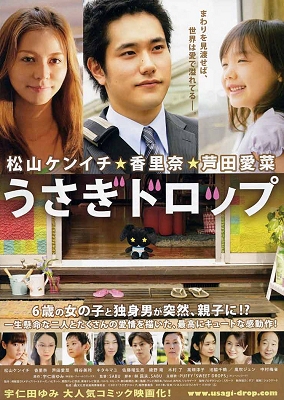
The 2011 live-action Bunny Drop movie does a good job adapting the first half of the anime and leaves things at that (alas, this movie is not subtitled).
The Roku app is functional. The video plays when you hit play. Otherwise, it's like a half-broken VCR, where the buttons don't reliably do what they're supposed to. Closed captions don't work. They do in the browser app, which doesn't appear to suffer from these issues.
Labels: dlibjapan, good morning japan, japanese, japanese tv, nhk cosmomedia, nhk world, streaming, television, tv japan