

October 21, 2023
Weather News

Aside from serious events that demand a more sober tone (like earthquakes), the presenters maintain a relentlessly upbeat attitude. Being easy on the eyes certainly helps as well (see the program guide).
The male co-anchors show up to talk shop and occasionally host a time slot but they are obviously not the main draws.
Hosted coverage begins at 5:00 AM JST and continues until 11:00 PM JST in six three-hour blocks: Morning, Sunshine, Coffee Time, Afternoon, Evening, and Moon. They will cover notable events like the recent annular eclipse and the Orionid meteor shower live.
Labels: geography, japanese culture, japanese tv, science, streaming, technology, television, weather


October 07, 2023
News from Japan (in Japanese)
Japan's commercial news networks and a number of regional television stations stream their news feeds on YouTube. These news networks are akin to the old school news agencies like Reuters. Stations often subscribe to more than one, including their competitors.
Because the primary purpose of these news networks is to provide their affiliates with broadcast content, the same blocks of material are reused and repeated throughout the day and week. But a broad slate of channels makes it easy to sample a fresh set of stories.
For a couple of fun peeks behind the scenes, Stay Tuned! (Netflix) is a slice-of-life comedy about a television station in Hokkaido. Wave, Listen to Me! (Crunchyroll) is an even wackier comedy about a late-night talk show host at a small radio station in Sapporo.
This is not a definitive list. Watch one channel and the YouTube bots will suggest a bunch more. The World Clock is a good resource for keeping track of the time.

News Networks
• All Nippon News Network (ANN) has 26 affiliates and originates from TV Asahi in Tokyo.
• Fuji News Network (FNN) has 28 affiliates and originates from Fuji Television in Tokyo. FNN has a live cam of the famous Shibuya Crossing.
• Nippon News Network (NNN) has 30 affiliates and originates from Nippon Television (NTV) in Tokyo.
• TBS News Dig is part of the Japan News Network (JNN) with 28 affiliates and originates from TBS Television in Tokyo.

Regional Stations
• HTB Hokkaido News originates from Hokkaido Television Broadcasting in Sapporo. HTB produced Stay Tuned! as part of its fiftieth anniversary.
• STV News originates from Sapporo Television Broadcasting in Sapporo. STV has been the highest rated television station in Hokkaido for over a decade.
• Nagoya TV News originates from the Nagoya Broadcasting Network in Nagoya and focuses on news from Aichi, Gifu and Mie prefectures.
• MBS News originates from the Mainichi Broadcasting System (MBS) in Osaka.
• Kansai News 24 is an ANN affiliate that focuses on news from Osaka, Kyoto, Hyogo, Wakayama, Nara, Shiga, and Tokushima prefectures, known in Japan as the Kansai region.
• Sun TV News originates from Sun Television in Hyogo prefecture.
• Home Hiroshima News originates from Hiroshima Home Television in Hiroshima prefecture.
• Kagoshima News KTS originates from Kagoshima Television Broadcasting Corporation in Kagoshima prefecture, located in the southern part of Kyushu.
 Of course, no news can be considered complete without the Weather News.
Because the primary purpose of these news networks is to provide their affiliates with broadcast content, the same blocks of material are reused and repeated throughout the day and week. But a broad slate of channels makes it easy to sample a fresh set of stories.
For a couple of fun peeks behind the scenes, Stay Tuned! (Netflix) is a slice-of-life comedy about a television station in Hokkaido. Wave, Listen to Me! (Crunchyroll) is an even wackier comedy about a late-night talk show host at a small radio station in Sapporo.
This is not a definitive list. Watch one channel and the YouTube bots will suggest a bunch more. The World Clock is a good resource for keeping track of the time.

• All Nippon News Network (ANN) has 26 affiliates and originates from TV Asahi in Tokyo.
• Fuji News Network (FNN) has 28 affiliates and originates from Fuji Television in Tokyo. FNN has a live cam of the famous Shibuya Crossing.
• Nippon News Network (NNN) has 30 affiliates and originates from Nippon Television (NTV) in Tokyo.
• TBS News Dig is part of the Japan News Network (JNN) with 28 affiliates and originates from TBS Television in Tokyo.

• HTB Hokkaido News originates from Hokkaido Television Broadcasting in Sapporo. HTB produced Stay Tuned! as part of its fiftieth anniversary.
• STV News originates from Sapporo Television Broadcasting in Sapporo. STV has been the highest rated television station in Hokkaido for over a decade.
• Nagoya TV News originates from the Nagoya Broadcasting Network in Nagoya and focuses on news from Aichi, Gifu and Mie prefectures.
• MBS News originates from the Mainichi Broadcasting System (MBS) in Osaka.
• Kansai News 24 is an ANN affiliate that focuses on news from Osaka, Kyoto, Hyogo, Wakayama, Nara, Shiga, and Tokushima prefectures, known in Japan as the Kansai region.
• Sun TV News originates from Sun Television in Hyogo prefecture.
• Home Hiroshima News originates from Hiroshima Home Television in Hiroshima prefecture.
• Kagoshima News KTS originates from Kagoshima Television Broadcasting Corporation in Kagoshima prefecture, located in the southern part of Kyushu.

Labels: business, dlibjapan, geography, japanese culture, japanese tv, nhk, streaming, television, weather
December 25, 2015
Merry Christmas!

Okay, enough of this "White Christmas" business.
I want some of that East Coast weather.
I want some of that East Coast weather.

September 09, 2015
The La Brea Fly Pits
Utah's hot, dry summers are not kind to flies, mosquitoes, and other annoying insects. The combination of heat, low humidity, and ultraviolet light (the average July UV index in Salt Lake City is 10; in New York it's 6) is as lethal as DDT.
 And at 4700 feet in elevation, summer mornings can be quite cool, even when the temperature reaches 100 degrees (Fahrenheit) in the late afternoon. I can open the door and windows and let the warm air out and the cool air in without ushering in a bunch of uninvited guests.
Conditions get wet and cool enough in the spring and fall to bring out the bugs in annoying numbers. Even during the summer, a couple will find their way in and spend the day banging off the glass and buzzing me, no matter how wide open the windows (wasps seem particularly stupid in this regard).
We're talking bugs with a serious death wish. They're like, "C'mon, Darwin, give me some of that natural selection!"
Splat. Wish granted.
I tried traditional fly paper and caught one fly in an entire month. Maybe they've evolved an aversion to the stuff. But as I said, not really worth spending a lot of time and money on. Still, a couple of flies droning around the room are like little kids running up and down the aisle during a cross-country flight.
I'm pretty sure fly paper--well, duct tape--would work on them. As it turns out, fly paper, like duct tape, is the right idea. It only needs a little tweak.
 A $6 pack of Catchmaster "Bug & Fly Clear Window Traps" did the trick. You place a plastic sheet of the stuff it in a corner of a sun-facing window (or any window where you observe bugs congregating). Stick it to the window and peel off the protective backing, exposing a film of transparent goo.
I was amazed at how quickly it worked. An hour later, flying annoyances gone. Or rather, permanently stuck. That's how long it took them to randomly wander into an insect version of the La Brea Tar Pits. I resisted tenting my fingers like Mr. Burns and cackling as the parasites went to meet their maker.
But I've got no sympathy for flies. Spiders, on the other hand, I respect. They're cold-blooded (literally) predators, and the enemy of my enemy is my friend (as long as they don't crawl on me).
It got me thinking that what we have here is the making of a cool science project. Leave a strip up for the whole summer and you'll end up with a veritable insect abattoir, including the teeny-tiny no-see-'ums you never guessed were there. You could stick traps all over the place and see what you collect where and how many over a span of time.
The downside is grossing out the teacher. But in truth, it's not any more disgusting than butterfly collecting. It's just that the little critters look so disgusting.
Okay, make that a big upside for the average kid.
 And at 4700 feet in elevation, summer mornings can be quite cool, even when the temperature reaches 100 degrees (Fahrenheit) in the late afternoon. I can open the door and windows and let the warm air out and the cool air in without ushering in a bunch of uninvited guests.
Conditions get wet and cool enough in the spring and fall to bring out the bugs in annoying numbers. Even during the summer, a couple will find their way in and spend the day banging off the glass and buzzing me, no matter how wide open the windows (wasps seem particularly stupid in this regard).
We're talking bugs with a serious death wish. They're like, "C'mon, Darwin, give me some of that natural selection!"
Splat. Wish granted.
I tried traditional fly paper and caught one fly in an entire month. Maybe they've evolved an aversion to the stuff. But as I said, not really worth spending a lot of time and money on. Still, a couple of flies droning around the room are like little kids running up and down the aisle during a cross-country flight.
I'm pretty sure fly paper--well, duct tape--would work on them. As it turns out, fly paper, like duct tape, is the right idea. It only needs a little tweak.
I was amazed at how quickly it worked. An hour later, flying annoyances gone. Or rather, permanently stuck. That's how long it took them to randomly wander into an insect version of the La Brea Tar Pits. I resisted tenting my fingers like Mr. Burns and cackling as the parasites went to meet their maker.
But I've got no sympathy for flies. Spiders, on the other hand, I respect. They're cold-blooded (literally) predators, and the enemy of my enemy is my friend (as long as they don't crawl on me).
It got me thinking that what we have here is the making of a cool science project. Leave a strip up for the whole summer and you'll end up with a veritable insect abattoir, including the teeny-tiny no-see-'ums you never guessed were there. You could stick traps all over the place and see what you collect where and how many over a span of time.
The downside is grossing out the teacher. But in truth, it's not any more disgusting than butterfly collecting. It's just that the little critters look so disgusting.
Okay, make that a big upside for the average kid.
Labels: appliances, science, technology, utah, weather
September 03, 2015
Window fans
One nice thing about living in the high desert is that while summer daytime temperatures can climb to 100 degrees (Fahrenheit), they often sink to a comfortable 65-70 degrees at night. Except then the problem is getting the hot air out and the cool air in.
Building codes in the U.S. stipulate wall and ceiling insulation ratings but rarely Whole House Mechanical Ventilation. And in an apartment (especially a forty-year-old one)? Fuhgeddaboudit. Unfortunately, because ventilating an apartment would be easy.
(The air conditioner and refrigerator in mine are as old as the apartment; the hermetically sealed compressor pioneered by General Electric is an amazingly rugged piece of machinery. But they are power hogs.)
When I was a kid back in the prehistoric times, my dad installed a WHMV system in our big baby boomer house. That plus tons of insulation in the attic made a huge difference, and was orders of magnitude cheaper than central air conditioning.
My solution has always been to buy a box fan and attach screws to mount it in the window. The first one was the best, with metal blades that were quiet and didn't turn too fast. They've been plastic ever since and noisier. But the last two really disappointed.
My previous Aerospeed fan wasn't unbearably loud but became steadily unbalanced (like a wobbly wheel). I started hearing what I thought was outside helicopter traffic (not that unusual where I live). It was the fan putting on a convincing ventriloquism act.
Its replacement, an inexpensive Lasko B20301, was well-rated on Walmart. That thing is a screamer, a turboprop ready to take off. I'm sure it'd be fine in a barn or a 2000 square foot house. It was too loud even from the bedroom.
So it was time to get a purpose-built window fan. The top-selling twin fan on Amazon is the Holmes HAWF2021. But the bad reviews (always read those) consistently mentioned the noise, and that made me nervous. I didn't feel like rolling the dice again.
In the reviews, somebody recommended the HDX FW23-A1 as the superior choice. HDX is Home Depot's store brand. Having decided I couldn't live with the Lasko, I took a closer look at the Home Depot listing.

Several reviews mentioned how quiet it was. That sold me. I trundled down to the local Home Depot and picked one up. It truly is the quietest fan I've had so far, and just ten bucks more than the Holmes. Plus, the airflow can be reversed with the flick of a switch.
Granted, it won't blow a gale through your living room; more like a gentle breeze. And in reverse, it's better than the air conditioner.
The accordion expander needs work. You have to play tug-of-war to get it out as far as in the picture. I wish they'd enclosed more than one of the Lego-like expansion "feet" instead. But the gap was easily filled by a piece of foam board.
The one disadvantage is that, unlike my old box fan kludges, when the HDX FW23-A1 isn't on it doesn't let much air through, which minimizes passive airflow. But that also means you don't have to hastily remove it with every change of the weather.
Building codes in the U.S. stipulate wall and ceiling insulation ratings but rarely Whole House Mechanical Ventilation. And in an apartment (especially a forty-year-old one)? Fuhgeddaboudit. Unfortunately, because ventilating an apartment would be easy.
(The air conditioner and refrigerator in mine are as old as the apartment; the hermetically sealed compressor pioneered by General Electric is an amazingly rugged piece of machinery. But they are power hogs.)
When I was a kid back in the prehistoric times, my dad installed a WHMV system in our big baby boomer house. That plus tons of insulation in the attic made a huge difference, and was orders of magnitude cheaper than central air conditioning.
My solution has always been to buy a box fan and attach screws to mount it in the window. The first one was the best, with metal blades that were quiet and didn't turn too fast. They've been plastic ever since and noisier. But the last two really disappointed.
My previous Aerospeed fan wasn't unbearably loud but became steadily unbalanced (like a wobbly wheel). I started hearing what I thought was outside helicopter traffic (not that unusual where I live). It was the fan putting on a convincing ventriloquism act.
Its replacement, an inexpensive Lasko B20301, was well-rated on Walmart. That thing is a screamer, a turboprop ready to take off. I'm sure it'd be fine in a barn or a 2000 square foot house. It was too loud even from the bedroom.
So it was time to get a purpose-built window fan. The top-selling twin fan on Amazon is the Holmes HAWF2021. But the bad reviews (always read those) consistently mentioned the noise, and that made me nervous. I didn't feel like rolling the dice again.
In the reviews, somebody recommended the HDX FW23-A1 as the superior choice. HDX is Home Depot's store brand. Having decided I couldn't live with the Lasko, I took a closer look at the Home Depot listing.

Several reviews mentioned how quiet it was. That sold me. I trundled down to the local Home Depot and picked one up. It truly is the quietest fan I've had so far, and just ten bucks more than the Holmes. Plus, the airflow can be reversed with the flick of a switch.
Granted, it won't blow a gale through your living room; more like a gentle breeze. And in reverse, it's better than the air conditioner.
The accordion expander needs work. You have to play tug-of-war to get it out as far as in the picture. I wish they'd enclosed more than one of the Lego-like expansion "feet" instead. But the gap was easily filled by a piece of foam board.
The one disadvantage is that, unlike my old box fan kludges, when the HDX FW23-A1 isn't on it doesn't let much air through, which minimizes passive airflow. But that also means you don't have to hastily remove it with every change of the weather.
Labels: appliances, economics, utah, weather
April 16, 2009
April showers

Labels: weather
April 01, 2009
The cherry blossom front
 In Japan, the school year, fiscal year, corporate orientation for new employees, and the television season begin on April 1 or during the first week of April.
Exercising more common sense, Japan doesn't do Daylight Savings Time.
The cherry blossoms start blooming in Tokyo around the last week of March, so falling cherry blossoms have become a symbol of transition, of endings and beginnings, guaranteed to show up in any high school melodrama.
The Japan Meteorological Agency--primarily responsible for important stuff like long-range weather forcasts and earthquake/volcano/tsunami alerts--also officially announces the beginning of the cherry blossom season and provides detailed weekly updates.
Sort of like tracking the changing of the leaves every autumn in New England, only with that ritual Japanese formality.
Because the cherry blossom season is tied to the growing season of each area, it moves in stages, from south to north and from the coasts inland. It's called the sakura zensen (桜前線) or "cherry blossom front."
Labels: geography, japan, science, social studies, weather
April 08, 2008
Juhyou
Especially noteworthy are "juhyou" (樹氷), or "frost-covered trees" (tree + ice). They are a product of Japan's "snow country," where cold Siberian winds meet warm Pacific currents, creating record snowfalls at fairly low latitudes (similar to the Appalachians of the mid-Atlantic region). The result is a natural flocking machine.
See a gorgeous photo essay on the subject here.
December 10, 2007
Friday rain, Sunday snow


October 24, 2007
Yin-Yang weather
After last weekend's cold front, we're back to enjoying perfect fall weather here in Utah. Perfect weather that is directly causing the hellish conditions in California. A dome of high pressure situated over the Great Basin brings us clear, crisp, blue skies. But the clockwise kick delivered by the high arc of the jet stream around this high pressure ridge spins off currents of air south and west toward Southern California. During the summer, hot air rising from the Mojave and Sonoran Deserts effectively stoppers the sink. But in the fall, all this gorgeous high pressure air drains out of the Great Basin and tumbles across the cold deserts, picking up additional energy ("adiabatic heating") as it falls five thousand feet to the ocean, warming and accelerating, and finally turning into the scorching Santa Ana winds.
Labels: weather
October 22, 2007
October snow

Labels: weather
September 18, 2007
Functionless clothing items
That's what Great Britain's Department of Health calls ties. "They perform no beneficial function in patient care and have been shown to be colonized by pathogens." Ditto long-sleeved shirts, watches, and jewelry.
I've been avoiding long-sleeved shirts, jewelry, watches, and ties for years. Of course, I don't work in a hospital, but why risk contaminating my keyboard? It's good to see solid scientific evidence backing up my fashion choices.
In Japan, the "Cool Biz" campaign swaps less air conditioning for a tie-less, jacketless, sleeveless work environment. It seems to be taking, as it's not unusual to see government officials going tie-less in settings where you'd never see an American bureaucrat so attired.
On the other hand, on solemn occasions like the Japanese equivalent of Memorial Day, the prime minister wears a morning coat. I have to admit, it looks a lot better than standard business attire. Dress way up a few times a year, or don't bother. I could live with that.
It's time for this custom to go world-wide and year-round.
I've been avoiding long-sleeved shirts, jewelry, watches, and ties for years. Of course, I don't work in a hospital, but why risk contaminating my keyboard? It's good to see solid scientific evidence backing up my fashion choices.
In Japan, the "Cool Biz" campaign swaps less air conditioning for a tie-less, jacketless, sleeveless work environment. It seems to be taking, as it's not unusual to see government officials going tie-less in settings where you'd never see an American bureaucrat so attired.
On the other hand, on solemn occasions like the Japanese equivalent of Memorial Day, the prime minister wears a morning coat. I have to admit, it looks a lot better than standard business attire. Dress way up a few times a year, or don't bother. I could live with that.
It's time for this custom to go world-wide and year-round.
July 13, 2007
Man, it's hot!

Labels: weather
June 08, 2007
Snow on Mt. Timpanogos

Labels: weather
November 15, 2005
Snow Country
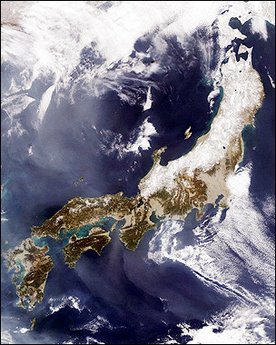
"The train came out of the long tunnel into the snow country. The earth lay white under the night sky."
So begins the novel Snow Country by Yasunari Kawabata. This 2004 satellite photograph vividly illustrates its location. At this latitude, Japan's "snow country" experiences the world's heaviest snowfall (as illustrated here). Where the Japan Alps cross central Honshu island, you can even make out the ridgelines separating the southern slopes facing the Kanto Plain and the warm Pacific from the northern slopes facing Siberia across the Japan Sea.
The scattered black dots are lakes. The big gray splotch at center right is Tokyo. West of Tokyo is Nagoya, and a short hop further west from Nagoya is Osaka. At the very top right is the island of Hokkaido. Halfway between Tokyo and Hokkaido is the city of Sendai.
To provide some geographical context, Tokyo is a tad south of Greensboro, North Carolina. Sendai is the same latitude as Washington, D.C. and Hokkaido shares the same latitudes as Minnesota. The mountains in northern Honshu are not as high as in central Honshu, so what is known as the Tohoku ("northeast") reigion is more directly exposed to those cold Siberian winds.