

September 23, 2023
Kazuya Kosaka
One of the rewards of listening to the Gold(en oldies) on J1 Radio is hearing covers of songs you never expected. Flash back to the late 1950s and early 1960s when Japan's television stations were first going on the air. They licensed Hollywood productions to fill in the program schedules.
Westerns were a staple on American television at the time, and so the genre naturally became a staple on Japanese television. Rawhide was a big hit. During a February 1962 publicity tour, Clint Eastwood, Paul Brinegar, and Eric Fleming met the Japanese press at the Palace Hotel in Tokyo.

It was only a matter of time before Japanese musicians began performing Western music and rockabilly. Kazuya Kosaka & The Wagon Masters not only covered the hits but reinterpreted them as well.
Here's Kosaku's version of "Rawhide."
And his cover of "Jailhouse Rock."
Kazuya Kosaka (1935–1997) is better remembered today in Japan for his long career in movies and television.

There are also J1 Radio apps for Roku, Android, and iPhone.
Westerns were a staple on American television at the time, and so the genre naturally became a staple on Japanese television. Rawhide was a big hit. During a February 1962 publicity tour, Clint Eastwood, Paul Brinegar, and Eric Fleming met the Japanese press at the Palace Hotel in Tokyo.

It was only a matter of time before Japanese musicians began performing Western music and rockabilly. Kazuya Kosaka & The Wagon Masters not only covered the hits but reinterpreted them as well.
Here's Kosaku's version of "Rawhide."
And his cover of "Jailhouse Rock."
Kazuya Kosaka (1935–1997) is better remembered today in Japan for his long career in movies and television.
There are also J1 Radio apps for Roku, Android, and iPhone.
Labels: japan, japanese culture, japanese tv, music, radio


December 01, 2021
Radio Garden
Radio Garden was created by the Netherlands Institute for Sound and Vision and the design firms Studio Puckey and Moniker. It hosts over eight thousand stations from around the world and can easily navigate to anyplace on the planet.
You can save favorites and bookmark links. There are apps for iPhones and Android devices too.

Also online are the NHK Radio News archives (in Japanese) and J1 Radio. The three main channels on J1 Radio are J1 Hits (pop/rock), J1 XTRA (Heisei era hits), and J1 GOLD (Showa era hits).
Now that we're on the subject, Wave, Listen to Me! is sort of WKRP in Hokkaido. The anime can be streamed on Funimation. Amazon has the English translation of the manga published by Kodansha.
On that nostalgic note, let's conclude with "My Broken Radio" by Hideaki Tokunaga (lyrics here).
You can save favorites and bookmark links. There are apps for iPhones and Android devices too.
Also online are the NHK Radio News archives (in Japanese) and J1 Radio. The three main channels on J1 Radio are J1 Hits (pop/rock), J1 XTRA (Heisei era hits), and J1 GOLD (Showa era hits).
Now that we're on the subject, Wave, Listen to Me! is sort of WKRP in Hokkaido. The anime can be streamed on Funimation. Amazon has the English translation of the manga published by Kodansha.
On that nostalgic note, let's conclude with "My Broken Radio" by Hideaki Tokunaga (lyrics here).
Labels: anime, funimation, japanese, manga, nhk, radio, streaming, technology
January 17, 2019
The old brand new

To be sure, in large swaths of the United States and the world, there are still no viable alternatives to satellite content delivery. But like a medieval circle of fate, technology is always circling around to where it began. The old becomes brand new again.
In terms of the large-scale infrastructure, the communications satellite was a simpler solution than the microwave relay stations that once dotted the land. In turn, those relay stations were a vast improvement over the copper wire telephone circuits they replaced.
Fiber optic cable wiped out the microwave towers and may soon do in the communications satellites.
Like the transistor, vacuum tube electronics, and the internal combustion engine, the amazing thing about television satellite service is that it works at all, let alone that it can be mass-produced as a consumer good.
A communications satellite orbits 22,236 miles above the equator, a tenth of the way to the Moon. And yet it beams a signal down to the Earth's surface that can be scooped up with an eighteen-inch dish on your roof and decompressed into 500 channels.
When I first got Dish, I was impressed at how "clean" the picture was. Completely static free. These days, it's ho-hum compared to free over-the-air HDTV.
OTA HDTV breathed new life into the old UHF broadcast spectrum. 5G networks promise to steal that precious "last mile" connection to the home away from fiber and cable.
Google's foray into the home Internet business ran into the buzz saw of regulatory capture, which lets cable cartels box out the competition. So Microsoft is going wireless instead, much as the smartphone leapfrogged the landline in the developing world.
The Microsoft Airband Initiative launched in July 2017 with the goal of working with partners to make broadband available to 2 million Americans in rural communities who lack access today and to help catalyze an ecosystem to connect millions more.

Back in 2016, Ars Technica reported that some of those old microwave towers are being repurposed to augment fiber optic networks. Because it's cheaper than laying brand new fiber and because radio signals move through the air faster than light through fiber.
And let's not too hastily write off satellites either. Elon Musk plans to tackle the latency problem of satellite-based Internet service with a swarm of satellites in low Earth orbit (such that at end-of-life they'll simply burn up in the atmosphere).
Every time you turn around, another moribund technology is "not dead yet." The solid-state disc drive should have sent old-fashioned "spinning rust" into retirement. Except every time it's knocked to the canvas, the hard disk drive staggers back to its feet like Rocky Balboa.

For example, Seagate has successfully prototyped a 16TB HDD using HAMR (Heat Assisted Magnetic Recording). The heat comes from a laser diode attached to the read/write head. Western Digital answered that challenge with a 16TB MAMR HDD (Microwave Assisted Magnetic Recording).
In the steampunk space opera future I like to imagine, the only way to build a faster-than-light starship engine will be with old-fashioned vacuum tubes and analog circuitry. And thus technology from the 1930s will end up being the most modern thing ever.
Labels: business, computers, directv, dish, radio, tech history, technology, television
July 05, 2018
And then there was one

While it was nice to have a "backup" channel if you missed a show the first time around, KBYU couldn't help diluting KUED's audience and ratings, and dividing loyalties especially during membership drives.

BYU Broadcasting announced plans to consolidate its television operations, BYUtv, KBYU Channel Eleven and BYUtv International, into one nationwide television network. Similarly, BYU Broadcasting said it plans to consolidate its radio operations, BYUradio (on SiriusXM Satellite Radio) and KBYU-FM/Classical 89, into a single radio network.
But listeners to Utah's last classical radio station proved to be a scrappy bunch. They weren't going down without a fight. And they won. Earlier this year, BYU Broadcasting purchased KUMT-FM (107.9) to host BYUradio,
preserving [the only] over-the-air classical music station in Utah. Classical 89 will continue to operate on its current frequency at 89.1 and 89.5 (Southern Utah County) on the FM dial.
So make that a win-win-win.
Labels: business, BYU, radio, television, utah
July 28, 2016
When quality came to Japan
 |
| Sarasohn (top) and Deming. |
While Deming would long be a prophet without honor in his own land, the Japanese took his advice to heart, applying it to their assembly lines and rewarding those who met its exacting standards with the "Deming Prize."
Less well known is that Deming was building on the substantial work already done by Homer Sarasohn, who'd been recruited by General MacArthur to rebuild Japan's electronics industry following the war.
When his stay in Japan came to a close, Sarasohn, in turn, recruited Deming.
Robert Cringely endeavors to correct the record in a compelling essay from his PBS column back in 2000: "How Homer Sarasohn Brought Industrial Quality to Japan and Why It Took Japan So Long to Learn."
(And note Sarasohn's quip about Donald Trump sixteen years ago).
Sarasohn's recollections of what he discovered upon inspecting the state of Japanese manufacturing in 1946 certainly come across as wildly incongruous now.
With the exception of the Zero fighter and some aircraft engines, their designs were bad and their manufactured goods were shoddy. Having come from the Rad Lab, I was particularly appalled to see the primitive nature of Japanese naval radar. Their vacuum tubes were bad and the radios were even worse, since each was hand-wired by untrained, often unsupervised, workers. They produced goods in mass quantities, ignoring quality.
Despite the Zero's reputation, Japan's war machine produced nothing like the deadly and reliable F6F Hellcat. Grumman designed the fighter to be simple to build and maintain, and manufactured 12,200 Hellcats in two years, continually improving the frame and powerplant.
As a result, the Hellcat racked up a 13:1 kill ratio over the most widely produced Model 52 Zero. The Model 64 Zero might have begun to match the much improved flight characteristics of the Hellcat, but never made it past the prototype stage.
And by then, the successor to the Hellcat, the Bearcat (which also didn't see action in WWII), had leapt far past the Hellcat and the Model 64, setting performance records that would be eclipsed only by jet fighters.
Essentially, Mitsubishi made Zeros the same way an artisan makes a fine watch. As Hayao Miyazaki observes, "Structurally, the Zero was not designed for mass production." Each Zero was a one-off. It was amazing that Mitsubishi managed to build 10,000 of them.
Meanwhile, the U.S. would deploy four air-superiority fighters into the Pacific Theater: the F6F Hellcat, the P-38 Lightning, the F4U Corsair, and by the end of the war, the P-51 Mustang.
Mass production in Japan before the war emphasized the "mass" part of production, betting on the numerical odds to produce a usable number of quality components. The result was vacuum tube yields of 10 percent. Sylvania, by comparison, had pushed yields to 85 percent.
Jonathan Parshall and Anthony Tully point out in Shattered Sword: The Untold Story of the Battle of Midway that Zero pilots had so little faith in their radios that they often removed them to save weight.
The aircraft radios carried on the Zero fighter were of inferior quality and of limited range and power and were difficult to use. As a result, while all carrier Zeros had radios, pilots rarely relied on them.
One of Homer Sarasohn's students was Akio Morita, cofounder of Sony Corporation, whose breakthrough product was the transistor radio.
At first, discrete transistors were treated the same as vacuum tubes. The real breakthrough in quality came with the planar process developed by Fairchild Semiconductor, that employed photolitholography to "print" solid state devices onto silicon wafers.
Unlike a discrete transistor, that could be tossed if a single unit didn't meet the right specs, a flaw in a silicon wafer ruined the whole batch. Producing literally perfect wafers became an economic necessity. And that, Sarasohn argues, is what lit the fire.
The problem is, there's nothing proprietary about quality. It took a while, but Detroit caught on, and the Koreans did too, taking over the DRAM business by 1991. And two decades later had grabbed the bulk of the consumer electronics business from Sony and Panasonic.
The job Japan has ahead of it is not only to iterate and improve but to truly create, to somehow (frankly, it might be impossible at this late date) rekindle the white-hot passion for innovation that propelled Japan, Inc. to greatness in those golden postwar years.
Related links
Twilight of the Zero
The rebirth of Japan's mass media
Labels: business, japan, japanese culture, radio, technology
September 29, 2014
Hanako and Anne
Yuriko Yoshitaka (featured in the second season of Galileo) just finished playing Anne of Green Gables translator Hanako Muraoka in NHK's Asadora morning melodrama, Hanako and Anne.

The series is based on a biographical novel written by her granddaughter, Eri Muraoka. The fictional version streamlines and simplifies her childhood, and goes out of its way to draw parallels between Hanako's life and Anne's story.
Hanako had seven siblings in real life, three in the series. As in Anne of Green Gables, the farming out of "excess" children to relatives was common practice. Hanako's daughter was actually her sister's child. Her own son died at the age of five.
This adoption (once quite common in Japan and still done today) is depicted in the series.
A Christian, Hanako's father had his daughter baptized into the Methodist Church (that part left out). From the age of ten, Hanako boarded at a missionary school for girls in Tokyo. The school, Toyo Eiwa Junior High and High School, still exists.
Like Anne, after graduating (with the equivalent of an associate's degree), she taught school before marrying and becoming a full-time writer. In the 1930s, she hosted a weekly children's program on NHK radio.
Hanako translated just about every popular work of young adult English literature published in the 19th and early 20th centuries, starting with The Prince and the Pauper and including Polyanna, The Secret Garden, and Anne of Green Gables.
Between 1927 and 1968, she translated two books a year on average. Published in 1952, her abridged version of Anne of Green Gables (completed in secret during the war) became a bestseller.
Over a dozen new translations and annotated editions of "Red-Haired Anne" (as it's titled in Japan) have been published since. The book appeared at exactly the right time in 1952 to leave a lasting imprint on the culture.
Hanako's life and career are also a good example of necessary and sufficient conditions coming together. Hanako was born with all the right tweaks in her Broca's area to make the most of a unique opportunity, and coupled that with tons of drive.
The television series depicts her as fanatical about learning English, far more than her classmates, which I think is exactly right. Nobody devotes that fabled "10,000 hours" to mastering a skill if they don't like it and don't consistently improve at it.
The series ends with the publication of Anne of Green Gables. Hanako traveled to North America for the first time in 1967. She died the next year at the age of 75.
 The life of a translator is not all that interesting, so the series devotes a considerable amount of screen time to the real-life soap opera of Hanako's classmate and friend, Byakuren Yanagihara ("Renko" in the series), a cousin of the Taisho Emperor.
Their friendship reveals the sociolinguistic conventions of the time: Hanako always refers to Renko using the honorific "-sama" while Renko addresses Hanako using the diminutive "-chan."
Byakuren married three times. The first two were blatant exchanges of titles for money, her brother having screwed up the family finances. She ended the second marriage (to a coal magnate thirty years her senior) with a scandalous affair and very public divorce.
Along the way she published several collections of tanka poetry and became a vocal advocate for women's rights.
Stripped of her title, she lived a much happier life as a commoner (though was devastated by the war-time death of her son in 1945). She and her third husband were married for 46 years, until her death in 1967.
The series is based on a biographical novel written by her granddaughter, Eri Muraoka. The fictional version streamlines and simplifies her childhood, and goes out of its way to draw parallels between Hanako's life and Anne's story.
Hanako had seven siblings in real life, three in the series. As in Anne of Green Gables, the farming out of "excess" children to relatives was common practice. Hanako's daughter was actually her sister's child. Her own son died at the age of five.
This adoption (once quite common in Japan and still done today) is depicted in the series.
A Christian, Hanako's father had his daughter baptized into the Methodist Church (that part left out). From the age of ten, Hanako boarded at a missionary school for girls in Tokyo. The school, Toyo Eiwa Junior High and High School, still exists.
Like Anne, after graduating (with the equivalent of an associate's degree), she taught school before marrying and becoming a full-time writer. In the 1930s, she hosted a weekly children's program on NHK radio.
Hanako translated just about every popular work of young adult English literature published in the 19th and early 20th centuries, starting with The Prince and the Pauper and including Polyanna, The Secret Garden, and Anne of Green Gables.
Between 1927 and 1968, she translated two books a year on average. Published in 1952, her abridged version of Anne of Green Gables (completed in secret during the war) became a bestseller.
Over a dozen new translations and annotated editions of "Red-Haired Anne" (as it's titled in Japan) have been published since. The book appeared at exactly the right time in 1952 to leave a lasting imprint on the culture.
Hanako's life and career are also a good example of necessary and sufficient conditions coming together. Hanako was born with all the right tweaks in her Broca's area to make the most of a unique opportunity, and coupled that with tons of drive.
The television series depicts her as fanatical about learning English, far more than her classmates, which I think is exactly right. Nobody devotes that fabled "10,000 hours" to mastering a skill if they don't like it and don't consistently improve at it.
The series ends with the publication of Anne of Green Gables. Hanako traveled to North America for the first time in 1967. She died the next year at the age of 75.
Their friendship reveals the sociolinguistic conventions of the time: Hanako always refers to Renko using the honorific "-sama" while Renko addresses Hanako using the diminutive "-chan."
Byakuren married three times. The first two were blatant exchanges of titles for money, her brother having screwed up the family finances. She ended the second marriage (to a coal magnate thirty years her senior) with a scandalous affair and very public divorce.
Along the way she published several collections of tanka poetry and became a vocal advocate for women's rights.
Stripped of her title, she lived a much happier life as a commoner (though was devastated by the war-time death of her son in 1945). She and her third husband were married for 46 years, until her death in 1967.
Labels: anne, asadora, japanese tv, language, nhk, radio, showa period
August 19, 2013
Complex simplicity
The HDTV (plasma or LCD) is another confirmation of a perhaps inexorable trend in consumer electronics over the past quarter-century: devices have gotten vastly simpler at the macro level as they've gotten vastly more complex at the micro level.
To start with a simple example: from three (audio/composite/S-Video) to five (audio/component) cables/jacks replaced by a single HDMI. The back of the TV is no longer a spider's web of wires.
The increasingly rare CRT is such an absurdly complex piece of equipment—basically a tiny linear accelerator—it's amazing that it works at all. From both a design and manufacturing standpoint, the LCD screen is simple by comparison.
The game-changer is that the micro level has been completely automated. Most of the macro assembly tasks are done by robots too. Back in the early days of the semiconductor, transistors were hand-made, just like vacuum tubes.
The planar process (the second great breakthrough in modern electronics, preceded by the transistor and followed by the integrated circuit) made it possible to mass-produce semiconductors using photolithography.
I grew up at the end of the vacuum tube era and dismantled my share of discarded TV sets (and even managed to fix a few). It's truly amazing what electronics engineers could accomplish with a handful of vacuum-tube driven discrete circuits.
A basic B&W set back then had a dozen or so tubes. The typical vacuum tube was the equivalent of two transistors. Your remote control has about a million times as many.
There wasn't a part in a vacuum tube TV you couldn't see with the naked eye, including the stuff inside the vacuum tubes. All of those parts were hand-assembled and quite literally added up to a scalding hot cauldron of energy-eating entropy.
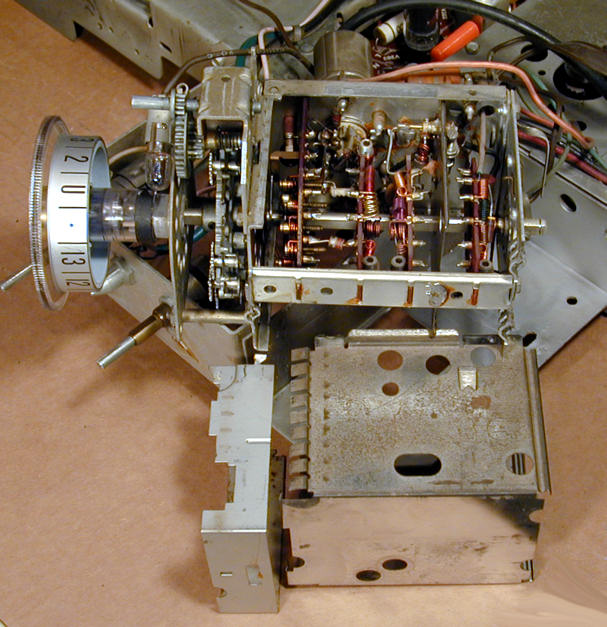
The tuner alone was a two or three-tube local oscillator, frequency mixer and IF amplifier built around a multi-deck rotary switch the size of a gear shift lever. It was a major point of failure, fueling a small industry in cleaning sprays.
The tuning coils were hand-soldered to the contraption, which had to be bolted to the frame. As you can see in this blast from the past at Phil's Old Radios, even though printed circuit boards were coming into use, a lot of the guts were still hand-wired.
That meant manufacturing televisions was hugely labor-intensive. In inflation-adjusted terms, A 19-inch TV from that era cost almost $2000 in today's dollars!
An LCD TV is simply a specialized laptop with five SKUs: a mainboard, screen, power supply (power brick), remote (instead of a keyboard), and case. Like white box PC parts, wholesalers will happily sell them directly to you (preferable in lots of 1000).
To start with a simple example: from three (audio/composite/S-Video) to five (audio/component) cables/jacks replaced by a single HDMI. The back of the TV is no longer a spider's web of wires.
The increasingly rare CRT is such an absurdly complex piece of equipment—basically a tiny linear accelerator—it's amazing that it works at all. From both a design and manufacturing standpoint, the LCD screen is simple by comparison.
The game-changer is that the micro level has been completely automated. Most of the macro assembly tasks are done by robots too. Back in the early days of the semiconductor, transistors were hand-made, just like vacuum tubes.
The planar process (the second great breakthrough in modern electronics, preceded by the transistor and followed by the integrated circuit) made it possible to mass-produce semiconductors using photolithography.
I grew up at the end of the vacuum tube era and dismantled my share of discarded TV sets (and even managed to fix a few). It's truly amazing what electronics engineers could accomplish with a handful of vacuum-tube driven discrete circuits.
A basic B&W set back then had a dozen or so tubes. The typical vacuum tube was the equivalent of two transistors. Your remote control has about a million times as many.
There wasn't a part in a vacuum tube TV you couldn't see with the naked eye, including the stuff inside the vacuum tubes. All of those parts were hand-assembled and quite literally added up to a scalding hot cauldron of energy-eating entropy.
The tuner alone was a two or three-tube local oscillator, frequency mixer and IF amplifier built around a multi-deck rotary switch the size of a gear shift lever. It was a major point of failure, fueling a small industry in cleaning sprays.
 |
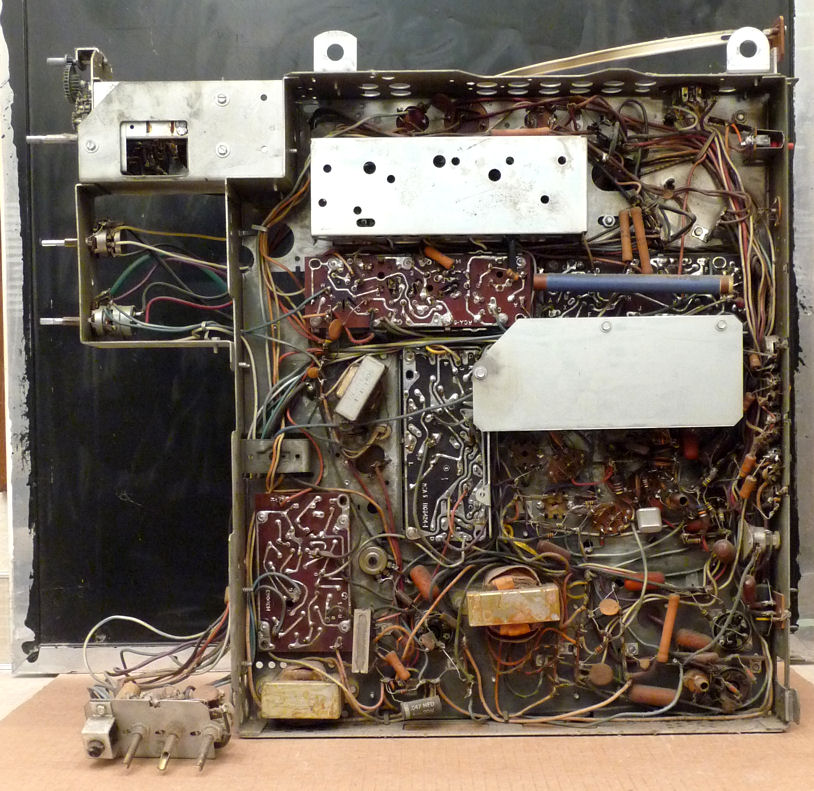
That meant manufacturing televisions was hugely labor-intensive. In inflation-adjusted terms, A 19-inch TV from that era cost almost $2000 in today's dollars!
An LCD TV is simply a specialized laptop with five SKUs: a mainboard, screen, power supply (power brick), remote (instead of a keyboard), and case. Like white box PC parts, wholesalers will happily sell them directly to you (preferable in lots of 1000).
Related posts
HDTV on the cheap
Seiki first impressions
The last picture tube show
Labels: business, radio, robots, science, technology, television
April 23, 2012
Ume-chan Sensei
NHK's Asadora or "morning (asa) drama (dorama)" is a fifteen-minute family melodrama that runs six days a week. The latest series is a "Showa drama," meaning it takes place in the middle part of the 20th century.
Showa dramas typically depict Japan (symbolized by the spunky female protagonist) struggling through the ashes of WWII to make a place for herself in the world. In this case, scaling the very high hurdle of becoming a medical doctor.
The television season in Japan officially begins in April, and Ume-chan Sensei is now the third Showa drama in a row since the 3/11 earthquake and tsunami, and the fourth of the last five (only two of the nine before that were Showa dramas).

Unlike the previous four, where the end of the war came at the climax of the first or second act, the very first episode of Ume-chan Sensei takes place on August 15, with the Emperor's radio speech announcing the surrender.
One thing this and previous Asadora have pointed out is that the Emperor had never made a radio address before, used stilted and dated language, and nobody under the age of forty could understand a thing he said. No King's Speech here.
The previous Showa dramas I've seen took place far from Tokyo, where the only damage came from an off-course B-29. Ume-chan Sensei begins in Kamata. I've been there. It's right between Tokyo and the industrial port city of Kawasaki.
Pretty much ground zero. The first scene starts with the family eating breakfast. Then Umeko runs outside—into an utterly wrecked and charred landscape. It was hard not to think of post-tsunami scenes from the Northern Japan.

I'm sure the director intended the connection to be drawn, and it makes for a fascinating and detailed look at post-war Japan I haven't seen before. Needless to say, the lead actress, Maki Horikita, makes it very much worth looking at too.

Showa dramas typically depict Japan (symbolized by the spunky female protagonist) struggling through the ashes of WWII to make a place for herself in the world. In this case, scaling the very high hurdle of becoming a medical doctor.
The television season in Japan officially begins in April, and Ume-chan Sensei is now the third Showa drama in a row since the 3/11 earthquake and tsunami, and the fourth of the last five (only two of the nine before that were Showa dramas).
Unlike the previous four, where the end of the war came at the climax of the first or second act, the very first episode of Ume-chan Sensei takes place on August 15, with the Emperor's radio speech announcing the surrender.
One thing this and previous Asadora have pointed out is that the Emperor had never made a radio address before, used stilted and dated language, and nobody under the age of forty could understand a thing he said. No King's Speech here.
The previous Showa dramas I've seen took place far from Tokyo, where the only damage came from an off-course B-29. Ume-chan Sensei begins in Kamata. I've been there. It's right between Tokyo and the industrial port city of Kawasaki.
Pretty much ground zero. The first scene starts with the family eating breakfast. Then Umeko runs outside—into an utterly wrecked and charred landscape. It was hard not to think of post-tsunami scenes from the Northern Japan.
I'm sure the director intended the connection to be drawn, and it makes for a fascinating and detailed look at post-war Japan I haven't seen before. Needless to say, the lead actress, Maki Horikita, makes it very much worth looking at too.
Related posts
Asadora
Ganbarou! Japan
Labels: asadora, history, japan, japanese tv reviews, radio, showa period, television, television reviews, ww2
December 18, 2006
Morse code RIP
Another one of those end-of-an-era things:
In an historic move, the FCC has acted to drop the Morse code requirement for all Amateur Radio license classes.Back in my geeky teenage years, I flirted off and on with the idea of getting an Amateur Radio license. The electronics wasn't a problem. And Morse code ultimately wasn't the biggest hindrance (though it surely didn't help). My problem was what one supposedly did with an Amateur Radio license, that is, communicate blindly--in real time--with people I didn't know, something I had absolutely no interest in doing. Steve Sailer explains this disinclination well:
I'm not quick in interpersonal situations . . . which means I'm unimpressive in real time. So, I greatly appreciate the asynchronous nature of cyberspace, since I can take whatever time I require to think through an idea. (Which is why I hate instant messaging.)I don't instant message either. I don't have a cell phone. I was born for the asynchronous age.
Labels: radio, technology