

January 01, 2025
Dragon Pilot
 Based on the manga created by Toshinao Aoki and Studio Bones, the animation in Dragon Pilot brings to mind the comic strip art of Bill Watterson. The premise of Dragon Pilot as well is the crazy kind of gross but hilarious and yet clever idea that Calvin of Calvin and Hobbes would come up with.
Unbeknownst to the rest of the world (and most Japanese), a select few of Japan's military aircraft, including an F-15J and an F-2 (Mitsubishi's made-in-Japan version of the F-16), are dragons disguised to look like fighter jets.
Hisone Amakasu is a rookie airman at the Japan Air Self-Defense Force Gifu Air Base. One day out of the blue she learns she has passed a "qualification" (she wasn't aware of) and is summarily transferred to a huge hanger way off in the corner of the base that no one seems to know about—except for an odd old woman who pushes a food cart around the base.
When Hisone finally finds the hanger, she walks in and is confronted by a huge dragon (she later names "Masotan") that promptly eats her.
The ground crew is delighted. It's been a while since a pilot passed muster with this particular OTF (an "Organic Transformed Flyer," as the military labels them). You see, the pilot doesn't ride atop the dragon like a horse. The dragon swallows the pilot, who "flies" the dragon from its guts. And when the flight is over, regurgitates her back out.
And, yes, the pilots have to wear special flight suits to keep from getting digested.
Needless to say, the dragon has a lot of discretion about who gets swallowed, and some, like Masotan, can get picky. The dragons are perceptive about the personalities of their pilots. They can even pick up mechanical issues with the real F-15Js they fly with (via the heads-up display in the helmets the pilots wear). But they don't talk.
It's eat or don't eat. Once they've formed an attachment, the one thing that really gives a dragon an upset stomach is his pilot forming a romantic relationship with another human being (which reminds me a similar plot device in My Zhime). No surprise, then, that the girls who make the best "D-Pilots" are not very socially adept.
For all its inherent silliness, Dragon Pilot raises fascinating questions about choice and free will. Hisone got something she didn't know she wanted. Nao wants something she can't get. Elle got what she didn't want instead of what she did. Moriyama gave up what she wanted and walked away to happily make another life for herself.
As Hisone tells Okonogi, a member of her ground crew and also, by family lineage (not something he had a lot of choice about either), a Shinto priest, "It's always best when the things you like and the things decided for you are in agreement."
That religious angle is no small matter. One of the old gods of Japan is a whale-sized monster, literally the size of a small island. It briefly comes out of hibernation every seventy-four years. The job of the dragon pilots is to escort it to a new resting place before it goes all Godzilla on Japan, and put it to bed with an ancient Shinto ritual.
The old school ritual required one of the miko attendants to stay behind in the "belly of the whale," so to speak. As far as Hisone is concerned, that is very much not okay. As it turns out, the food cart lady is the last living member of her squadron from the last time, when her reaction was the same as Hisone's.
In Calvin and Hobbes style, Hisone figures out an unlikely solution. It's a credit to the writing that the series manages to take these serious turns—and turn back again—without spoiling the comedic mood created earlier or making light of the dramatic decisions that Hisone faces (but be sure to stick through the final closing credits).
Masotan ultimately gets a character arc too, which suggests that perhaps the dragons will figure out how to compromise on the whole personal boundaries thing, and not force their pilots into the kind of all-or-nothing choice that Moriyama was left with. We have every reason to hope that the dragons will mature alongside their pilots.
Dragon Pilot is streaming on Netflix.
Labels: anime reviews, japanese culture, netflix, religion, shinto


November 06, 2024
Matt Alt on minimalism

To begin with, ascetic practices attributed to Zen Buddhism are not the same as the disciplined use of space due to the fact that there isn't that much of it.
Ongoing population decline notwithstanding, Japan is still home to 126 million people who live in a country the size of California. Only 11 percent of the total land area is arable and less than a third of that is actually usable for housing.
That certainly sounds like a good argument for a less-is-more lifestyle. Except what space is available is nowadays bound to be crammed to the gills with stuff (as George Carlin delightfully put it).
After all, Kondo wrote originally for a Japanese audience, that had apparently forgotten they were supposed to be minimalists living in the land of minimalism.
Though to give Kondo the benefit of the doubt, I believe this is largely a postwar phenomenon brought about by both a booming economy and the additional confidence that all your stuff will still be here tomorrow.
As I discussed in a post about how Edo-period cities handled the constant plague of massive urban fires, perhaps Japanese minimalism simply evolved as a way to cope with that pretty grim reality.
Starting with the Great Fire of Meireki in 1657, fire was such ever-present fact of life that the average Edokko could expect his house to burn down at least once during his lifetime.
This expectation didn't end with the Meiji. As Edward Seidensticker writes in Low City, High City, "From early into middle Meiji, parts of Nihonbashi were three times destroyed by fire. There were Yoshiwara fires in 1871, 1873, 1891, 1911, and of course in 1923."

As late as 1995, the widespread damage from fires throughout Kobe following the Great Hanshin earthquake was a big wakeup call. Fire is no longer the threat it once was in Japan's urban centers, which has allowed clutter to proliferate.
When one of those old Edo period storehouses shows up in a modern mystery series, it will be crammed floor to ceiling with a haberdashery of clutter, that the detectives will have to comb through to find the critical clue.
As Kyoichi Tsuzuki points out, "Simplicity isn’t about poverty at all. It’s about wealth." It's about being able to buy all that stuff and then being able to afford to store it someplace else. Or replace it on a whim.
It's also a good way to have your minimalist cake and eat it too. Before the fussy relatives come over, cart all that materialistic excess to the storehouse and show off your splendidly simple life.
Or I guess you could hire Marie Kondo to eliminate the need in the first place.
Labels: economics, geography, history, japan, japanese culture, religion
October 30, 2024
Mieruko-chan

Donna Howard investigates the provenance of relics and antiques with the help of people from the past who are only visible to her.
For Natsume, his second sight (inherited from his grandmother) often results in the supernatural Shinto world intruding on his otherwise ordinary day-to-day life.
Mieruko can see dead people too. Her name is a pun on the verb meaning "I can see." That makes her privy to an extensive and weirdly thriving ecosystem of the living dead invisible to all but a select few.
Unfortunately for Mieruko, she has a hard time telling the good dead people from the bad dead people.
Even the guardian deities (inari) at the Shinto shrine are fierce and intimidating. Most of the dead people and creepy crawlies look like mutating corpses. Which is bad enough, except when they realize she can see them. Mieruko has gotten good at maintaining a look of deadpan indifference.
The rules governing Mieruko's abilities mirror those in Natsume's Book of Friends (which just debuted a new season). Creatures from the spirit world can only physically interact with you if they catch you looking at them first. Maintaining an attitude of stoic indifference can be the best recourse.
Which brings me to a new word I learned reading the manga: suruu sukiru (スルースキル), a transliteration of "through skill." Weblio defines it as the "ability to ignore bad things happening to you." In other words, the skill to work through a problem by tuning out and not getting upset about it.
But like Natsume, a girl's got her limits. There are times when Mieruko has no choice but to lend the ghouls an ear. Occasionally she discovers their intentions are benign. At other times, not so much. It's easier when the monsters behave like monsters, but even there she can jump to the wrong conclusions.
The occasional Sixth Sense twist will also fool the reader. And there's a touch of Dexter in the cat killer arc as well (which is featured in the anime).
Her best friend Hana is a ghost magnet ("Like moths to a flame," an old soothsayer ally observes), though not having second sight herself, she's clueless about their presence. One of their classmates also has second sight, though not being as powerful as Mieruko, she misjudges their respective abilities.
These moral dilemmas lend Mieruko-chan depth without being depressing or nihilistic. Some of the stories are genuinely heartwarming. If you're a fan of Edward Gorey or Charles Addams, Mieruko-chan is right in your wheelhouse.
Written and illustrated by Tomoki Izumi. Published in Japan by Kodansha and by Yen Press in the United States. The anime is based on the first three volumes of the manga. A live-action film adaptation is scheduled for release in 2025.
Related links
BookWalker (English emanga)
BookWalker (Japanese emanga)
Amazon (Kindle and paperback)
Crunchyroll (anime)
Labels: anime, bookwalker, crunchyroll, ebooks, japanese culture, kindle, manga, manga reviews, movies, religion, shinto
October 05, 2024
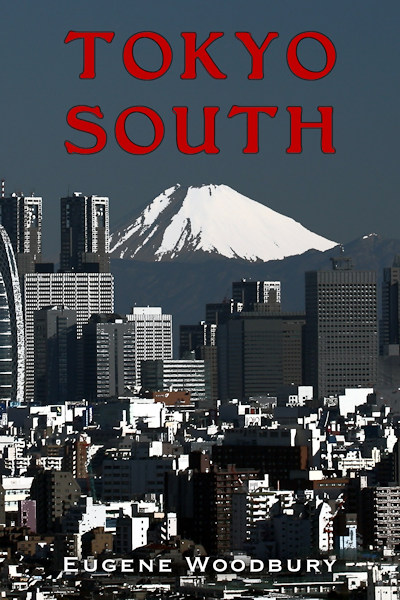
Tokyo South
The first chapter of Tokyo South, "Lost in the Works," was the innagural story of my writing career. I'd signed up for a computer programming class at BYU and discovered that I liked using the Pascal editor as a crude word processor (this was back during the Apple II era) more than programming.
Then "Number Games" won second place in the 1984 Vera Hinckley Mayhew Awards, my first solid bit of external validation. (I doubt the story would be so well received today; I like to call the first half of the 1980s at Brigham Young University under President Jeffrey Holland its glasnost era.)
Over the last two decades, a series of reorganizations and consolidations and force reductions finally resulted in the the Tokyo North and South missions being reunited in 2007. This Ted Lyon interview makes it clear that the shenanigans I describe in Tokyo South were by no means unique to Japan.
If anything, time and nostalgia and the detached sense of sang-froid that comes with age and experience led me to pull my punches a bit.
Tokyo South will be made available at a later date.
Related posts
The evolution
Tokyo South is alive
Tokyo South is dead
The weirdest two years
The problem with projections
Labels: books, BYU, ebooks, japan, japanese culture, kindle, peaks island press, publishing, religion, tokyo south
April 24, 2024
The Amakusa Church

For example, Stiyl Magnus and Kaori Kanzaki are members of Necessarius, the Special Forces sorcery squad of the Anglican Church.
Okay, that part is fiction.
Kaori Kanzaki is a former leader of the Amakusa Catholics, descendants of the "Hidden Christians" that preserved the faith after the disaster of the Shimabara Rebellion in 1637.
That last part is not.
Jesuit missionaries arrived in Japan in the 1540s in the company of Portuguese traders. They were followed by Franciscans and Dominicans under the aegis of Spain. During the latter half of the sixteenth century, they enjoyed the patronage of Oda Nobunaga, the first of the Three Great Unifiers of Japan during the Warring States period.
Nobunaga had no interest in Christianity per se, but he was very interested in the firearms provided by the Spanish and Portuguese. Christianity was also a useful political check on the Buddhist factions in Kyoto that were a constant thorn in his side.
Alas, several years after Nobunaga's assassination, Spanish conquistadores were caught saying the quiet part out loud and Christianity quickly fell out of favor with the powers that be. As Hisaki Amano explains,
A Spanish ship en route from the Philippines to Mexico suffered serious damage in a series of typhoons and drifted ashore in Tosa (modern-day Kochi Prefecture). Under interrogation, the ship's crew responded that Spain was a world power that dispatched missionaries to convert the local population before occupying the countries.
Nobunaga's successor, Toyotomi Hideyoshi, began persecuting Christians with a vengeance, culminating in the martyrdom of twenty-six priests and believers in Nagasaki in 1597. Under the Tokugawa shoguns, Christianity was outlawed. Especially after the Shimabara Rebellion, simply being a Christian was deemed a capital offense.
That legal status was not amended until the late nineteenth century.
The Shimabara Rebellion erupted in 1638 on the island of Kyushu. Nagasaki was once a major Portuguese trading port and Shimabara had the highest percentage of Christians in the country. The rebellion began as a peasant uprising, and was soon joined by Catholic Christians chafing under the heavy hand of local leaders and the shogunate.
Although the rebellion was not without cause and the governor of Shimabara was later executed for misrule and incompetence, such a direct challenge to the legitimacy of the Edo government could not go unanswered.
At the age of seventeen, Amakusa Shiro became the leader of the Japanese Roman Catholics in Shimabara. After a tortuous siege, Shogunate forces overran Hara Castle in 1639 and killed upwards of 37,000 rebels and sympathizers. But the Hidden Christians persevered until the anti-Christian edicts were removed two and a half centuries later.
This is a case where the winners wrote the history books, so Amakusa Shiro was made the villain. He is one of the bad guys in Makai Tensho, a 1967 fantasy novel by Futaro Yamada that has Amakusa Shiro rising from the grave to exact revenge on the shogunate.
Three movies have been made from the book, the most recent in 2003. The best known remains the 1981 version starring Sonny Chiba as Yagyu Jubei, a role he returned to often in samurai action series such as Shogun's Samurai. Overseas releases appended Samurai Reincarnation to the title.
Tubi has a generous selection of Sonny Chiba films and series, including a dubbed version of Samurai Reincarnation and half a season of Shogun's Samurai.
Over the past century, and certainly since 1945, the image of Christianity in Japan has been thoroughly rehabilitated. Christian style weddings (fake pastor included) have become all the rage. Former prime minister Aso Taro is a Catholic. And Christmas (along with Santa Claus) is now one of Japan's most popular unofficial holidays.
Along the way, as evident in series like A Certain Magical Index, Hellsing, and The Ancient Magus Bride, Christianity, and Catholicism in particular, became a rich source of dramatic material. Unconstrained by the usual cultural preoccupations, Japanese writers often push those religious tropes in quite unexpected directions.
Labels: anime, anime reviews, geography, japanese culture, japanese movie reviews, politics, religion
April 17, 2024
A certain anime franchise

One-Punch Man is another recent example. When it comes to consistent world building across an entire franchise, I've taken a particular liking to the three anime series based on the light novels by Kazuma Kamachi.
Sharing many of the same characters and storylines, A Certain Magical Index, A Certain Scientific Railgun, and A Certain Scientific Accelerator take place in Academy City. Imagine if every major high school, university, research institute, and corporate lab in the country had extension campuses within the same prefectural boundaries.
This being Japan, students are tested and ranked from zero (no superpowers) to six (out of this world). Following a normal distribution, there are a lot of zeroes and ones, and only seven Fives. Even the Fives are ranked, with Accelerator at the top. The ranks are logarithmic, so similarly ranked espers can still be orders of magnitude apart in their powers.
Espers are seen as "scientific," as distinguished from skills derived from magic. When Index Librorum Prohibitorum (her name derived from the 103,000 forbidden magical books she's memorized) shows up in Academy City with a bunch of sorcerers and miniskirted Catholic nuns in her wake, her presence throws Toma Kamijo's life into turmoil.
Incidentally, the Index Librorum Prohibitorum was an actual list of publications deemed "heretical or contrary to morality." It was revised and updated until 1966, though it contained thousands of volumes, not hundreds of thousands.

Railgun and Accelerator belong almost entirely to the latter genre while half or more of Index could share the same world as The Ancient Magus Bride.
In the second and third seasons of Index, it's the English Reformation redux as the Anglicans and Puritans go to war with the Catholic Church. I get a real kick out of the tossed salad of Western and Eastern religious tropes that show up so often in manga and anime, like Jesus and Buddha sharing a Tokyo apartment in Saint Young Men.
Toma Kamijo, the protagonist in A Certain Magical Index, is actually a negative infinity in the esper superpower rankings. With his right hand, he can negate both magic and esper skills. He seems to be the only one who can do this, which means that all the espers milling about in Academy City create a unique law enforcement problem.
Working alongside the regular police are two additional organizations. "Judgment" is run by the students, who basically form patrol units of glorified hall monitors. Though when the hall monitors have superpowers, they tend to stray outside their jurisdictional boundaries. "Anti-Skill" is comprised of heavily-armed SWAT teams.
But when high-level espers go off the rails, even Anti-Skill can find themselves out of their depth. Then only another Five (or Toma Kamijo) can hope to match them. Kuroko Shirai (a level Four teleporter) is a member of Judgment. She's also roommates with Mikoto Misaka, a level Five, so Mikoto often ends up getting drawn into the fray.
Mikoto has a skill set similar to Magneto in X-Men. Her preferred technique is to propel a coin through a self-generated electric field to hypersonic speeds, hence her "Railgun" moniker.
Despite the proliferation of so many superpowered individuals in Academy City, there is, refreshingly, no one ring to rule them all, no big bad, no supervillain. Accelerator certainly has the potential to step into the role, though his reasoning is that if he really could become the biggest big bad in the world, everybody would leave him alone.

The underlying motivations for these actors come down to ordinary human failings like arrogance, envy, and greed, though A Certain Scientific Accelerator starts out as Magnum Force and turns into the sixth season opening arc of Buffy, where the Scooby Gang resurrects Buffy (with near apocalyptic results in this case).
The crazies aside, they don't perceive themselves as bad people doing bad things. They're too busy filling out grant proposals and delivering papers at conferences to worry about the moral implications of their experiments. Surrounded by so many fascinating labs rats, who can blame them for the odd ethical lapse? Scientific progress justifies all!
Tying the three series together is the kind of underground experiment that the Cigarette Smoking Man from The X-Files would love. It involves the manufacture of 20,000 Railgun clones that have been specifically designed to raise Accelerator's powers to the mythical Level Six through the brute-force use of real-time Darwinian selection.
The fate of the clones draws Mikoto into a no-win conflict with Accelerator, the most powerful level Five in Academy City. When we first meet him, Accelerator is a bona fide sociopath. But not beyond salvation. The terrible things we see him doing were not his idea. But he is the reason the Railgun clones were created.
Mikoto's low point comes when she realizes that fighting the establishment using the "Hulk smash!" approach simply results in one Pyrrhic victory after the next. Wreck a laboratory and they'll build another. The only way to stop these Doctor Frankensteins to make them question the validity of the experiments themselves.
This is when Toma steps in to settle things with a good old-fashioned fist fight, he being the only person who can literally reduce every superhero to his level.
Toma takes so much damage getting close enough to deliver the beat-downs that he's got his own hospital room reserved for him. Luckily for him, he can count the Frog-Faced Doctor as an ally. Also known as Heaven Canceller, the Frog-Faced Doctor can reattach limbs and bring practically anybody back to life as long as they're not stone-cold dead.
Along the way, Toma likely sets some sort of cinematic record for getting into brawls with women. As Arnold Schwarzenegger's Harry Tasker says in True Lies, "Yeah, but they were all bad." Academy City is an equal opportunity employer on both sides of the equation and thus home to some of the more interesting female villains in the genre.

Accelerator's attempts to resolve his own moral quandaries eventually restores a portion of his humanity when choses to defend the final Misaka clone (known as "Last Order") from yet another mad scientist. Though doing so doesn't make him nice. He's like Spike in Buffy after he gets his soul back.
The substance of the conflict is told from the POV of Toma Kamijo in Index, Mikoto Misaka in Railgun, and then with Accelerator as the main character. The result is often great superhero storytelling without any spandex or the world ending every other week.
One ongoing flaw in Railgun is an odd scripting quirk that frontloads each of the narrative arcs with all the comic relief at once. Granted, this approach quickly dispenses with most of the dumb stuff, after which the narratives turn increasingly dark, at times descending from science fiction into outright horror.
The fan service in Index that gets tossed in at random intervals is no less juvenile, though pretty typical of shonen-oriented content. Accelerator is mostly free of slapstick. I guess Accelerator getting stuck with the chirpy Last Order and her third-person self-references was considered punishment enough.
All of the Misaka clones do this, something to do with their programming. It does help to tell who is a clone and who isn't.
The first five series follow a fairly cohesive narrative, interspersed with standalone arcs. Index begins with Toma meeting Index and explains her relationship to the Church of England. Starting with episode ten, we get an abridged version of the Mikoto Misaka clone arc that is significantly expanded upon in the first season of Railgun.
The first season of Index concludes with a segue to the Accelerator series and then adds a short arc that brings the Anglicans back into the story. Season two returns to the religious wars heating up between Academy City and the Catholic Church and the renegade Amakusa sect.
The Index story arcs at this point can get pretty scattershot and confusingly complex. In season two, the best Index episodes are those that feature Accelerator. I think Railgun has better overall consistency in terms of the plotting and writing.
1. A Certain Magical Index (1)
2. A Certain Scientific Railgun (1)
3. A Certain Scientific Railgun (2)
4. A Certain Scientific Accelerator (1 season)
5. A Certain Magical Index (2)
6. The Miracle Of Endymion
7. A Certain Magical Index (3)
8. A Certain Scientific Railgun (3)
The timeline plays out in approximately the above order. Except for Accelerator, the series have two-cour seasons so we're talking about a ton of content. The core of the franchise can be condensed to series 1 – 4. Crunchyroll places The Miracle Of Endymion between seasons two and three in the Index series.
Labels: anime, anime lists, anime reviews, japanese culture, japanese tv, religion, streaming
April 10, 2024
Christianity is cool
Catholicism has the deepest roots, having arrived in Japan in the mid-16th century. So the aesthetics associated with Catholic culture and architecture are the first things Japanese think about when Christianity is mentioned. After that comes the ecclesiastical structure, extrapolated from the Roman Curia.
Anime like Witch Hunter Robin and Hellsing (Catholics versus Anglicans) play off the supposed existence of an all-powerful Catholic Church that shows up in movies like Constantine, Stigmata, and The Da Vinci Code. The Catholic Church is just too cool an institution not to imagine it running a global conspiracy.

And as with the spy agencies of any country, in the paranormal action world, the Catholic Church is also a good source of skilled agents, operators, and intelligence networks. Ghost Hunt is an ecumenical paranormal actioner, so it naturally features a Catholic priest as one of the ghost hunters.
At the same time, in terms of theology, the suggestively Catholic Haibane Renmei can stand beside any of C.S. Lewis's work as an accessible Christian parable. The same is true of anime such as Madoka Magica and Scrapped Princess, though you may have to look harder to see the metaphors.

They eagerly pilfer Christian eschatology for interesting characters and conflicts (another good reason to study religion!). Kaori Yuki's Miltonesque Angel Sanctuary turns Paradise Lost into a Gothic romance, with a war in heaven and a descent to the underworld to reclaim a lost love.
At the other extreme, the quite clever The Devil is a Part-Timer (stranded in Japan, the devil gets a job at McDonald's to make ends meet) features both Satan and Lucifer as separate characters.
The only overtly religious aspect of The Devil is a Part-Timer is an institutional church roughly analogous to the medieval Catholic Church (under the Medici popes). The state religion in Scrapped Princess is largely the same.
Then there's the offbeat syncretism of Saint Young Men, about Jesus and Buddha hanging out in modern-day Tokyo. Manga artist Hikaru Nakamura approaches the subject with a goofy but respectful touch. Unless you find the concept itself heretical, there's nothing at all blasphemous about it.
Saint Young Men is hugely popular in Japan (a staggering 10 million copies sold). It won the 2009 Tezuka Osamu Cultural Prize and is still in print. An anime series and movie were released in 2012 and 2013.
There's none of that here. Whether the Shinto gods in Natsume's Book of Friends or the traditional folklore of Northern Europe in The Ancient Magus' Bride, these writers have done their homework. They honestly respect the source material.
What gives manga publishers pause when it comes to the Norther American audience is the fear that somebody will whine and stamp their feet and the bad publicity will kill sales. Nobody's going to get killed. But the suits understandably get skittish about the fringe elements that breath such threats.
During the localization of Saint Tail (which features a Catholic basilica as the "Bat Cave") for the North American market, references to God were
removed from the first two volumes in a possible anticipation of a TV broadcast. Considering that Seira Mimori [the protagonist's sidekick] spends half of the time in a nun's habit, one wonders why they thought they could do Saint Tail without references to God.
Common sense finally prevailed and the censoring stopped with the third volume.
This is rarely a problem in Japan, where the whining and foot stamping mostly comes from the political right. They're strident secularists, except when the emperor enters the picture. Then they turn into strident Shintoists. Until they die, that is, at which point Buddhism kicks in with a vengeance.
"Buddhism for the dead, Shinto for the living," so the saying goes. In everyday life, Japanese move back and forth between Shinto rites and Buddhist beliefs and Christian-style wedding ceremonies. It's not that the adherents are blurring the lines. The lines were never firmly drawn in the first place.
You might expect this sort of fuzzy wuzziness to lead to the kind of apathy and neglect that emptied out the churches in secularized Europe. But in Japan, people not getting worked up about stuff can motivate the curious to mix and match belief systems in ways nobody else would have dreamed of.
And in the process, scrub the dust off of old, worn-out tropes to reveal the shining gems buried beneath.
Related posts
Pop culture Catholicism
Pop culture Buddhism
Pop culture Shinto
The Ancient Magus' Bride
Constantine
Haibane Renmei
Hellsing
Madoka Magica
Scrapped Princess
Labels: anime, eschatology, haibane, hellsing, history, japanese culture, movies, pop culture, religion, social studies
March 30, 2024
Angel Beats

In the first scene, Yuzuru Otonashi wakes up in the afterlife and promptly gets killed again. He doesn't die because he's already dead. Which is a good thing, because he's fallen in with a gang of like-minded teenagers who have decided they do not want to "go gentle into that good night," and have armed themselves accordingly.
That means fighting Angel, who's gotten very good at killing them in turn (getting killed here is like a painful time-out in the penalty box). Angel's ungentle job it is to see that they do go gentle into that good night. And that means being good students instead of a bunch of delinquents.
You see, Angel is the student council president. Purgatory is a Japanese high school. And Angel has appointed herself Charon, the ferryman.
Refreshingly, these rebels really are a bunch of delinquents, and despite all the scheming by Yuri, their bad girl leader, they're not good at being bad. Otonashi admits he would have joined whatever group approached him first. All they know is the current status quo, so that is what they defend—to their repeated deaths.
Though following Jun Maeda's reliable formula, this is executed with a good deal of dark humor that at times is quite funny.
Helped along by the fact that Angel isn't a mindless antagonist, and this hapless gang—who admit they don't really know what they're rebelling against (to quote Marlon Brando: "Whaddya got?")—aren't necessarily the protagonists. Because the only true enemy is the self.
Yeah, I know, that's about as trite as truisms get, but stick with it. It pays off.
There's an element of The Matrix here. The red pill students know they're dead but alive in an unreal world, while the blue pill students remain completely oblivious. Except here Maeda fills in the gaps that The Matrix misses, by giving all parties compelling, even moral, reasons for their opposing choices.

Though in substance and message, Angel Beats! reminds me more of Haibane Renmei, Yoshitoshi ABe's subtle and sublime meditation on grace and redemption. ABe's protagonist is Rakka, who is reborn into an afterlife that resembles a semi-rural village in mid-20th century Eastern Europe.
In the pastoral world of Haibane Renmei, there is no god to rail against, no highway to heaven, no sign posts pointing the way. Their only job is to live out their afterlives in the community while "working out their salvation with fear and trembling" (Philippians 2:12).
While Haibane Renmei is quiet and meditative, Angel Beats! is loud and obvious. It's the garage band version, with the volume turned up to eleven. Literally, as one of the gang's tools of subversion is a student rock band that stages illegal concerts to distract Angel's minions during their ammo resupply raids.

Angel Beats! also has a distinctly Buddhist slant. ABe created a purposely Catholic version of purgatory for Haibane Renmei. In Angel Beats! Christian salvation isn't in the cards. Whether you move onto the next world is purely a product of self-realization or satori, and only you can hold yourself back.
On this score, Joseph Smith would agree.
For our words will condemn us, yea, all our works will condemn us; we shall not be found spotless; and our thoughts will also condemn us; and in this awful state we shall not dare to look up to our God; and we would fain be glad if we could command the rocks and the mountains to fall upon us to hide us from his presence (Alma 12:14).
Everybody in this purgatory is terrified of resurrecting the memories of who they were before they died, and instead are obsessed with what could have been versus what actually was. As Socrates said, "The unexamined life is not worth living." So the dead stay dead until they face that examination directly.
Still, it wouldn't hurt if someone could figure out these eschatalogical truths first and then point the way to everybody else. Eventually joining forces, that is what Angel and Otonashi end up striving to do, until the only job left to them is to save themselves.
Related posts
The catechism of Angel Beats!
Make 'em laugh, make 'em cry
Set Apart
Angel Beats! (Crunchyroll)
Labels: anime, anime reviews, buddhism, fantasy, haibane, jun maeda, lds, religion, shinto, your name
December 23, 2023
The atonement of Pacifica Casull
 In contrast to the ending of Scrapped Princess, I found the atonement scene in The Lion, the Witch and the Wardrobe to be a weak representation of the material being analogized. Furthermore, it makes no sense disconnected from its Christian eschatological framework. And requires a huge suspension of disbelief to make sense of it even when it's not.
C.S. Lewis's hand-wave in this regard is "deep magic," which I think is his way of saying, "Stop asking why." I don't blame him. The Doctrine of the Atonement in the Catholic Encyclopedia covers all the arguments and analogies the dedicated church-goer of any faith has ever heard of and dismisses them one by one as "close but not quite." Ultimately, it can't do much better than the tautology it begins with:
Atonement is the Satisfaction of Christ, whereby God and the world are reconciled or made to be at one.
That sounds awfully Deepak Chopra. The saying, "Fish discover water last," resonates here. Lewis tremendously advanced the cause of Christianity by reframing it in the context of medieval legend and mythology, his areas of expertise. But I think it's necessary to look further afield, to audiences not culturally conditioned to make snap connections between the analogy and the thing being analogized.
Taking Scrapped Princess as a case in point, I can't say whether author Ichiro Sakaki and director Soichi Masui intended the metaphor to be extended this far, but Scrapped Princess frames this bedrock principle of Christian theology with a clarity and logic I've never seen before.
The Earth of Scrapped Princess (which could be viewed as a sequel to The Day the Earth Stood Still) was long ago on the losing side of a literal war in the heavens. After the surrender, the planet was stripped of its advanced technology and sealed inside a kind of global "Biosphere Two." Now called "Providence," it is ruled by a computer system that makes its will known through the "Church of Mauser."
The system maintains Providence in a permanent Middle Ages. The primary means of control is the church (an obvious nod to Rome). But there are several other subroutines running as checks and balances to this goal. Aside from the human Inquisitioners, angel-like beings known as "Peacemakers" (self-aware but cruelly stoic robots) that can trigger Armageddon and reboot the Middle Ages all over again.
Human nature being what it is, sooner or later people start getting too big for their britches, begin discovering the "old technology" (a nod to the Renaissance), and generally causing problems. And so the slate has to be wiped clean.
The other, seemingly contradictory routine is the "Providence Breaker." This independently-running program is designed to terminate the entire system when certain conditions are met, and return to the human race their free agency. It tests for these conditions by raising up a "savior" who is prophesied to destroy the world. If she dies before her sixteenth birthday, then nothing happens and the subroutine restarts.
The anime series doesn't explore all the alternative options, but the following exegesis does fit the material: a Napoleonic figure who rises precipitously to prominence and plows through church and state wouldn't trigger the Providence Breaker either. Because that would inevitably result in a repeat of the same situation, the reason for the world being in this state in the first place.
Rather, the savior has to die to save the world, literally have her blood shed to trigger the Providence Breaker. In the end, Pacifica is betrayed by her own kin, just as Mauser, the original designer of the system, originally betrayed human freedom for "the greater good." (Compare to King Hezekiah trading away future liberty for a present peace in 2 Kings 20:16-19.)
Up to that point, Pacifica has been protected by her mecha "Dragoons" (Knights Templar), and by her followers. If they are not strong and resourceful enough, she will die before her sixteenth birthday. If they are too strong, then their power will corrupt absolutely and nullify the effort. It is only on the razor's edge between these two extremes that her atonement becomes efficacious.
In the end, telling Pacifica that "you were born to destroy me," Mauser's virtual ghost leaves the final choice between peaceful tyranny and chaotic freedom up to her. When Pacifica chooses the latter, like a good deist, Mauser instructs the human race that it is now time for them to take responsibility for their own actions and their own future. And shuts itself down.
This interpretation comes to a logical conclusion and makes a clear, comprehensible point. Not that it's necessarily doctrinally correct (depending on what doctrine you adhere to), but as my old violin teacher used to say, if you're going to play the wrong note, at least play it well. That shouldn't be too much to ask of religious theologies that claim to have the power to damn or save us for all eternity.
Related posts
The catechism of Angel Beats!
Scrapped Princess
The passion of the magical girl
The Lion, the Witch and the Wardrobe
Labels: anime, apocalyptic fiction, deep thoughts, eschatology, magic, religion, robots
September 25, 2021
Hills of Silver Ruins (2/30)
The different Taoist sects described in this chapter appear analogous to the schools of Mahayana and Vajrayana or Esoteric Buddhism. A similar schism occurred in the early Middle Ages during what I call Japan's "Protestant Reformation." For Nichiren, Japan's Martin Luther,
religious ideals were inseparable from society and had to be realized in society. Salvation could not be achieved only at the level of individual meditation, because, first, no individual exists by himself, and secondly, because a living being can only realize itself through action and not by mere spiritual activity
In Chinese mythology, the Ten Kings of Hell (十王) judge the sins of the dead and determine how they will be reborn in the next life, a "Buddhist concept modified by Taoism and indigenous folk beliefs."
Labels: 12 kingdoms, black moon, fantasy, japanese, religion, translations
October 24, 2020
Hills of Silver Ruins (1/22)
In Old Testament terms, a kirin is like the prophet Samuel when God tells him to choose a successor to King Saul. "I am sending you to Jesse of Bethlehem. I have chosen one of his sons to be king." After rejecting all of Jesse's other sons, Samuel settles on David and God gives him the go-ahead. "So Samuel took the horn of oil and anointed him in the presence of his brothers" (1 Samuel 16:1-13 NIV).
The private revelation expresses the Divine Will. The public pronouncement reveals the Word of Heaven.
Labels: 12 kingdoms, black moon, fantasy, japanese, religion, translations
October 24, 2019
Emperor Naruhito becomes Emperor (again)
The question of a female emperor aside (more a 19th century issue), the Imperial Household Agency sinks the roots of these ceremonies as deep as they will go. Forget about the Middle Ages. The accession regalia is based on the best known historical recreations of Heian era (794–1185) court dress.
Empress Masako and her female attendants wore juunihitoe, a twelve-layer robe (the literal meaning of the word) quite different from a kimono. The emperor wore a ryuei-no-kanmuri headpiece and a sokutai.


Unlike kimono, yukata, haori and hakama, which are still worn today (you can probably see all four while watching a sumo tournament), you'll only encounter juunihitoe and sokutai on these rare formal occasions and in historical dramas.
Shinto serves the same approximate function in these ceremonies as the Church of England does in the coronation of British monarchs. The Imperial Household Agency maintains a pro forma separation of church and state by organizing the "private" religion rites independent of the "public" enthronement.
It's all the same taxpayer money and civil servants, of course, but like the rites and rituals themselves, there is a great deal to be said for going through the motions.
The substance of the enthronement mostly came down to Emperor Naruhito accepting the job offer. Here is the official translation by the Imperial Household Agency.
I have hereby succeeded to the Throne pursuant to the Constitution of Japan and the Special Measures Law on the Imperial House Law. When I think about the important responsibility I have assumed, I am filled with a sense of solemnity.
Looking back, His Majesty the Emperor Emeritus, since acceding to the Throne, performed each of his duties in earnest for more than thirty years, while praying for world peace and the happiness of the people, and at all times sharing in the joys and sorrows of the people. He showed profound compassion through his own bearing. I would like to express my heartfelt respect and appreciation of the comportment shown by His Majesty the Emperor Emeritus as the symbol of the State and of the unity of the people of Japan.
In acceding to the Throne, I swear that I will reflect deeply on the course followed by His Majesty the Emperor Emeritus and bear in mind the path trodden by past emperors, and will devote myself to self-improvement. I also swear that I will act according to the Constitution and fulfill my responsibility as the symbol of the State and of the unity of the people of Japan, while always turning my thoughts to the people and standing with them. I sincerely pray for the happiness of the people and the further development of the nation as well as the peace of the world.
Emperor Naruhito is following his father's example of keeping these things short and to the point. Inaugural and State of the Union stemwinders should have a timer that cuts the mic after twenty minutes. No such speech need be any longer than Abraham Lincoln's nonpareil Second Inaugural Address.
Related posts
Happy Reiwa 1!
The last year of Heisei
The name of the new era
Labels: akihito, fashion, history, japan, japanese culture, naruhito, politics, religion
February 07, 2019
Seeing the supernatural
I mean people who can see specters and spirits whether they want to or not. And given the choice, would often rather not.

The Sixth Sense set the contemporary Hollywood standard for seeing dead people. Its popularity spawned series like Ghost Whisperer and Saving Hope, which established the trope of dead people with "issues," who can't "move on" or "into the light" until they resolve whatever mortal problem is plaguing them.
This is "second sight" that requires a degree in psychiatry. (I'd love to see Niles and Frasier Crane tackle the job.) Now, in Kate's paranormal detective series, Donna can see the dead, but the dead have little interest in the living unless the living express an interest in them.
Yet despite being a trope so ubiquitous that it can be dropped into a story with little more than a hand-wave of an explanation, the Hollywood implementation is remarkably constrained in its scope and reach, both in terms of what sort of beings the unseen are and what they can do.
Even series like Buffy and Lucifer stick closely to Judeo-Christian folk theology and established mythological prototypes. This in marked contrast to Japan, where the genre is one of the most popular and expansive in Japanese fantasy, producing many identifiable genres and genres within genres.

This syncretism spawned several competing schools of thought. To grossly simplify, honji suijaku (本地垂迹) argues that the Shinto kami are manifestations of Buddhist deities. The contrary "inverted" honji suijaku (反本地垂迹) holds that the primal natural forces of Shinto gave rise to Buddhism and Confucianism.
And then there is a kind of compromise that recognizes the autonomy of the Shinto kami and logically asserts that they are thus in need of Buddhist salvation too.
The latter doctrine is favored in the Spirit World Warrior genre, according to which corrupt souls and delinquent kami require a swift kick in the keister to move them on down the road to reincarnation. Forget about talk therapy. Take off the gloves and blast them into another dimension. For their own good, of course.
To be sure, there are those like Inari in Inari Kon Kon and Yurie in Kamichu who take a kinder, gentler approach. But these exegeses aside, the wide-ranging taxonomy of the kami is what gives the trope so much creative depth. As manifestations of the "interconnecting energy of the universe," the kami
can be elements of the landscape, forces of nature, as well as beings and the qualities that these beings express; they can also be the spirits of venerated dead persons. Kami are not separate from nature, but are of nature, possessing positive and negative, and good and evil characteristics.
In platonistic terms, those with second sight can see what is casting the images on the cave wall. Every metaphysical thing has a physical manifestation, as in Princess Mononoke, in which corruption and pollution reveal themselves as slimy creatures and mad boars and infectious diseases.

One rule I would stipulate is that the magical world and the "normal" world must overlap. Narnia and Harry Potter mostly belong to the isekai ("different world") genre, as do anime like Kakuriyo. Even though Aoi has second sight in this world, the story takes place almost entirely in the "Hidden Realm."
By contrast, Lewis's That Hideous Strength takes place in this world. The Ancient Magus Bride is also set in the contemporary English countryside, where the old magic still thrives and Chise can see the sprites and spirits all around her.
Related posts
Pop culture Shinto
Pop culture Buddhism
Ghostbusting in Japan
The Passion of the Magical Girl
Labels: anime, culture, japanese culture, pop culture, religion
January 18, 2018
Your Name

The subjects of these vignettes are often shown standing on the concrete slab that remained of their home or business. Such scenes are becoming less common as the Japanese government pours billions into the recovery efforts, in some cases raising entire communities hundreds of feet above sea level.
Last year, the NHK documentary series 72 Hours (in which a film crew camps out in a particular place for three days straight and interviews anybody willing to appear on camera) visited Yonomori Park in Tomioka, Fukushima, renown for its wide boulevards of lush cherry trees.
Because of its proximity to Fukushima, only registered residents are allowed to visit the northeastern part of the town. The result is a kind of open-air Pompeii. Past the barricades, human civilization stopped in 2011, slowly being reclaimed by nature and repopulated by mildly radioactive boars.

Makoto Shinkai wrote Your Name with this context in mind. In the alternate reality of Your Name, a disaster visits Japan on a smaller scale and in non-linear time. A rural town in Gifu Prefecture instead of rural fishing villages north of Sendai. But the parallels are clear.
Still, Shinkai begins with a feint, a body-switching Freaky Friday physical comedy (though elevated to near transcendental levels by his gorgeous cinematography). Even there, his direction is laden with symbolism deeper and darker than the subject matter initially suggests.
The first time we see Mitsuha in school, the teacher is explaining the etymology of tasogare ("twilight"). It was originally pronounced tasokare, literally, "Who are you?" In a world without artificial lighting, identifying a person at twilight could be tricky.

A moment later, Mitsuha turns a page and that question stares back at her from her notebook, written by Taki the last time he switched bodies with her.
A word from classical poetry with Chinese roots, tasogare also suggests an otherworldly time when "gods and ghosts walk unnoticed upon the earth" (as I have Gendô explain in Serpent of Time). Only during the twilight can Mitsuha and Taki meet before their timelines realign.
Given this aura of magical realism, of course Mitsuha and her sister are Shinto shrine maidens. (As cinematic reference points, see Inuyasha, Ginkitsune, and Kamichu! just to start with.)

But the unifying metaphor that ties the film together is the red thread. Originating in ancient China, the red thread of fate "connects those who are destined to meet, regardless of time, place, or circumstance. The thread may stretch or tangle, but it will never break."
Mitsuha ties up her hair with a red ribbon and Taki wraps a red strap around his wrist every morning. Thanks to a Heisenbergian trick of time and place, it is the same red thread.
More subtly, I believe that Shinkai is symbolically referencing his own work, namely Children Who Chase Lost Voices (2011). This retelling of the myth of Izanagi and Izanami (Orpheus and Eurydice) takes a young girl to the Gate of Life and Death in the center of the Underworld.

To get to the Gate, where Asuna hopes to find her father, she descends into a giant crater. In Your Name, The town of Itomori surrounds an impact crater. When Mitsuha, her sister and grandmother visit the family shrine within a metaphorical underworld, the site is in the center of an impact crater.

In the wake of the 2011 disaster, hundreds of "tsunami stones" in the hills of coastal Japan attracted renewed attention. The stones marked the high-water mark of previous disasters. Geological data and historical records point to a "Sanriku earthquake" in the year 869 in the same Tôhoku region.

The past is prelude. Forgetting the past, Santayana warned, we are doomed to repeat it. There's no telling when Godzilla will come stomping in from the sea. Hence the curse of samsara, the "cyclicality of all life, matter, existence."
All things pass away. All things come around again. And once more pass away. The pathos of life.
Mono no a'wa're is Shinkai's specialty, referring to the Japanese aesthetic concept of the beauty that can be found in the transitory nature of things, "a gentle sadness (or wistfulness) at their passing as well as a deeper gentle sadness about this state being the reality of life."
And yet. Reinterpretations and extrapolations of Buddhist and Shinto metaphysics are part and parcel of Japanese fantasy. Reincarnation need not be a curse. While Children Who Chase Lost Voices is about accepting loss and moving on, Your Name circles around and rekindles hope anew.
As does Ocean Waves, giving its characters a second metaphorical chance at a life that still-could-be. Angel Beats offers them rebirth and a second life (and a similar ending). Your Name splits the difference, suggesting that we can step outside of time and not become prisoners of fate.
It is a message that Japan, particularly since 11 March 2011, very much wanted to hear.
Related posts
Makoto Shinkai
Your Name (not a review)
Hollywood made in Japan
Walk on water
Labels: anime, anime reviews, fantasy, movie reviews, nhk, religion, shinkai, tohoku earthquake, your name
June 15, 2017
Church of the extrovert
(In other words, my "activism" ends exactly at the point I'd have to get out of my armchair to do anything about it.)
On the other hand, a religion that promotes itself as having a "catholic" outreach must realize that differences in human nature exist. Unfortunately, it's easier to pursue utopian universality by pretending that everybody is (or should be) a clone of whoever's in charge.
As a case in point, an article about psychological depression in the Winter 2017 BYU Magazine uses missionary service to illustrate several aspects of the problem and then completely misses the point. Because one size fits all.
Consider the sidebar featuring the anecdote in which Lindsay, "a self-
The "advice" that follows never acknowledges that perhaps being "bold and assertive and confident" isn't for everybody and certainly not for every missionary. Instead, one is supposed to "increase resilience" and develop "coping skills." In other words, conform.
The coping strategies that worked for her--"spending time alone or reading a book"--are not allowed. Perversely enough, the only acceptable alternative this Hobson's choice offered her was to be labeled mentally ill.
To be sure, people have all kinds of issues, and being "with a companion 24/7 that [you] didn't choose, learning a foreign language, and adapting to a different culture" are some of the demanding pressures that inevitably come with being a Mormon missionary.
But, frankly, those pressures--which are finite in duration and not that much more demanding than the rest of post-mission real life--are peanuts compared to the expectations of unavoidable social engagement. And yet these expectations are simply never questioned.
Buddhism and Catholicism long ago figured out that there are convert-the-world types and there are vow-of-silence types. If you're one of the latter and find yourself in a church that's pedal-to-the-metal on the former, you're going to have problems, period.
The church of the extrovert is fine for those who are extroverts, want to become extroverts, or are willing to put up with being around extroverts. It's a Darwinistic gauntlet that systematically filters out the "unfit" personality types. That's fine too. It's a free world.
But if being the life of the party is the necessary condition the viability of the organization depends on, a church that prioritizes sociability and good PR may not be long for this earth. As Rod Dreher argues in The Benedict Option,
If believers don’t come out of Babylon and be separate, sometimes metaphorically, sometimes literally, their faith will not survive for another generation or two in this culture of death.
In his conversation with Albert Mohler about the book, he further explains:
My life is shaped around the chanting of Psalms and on all kinds of sensual ways that embody the faith. Of course you can have smells and bells and go straight to hell; that doesn't change you and lead to greater conversion. But for me as an Orthodox Christian and me as a Catholic, the faith had more traction and it drew me in closer and closer. I don't know if evangelicals can do that, because as I look at evangelicalism I see people who are zealous for the Lord, no doubt about it, but also susceptible to every trend that comes along.
(The "Benedict" Dreher refers to is not Pope Benedict XVI but the sixth century Benedict of Nursia. He founded the Order of Saint Benedict that defined the structure and objectives of monastic life and helped preserve Western Civilization through the Dark Ages.)
On the other hand, the Mormon church recently began dismantling its tight relationship with the BSA organization, and has hinted that it may divorce it entirely. So rejecting the popular secular option is always a possibility (though it remains increasingly unlikely).
Related posts
Up with introverts
The weirdest two years
Understanding Japanese women (and introverts)
Labels: buddhism, history, introversion, lds, religion, social studies
April 13, 2017
The evolution of the missionary program
Stage I. Mine was one of last cohorts of the legacy system. This was the "Every Young Man Should Serve a Mission" era. (As for the young women, well, if you still hadn't gotten hitched by twenty-one, then sure. But why haven't you gotten hitched?)
In the late 1970s, the church's PR efforts hit Madison Avenue and sociologists started paying serious attention to the church's growth numbers. These studies famously culminated in Rodney Stark's 1984 calculation of a 64 million to 267 million growth in membership over the next century.
Ah, here was "independent" confirmation of the inevitable Mormon hegemony, cementing Mormonism's "fastest growing religion" status (an error that continues to this day). Buoyed by these dubious statistical projections, church leaders convinced themselves they were going to convert the world.
Except the numbers Stark and others were using in their models came from the church itself. The public membership numbers the church publishes each year don't count butts in pews. They're derived from open-ended accounting methods based the accumulation of unexpired membership records.
 |
| The truth is way out there. |
In fact, the church does count how many butts are in the pews every Sunday. Otherwise it'd end up building chapels that sat empty and unused. But like Fox Mulder, they want to believe. And like the Cigarette Smoking Man, they keep the numbers that matter close to the vest.
In any case, wishful thinking eventually ran into the brick wall of reality. To start with, consider the workforce. The more they stressed the hard sell, the more missionaries figured out how to game the system.
Stage II. As these get-big-quick schemes began imploding in missions like Tokyo South, the church decided that not enough young men were serving missions. And it cost too much. The answer was to match mission lengths for men and women at eighteen months.
Mission financing was taken over by the church and quasi-socialized (and then tweaked to preserve the tax incentives) so everybody faced the same up-front costs.
Sounds good in theory. Except a whole lot of twenty-year-olds were more than happy to take a six-month discount on "the two best years." The church was suddenly faced with the challenge of keeping the spiritual sales force intact during its most productive period (the last six months).
That idea was deep-sixed. The cost-sharing measures were preserved.
Stage III. Instead of greasing the skids, maybe it was time to borrow from those Marines Corps ads: "The few, the proud." Raise standards. Toughen the requirements. Emphasize quality over quantity. Missionaries were an elite group, not the hoi polloi.
But once again, too many kids decided that this was good excuse to give the whole ordeal a pass. Especially when dealing with theological cannon fodder, there's strength in numbers. Quantity matters more than quality (because you're never going to have that much quality).
Stage IV. In the meantime, the cruel world was intruding all over the place. Years of cultural diplomacy with China never paid off, delivering a blow to the multi-level marketing strategy I was taught in the MTC. (Seriously, with a few script changes, it could have been turned into any sales pitch.)
The convert-the-world true believers no longer believed quite so much, accepting the stark reality that, in real terms, church membership growth tracks closely to the natural rate. By "natural" I mean the birds and the bees. Mormon boy meets Mormon girl and a bunch of Mormon kids result.
Behind the scenes, the number crunchers at church headquarters were doing (more accurate) butts-in-pews analyses that pointed to a strong correlation between "served a mission" and "shows up to church on Sunday."
That meant maximizing the number of Mormon kids going on missions, which had the best odds of turning them into Mormon adults. It didn't matter if they converted anybody on their mission as long as they converted themselves. Think of it as an institutionalized sunk cost fallacy in action.
It was time to grease the skids again, but with a different set of variables. Knock one year off the start date for men, two years for women. Guys wouldn't have to red-shirt their freshman year and women wouldn't be taking themselves out of the college (BYU) dating market.
Plus, an eighteen-year-old is that much more susceptible to peer group pressure. What are you gonna do straight out of high school? Answer: go on a mission. What joining the military used to be.
This time it looks like they got it right. So far, the new program has been hugely successful. Pay no attention to the slumping conversion rates. Missionaries now spend less time proselytizing and more time trying to be useful. It's turned into the Mormon Peace Corps.
Frankly, that's what the missionary program should have been all along.
Related posts
How it began
The truth is worse
Tokyo South is alive
The weirdest two years
The problem with projections
Labels: books, ebooks, lds, peaks island press, publishing, religion, tokyo south