

October 01, 2025
Tokyo South Available for Download
 |
| Utagawa Hiroshige |
Eugene reflected quite often on his mission and many of his reflections can be found on this blog, including a post from 2009/2024.
The book retains the perspective of a young man leaving home: family life, college life, and homeland. He encounters not only a new culture and new perspectives but a variety of human beings, ranging from ambitious and rule-oriented to whimsical and romantic to matter-of-fact and dedicated. Most importantly, he encounters and falls in love with place:
For the first time [Thackeray] understood mono no aware—the idiom that referred to the pathos and beauty of the human condition, the tremulous ache of a freshly broken heart. For the first time he knew that America was very far away.
The text is downloadable only as a PDF. Click on the button below.

Labels: ebooks, tokyo south


December 18, 2024
Manga goes digital
Yeah, I know, hindsight is 20/20, but that bit of prognostication aged rather badly. In less than a decade, Japan's manga market practically turned itself upside down and is currently the most profitable it has been in thirty years.

I once bought Japanese manga from Honto. To take advantage of Honto's more affordable shipping rates (compared to Amazon-Japan), the entire process took about a month. Now Honto no longer stocks and ships paper books and I can get Japanese manga from BookWalker instantly.
Customer convenience is only half of the equation. Industry observer Haruyuki Nakano notes that
For some years now, publishers have been switching emphasis from traditional publishing to the rights and IP business. Shueisha had income of ¥51.1 billion for nondigital publishing in the period from June 2023 to May 2024, compared with ¥72.0 billion for digital publishing and ¥75.3 billion for business including publishing rights and sale of goods.
Hence Sony's interest in acquiring Kadokawa. Having Kadokawa under the same corporate umbrella would let Sony tap into the licensing income streams while eliminating the need to shop for content on behalf of its studios and streaming services. Because Sony would already own the IP.
Successful businesses adapt to new technology and the evolving marketplace. Traditional publishers like Kadokawa and the much bigger Hitotsubashi Group remain powerhouses in the industry. Japan's keiretsu can't turn on a dime. But once they get their bearings, it's full steam ahead.
Publishing is publishing, regardless of how the content gets distributed.
To paraphrase Seth Godin, they figured out they were in the storytelling and information business, not the newsprint business. Compared to magazines, higher quality tankoubon (print digest) sales have remained fairly robust.
Physical media is seeing a decline in video as well. Panasonic and Sony haven't updated their Blu-ray player lines since 2018. Samsung stopped making new players in 2019. LG stopped manufacturing Blu-ray players altogether. When the current inventory runs out, LG will not restock.
But just as vinyl LPs are still being pressed, there will be an ongoing demand for DVDs and Blu-Ray discs. And I am also sure that print books will outlast them all.
Labels: anime, bookwalker, business, crunchyroll, ebooks, japanese tv, kadokawa, manga, publishing, sony, viki
October 30, 2024
Mieruko-chan

Donna Howard investigates the provenance of relics and antiques with the help of people from the past who are only visible to her.
For Natsume, his second sight (inherited from his grandmother) often results in the supernatural Shinto world intruding on his otherwise ordinary day-to-day life.
Mieruko can see dead people too. Her name is a pun on the verb meaning "I can see." That makes her privy to an extensive and weirdly thriving ecosystem of the living dead invisible to all but a select few.
Unfortunately for Mieruko, she has a hard time telling the good dead people from the bad dead people.
Even the guardian deities (inari) at the Shinto shrine are fierce and intimidating. Most of the dead people and creepy crawlies look like mutating corpses. Which is bad enough, except when they realize she can see them. Mieruko has gotten good at maintaining a look of deadpan indifference.
The rules governing Mieruko's abilities mirror those in Natsume's Book of Friends (which just debuted a new season). Creatures from the spirit world can only physically interact with you if they catch you looking at them first. Maintaining an attitude of stoic indifference can be the best recourse.
Which brings me to a new word I learned reading the manga: suruu sukiru (スルースキル), a transliteration of "through skill." Weblio defines it as the "ability to ignore bad things happening to you." In other words, the skill to work through a problem by tuning out and not getting upset about it.
But like Natsume, a girl's got her limits. There are times when Mieruko has no choice but to lend the ghouls an ear. Occasionally she discovers their intentions are benign. At other times, not so much. It's easier when the monsters behave like monsters, but even there she can jump to the wrong conclusions.
The occasional Sixth Sense twist will also fool the reader. And there's a touch of Dexter in the cat killer arc as well (which is featured in the anime).
Her best friend Hana is a ghost magnet ("Like moths to a flame," an old soothsayer ally observes), though not having second sight herself, she's clueless about their presence. One of their classmates also has second sight, though not being as powerful as Mieruko, she misjudges their respective abilities.
These moral dilemmas lend Mieruko-chan depth without being depressing or nihilistic. Some of the stories are genuinely heartwarming. If you're a fan of Edward Gorey or Charles Addams, Mieruko-chan is right in your wheelhouse.
Written and illustrated by Tomoki Izumi. Published in Japan by Kodansha and by Yen Press in the United States. The anime is based on the first three volumes of the manga. A live-action film adaptation is scheduled for release in 2025.
Related links
BookWalker (English emanga)
BookWalker (Japanese emanga)
Amazon (Kindle and paperback)
Crunchyroll (anime)
Labels: anime, bookwalker, crunchyroll, ebooks, japanese culture, kindle, manga, manga reviews, movies, religion, shinto
October 05, 2024
Tokyo South
The first chapter of Tokyo South, "Lost in the Works," was the innagural story of my writing career. I'd signed up for a computer programming class at BYU and discovered that I liked using the Pascal editor as a crude word processor (this was back during the Apple II era) more than programming.
Then "Number Games" won second place in the 1984 Vera Hinckley Mayhew Awards, my first solid bit of external validation. (I doubt the story would be so well received today; I like to call the first half of the 1980s at Brigham Young University under President Jeffrey Holland its glasnost era.)
Over the last two decades, a series of reorganizations and consolidations and force reductions finally resulted in the the Tokyo North and South missions being reunited in 2007. This Ted Lyon interview makes it clear that the shenanigans I describe in Tokyo South were by no means unique to Japan.
If anything, time and nostalgia and the detached sense of sang-froid that comes with age and experience led me to pull my punches a bit.
Tokyo South will be made available at a later date.

Related posts
The evolution
Tokyo South is alive
Tokyo South is dead
The weirdest two years
The problem with projections
Labels: books, BYU, ebooks, japan, japanese culture, kindle, peaks island press, publishing, religion, tokyo south
September 18, 2024
Yokohama Shopping Log

Happily, a few years later, the English translation has been published and the Japanese edition is available as an ebook.
Imagine that life as we know it came to a screeching halt. When the apocalypse was over and the dust settled, what remained looked like northern Maine in the summer and Yokohama was reduced to the size of Bangor. The world as we know it is over and human civilization has entered its twilight years. But otherwise we all feel fine.
Alpha Hatsuseno is an android (indistinguishable from a human being). No, she and her robot allies are not hunting down the few stragglers left. When she's not exploring the Hudson River School landscapes on her scooter or during one of her walkabouts, she runs an off-the-beaten-track coffee shop on the coast.
Until the coffee shop gets wiped out by a typhoon. But, hey, that's life. A good excuse for another walkabout.
In some places amidst the crumbling infrastructure, the street lights still come on at night. In others, the street lights have evolved into trees that glow in the dark where the streets used to be. The planet finds a way forward, simultaneously disintegrating and remaking itself as it takes a leisurely stroll into oblivion.
I like to imagine Yokohama Shopping Log as the sequel to Girl's Last Tour, as if Chito and Yuuri and their halftrack fell through a wormhole and ended up in the bucolic countryside of Non Non Biyori or Super Cub or Laid-Back Camp.
In the English language, the ending of the world has been most famously memorialized by Robert Frost.
Some say the world will end in fire,
Some say in ice.
From what I’ve tasted of desire
I hold with those who favor fire.
But if it had to perish twice,
I think I know enough of hate
To say that for destruction ice
Is also great
And would suffice.
But contrary to Dylan Thomas, there's something to be said for going "gentle into that good night." Yokohama Shopping Log exemplifies the iyashikei genre that portrays "characters living out peaceful lives in calming environments." As it turns out, the world will not end with fire or ice but with a long wistful sigh.
Written and illustrated by Hitoshi Ashinano, whose show-don't-tell pen and ink artwork is often devoid of text. Published in Japan by Kodansha and by Seven Seas in the United States.
Related links
BookWalker (English emanga)
BookWalker (Japanese emanga)
Amazon (Kindle and paperback)
Labels: anime, anime lists, apocalyptic fiction, bookwalker, ebooks, japanese culture, manga, manga reviews, technology
August 28, 2024
BookWalker
Because the publisher would still be out of pocket for the royalties on those 100,000 books.
As a result, as illustrated in Sleeper Hit, a cautious publisher starts small, tracks the weekly sales numbers, and only prints a second edition when demand significantly outstrips the supply (the Japanese title of the series translates as "Print the Second Edition").
The typical long-tail manga (that didn't generate a ton of online buzz during first-run syndication) starts out with small print run. Unless brought back to life by an anime series or a live-action adaptation (or as in Sleeper Hit, a grass roots marketing push), that'll be it.
As a result, most tankoubon (paperback manga published in book format) do not stay in print for long.

For Japanese emanga, BookWalker has become my online retailer of choice. You can access the English and Japanese sites with a single account and view your digital libraries in a browser or via the Android and iOS apps. (BookWalker no longer supports a desktop app.)
On the Japanese site, you can switch to the English site by clicking Global Store at the top right. On the English site, the button is labeled 日本ストア(Japan Store). One neat feature is that when you search for a manga in a series, it will return a link to the series as well.
Amazon is still worth checking out. Its prices are competitive, the Japanese Kindle store will keep growing, and it has a decent desktop app. Then again, BookWalker is no slacker when it comes to sales and specials too. All the more so given the current exchange rates.
Related links
BookWalker (Japanese)
BookWalker (English)
Kindle Store
Yes Asia
Labels: books, bookwalker, business, ebooks, manga, publishing
August 07, 2024
Tear down this e-wall!

In Japan, copyrighted works like music, movies, and books are exempt from price fixing laws that prohibit the imposition of resale price maintenance rules on resellers. That means a Japanese publisher can enforce the manufacturer's suggested retail price (MSRP) on intellectual property published and sold in Japan.
Even so, the reimportation of Japanese books has never been part of the debate. Piracy has since become a bigger problem. But, if anything, walled gardens exacerbate the piracy problem.
And yet those walled gardens persist.
When you publish a Kindle ebook on Amazon's KDP platform, you can make it available on all Amazon platforms. In a sane world, every digital title in the Amazon catalog would be listed in every Amazon store worldwide. But purchasing Japanese Kindle ebooks on Amazon outside of Japan requires jumping through a bunch of hoops.
Precisely the sort of thing the World Wide Web was supposed to eliminate by being, you know, World Wide. Some progress has finally been made on that front, with legal Japanese IP finding purchase outside the walls.
Amazon US breaks out Japanese as its own category in the Foreign Language section of the Kindle store. Given the great appeal of manga, the e-walls there are crumbling the fastest. The Japanese edition of Ascendance of a Bookworm can be purchased from Amazon US in both the ebook and paperback formats.

Those walled gardens still exist. Companies like Apple and Amazon are basically tossing titles over the walls rather than breaking them down and creating an all-inclusive catalog in the cloud.
This makes sense for paperbacks, as warehousing and shipping traditionally printed books is expensive. It shouldn't be an issue with ebooks.
Except it is. For the customer, even in the digital realm, Amazon Japan is treated as a completely separate entity from Amazon US. For example, Amazon Japan carries the Japanese and English editions of Yokohama Shopping Log. Amazon US only has only the English edition.
By contrast, you can access both the Kadokawa BookWalker English and Japanese catalogs from a single account. And with yen exchange rates hitting lows not seen in forty years, Japanese ebooks are a bargain abroad. You can read BookWalker ebooks in a browser or by using their apps, which work like the Kindle Reader apps.
BookWalker has the English and Japanese ebooks for Yokohama Shopping Log on its respective websites. Granted, BookWalker is the storefront for a single publisher. But the only obstacle here is scale.
Amazon Web Services is the biggest cloud computing platform in the universe. Scale isn't a problem. Amazon could merge their ebook catalogs or take the single-login approach. Either way, "Mr. Bezos, tear down this e-wall!" (Yeah, I know, he's not really in charge anymore, but I couldn't resist the reference.)
Related links
BookWalker (English)
BookWalker (Japanese)
Kindle Store
Yes Asia
Labels: books, bookwalker, business, ebooks, kadokawa, kindle, manga, publishing, streaming, technology
May 11, 2024
Japanese language links

My main online dictionary is Weblio. I also reference Eijirou and Word Bank.

NHK World Japan is NHK's English language service. The live feed can be viewed online, along with an extensive VOD library and OTA in some areas (9.4 in Northern Utah). There are apps for most streaming platforms.

The previous 24 hours of NHK Radio newscasts can be streamed online.

For now, my primary sources for anime and Jdrama are Crunchyroll, Netflix, and Tubi. Many of the Japanese historical dramas on Tubi are distributed by Samurai vs Ninja. I purchase emanga at BookWalker.
A Japanese tutoring YouTube channel I watch on a regular basis is Kaname Naito.
Related links
Weblio
Eijirou
Word Bank
Word Hippo
NHK World (Japanese)
NHK World (English)
News from Japan
NHK Radio News
Crunchyroll
Tubi
Netflix
Samurai vs Ninja
BookWalker (Japanese)
BookWalker (English)
Kindle Store
Yes Asia
Labels: anime, bookwalker, crunchyroll, ebooks, hidive, japanese, japanese tv, jdrama, jme, kindle, language, netflix, nhk, nhk world, samurai vs ninja
June 24, 2023
Hills of Silver Ruins (downloads)
Labels: 12 kingdoms, black moon, ebooks, fantasy, japanese, translations
June 10, 2023
Hills of Silver Ruins (downloads)
Labels: 12 kingdoms, black moon, ebooks, fantasy, japanese, translations
June 03, 2023
Twelve Kingdoms (downloads)
When downloading a file, Google Drive will default to preview mode. To skip this step, click the download icon at the top right on the Google Drive page.
| Poseidon of the East | index epub mobi doc 10/23 | |
| The Wings of Dreams | index epub mobi doc | |
| Shadow of the Moon | index epub mobi doc 04/23 | |
| A Thousand Leagues of Wind | index epub mobi doc | |
| The Shore in Twilight | index epub mobi doc | |
| Hills of Silver Ruins | I–IV | index epub mobi doc 06/23 |
| I | index epub mobi doc 05/23 | |
| II | index epub mobi doc 06/23 | |
| III | index epub mobi doc 06/23 | |
| IV | index epub mobi doc 06/23 | |
| Dreaming of Paradise | index epub mobi doc 07/23 | |
| Hisho's Birds | index epub mobi doc 07/23 |
Chapters are numbered sequentially for file management purposes. The [part + chapter] style used in the books is displayed at the beginning of each chapter.
Translations of Masho no Ko ("The Demon Child") and Kaze no Umi, Meikyu no Kishi ("A Sea of Wind, Shores of the Labyrinth") are available at the Worlds in Translation website.
Labels: 12 kingdoms, ebooks, fantasy, japanese, translations
May 29, 2023
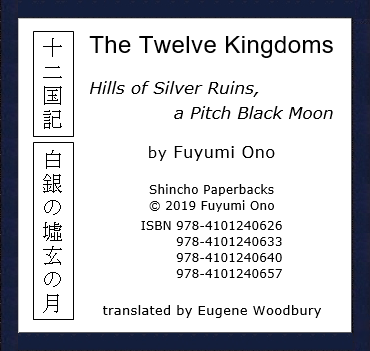
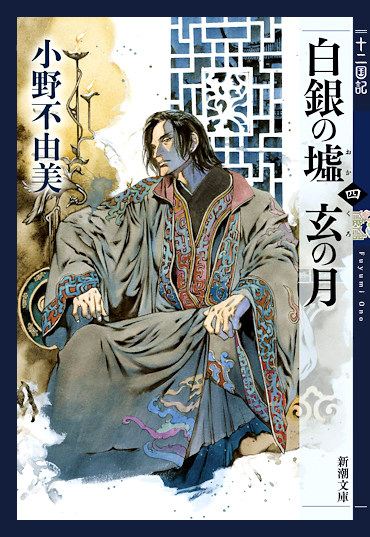
Hills of Silver Ruins IV
Maps
Notes
Glossary
Downloads
More about the title
More about the covers
Labels: 12 kingdoms, black moon, ebooks, fantasy, japanese, translations
May 28, 2023
Hills of Silver Ruins IV (notes)
|
Chapter 01 Chapter 02 Chapter 03 • Chapter 04 Chapter 05 Chapter 06 Chapter 07 Chapter 08 Chapter 09 Chapter 10 Chapter 11 Chapter 12 Chapter 13 Chapter 14 • Chapter 15 Chapter 16 Chapter 17 Chapter 18 Chapter 19 Chapter 20 • |
Chapter 21 Chapter 22 Chapter 23 Chapter 24 Chapter 25 Chapter 26 Chapter 27 Chapter 28 Chapter 29 Chapter 30 Chapter 31 Chapter 32 Chapter 33 Chapter 34 • Chapter 35 Chapter 36 Chapter 37 Chapter 38 Chapter 39 Chapter 40 Chapter 41 • |
Maps
Notes
Glossary
Downloads
More about the title
More about the covers
Labels: 12 kingdoms, black moon, ebooks, fantasy, japanese, translations
July 11, 2022
Hills of Silver Ruins III


Maps
Notes
Glossary
Downloads
More about the title
More about the covers
Labels: 12 kingdoms, black moon, ebooks, fantasy, japanese, translations
July 10, 2022
Hills of Silver Ruins III (notes)
|
Chapter 01 Chapter 02 Chapter 03 • Chapter 04 Chapter 05 Chapter 06 Chapter 07 Chapter 08 Chapter 09 • Chapter 10 Chapter 11 Chapter 12 Chapter 13 Chapter 14 Chapter 15 Chapter 16 |
Chapter 17 • Chapter 18 Chapter 19 Chapter 20 Chapter 21 Chapter 22 Chapter 23 • Chapter 24 Chapter 25 Chapter 26 Chapter 27 Chapter 28 • Chapter 29 Chapter 30 Chapter 31 Chapter 32 Chapter 33 |
Maps
Notes
Glossary
Downloads
More about the title
More about the covers
Labels: 12 kingdoms, black moon, ebooks, fantasy, japanese, translations
November 24, 2021
Embracing Defeat

The first years of the Occupation saw a spate of surprisingly liberal reforms (that drove conservative anti-war politicians like Shigeru Yoshida up a wall). Leftists, labor organizers, and even communists were released from jail and the press was unleashed.
Dower documents how enthusiastically the Japanese public embraced these freedoms. Analyzing the flood of mass media publications that followed, he portrays how ordinary people were affected by the most dramatic social upheaval in Japanese history.
This bottom-up revolution inevitably ran headlong into the top-down political machinations originating from SCAP (Supreme Commander for the Allied Powers). General Douglas MacArthur was very much Japan's last shogun.
Over the course of seven years, the fusion of these forces shaped the face of modern Japan. A result, Dower argues, that did not arise from "a borrowed ideology or imposed vision, but a lived experience and a seized opportunity."
Related links
August 15
The last shogun
Victory in Defeat
The Showa drama
The rebirth of Japan's mass media
Labels: books, ebooks, embracing defeat, history, japan, japanese culture, ww2
October 11, 2021
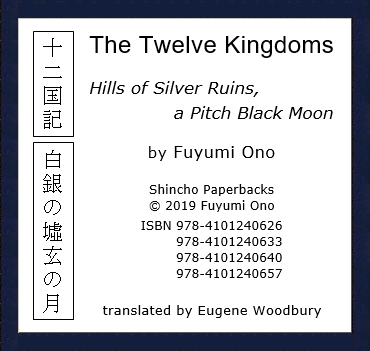
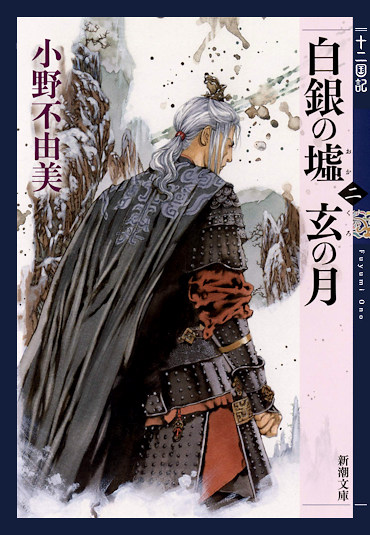
Hills of Silver Ruins II
Maps
Notes
Glossary
Downloads
More about the title
More about the covers
Labels: 12 kingdoms, black moon, ebooks, fantasy, japanese, translations
October 10, 2021
Hills of Silver Ruins II (notes)
|
Chapter 01 Chapter 02 • Chapter 03 Chapter 04 Chapter 05 Chapter 06 Chapter 07 Chapter 08 • Chapter 09 Chapter 10 Chapter 11 Chapter 12 Chapter 13 Chapter 14 • Chapter 15 Chapter 16 |
Chapter 17 Chapter 18 Chapter 19 Chapter 20 Chapter 21 Chapter 22 Chapter 23 Chapter 24 • Chapter 25 Chapter 26 Chapter 27 Chapter 28 Chapter 29 Chapter 30 Chapter 31 • Chapter 32 |
Maps
Notes
Glossary
Downloads
More about the title
More about the covers
Labels: 12 kingdoms, black moon, ebooks, fantasy, japanese, translations
March 27, 2020
The rising ebook in Japan

 For a country with such a post-modern reputation, Japan loves paper, especially paper books and paper money. The ¥10,000 note, the equivalent of a $100 bill, is used and accepted everywhere.
Cash in circulation in Japan amounts to over 20 percent of GDP, significantly higher than the United States (8.3 percent), China (9.5 percent), or the Eurozone (10.7 percent).
Recent trends suggest that Japanese may be embracing electronic publishing faster than they are embracing electronic money. The ebook in Japan gained significant momentum in 2019.
According to the All Japan Magazine and Book Publisher's and Editor's Association, while print sales fell for the fifteenth straight year, sales of digital manga shot up 29.5 percent. Digital book publishing rose 8.7 percent. The entire digital market was up 23.9 percent. The overall publishing market even saw a small increase.
Physical video media also took a hit, with the Japan Video Software Association reporting that the market for physical media declined almost 11 percent from 2019 to 2019. Blu-Ray sales fell one percent while DVD sales were down 20 percent.
Like the ebook, Japan is also embracing the convenience and lower costs of streaming. Netflix, Hulu (wholly owned in Japan by Nippon TV), and Amazon Prime are making their presence known in a big way. Even NHK is jumping on the bandwagon, and will launch a domestic live streaming service in April.
Labels: business, ebooks, economics, hulu, japan, japanese culture, netflix, nhk, publishing, streaming, television
June 21, 2018
The proof is in the printing

A "light novel" (novella) I purchased back in 1989 for 360 yen ($3.25) has grayed and faded a bit but the paper remains pliable and the spine hasn't lost a bit of flexibility. Manga and paperbacks I ordered from Japan over a decade ago remain in near mint condition.
Despite a consignment system and resale price maintenance laws, paperbacks in Japan often cost much less than mass market paperbacks in the U.S. The Chihayafuru tankoubon I recently purchased are 429 yen each. Less than four dollars at the current exchange rate.
A 350 page short story collection by Fuyumi Ono is priced at 637 yen. That's about $5.75. The paper, full-color dust cover, and binding are comparable to the higher-grade "trade paperback" category. So what accounts for these differences in quality and cost? Shouldn't English-language publishers be able to leverage enormous economies of scale?
To start with, Japanese publishers don't dole out advances. Instead, they pay up-front at the time of the print run. Japanese publishers were essentially printing-on-demand before POD became a thing (though short print runs also mean that books can go out of print pretty fast).
According to Tetsuro Daiki, general manager of legal and licensing at Shogakukan (a major publisher), "The full sum [of royalties] is paid one month after the release of a book." And all those royalties go straight to the writer.
Publishing contracts in Japan are so standard that agents are rarely used (except when licensing foreign translations). This is in large part because the writer retains subsidiary rights by default. In the land of the doujinshi, Japanese publishers know that if you love something, you set it (sort of) free.
To be sure, when negotiating subsidiary rights, the publisher typically steps in as the agent, often with a seat on the "production committee." Again, as Tetsuro Daiki explains, "the authors as well as Shogakukan stand side by side in the contract negotiations." He believes, of course, this is for the best.
If authors try to keep all the [rights] to themselves and regard publishers as enemies, they [have] to confront all the odds single-handedly, leading to negligence of their essential creative activities. It is better if the authors devote themselves to writing, painting and creating new works, leaving business to publishers. This is the choice of the majority of authors in Japan.
The upshot is that publishers like Shogakukan can make available to their authors media formats (including manga, anime, periodicals, video games, television and theatrical adaptations, and even radio dramas on CD) rarely if ever offered to mid-listers in the English-speaking market.
For example, the Bakuman manga series (Shueisha) by Tsugumi Ohba and Takeshi Obata has been adapted to an anime series (NHK Educational television), video game (Bandai), novel (Shueisha), and a live-action film (Toho). The extensive cross-ownership inherent in the production committee system results in extensive cross-promotion and pooled risks.
 Which is all well and good. But as bestselling manga artist Shuho Sato explains in Manga Poverty, his autobiographical exposé of publishing industry finances in Japan, the "average" mangaka can still spend years in the red and never earn enough to cover his out-of-pocket expenses.
The market for print magazines in Japan has contracted sharply over the past decade. Publishers regularly lose money on first serialization rights. Reading the writing on the wall, when Shuho Sato renegotiated with Shogakukan, he transferred the secondary rights to his own company.
Shuho Sato's story ends with him adopting a hybrid approach. Shogakukan prints and sells the paper product while he publishes electronically through his website and shares that platform with other mangaka. After all, he asks,
If you truly believe that [authors] should feel indebted to publishers for making [their books] sell, then doesn't it also make it the publisher's fault if they don't sell?
One of Sato's more interesting revelations is how much it costs to produce a perfect bound book in volume. He secured from an industry source a quote of 150 yen per copy on a print run of 50,000 units that included a 10 percent royalty based on a list price of 500 yen. (Remember that Japanese publishers pay out royalties at the time of the print run.)
Subtract the royalty payment and the unit cost falls under a dollar. This again raises questions about the costs of manufacturing perfect bound books on this side of the Pacific and what exactly all the "overhead" is paying for.
A safe prediction is that hybrid or self-publishing will become the predominant economic model for mid-list writers and artists capable of producing all their own IP by the sweat of their own brows. The future of "traditional" publishing may well be a return to its roots primarily as printers.
Related posts
Manga economics
Manga circulation in Japan
The manga development cycle
The publishing industry in Japan
Labels: business, ebooks, economics, japan, publishing, technology, thinking about writing