

November 16, 2023
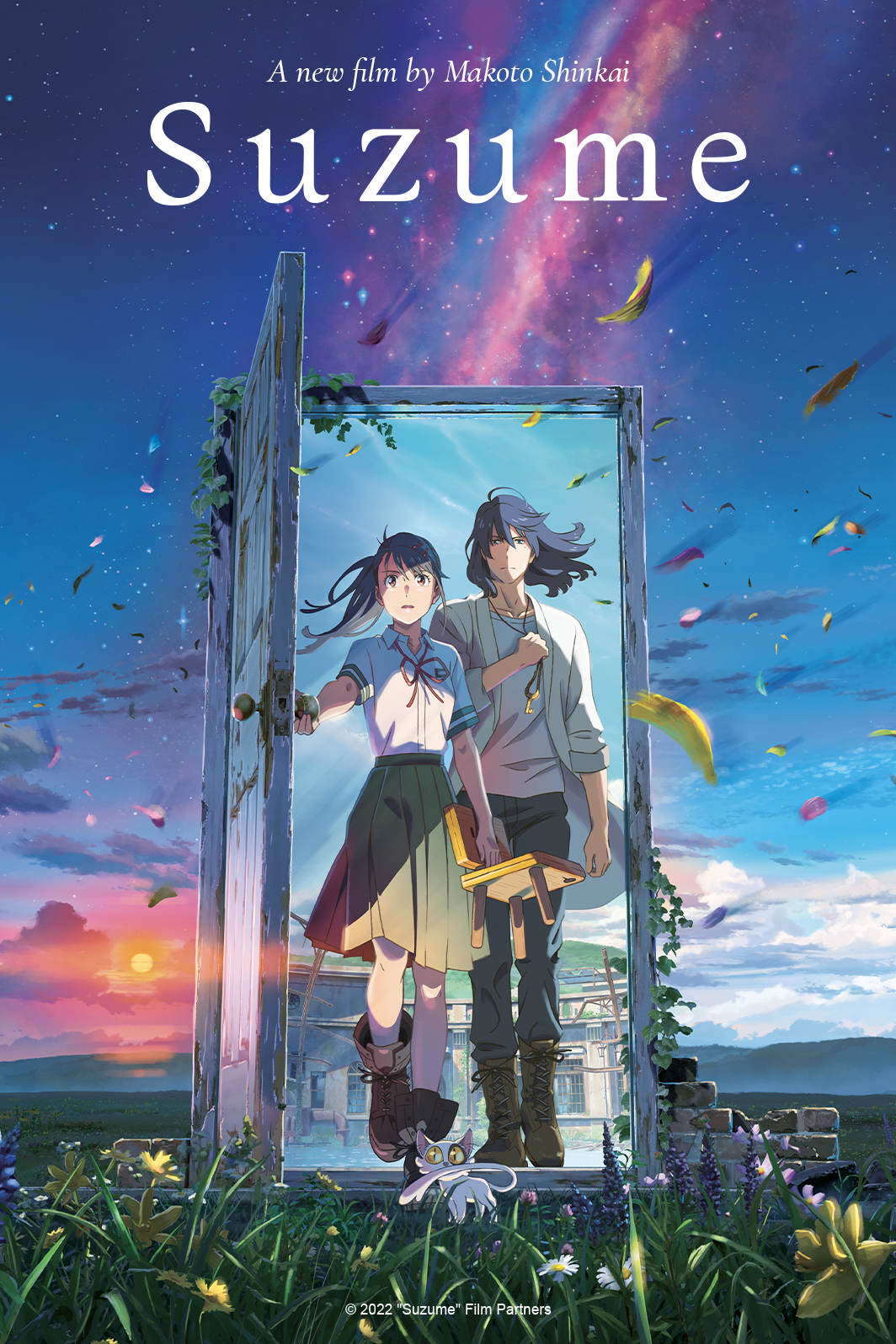
Suzume
Suzume's journey begins in a quiet town in Kyushu (in southwestern Japan) when she encounters a young man who tells her, "I'm looking for a door." What Suzume finds is a single weathered door standing upright in the midst of ruins as though it was shielded from whatever catastrophe struck. Seemingly drawn by its power, Suzume reaches for the knob. Doors begin to open one after another all across Japan, unleashing destruction upon any who are near. Suzume must close these portals to prevent further disaster.
Suzume is Makoto Shinkai's thirteenth directorial work. Here's to hoping Crunchyroll licenses more of his catalog.
Labels: anime, crunchyroll, japan, movies, shinkai


November 08, 2018
Bakuman (the future)
The editors in Bakuman do pay a lot of attention to their spreadsheets. Akito writes on a laptop. But then everything gets printed out on paper. And faxed. Final proofs are hand-delivered.

In one of the more poignant scenes in the series, Moritaka is walking home from a school reunion where everybody was talking up their holiday plans. He glances at his calloused, ink-stained hands and realizes that, aside from gall bladder surgery, he's never taken a day off.
"No regrets," he tells Akito, and Akito agrees. When they got married, he and Kaya barely managed to squeeze in a honeymoon.
That could be changing. There is plenty of talk about the aging of Japan's population. Over the past quarter century, circulation at the major manga magazines dropped by two-thirds as the baby boom echo aged out of the target demographic and into middle age.
But at the same time, manga and anime have gone international and gone online, with Crunchyroll and Netflix leading the way. Justin Sevakis points out that "there has never been more money flowing from international fans to anime productions in the history of the art form."
Even light novels are getting in on the act in a big way, something I would not have predicted just a decade ago.
At Yen Press, a joint venture between Kadokawa and the New York-based Hachette Book Group, Kurt Hassler launched light novel imprint Yen On in 2014, introducing Reki Kawahara's Sword Art Online with the modest goal of publishing 12 books annually. That figure doubled the following year, and now Hassler says that Yen On will release 110 light novels through the rest of this year, representing growth of nearly 1000 percent in four years.
How popular culture is being created is also changing. As depicted in Shirobako, out of sheer necessity, technology has transformed the animation industry. 3DCG animation is only a small part of the revolution.
Even if an artist works initially on paper, everything gets scanned and imported into the animation software where the cleanup, coloring, and actual animation takes place. "Dailies" are generated and tweaked on the fly.
This process allows animation studios (in Japan and Hollywood) to subcontract with companies in South Korea, China, and Vietnam. Work product can be uploaded to and downloaded from the cloud in real time.
When it comes to creating backgrounds, directors like Makoto Shinkai have become masters of Photoshop (Garden of Words may be his most staggeringly gorgeous). This approach is disparaged by purists of the hand-drawn school. I don't care as long as it works.
The first time I saw the opening credit roll for Inari Kon Kon in HD, I was gobsmacked. Sure, it's a Photoshop, but it's breathtakingly beautiful.

When it comes to manga, the silly Eromanga Sensei offers a serious look at the future. Masamune naturally writes on a laptop. Sagiri (the artist) works entirely in the digital domain, using a Cintiq 13HD Wacom tablet (according to people who pay close attention to such things).
When she's finished with an illustration, she simply shoots an email off to her editor with a multi-layer PDF attached.
To be sure, a computer won't be drawing Moritaka's manga for him anytime soon. But the cost and time savings could prove considerable.
To start with, the ink is gone, along with the most physically onerous and time-consuming chores, such as whiting out mistakes (using, yes, Wite-Out) and often redrawing whole pages, manually layering in background textures, and sizing screentone overlays with an Exacto knife.
I grew up in at the end of the typewriter era, when "high-tech" was an IBM Selectric. But after using a primitive word processor on my brother's Apple IIe, there was no going back.
There are productivity gains to be made on both the production and publishing sides. The iconoclastic Shuho Sato adopted the increasingly popular "hybrid" model, his "traditional" publisher dealing with the paper product while he maintains a platform for distributing manga electronically.
We are quickly approaching the day when all commercial art is digital from start to finish. Using platforms like Amazon KDP, you can publish digitally and on paper (print-on-demand) for "free." And then with a push of a button, your book will appear in every Amazon store in the world.
"Free," however, doesn't factor in the costs in time and resources incurred by the writer, which can range from very little to a whole lot. Formatting a professional-looking ebook is a much more straightforward process than formatting a professional-looking print-ready manuscript.
And the eternal challenge still remains of reaching the reader. So perhaps the future of publishers will not be to physically publish but to publicize.
Related posts
Bakuman (the context)
Bakuman (the review)
Bakuman (the anime)
Manga economics
The teen manga artist
The manga development cycle
Labels: anime, business, kadokawa, manga, publishing, shinkai, tech history, technology, thinking about writing, tubi
September 06, 2018
New old titles at CR

Sherlock Hound features some of Hayao Miyazaki's earliest work. As you might surmise from the title, in this version, Sherlock Holmes is a dog. And so is everybody else. Lots of fun. I reviewed the series here.
In Magic Users Club (watch the OVA first), we learn that sitting on a broom (sans a pillow) hurts your butt, and the best way to deal with an alien spacecraft is to turn it into a giant cherry tree. (The first scene of the OVA has no sound because there is no sound in space.)
 Patema Inverted and King of Thorn explore the unreliability of human perspective. I reviewed the former here.
Patema Inverted literally asks which way is up. King of Thorn wonders if really you know what time it is. Both require mighty suspensions of disbelief to get past the premises. But there's tons of material for anybody who enjoys musing about philosophical what-ifs.
In terms of narrative structure, King of Thorn reminded me of the "No Reason" episode of House.
Crunchyroll doesn't yet have the 3DCG Appleseed movies but it does have the 3DCG Vexille, a pastiche of every post-apocalyptic, mecha, and military anime series ever made. Watch it as a work of social commentary rather than for its dubious cinematic merits. I reviewed it here.

Welcome to the Space Show takes a gang of kids from rural Japan on an Art Deco roller coaster ride through a fractious galactic empire ruled by a reality TV show host. As the title suggests, it's a dazzling and hilarious trek through the stars.
Night on the Galactic Railroad is based on the fantasy novel by Kenji Miyazawa, an agronomist and social activist who died in 1933 at the age of thirty-seven. Little known for his poetry and fiction in his lifetime, he is now considered one of Japan's great literary figures.
Night on the Galactic Railroad inspired Leiji Matsumoto's anime classic Galaxy Express 999. This morally complex work of science fiction won the Shogakukan Manga Award in 1978 and the Animage Anime Grand Prix prize in 1981.

Video links
5 Centimeters per Second
King of Thorn
Galaxy Express 999 (Tubi)
Magic User's Club
Magic User's Club OVA (YouTube)
Night on the Galactic Railroad
Patema Inverted
Sherlock Hound (YouTube)
Voices of a Distant Star
Vexille
Welcome to the Space Show
Labels: anime, anime lists, anime reviews, crunchyroll, fantasy, matsumoto, miyazaki, movies, science fiction, shinkai, streaming
January 25, 2018
Makoto Shinkai commercials
As impressive as the Destination Canada ad is, this ad for Z-kai Group is even more exquisite. As Red Veron puts it, "Makoto Shinkai and his studio can make something as monotonous as schoolwork into something great with ridiculously pretty animation and music."
The Z-kai Group "offers a wide range of educational services to develop genuine academic abilities that will be of use in the future." Though rather like Geico, it's probably more famous in Japan because of its unique and occasionally bizarre commercials.
Labels: advertising, anime, shinkai
January 18, 2018
Your Name

The subjects of these vignettes are often shown standing on the concrete slab that remained of their home or business. Such scenes are becoming less common as the Japanese government pours billions into the recovery efforts, in some cases raising entire communities hundreds of feet above sea level.
Last year, the NHK documentary series 72 Hours (in which a film crew camps out in a particular place for three days straight and interviews anybody willing to appear on camera) visited Yonomori Park in Tomioka, Fukushima, renown for its wide boulevards of lush cherry trees.
Because of its proximity to Fukushima, only registered residents are allowed to visit the northeastern part of the town. The result is a kind of open-air Pompeii. Past the barricades, human civilization stopped in 2011, slowly being reclaimed by nature and repopulated by mildly radioactive boars.

Makoto Shinkai wrote Your Name with this context in mind. In the alternate reality of Your Name, a disaster visits Japan on a smaller scale and in non-linear time. A rural town in Gifu Prefecture instead of rural fishing villages north of Sendai. But the parallels are clear.
Still, Shinkai begins with a feint, a body-switching Freaky Friday physical comedy (though elevated to near transcendental levels by his gorgeous cinematography). Even there, his direction is laden with symbolism deeper and darker than the subject matter initially suggests.
The first time we see Mitsuha in school, the teacher is explaining the etymology of tasogare ("twilight"). It was originally pronounced tasokare, literally, "Who are you?" In a world without artificial lighting, identifying a person at twilight could be tricky.

A moment later, Mitsuha turns a page and that question stares back at her from her notebook, written by Taki the last time he switched bodies with her.
A word from classical poetry with Chinese roots, tasogare also suggests an otherworldly time when "gods and ghosts walk unnoticed upon the earth" (as I have Gendô explain in Serpent of Time). Only during the twilight can Mitsuha and Taki meet before their timelines realign.
Given this aura of magical realism, of course Mitsuha and her sister are Shinto shrine maidens. (As cinematic reference points, see Inuyasha, Ginkitsune, and Kamichu! just to start with.)

But the unifying metaphor that ties the film together is the red thread. Originating in ancient China, the red thread of fate "connects those who are destined to meet, regardless of time, place, or circumstance. The thread may stretch or tangle, but it will never break."
Mitsuha ties up her hair with a red ribbon and Taki wraps a red strap around his wrist every morning. Thanks to a Heisenbergian trick of time and place, it is the same red thread.
More subtly, I believe that Shinkai is symbolically referencing his own work, namely Children Who Chase Lost Voices (2011). This retelling of the myth of Izanagi and Izanami (Orpheus and Eurydice) takes a young girl to the Gate of Life and Death in the center of the Underworld.

To get to the Gate, where Asuna hopes to find her father, she descends into a giant crater. In Your Name, The town of Itomori surrounds an impact crater. When Mitsuha, her sister and grandmother visit the family shrine within a metaphorical underworld, the site is in the center of an impact crater.

In the wake of the 2011 disaster, hundreds of "tsunami stones" in the hills of coastal Japan attracted renewed attention. The stones marked the high-water mark of previous disasters. Geological data and historical records point to a "Sanriku earthquake" in the year 869 in the same Tôhoku region.

The past is prelude. Forgetting the past, Santayana warned, we are doomed to repeat it. There's no telling when Godzilla will come stomping in from the sea. Hence the curse of samsara, the "cyclicality of all life, matter, existence."
All things pass away. All things come around again. And once more pass away. The pathos of life.
Mono no a'wa're is Shinkai's specialty, referring to the Japanese aesthetic concept of the beauty that can be found in the transitory nature of things, "a gentle sadness (or wistfulness) at their passing as well as a deeper gentle sadness about this state being the reality of life."
And yet. Reinterpretations and extrapolations of Buddhist and Shinto metaphysics are part and parcel of Japanese fantasy. Reincarnation need not be a curse. While Children Who Chase Lost Voices is about accepting loss and moving on, Your Name circles around and rekindles hope anew.
As does Ocean Waves, giving its characters a second metaphorical chance at a life that still-could-be. Angel Beats offers them rebirth and a second life (and a similar ending). Your Name splits the difference, suggesting that we can step outside of time and not become prisoners of fate.
It is a message that Japan, particularly since 11 March 2011, very much wanted to hear.
Related posts
Makoto Shinkai
Your Name (not a review)
Hollywood made in Japan
Walk on water
Labels: anime, anime reviews, fantasy, movie reviews, nhk, religion, shinkai, tohoku earthquake, your name
November 17, 2016
"Your Name" (not a review)

Until this year, Makoto Shinkai's oeuvre could be described as the "anime art house masterpiece." In my opinion, his only successful long-form film was Children Who Chase Lost Voices (also titled "Journey to Agartha"), based on the Izanagi and Izanami (Orpheus and Eurydice) myth.
The Place Promised in Our Early Days and 5 Centimeters per Second certainly took us somewhere, but I'm not certain where, and I'm not convinced he knew either (though it was awfully pretty getting there).
His extraordinary skills as a cinematographer have never been in doubt. But Shinkai's talents as an auteur (wearing the producer, writer, and director hats) truly leap off the screen in his short work: She and Her Cat, Voices of a Distant Star, and The Garden of Words.
Rather, I still believe that it is Mamoru Hosoda's talent for accessible storytelling and his firm grasp of the structured cinematic narrative that places him more in the tradition of the legendary Hayao Miyazaki.
Until this year, that is. The caveat is necessary because over the summer (2016), Makoto Shinkai's latest animated film rocketed into the stratosphere, earning over $190 million in its home market (which is about a third the size of the U.S. market).
Your Name is currently the seventh highest-grossing film ever in Japan. The only animated films to earn more are Frozen and Studio Ghibli productions. The box office is strong enough that it is certain to reach second place at the $200 million mark.
(Among all movies ever released in Japan, Spirited Away occupies the top spot with almost $300 million, followed by Titanic, Frozen, and the first Harry Potter film. Then comes Howl's Moving Castle and Princess Mononoke.)
Of course, the big question is why.

Joe Konrath believes that artistic success has a lot to do with creating a deep backlist, working hard, and then counting on plain old luck. Makoto Shinkai put in the hours and built a fan base and an impressive catalog of work.
And then everything clicked: right place, right time, right subject matter.
Certainly the story he tells has a lot to do with it. The BBC does a pretty good job explaining "Why the story of body-swapping teenagers has gripped Japan."
The body-swapping plot device is hardly a unique one. The modern genre goes back to Vice Versa: A Lesson to Fathers, a 1882 comic novel by Thomas Anstey Guthrie, and brought up to date with Freaky Friday in 1972. Disney has made and remade movies based on the book three times.
A better comparison is the anime Kokoro Connect, in which the seemingly random body-swapping (which turns out to be under the control of a "higher" power), also "touches on universal themes such as coming of age, adolescence, and the struggle to assert your identity in a confusing world."
Shinkai himself credits a poem by Ono no Komachi, one of the two Komachi poems that also inspired my novel, The Path of Dreams (the translation here is by Jane Hirshfield from The Ink Dark Moon):
Did he appear
because I fell asleep
thinking of him?
If only I'd known I was dreaming
I never would have wakened
In the Freaky Friday films and its descendants, the body-swapping plot device is played for laughs. There are humorous moment in Kokoro Connect, but as with Your Name, it is not primarily a comedy. For Shinkai, not primarily a comedy means there are still comedic elements.
To be sure, Shinkai doesn't make depressing films. But "upbeat" is not usually the word used to describe them. "Contemplative" and "introspective" might be more accurate adjectives, with an emphasis on interior melodrama.
Mamoru Hosoda has always been able to leaven the pathos with humor, while Shinkai can be fairly criticized for an often unrelentingly earnest approach. His lighter touch in Your Name undoubtedly accounts for its appeal, even while addressing a solemn subject.
The story's real-world antecedent, which he candidly admits to, is the Tohoku tsunami, that in March 2011 killed almost 16,000 people. In Your Name, Shinkai provides the necessary psychological distance by making the disaster a more exotic and less disastrous meteor strike.
But it is still a disaster whose worst aspect could have been avoided with the proper information. Hence the "time slip" denouement (knowing how a story ends ahead of time doesn't bother me).
Which prompts me to hypothesize that the focus of attention on the "body-swapping" business perhaps misses the point. This is far more about transmigration of the soul. In Kokoro Connect, these transmigrations are simply happening in real time without death getting in the way.
That makes it more of a reincarnation story, which brings to mind the quite similar ending in Angel Beats. Theologically, what we find here is a salvific view of reincarnation, that portrays rebirth as integral to the moral evolution of the individual, a second chance to get things right.
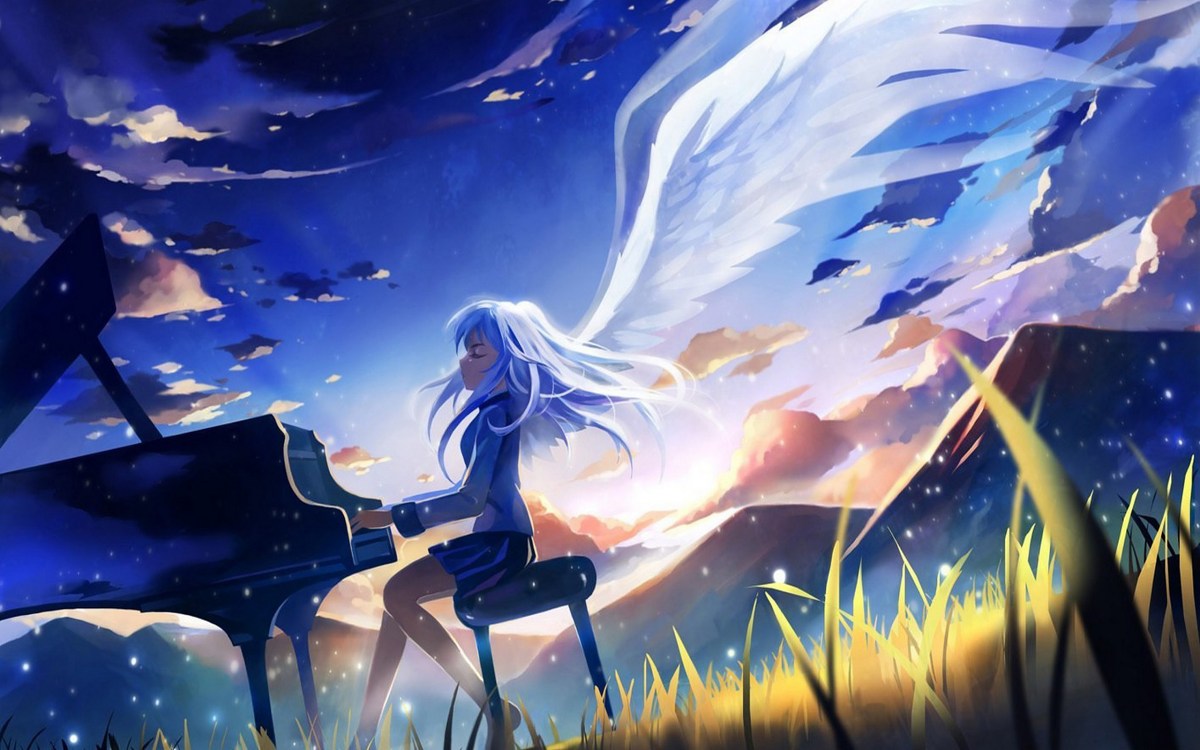
"To die with a peaceful mind will stimulate a virtuous seed and a fortunate rebirth." This is the theme of Angel Beats.
The consciousness in the newly born being is neither identical to nor entirely different from that in the deceased but the two form a causal continuum or stream. Transmigration is influenced by a being's past karma.
By placing this "fortunate rebirth" in the context of the survival of an entire community, as opposed to the tribulations of a bunch of angsty teenagers, Shinkai has greatly expanded the scope and reach of the genre, and formed it into a national touchstone.
Your Name is slated for an Oscar-qualifying run in the U.S. this fall. In any case, it is unlikely to gross even a tenth of its Japanese box office. Spirited Away pulled in $10 million, and, sadly, that's actually a respectable amount for a Japanese film.
Spirited Away presented an otherworldly cosmology to audiences used to fairy tales filtered through the Disney lens. Critical opinion aside, it will be interesting to see how well the transcendental message of Your Name communicates across cultures.
Related links
Makoto Shinkai
Mamoru Hosoda
Voices of a Distant Star
Angel Beats! (Yahoo CR)
Kokoro Connect (CR)
Labels: anime, buddhism, hosoda, japanese culture, personal favs, religion, shinkai, social studies, your name
April 21, 2016
She and Her Cat—Everything Flows

She and Her Cat—Everything Flows consists of four eight-minute episodes that tell a complete story. If you know how long cats live, and that we meet Daru (the cat) when she is in elementary school, the story of a life. Except it doesn't quite end like that.
But, well, it does.
As I've noted previously, mono no a'wa're is Shinkai's specialty, referring to the classical Japanese aesthetic concept of the sublime found in the ephemeral nature of things, of the beauty found in loss. Or as Jung phrased it, "In the shadow is the gold."
Kazuya Sakamoto tells a surprisingly upbeat story about what is too often a tediously downbeat subject. Death and estrangement haunt these scant thirty minutes without being mentioned. But so do rebirth and reunion. (A cat as the narrative point-of-view doesn't hurt either.)
A'wa're isn't about gloom or nihilism. It's the simple recognition that nothing lasts forever. Meaning the bad things in life don't last forever either. Cats have nine lives, after all, which makes them at least as long-lived as humans. The things that are no longer here aren't really gone.
They've simply come around again in a different form, including a cat like Daru.
She and Her Cat—Everything Flows can be viewed in its entirety on Crunchyroll.
Labels: anime, anime reviews, cats, personal favs, shinkai
January 28, 2016
Galapagos art
But there is a positive definition that can be drawn from Darwin's observation of a species diversifying to fill every available ecological niche. I'm thinking here specifically of the way that art finds an audience, and specifically art that strives to be popular or at least "accessible."
There's the "big dinosaur" approach: put all your eggs into one basket and watch that basket. But there's only so much room at the top. Even before a wayward asteroid wipes out the big guys, a lot of little critters are scampering around in the undergrowth, making nests in tight and overlooked places, doing well in marginal environments that could never support the lumbering giants.
New York and Hollywood are giants in publishing and movie making, not only in the U.S. but around the world. No asteroids on the horizon. Well, Amazon is a pretty big rock, but as the whole self-publishing scene is proving, as long as you avoid getting stomped on, it's much easier for the little, furry animals to be everywhere the giant isn't.
Self-publishing has been alive and well in Japan for decades, in the doujinshi (self-published manga) market. Doujinshi made Comiket the biggest comic book convention in the world.
Despite the healthy amount of fan fiction involved, Japanese publishers generally refrain from pursuing copyright claims on not-for-profit IP, instead using doujinshi as the minor league teams of manga world and Comiket as the playoffs. The broad acceptance of manga as a literary form has kept the young adult book market in Japan alive despite the slumping population.
Manga attracts talent from across the spectrum, with a lot of cross-pollination. As with anime, low production costs (first-run broadcast and publishing rights break-even at best) mean that publishers can target smaller niches and experiment with marginal projects without breaking the bank. (I don't mean vanity projects where the editor is thinking "Newbery" and not "a good read.")
In other words, playing "small ball"—getting base hits—instead of trying to smack a home run every time at bat.
Tie-ins are famous in Hollywood, but in Japan they're a necessity: novels based on manga; manga based on novels, manga artists illustrating novels; television and movies based on novels and manga, fiction and non-fiction, in every imaginable genre. The anime series A Certain Magical Index alone has generated over 30 novels and spin-offs (Yen Press has picked up the print license).
In an odd but revealing way, there's an upside-down and backwards version of this at work in the U.S. market vis-à-vis Japanese media. The Japanese movie titles available on Netflix, for example, might suggest that all Japanese watch are perennial classics by a handful of directors (mostly Kurosawa), Studio Ghibli, schlock horror, budget samurai actioners, and exploitation flicks.
That's because either these titles have built-in audiences (thanks to John Lasseter, Ghibli films have no problem attracting Hollywood talent to do voice-overs), or, at the other end of the spectrum, can be licensed for dirt cheap because they're not worth much in Japan either.
Otherwise, Hollywood is so dominate that if GKids or Disney aren't interested, "general interest" family films like The Perfect World of Kai and The House Imp and The Great Passage end up nowhere to be found. The best-selling novel of 2014 in Japan was a YA adventure title: Daughter of the Murakami Pirates. It hasn't been licensed in the U.S.
The Japanese publisher doesn't want to license the IP for a song (and risk a quick and shoddy translation on top of that), and no American publisher yet wants to risk the investment.
The only way to make it work is to zero out the upfront costs. Digital Manga has been trying this approach with some success (although with "minor league" IP). The anime industry is heading in that direction in the streaming space. Publishers could likewise release titles directly as ebooks and cut out the middleman completely. In fact, emanga are currently more popular in Japan than ebooks.
Unfortunately, when it comes to digital, the big publishers in Tokyo are determined to stick their heads in the sand as firmly as the big publishers in New York. Observes Jason Thompson,
Most Japanese publishers have no coherent digital strategy, and the extra step of licensing them in America makes them even slower to react to change. Perhaps wary of creating an iTunes-like behemoth which could drive prices down, publishers haven't united in any reasonable way to create a consistent digital newsstand/bookstore format for their titles.
Welcome to the club. The bitter pill to swallow is that properties worth tens of millions in Japan are worth tens of thousands in the U.S. The music industry in Japan is only begrudgingly beginning to accept that fact. As Justin Sevakis notes:
The Japanese music industry is both ridiculously luddite, and ruled by thuggish talent agencies with delusions of worldwide grandeur. They want to hold back their precious artists from America until they're ready to make a big splashy debut, but when they do, they refuse to play ball with American media and expect their completely unknown artists to be able to throw their weight around like they do back home.
Little by little, legit DRM-free tracks from established Japanese artists are appearing outside the walled garden of iTunes-Japan. The upside of Japan's declining consumer base is the realization that something is better than nothing and thus the inevitable need to grow outside the home market. And there's always Amazon waiting in the wings to shake things up.
The model here is what Crunchyroll did a while back when it streamed all of Makoto Shinkai's films for a weekend. Because before the world can clamor for your product, it has to at least know it exists.
Labels: anime, business, gkids, japanese culture, manga, movies, music, publishing, shinkai
June 06, 2015
Makoto Shinkai
Shinkai waxes moodier than I usually care for, emphasizing affect over effect. But, boy, can he capture moods! His visual palette is stunning, exquisite, and deeply evocative. Voices of a Distant Star is less a film than a narrative poem. (It's also the best version of Ender's Game that isn't Ender's Game.)
 |
| (Click on images to enlarge.) |
The excruciatingly gorgeous 5 Centimeters per Second vividly captures (especially in the last scene) a very real moment of self-realization. You want honest emotions? Like, man, I'm grokking it totally. But I'm not sure I'd call it "entertaining." Not beyond the dazzling cinematography.
In other words, 5 Centimeters per Second may be the most beautiful work of literary fiction ever created.

One exception in the collection is Children Who Chase Lost Voices. This retelling of Orpheus and Eurydice (Izanagi and Izanami) visually merges the worlds of Totoro and Princess Mononoke in a young adult adventure through the underworld. Death and loss is still the subject, but less meditatively.

Mono no a'wa're is Shinkai's specialty, referring to the classical Japanese aesthetic concept of the beauty that can be found in loss and in the transitory nature of things, "a gentle sadness (or wistfulness) at their passing as well as a longer, deeper gentle sadness about this state being the reality of life."
A'wa're isn't about being nihilistic or deliberately depressing. It's the simple recognition that nothing lasts forever, and if you know where to look there's beauty in that too, so it doesn't have to completely bum you out.
Shinkai's oeuvre truly comes together in Garden of Words, a story told in images that suffuse the senses like a Monet exhibition. No cinematic rain has ever felt wetter. Though here Shinkai does drive toward a specific resolution that pays off in the final frames (stick all the way through the credits).

Senri Oe's 1988 hit single, "Rain," inspired the screenplay. In the movie it's performed by Motohiro Hata.
In Garden of Words, Shinkai has given a well-established romance subgenre (in Japan) a poignant twist. Once you realize that, the film is worth watching again to see how he advances the plot without showing his hand, and how many subtle touches come alive with the additional context.
Netflix still carries The Place Promised in Our Early Days in its dwindling DVD catalog. All of the titles are available at Amazon in one form or another. She and Her Cat is included as an extra on the Voices of a Distant Star DVD.
• She and Her Cat (short; cats)
• Voices of a Distant Star (short; science fiction)
• The Place Promised in Our Early Days (science fiction)
• 5 Centimeters per Second (contemporary)
• Children Who Chase Lost Voices (fantasy)
• The Garden of Words (short; contemporary)
Labels: anime, crunchyroll, hosoda, miyazaki, personal favs, shinkai, studio ghibli
January 05, 2009
A lily by any other name
My first sale as a writer was an autobiographical story to Cricket Magazine. In the published version, the editor changed the main character to a girl. I've favored female protagonists ever since. The New Era managing editor Richard Romney once said that I wrote female characters better than Jack Weyland. I still consider that one of the nicest compliments I've ever gotten.
Just to clarify, yaoi is a romance genre featuring guys falling for other guys. Yuri (meaning "lily") is a romance genre about girls falling for other girls. At first glance, the two would seem a complementary pair. Both are written (mostly) by women for (mostly) women. Just as yaoi is not seriously categorized as "gay" literature, yuri is not a synonym "lesbian" literature.
Furthermore, I've come to consider yaoi, if anything, as a rather strange "old school" extension of the Harlequin romance. Yaoi provides a curious solution to a knotty problem with the standard romance formula. Namely (and this is largely my sister's insight), that yaoi is a way of exploiting unequal power dynamics in romantic relationships while avoiding the taint of misogyny.
The "traditional" historical romance centers social and physical power in an alpha male--the pirate or prince or highwayman. The woman counters the total domination by the male with her sexuality and "feminine wiles." Following the customary evolutionary roles, the man ultimately "captures" the woman, and the woman in turn "tames" the man.
Translated to a contemporary context, though, this formula crashes into the wall of political correctness. The typical dodge is to give the alpha male a high-testosterone occupation or a much higher socioeconomic status than the woman (Michael Douglas in The American President, Tom Hanks as a corporate exec in You've Got Mail, Edward as, well, Edward in Twilight).
In a "chic lit" classic like Bridget Jones's Diary, Bridget is involved in relationships way above her social and economic class. And making women as sexually promiscuous as men, as in the hopelessly dreary Sex and the City, ultimately plays right back into the predatory male game plan, the old formulas rather transparently repackaged.
But if the relationship involves only men (quoting Kate),
then nobody has to excuse the blatant use of power. So teenage girls, who may feel rather powerless (since they have just seen their male counterparts gain weight, muscle and height that they don't have), may be drawn to material where real issues of power are played out without excuse or without the pretense that power isn't real, there and in your face.
The exaggerated and often S/M power differentials in yaoi essentially mirror Rhett Butler sweeping Scarlett off her feet and hauling her up to the bedroom, her protestations notwithstanding. It's retro Harlequin that conforms to every Freudian stereotype in the book.
Yuri, in contrast, tends to favor stories in which conflict arises from character largely outside men-are-from-Mars, testosterone-driven power struggles, and thus oddly mirrors classic action flick "buddy" pairings. In any case, class and power can't be entirely expunged from the narrative. There must be an aggressive member in the dyad or nothing would happen.
But while yaoi and genre romances tend toward idealistic or artificial narrative constructs (not that there's anything wrong with that--the same goes for guy entertainment), yuri (which, to be sure, hits porn at one extreme and lesbian literature at the other) remains largely rooted in how real people--specifically women--actually relate to each other in the real world.
As Erica Friedman puts it, yuri features "intense emotional connections between women" that can't necessarily be classified as love, but involve a "seriously intense bond that could easily become something more." Hence, to generalize, "mainstream" yuri can be said to revolve mainly around the evolution and devolution of friendships.
Many of the bittersweet, superbly-written short stories in Kawaii Anata ("Adorable You") by Hiyori Otsu, to take one exemplary example, could have run in the The New Era with very little tweaking. (The one place the short story is alive and well and widely-read by teenagers is Japanese manga.)
Similar yuri elements can be found throughout the Y/A canon. The kind of relationship Anne and Diane enjoy in Anne of Green Gables is a mainstay of yuri fiction. In her short story collection, Kuchibiru, Tameiki, Sakura-iro ("Her Lips, a Sigh, and the Color Pink"), Milk Morinaga has a character introduce herself as "I'm Diane to your Anne."
The core material from Anne of Green Gables, Anne of Avonlea, and Anne of Windy Poplars fits squarely into the yuri genre. Interestingly, these are the three novels that Kevin Sullivan tapped for his two miniseries, leaving out most of the formulaic (hetero) romance material from Anne of the Island.
Other examples includes Harriet and Beth Ellen from Harriet the Spy and The Long Secret (which I've always considered the better book) by Louise Fitzhugh. And at the other end of the genre scale, Lynne Ewing's Buffyesque Daughters of the Moon series.
Evolutionary psychology provides a useful tool for analysis here. Unless placed in a competitive context or placed outside behavioral norms (the nerds in any John Hughes flick) or given special attributes (every sports and superhero fantasy from Star Wars to Harry Potter to Spider-Man), normal boys are not that interesting. Unformed clay.
This is apparent in the NHK kid's show Whiz Kids. Imagine if the old PBS series Electric Company was produced by the Dr. Who people. The anime series Kodocha is based on shows like this, a bunch of preternaturally smart kids doing what a bunch of preternaturally smart kids would do with a television studio at their disposal.
Aside from the handful of adults who help "anchor" the show, the age cutoff for the cast is around twelve or thirteen. And reflecting a phenomenon that every geeky teenage boy is painfully aware of, while many of the girls can be categorized as "young women," the boys are still Bart Simpson. Even the preternaturally smart ones are candles competing with tungsten arc lamps.
Manga publishers and anime producers have long known that they can exploit this painful differential with some gratuitous nudity or by dropping yuri-ish hints into otherwise "guy" material--the vicarious thrill of imagining girls getting hot and heavy with each other being preferable to watching the kind of girl you'll never have doing the same thing with the BMOC.
The necessity of this spark remains when the hinting and nudging is taken away. In The Melancholy of Haruhi Suzumiya, Kyon is a blank slate until Haruhi bounds into his life. In Ah! My Goddess, Keiichi is immobility incarnate, even after Belldandy shows up. In Sing Yesterday by Kei Toume, Rikuo hasn't gotten to first base with Shinako or Haru after six volumes.
Alas, the brilliant Ranma 1/2 begins to grate when you realize that, male or female, he's never going to grow up.
To compare, Akiko Morishima's collection of yuri short stories, Rakuen no Joken ("Conditions of Paradise") isn't chock full o' plot either. But Morishima's wonderfully-drawn stories and realistically-aged characters do depict lives moving forward, which is enormously more satisfying.
The odd shounen exception proving the rule are manga like the Kimikisu series, based on dating sims. Because the whole point of a dating sim is to challenge the player to round the bases, the story has to go somewhere with a refreshing alacrity. Kimikisu boasts little else in terms of plot--getting to first base alone is a challenging-enough goal. But at least they get there!
Now, I do understand characters like Ranma, Rikuo, Kyon and Keiichi. The old evolutionary instincts grinding away in the background. It's hard for guys to move off the dime without the sense that they're accomplishing something concrete, conquering new lands, rising in a hierarchy. As in every Bond film, consummating the relationships celebrates the end of the quest. Game over.
Hence the constant keeping of things at arm's length. In contrast, shoujo and yuri protagonists are more likely to get up close and personal, pushing the story along romantically and physically. Because that's when things start getting interesting.
Nor, I find, am I alone in this assessment, as yuri manga-ka like Milk Morinaga and Takako Shimura write for magazines whose primary market is men.
To be even-handed, an equally deadly plot device on the shoujo side is the love triangle. Again, evolutionary psychology explains why geeky guys in particular loath the conceit: when two males compete for a female, somebody's going to get hurt, and probably the guy wearing glasses. For the Mary Sue, the duplication of attention is great for her self-esteem. Hell for everybody else's.
In Anne of the Island, L.M. Montgomery creates two interlocking love triangles, which means that everybody suffers. Kevin Sullivan's adaptation skips quickly through the love triangle business (using an either/or formula which denies the hedged bet), making the movie better than the book (though as I point out here, it slights Anne's educational accomplishments).
Granted, shounen manga and anime writers invented the male version of this, known as harem. And it's just as annoying, especially lacking any hope (in the non-porn genres) of consummation.
To be sure, Robert McKee argues that we shouldn't expect fiction to mirror real life, but for fiction to capture something that is like real life, a distinction that confuses too many artists. In the excruciatingly gorgeous 5 Centimeters Per Second, Makoto Shinkai vividly captures (in the very last frame) a very real moment of self-realization. Been there, done that. I can identify.
And that's the problem. Plot is a necessary condition, not a sufficient condition. We ultimate invest in the character of the characters. And at the end of 5 Centimeters Per Second, we realize we've invested an hour of our time in a character who doesn't have any. Real? Like, man, I'm grokking it totally. But entertaining? Not beyond the dazzling cinematography.
In Video Girl Ai, Youta spends the entire series summoning up the courage to admit that he loves, well, Ai or Moemi, he's not quite sure. But at least in the end he's willing to pay a literal ferryman and literally walk across broken glass to seal his decision. Just punishment for all the angsty dithering he's put us through.
If nothing much is going to happen--essentially the most real thing about real life for most of us--then character must become the summum bonum of the story, without placing the protagonist's travails infinitely beyond the grasp of the reader. For me, yuri's consistent ability to accomplish this makes it perhaps the most "realistic" of niches in the otherwise unreal romance genre.
Labels: anime, anne, criticism, japan, manga, nhk, publishing, shinkai, yaoi, yuri
March 06, 2006
Voices of a Distant Star

The story echoes plot elements from Ender’s Game, told in the style of the “mecha” genre. High school student Mikako has been mustered into a space armada as a battle robot pilot, charged to track down an alien invasion force that destroyed the Mars colony. As the pursuit draws the armada further away from Earth, from lights hours to light years, Mikako’s increasingly poignant email messages home take longer and longer to arrive. Because of the distortions of Einsteinian relativity, Mikako stays the same age while boyfriend Noboru, aging “normally” back on Earth, is left to pine.
It soon becomes not a story about space invaders, but about the division of two souls clinging to thinnest tendrils of hope, hope condensed into a few shared words separated by years of silence. A strange thing words are, that can communicate so much hope when there is so little to hope for. The result is a kind of cinematic haiku. The emotions it engenders could more precisely be described as a'wa're, the classical Japanese aesthetic concept of loss and transitory beauty, suggesting "an anguish that takes on beauty or a sensitivity to the finest--the saddest--beauties."
The existential nature of the story is partially explained by the fact that Makoto Shinkai created the whole thing on his (considerably enhanced) desktop computer, a mix of digitized hand-drawn cells and computer-generated animation. It's no slap-dash effort, either. The foreground animation is understandably minimalistic. The 3D animation isn’t Pixar, but it’s nothing to frown at. And Shinkai’s background mattes are gorgeous, even breathtaking at times.
He eventually partnered with a commercial studio to handle the post-production and marketing. And the American distributor (ADV Films) has taken Shinkai’s work a step farther. Thanks to the magic of DVD technology, you can choose from Japanese (with subtitles) and an English dub track. Rare for me for other than Studio Ghibli productions (Princess Mononoke, Spirited Away), but I recommend both versions. The English dub is above average, and it’s fascinating to compare it with the literal subtitles and the original Japanese.
(There is a second Japanese track as well, the original “scratch” track, but I think somebody messed up the indexing because tracks 2 and 3 are the same. The real scratch track can be found under the “storyboard” option in the Extras menu.)
A good dub, after all, requires a rewrite by somebody who can actually write, which is not the same as being capable of producing a competent translation. Science fiction great Neil Gaiman, for example, was hired to rewrite the Princess Mononoke dub. There’s sort of an artistic Heisenberg uncertainty effect going on here. Once you start to mess around with the source material--especially when moving between quite different cultures--the final product will inevitably change, and better to admit that going in.
The end result is that the dub and sub end up as two often quite different retellings of the same story. The full impact of the last five minutes, very much a remarkable work in free verse, demands viewing in both languages.
Also included on the DVD is a similarly moody short titled She and Her Cat, cut three different ways, and a (clumsily subtitled) interview in which Shinkai talks about making movies the same way that the novelist creates a work that is completely independent and individualized. Though that reminds me of the historian’s quip in a Benjamin Franklin documentary, to the effect that Franklin’s autobiography can be considered the first best-selling self-help book, except that many of its readers have failed to take into account that Franklin was, well, a genius.
It’s one thing to be talented at writing, or drawing, or editing; quite another to be equally and productively talented at them all at the same time. The day of the desktop auteur I don’t think has yet arrived. But Shinkai, at least, is hard at work. His new film as well, The Place Promised in Our Early Days, has that refined sense of melancholy written all over it. Shinkai has definitely found his oeuvre and is sticking to it.
Labels: anime reviews, personal favs, robots, science fiction, shinkai